The Biblical Mandate for the Abide Discipleship Program
Discipleship is teaching disciples to prayerfully read, study, and meditate on God's Word, and to interpret, apply, and obey it, empowered by the Holy Spirit.
From Passive Reader to Active Disciple
Have you ever sat down with your Bible, read an entire passage with good intentions, closed the book, and then realized moments later that you cannot remember a single thing you read? For many believers, that experience is embarrassingly familiar. Even more common is the spiritual diet that consists almost entirely of second-hand nourishment: the pre-chewed insights of pastors and teachers handed over on Sunday mornings. Sermons are vital. But no disciple can survive a lifetime on pre-chewed food.
The Abide program begins with a bold and scripturally grounded conviction: Discipleship is teaching disciples to prayerfully read, study, and meditate on God's Word, and to interpret, apply, and obey it, empowered by the Holy Spirit. In short: Meditate and Obey. Study and Apply. Hear and Do. This is what it means to abide in Christ. And it is not the Abide program's idea. It is God's. The pages that follow make that case from Scripture.
We find our grounding in Psalm 119:1–8. The Psalmist declares that those who walk in the law of Yahweh are truly blessed (Ashrei). In Hebrew, this blessedness is more than a fleeting emotion. It is a deep sense of joy, contentment, and satisfaction rooted in God's redemptive favor. The blessed seeker differs from the forgetful reader because they seek Yahweh with a whole heart. When you move from merely glancing at a text to walking in it, the Bible ceases to be a dense historical record and becomes a living source of stability.
1 How blessed are those whose way is blameless, Who walk in the law of Yahweh. 2 How blessed are those who observe His testimonies, They seek Him with all their heart. 3 They also do not work unrighteousness; They walk in His ways. 4 You have commanded us, To keep Your precepts diligently. 5 Oh may my ways be established To keep Your statutes! 6 Then I shall not be ashamed When I look upon all Your commandments. 7 I shall give thanks to You with uprightness of heart, When I learn Your righteous judgments. 8 I shall keep Your statutes; Do not forsake me utterly!
Engage the Text: Psalm 119:1–8
- What word is repeated in the first two verses? How many times does it appear in verses 1–2?
- List the different terms the Psalmist uses for God's Word (e.g., law, testimonies, precepts, statutes).
- What is the emotional or spiritual state of the person who looks upon all of God's commandments in verse 6?
- What is the specific plea or desire expressed by the Psalmist in the final verse (v. 8)?
- The Psalmist opens with a repeated word. What does that repetition communicate about the relationship between God's law and human flourishing?
- What does it mean to seek God with a "whole heart" (v. 2) rather than just a divided interest?
- How does "walking in His ways" (v. 3) provide a practical defense against "unrighteousness"?
- In verse 7, what is the relationship between "learning" and "giving thanks"?
- Which of the terms for Scripture (law, precepts, statutes, etc.) resonates most with your current season of life? Why?
- In what area of your life do you currently feel "ashamed" when looking at God's commands? How can you move toward the "blessedness" described here?
- What is one practical step you can take this week to "seek Him with all your heart" rather than just a portion of it?
The shift from passive reader to active disciple begins with whole-hearted seeking. The Abide program gives you the tools and rhythms to make that shift — not by adding religious duty, but by opening direct access to the Source of life.
The Living Logos: Jesus as the Ultimate Interpreter
The strategic importance of the Abide program rests on a theological foundation: Jesus is the Logos. The Bible is not a dead book or a collection of moralistic data. It is the divine communication of God's nature. John 1:1–18 reveals that the eternal Word became flesh and dwelt among us.
1 In the beginning was the Word, and the Word was with God, and the Word was God. 2 He was in the beginning with God. 3 All things came into being through Him, and apart from Him nothing came into being that has come into being. 4 In Him was life, and the life was the Light of men. 5 And the Light shines in the darkness, and the darkness did not overtake it. 6 There was a man having been sent from God, whose name was John. 7 He came as a witness, to bear witness about the Light, so that all might believe through him. 8 He was not the Light, but he came to bear witness about the Light. 9 There was the true Light which, coming into the world, enlightens everyone. 10 He was in the world, and the world was made through Him, and the world did not know Him. 11 He came to what was His own, and those who were His own did not receive Him. 12 But as many as received Him, to them He gave the right to become children of God, even to those who believe in His name, 13 who were born, not of blood nor of the will of the flesh nor of the will of man, but of God. 14 And the Word became flesh, and dwelt among us, and we beheld His glory, glory as of the only begotten from the Father, full of grace and truth. 15 John bore witness about Him and cried out, saying, "This was He of whom I said, 'He who comes after me has been ahead of me, for He existed before me.'" 16 For of His fullness we have all received, and grace upon grace. 17 For the Law was given through Moses; grace and truth came through Jesus Christ. 18 No one has seen God at any time; the only begotten God who is in the bosom of the Father, He has explained Him.
In John 1:18, we find the lynchpin of our methodology: "No one has seen God at any time; the only begotten God who is in the bosom of the Father, He has explained Him." The Greek word for "explained" is exegeomai, from which we get the term exegesis. Just as a scholar draws out the true meaning of a text, Jesus perfectly draws out the reality of the Father for us. Because Jesus is the Living Word, our mission is clear:
- Become better interpreters of the written Word to see the face of the Living Word.
- Transfer truth from the mind to the heart through the proxy of the text.
- Commune with the Father by knowing the Son through the Scriptures.
Engage the Text: John 1:1–18
- What different titles or names does John use to describe Jesus in this passage? List as many as you can find.
- What is the relationship between "the Word" and God in verses 1–2? What does verse 3 say the Word did?
- What major event is described in verse 14? What two qualities are specifically attributed to Jesus in that verse?
- What does verse 18 say about who has "explained" God to us, and what is the Greek word behind that term?
- "Explained" comes from exegeomai — the root of "exegesis." What does this imply about how Jesus intended His Word to be engaged — drawn out of the text, or read into it?
- What does it mean that the Word was "with God" and yet "was God"? How does this establish Jesus' authority as an interpreter?
- Verse 14 says the Word "dwelt" (tabernacled) among us. How does this connect to God's presence in the Old Testament?
- How does verse 17 distinguish between the Law of Moses and the Grace and Truth of Jesus?
- If Jesus has "explained" (exegeted) the Father to us, how should that change your confidence when you read the Bible?
- In what way have you seen the "Light" of Jesus shine in the "darkness" of your own life recently?
- What does "receiving Him" (v. 12) look like for you practically today, beyond an initial conversion experience?
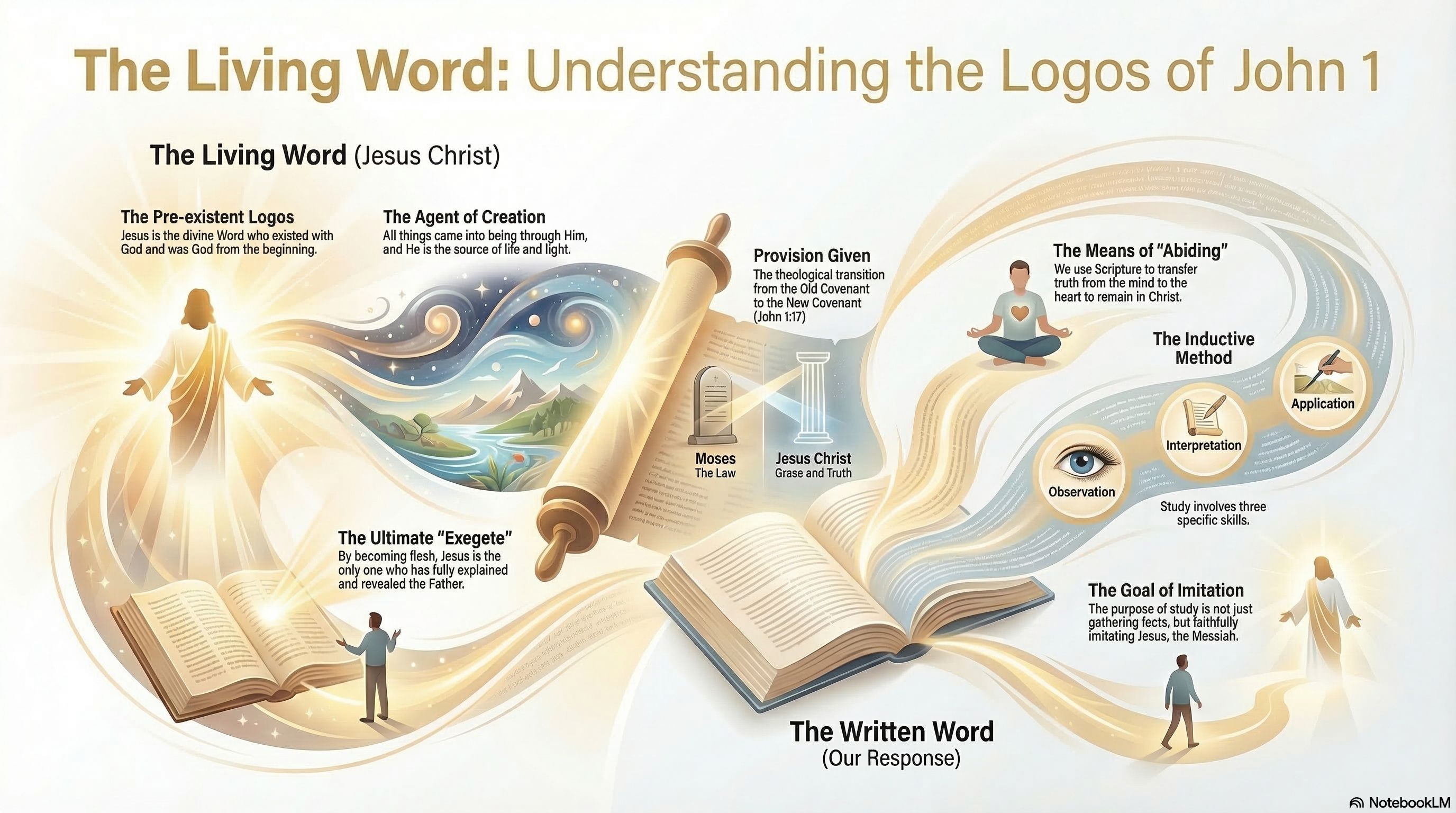
Viewing Jesus as the ultimate interpreter transforms study from a clinical exercise into an act of communion. When we look into the text, we are not gathering data. We are looking into the face of Jesus. To know the text is to know the Savior. To ignore the text is to remain a stranger to the Father He revealed.
The Vital Connection: Abiding in the Vine
If John 1:1–18 establishes who Jesus is — the pre-existent, divine Word who perfectly reveals God — then John 15:1–11 tells us how we must live in relationship with Him. The first passage answers "Who is the Word?" The second answers "How do we stay connected to Him?"
1 "I am the true vine, and My Father is the vine-grower. 2 "Every branch in Me that does not bear fruit, He takes away; and every branch that bears fruit, He cleans it so that it may bear more fruit. 3 "You are already clean because of the word which I have spoken to you. 4 "Abide in Me, and I in you. As the branch cannot bear fruit from itself unless it abides in the vine, so neither can you unless you abide in Me. 5 "I am the vine, you are the branches; he who abides in Me and I in him, he bears much fruit, for apart from Me you can do nothing. 6 "If anyone does not abide in Me, he is thrown away as a branch and dries up; and they gather them, and cast them into the fire and they are burned. 7 "If you abide in Me, and My words abide in you, ask whatever you wish, and it will be done for you. 8 "My Father is glorified by this, that you bear much fruit, and so prove to be My disciples. 9 "Just as the Father has loved Me, I have also loved you; abide in My love. 10 "If you keep My commandments, you will abide in My love; just as I have kept My Father's commandments and abide in His love. 11 "These things I have spoken to you so that My joy may be in you, and that your joy may be complete.
This passage is where the Abide program gets its name. Jesus does not use the word abide once or twice as a passing suggestion. He repeats the command ten times in eleven verses. That repetition is itself an instruction: this is the thing. Everything else in the program flows from here.
Using the metaphor of the Vine and the Branches, Jesus presents the most crucial principle of discipleship. He is the Vine. We are the branches. To abide means to remain in, continue in, or stay connected to Him. The stakes could not be clearer: "Apart from Me you can do nothing" (v. 5). A branch severed from the vine does not produce less fruit. It produces none. It withers.
But there is also a grace in this passage that is easy to miss. In verse 2, Jesus notes that the Father prunes every branch that does bear fruit — not to punish it, but so that it may bear even more. The pruning is for growth. Every season of difficulty the disciple walks through is the Father's investment in a larger harvest.
Verse 7 is the theological heart of the entire Abide program: "If you abide in Me, and My words abide in you, ask whatever you wish, and it will be done for you." Abiding in Jesus is inseparable from letting His words abide in you. The daily work of reading, studying, and meditating on Scripture is not an academic exercise alongside our relationship with Jesus. It is the relationship.
| Abiding Actions | Abiding Results |
|---|---|
| Keeping His commandments (v. 10) | Complete and absolute joy (v. 11) |
| Remaining in His love (v. 9) | Bearing "much fruit" (v. 5, 8) |
| Letting His words abide in you (v. 7) | Answered prayer (v. 7) |
| Obeying His commands (v. 10) | Glorifying the Father (v. 8) |
Engage the Text: John 15:1–11
- Who are the three parties in the central metaphor? What role does each one play?
- Count the repetitions: how many times does Jesus use the word "abide" in these eleven verses?
- What does Jesus say will happen to a branch that does NOT abide? List the sequence of events from verses 5–6.
- Verse 7 contains a two-part condition and a promise. What are both parts of the condition, and what is the promise?
- Jesus repeats "abide" more than any other command in this passage. What does that concentration suggest about where a disciple's attention should be fixed first?
- What does it mean for a human being to "abide" in a divine Person? How does this transcend mere rule-following?
- Why does the Father "prune" (clean) the branches that are already bearing fruit (v. 2)? What does this reveal about God's goals for us?
- The sequence of drying up → gathering → burning is three stages. What does this progression tell us about the consequences of disconnection — are they immediate or gradual?
- Where in your life are you currently trying to "bear fruit from yourself" instead of abiding in the Vine?
- How do you typically react to "pruning" seasons (difficulties that lead to growth)? Can you see God's hand in a recent pruning?
- What is one specific "commandment" (v. 10) you have been hesitant to keep, and how would keeping it help you "abide in His love"?
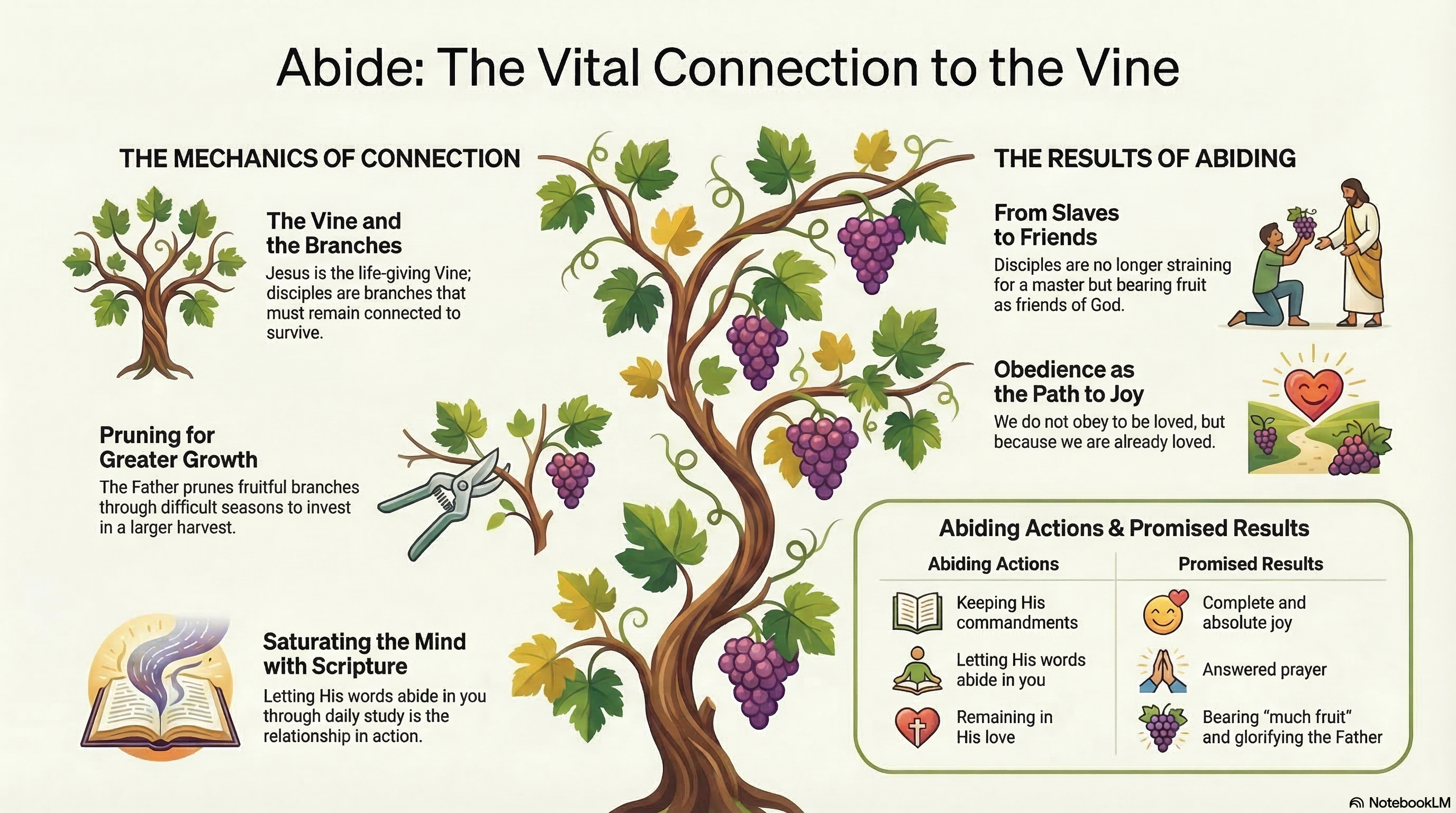
Obedience is not a burden; it is the mechanism of fellowship. We do not obey to be loved; we obey because we are loved, and that obedience keeps the nutrients of the Vine flowing into our lives. The entire Abide program is built on this single, repeated command: stay connected. Let His words live in you. Bear fruit. And let His joy become yours.
The Mirror and the Foundation: The Danger of Passivity
There is a gap between hearing the Word and doing it, and James 1:22–25 names that gap a delusion. James compares the passive reader to a man who looks into a mirror, sees the spinach in his teeth, and walks away without removing it. The point is direct: seeing the truth of your condition in the mirror of the Word accomplishes nothing if you refuse to act on what you see.
16 Do not be deceived, my beloved brothers. 17 Every good thing given and every perfect gift is from above, coming down from the Father of lights, with whom there is no variation or shifting shadow. 18 In the exercise of His will He brought us forth by the word of truth, so that we would be a kind of first fruits among His creatures. 19 Know this, my beloved brothers. But everyone must be quick to hear, slow to speak and slow to anger; 20 for the anger of man does not achieve the righteousness of God. 21 Therefore, laying aside all filthiness and all that remains of wickedness, in gentleness receive the implanted word, which is able to save your souls. 22 But become doers of the word, and not merely hearers who delude themselves. 23 For if anyone is a hearer of the word and not a doer, he is like a man who looks at his natural face in a mirror; 24 for once he looked at himself and has gone away, he immediately forgot what kind of person he was. 25 But one who looks intently at the perfect law, the law of freedom, and abides by it, not having become a forgetful hearer but a doer of the work, this man will be blessed in what he does.
Engage the Text: James 1:16–25
- Describe the mirror analogy in verses 23–24. What does the man see, and what does he do immediately after?
- In verse 25, what three things does the doer of the work do with "the perfect law, the law of freedom"? What specific result is promised to him?
- What attributes of God are listed in verse 17, and what is the "good thing" He gave in verse 18?
- Why does James say this kind of self-deception is possible for someone who genuinely hears the Word — not someone who avoids it?
- Why does James call God the "Father of lights" (v. 17)? How does the lack of "variation" in God contrast with the "forgetfulness" of the hearer in verse 24?
- Verse 18 says we were "brought forth by the word of truth." What is the connection between our spiritual birth and our ongoing reception of the "implanted word" (v. 21)?
- What does it mean for a law to be a "law of freedom" (v. 25)? How can a set of commands produce liberty rather than restriction?
- What is the "filthiness" or "remains of wickedness" (v. 21) that you need to lay aside today to better receive God's Word?
- Think of a recent time you "looked in the mirror" of the Word. Did you immediately forget, or did you "abide by it"? What made the difference?
- How can you practice being "quick to hear and slow to speak" (v. 19) in your next conversation?
Jesus reinforces this with the parable of the two builders in Matthew 7:
- The Wise Builder: Hears the words and does them, building on the rock.
- The Foolish Builder: Hears the words and does not do them, building on the sand.
15 "Beware of the false prophets, who come to you in sheep's clothing, but inwardly are ravenous wolves. 16 "You will know them by their fruits. Are grapes gathered from thorn bushes or figs from thistles? 17 "Even so, every good tree bears good fruit, but the bad tree bears bad fruit. 18 "A good tree cannot bear bad fruit, nor can a bad tree bear good fruit. 19 "Every tree that does not bear good fruit is cut down and thrown into the fire. 20 "So then, you will know them by their fruits. 21 "Not everyone who says to Me, 'Lord, Lord,' will enter the kingdom of heaven, but he who does the will of My Father who is in heaven will enter. 22 "Many will say to Me on that day, 'Lord, Lord, in Your name did we not prophesy, and in Your name cast out demons, and in Your name do many miracles?' 23 "And then I will declare to them, 'I never knew you; DEPART FROM ME, YOU WHO PRACTICE LAWLESSNESS.' 24 "Therefore everyone who hears these words of Mine and does them, may be compared to a wise man who built his house on the rock. 25 "And the rain descended, and the rivers came, and the winds blew and fell against that house; and yet it did not fall, for it had been founded on the rock. 26 "And everyone hearing these words of Mine and not doing them, may be compared to a foolish man who built his house on the sand. 27 "And the rain descended, and the rivers came, and the winds blew and slammed against that house; and it fell, and great was its fall."
Engage the Text: Matthew 7:15–27
- In Matthew 7:24–27, what is the one and only difference between the wise builder and the foolish builder?
- In verses 24–27, what three weather events do BOTH builders experience? What is the only difference in the outcome?
- What test does Jesus give in verses 16–20 to distinguish between true and false prophets?
- Both builders hear the same words and face the same storm. Who is the actual audience for this warning — unbelievers who have never heard, or people who regularly hear Jesus' words?
- Why does Jesus emphasize doing the will of the Father (v. 21) as the requirement for entering the kingdom? How does this relate to the "fruit" test earlier?
- What is the "sand" representing in the foolish builder's life? Is it necessarily "bad" things, or just the absence of "doing"?
- In verse 23, Jesus says "I never knew you." How does this link "knowing Jesus" with "practicing the Word"?
- If a "storm" (crisis) hit your life today, which parts of your spiritual "house" would be revealed as built on sand (hearing without doing)?
- How can you move from saying "Lord, Lord" (religious language) to actually "doing the will of the Father" in one specific relationship this week?
- What "fruit" is currently being produced by the "tree" of your life? What does that fruit reveal about the health of your roots?
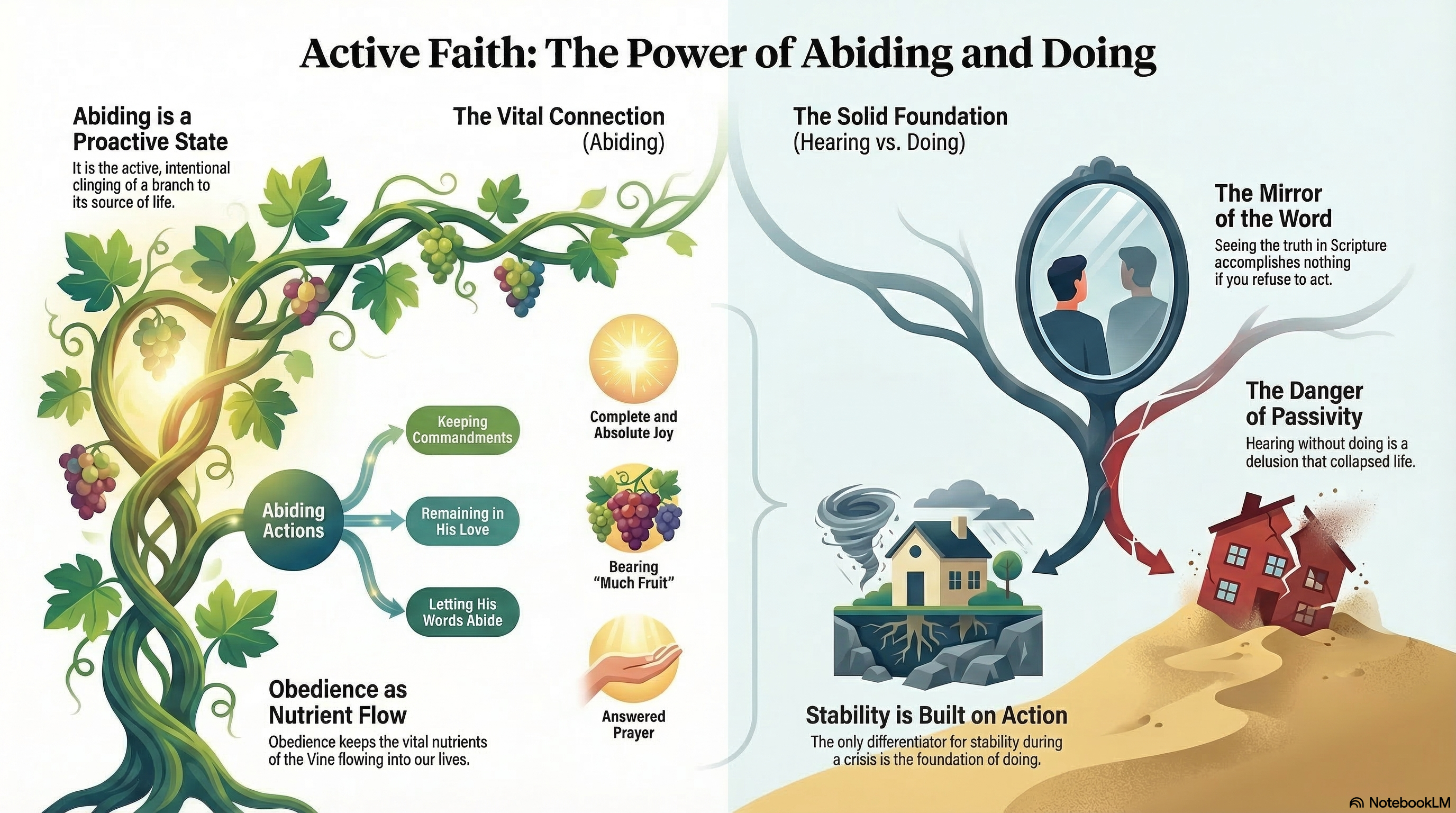
The storm hits both builders. Crisis does not discriminate based on how many sermons you have heard. The only differentiator for stability is the foundation of doing. Passive listening results in a house that collapses. Active obedience results in a life that stands.
Total Life Immersion: The Ancient Mandate
The New Testament call to abide is not a new idea. It is a continuation of the ancient Shema found in Deuteronomy 6:4–9, which mandates total life immersion. Yahweh commands that His words be on our hearts and woven into every transition of the day: sitting in the house, walking by the way, lying down, and rising up. This is not reserved for quiet time. It is for the spaces between.
4 "Hear, O Israel! Yahweh is our God, Yahweh is one! 5 "You shall love Yahweh your God with all your heart and with all your soul and with all your might. 6 "These words, which I am commanding you today, shall be on your heart. 7 "You shall teach them diligently to your sons and shall speak of them when you sit in your house and when you walk by the way and when you lie down and when you rise up. 8 "You shall bind them as a sign on your hand, and they shall be as phylacteries between your eyes. 9 "You shall write them on the doorposts of your house and on your gates.
Engage the Text: Deuteronomy 6:4–9
- Deuteronomy 6:7 lists four specific moments of the day. What are they? Do they describe scheduled religious times or transitions in everyday life?
- What three "faculties" of the human person are mentioned in the command to love God in verse 5?
- Where are the two physical locations mentioned for writing the words in verse 9?
- These four moments span daily life transitions rather than temple occasions. What does this suggest about when God expects His Word to be present in a disciple's mind?
- Why does the command to "love Yahweh" (v. 5) precede the commands about teaching and speaking the Word (v. 7)?
- What is the significance of placing the Word on "doorposts" and "gates" (v. 9)? What does this reveal about the relationship between the home and the world?
- In your typical day, which of the four moments (sitting, walking, lying down, rising up) is most often filled with "noise" rather than the Word?
- How can you practically "bind" a specific truth to your "hand" (your actions) this week?
- If someone walked through the "gates" of your life or home, would they see evidence that Yahweh is your God?
To live this way, we must practice hagah, the Hebrew word for meditation. Unlike Eastern meditation, which seeks to empty the mind, biblical hagah aggressively fills it. The word means to mutter, muse, moan, and chew. Two illustrations capture it well:
- The Cow Chewing the Cud: Swallowing, bringing it back up, and chewing again to extract every bit of nourishment.
- The Dog with a Bone: Gnawing on the same truth for hours, refusing to let it go.
8 "This book of the law shall not depart from your mouth, but you shall meditate on it day and night, so that you may be careful to do according to all that is written in it; for then you will make your way successful, and then you will be prosperous. 9 "Have I not commanded you? Be strong and courageous! Do not be in dread or be dismayed, for Yahweh your God is with you wherever you go."
Engage the Text: Joshua 1:8–9
- Joshua 1:8 contains three commands about the "book of the law." List all three. What is the stated purpose of the middle command?
- What two things does God command Joshua NOT to be in verse 9?
- What is the "reason" given at the end of verse 9 for why Joshua can be courageous?
- What is the relationship between "meditating day and night" and being "careful to do"? Why is one necessary for the other?
- God promises Joshua that he will make his way "prosperous" and "successful." Given the context of leading a nation into war, what kind of success is God talking about?
- Why does God follow the command to meditate with the command to "be strong and courageous"? How does the Word combat "dread" and "dismay"?
- What "battle" are you currently facing where you need the strength and courage that comes from the Word?
- What does "day and night" meditation look like for someone with a modern work schedule?
- Is there a "book of the law" (a specific part of Scripture) that has "departed from your mouth" recently? How can you bring it back?
1 How blessed is the man who does not walk in the counsel of the wicked, Nor stand in the way of sinners, Nor sit in the seat of scoffers! 2 But his delight is in the law of Yahweh, And in His law he meditates day and night. 3 And he will be like a tree firmly planted by streams of water, Which yields its fruit in its season And its leaf does not wither; And in whatever he does, he prospers. 4 The wicked are not so, But they are like chaff which the wind drives away. 5 Therefore the wicked will not rise in the judgment, Nor sinners in the congregation of the righteous. 6 For Yahweh knows the way of the righteous, But the way of the wicked will perish.
Engage the Text: Psalm 1
- Psalm 1 describes the blessed man with a specific image from nature. What is that image, and what four characteristics does it include?
- What image does the Psalmist use for the wicked in verse 4? What happens to that image?
- The blessed man is like a planted tree; the wicked are like chaff. Why does the Psalmist choose these two specific images to contrast the outcomes of the two paths?
- The Psalm begins with three negatives (does not walk, stand, or sit). How does avoiding the wrong "counsel" create space for "delight" in the Law?
- What does it mean that "Yahweh knows the way of the righteous" (v. 6)?
- Whose "counsel" are you currently walking in (podcasts, friends, social media)? How does it compare to the Law of Yahweh?
- Are you currently feeling more like a "tree" or "chaff"? What is one stream of "water" (Scripture) you can plant yourself by today?
- What "fruit" are you hoping to yield in your current season (v. 3)?
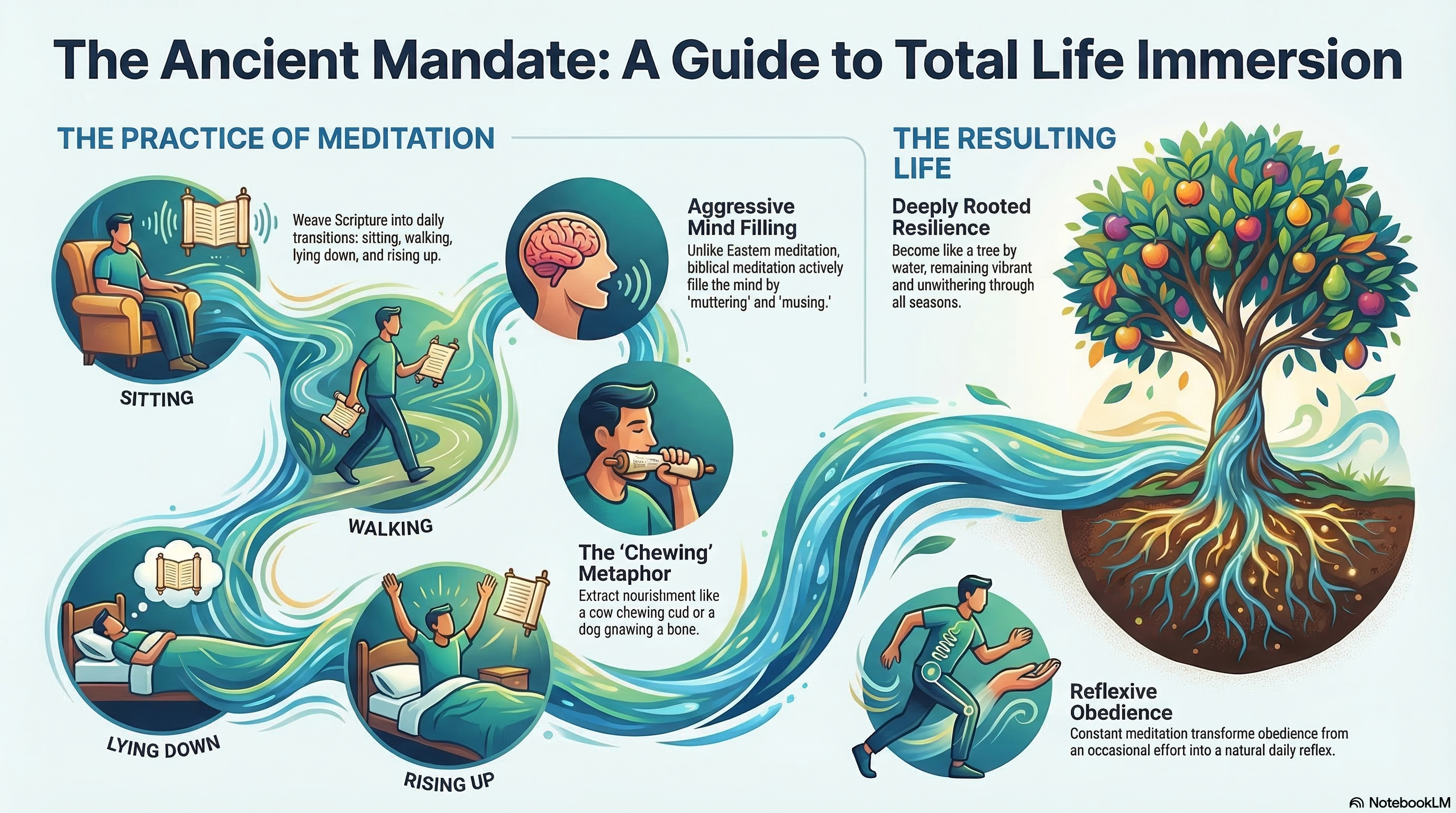
Psalm 1 shows us the result of this constant chewing. The one who meditates day and night becomes like a tree firmly planted by streams of water, yielding fruit in its season, with leaves that do not wither. Continuous hagah leads to a deeply rooted, prosperous life, because it ensures that obedience becomes a reflex rather than an occasional effort.
The God-Breathed Manual: Authority and Sufficiency
We cannot build a life on human opinion. We need Theopneustos — a God-breathed revelation. Paul explains that all Scripture is breathed out by God and is profitable in four specific ways. Think of the Word as a spiritual physical therapist:
- Didaskalia (Teaching): The Map. It shows us what is true and provides the foundational path we are meant to walk.
- Elegcho (Reproof): The Diagnosis. Like a divine prosecutor, it convicts us when we have strayed and shows us exactly where we have gone wrong.
- Epanorthosis (Correction): The Adjustment. This word literally means "to stand up straight again." The text does not just diagnose the problem; it actively restores us to an upright posture.
- Paideia (Training): Building Muscle. The ongoing instruction that forms new habits of righteous behavior, conditioning us so that we are equipped for every good work.
14 But you, continue in the things you learned and became convinced of, knowing from whom you learned them, 15 and that from childhood you have known the sacred writings which are able to make you wise unto salvation through faith which is in Christ Jesus. 16 All Scripture is God-breathed and profitable for teaching, for reproof, for correction, for training in righteousness, 17 so that the man of God may be equipped, having been thoroughly equipped for every good work.
Engage the Text: 2 Timothy 3:14–17
- What does "God-breathed" (theopneustos) say about the origin of Scripture? Who is identified as the ultimate author?
- Paul lists four purposes for which Scripture is profitable. List all four in the order he gives them.
- What is the ultimate goal stated in verse 17? What single phrase describes the degree of that equipping?
- In verse 14, what two things does Paul urge Timothy about "the things you learned"? What does he say Timothy should know about the source of that learning?
- Paul calls Timothy to "continue" in and be "convinced of" what he learned. What does the pairing of persistence and conviction suggest about mature Bible engagement versus passive familiarity?
- Why does Paul mention Timothy's "childhood" (v. 15) in the context of the "sacred writings"? What does this say about the timing of discipleship?
- The text says "thoroughly equipped" — not just "equipped." What does that intensifier suggest about the sufficiency of Scripture for all a disciple faces?
- How does the "profitable" nature of Scripture (v. 16) contrast with the "deceptive" nature of human opinion?
- Knowing Scripture is directly from God's own breath, how should that change the posture you bring to your next reading session?
- Of the four profitable purposes (teaching, reproof, correction, training), which one do you currently most need the Scripture to do in your life?
- If you were "thoroughly equipped for every good work" starting tomorrow, what is one "good work" you would tackle that you currently feel unready for?
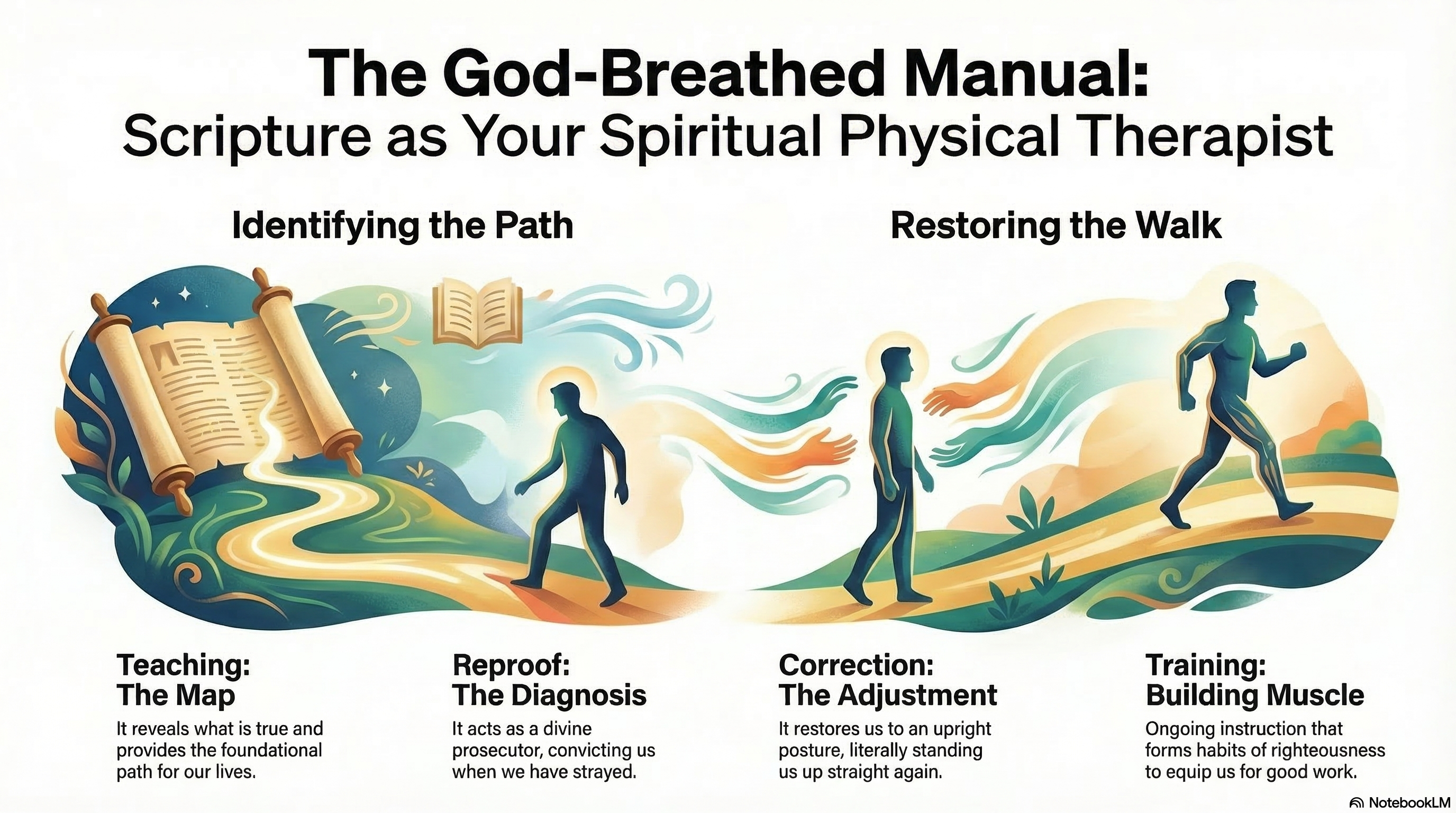
This fourfold process moves a believer from spiritually injured to thoroughly equipped. The Bible does not simply inform us of our faults. It provides the exercises necessary to walk in righteousness.
The Divine Partner: The Role of the Holy Spirit
Human intellect alone cannot grasp spiritual truth. 1 Corinthians 2:14 states that the natural man cannot understand the things of the Spirit of God. We require the Holy Spirit — the indispensable partner — to unlock the words we chew on.
10 But to us God revealed them through the Spirit, for the Spirit searches all things, even the depths of God. 11 For who among men knows the thoughts of a man except the spirit of the man which is in him? Even so the thoughts of God no one knows except the Spirit of God. 12 Now we have received, not the spirit of the world, but the Spirit who is from God, so that we may know the things freely given to us by God, 13 which things we also speak, not in words taught by human wisdom, but in those taught by the Spirit, combining spiritual thoughts with spiritual words. 14 But a natural man does not accept the things of the Spirit of God, for they are foolishness to him, and he cannot understand them, because they are spiritually examined.
Engage the Text: 1 Corinthians 2:10–14
- What analogy does Paul use in verse 11 to explain how the Spirit knows God? State both sides of the comparison.
- What does verse 14 say about why a "natural man" cannot understand the things of the Spirit?
- What did we receive according to verse 12, and for what purpose?
- Based on Paul's analogy, why is the Holy Spirit uniquely qualified to reveal the things of God — and why can no amount of human intelligence or research substitute for Him?
- Verse 12 mentions "the spirit of the world." How does this world-spirit compete with the Spirit of God in our understanding of Scripture?
- Why is "spiritual examination" (v. 14) required for biblical truth? Can a brilliant but unbelieving scholar truly "understand" the Bible's message?
- When was the last time you felt like you were "searching" the Bible with your own spirit rather than the Spirit of God?
- What "things freely given to us by God" (v. 12) are you most thankful for today?
- How can you practically invite the Spirit's partnership before you begin your next study session?
Jesus identifies the Spirit as the Advocate and Teacher. He is the divine enabler who searches the depths of God to reveal them to us, brings Jesus' words to our remembrance, and transforms careful study into intimate dwelling with the Father.
15 "If you love Me, you will keep My commandments. 16 "And I will ask the Father, and He will give you another Advocate, that He may be with you forever; 17 the Spirit of truth, whom the world cannot receive, because it does not see Him or know Him. You know Him because He abides with you and will be in you. 18 "I will not leave you as orphans; I will come to you. 19 "After a little while the world will no longer see Me, but you will see Me; because I live, you will live also. 20 "On that day you will know that I am in My Father, and you in Me, and I in you. 21 "He who has My commandments and keeps them is the one who loves Me; and he who loves Me will be loved by My Father, and I will love him and will disclose Myself to him." 22 Judas (not Iscariot) said to Him, "Lord, what then has happened that You are going to disclose Yourself to us and not to the world?" 23 Jesus answered and said to him, "If anyone loves Me, he will keep My word; and My Father will love him, and We will come to him and make Our dwelling with him. 24 "He who does not love Me does not keep My words; and the word which you hear is not Mine, but the Father's who sent Me. 25 "These things I have spoken to you while abiding with you. 26 "But the Advocate, the Holy Spirit, whom the Father will send in My name, He will teach you all things, and bring to your remembrance all that I said to you. 27 "Peace I give to you; My peace I give to you; not as the world gives do I give to you. Do not let your heart be troubled, nor let it be fearful. 28 "You heard that I said to you, 'I go away, and I will come to you.' If you loved Me, you would have rejoiced because I go to the Father, for the Father is greater than I. 29 "And now I have told you before it happens, so that when it happens, you may believe. 30 "I will not speak much more with you, for the ruler of the world is coming, and he has nothing in Me; 31 but so that the world may know that I love the Father, I do exactly as the Father commanded Me. Get up, let us go from here.
Engage the Text: John 14:15–31
- In John 14:26, Jesus names two specific things the Holy Spirit will do. What are they?
- What relational promise does Jesus make in John 14:23 for those who love Him and keep His word? Who are the two Persons He mentions?
- What kind of "peace" does Jesus offer in verse 27, and what does He contrast it with?
- In verse 23, Jesus uses the word "dwelling" — not "visiting." How does the permanence of that word deepen your understanding of what abiding means beyond occasional devotional practice?
- Jesus calls the Spirit "another Advocate" (v. 16). In what ways does the Spirit continue the work that Jesus started while on earth?
- Why is "loving Jesus" (v. 15, 21, 23) the prerequisite for receiving the Spirit's revelation and the Father's dwelling?
- What is the connection between "keeping His word" and "disclosing Himself" (v. 21)?
- Do you currently feel more like an "orphan" (v. 18) or like someone who has an "Advocate" always with them? Why?
- In what specific area of your life do you need the "peace" that Jesus gives today?
- How can you make your heart a more welcoming "dwelling" (v. 23) for the Father and the Son this week?
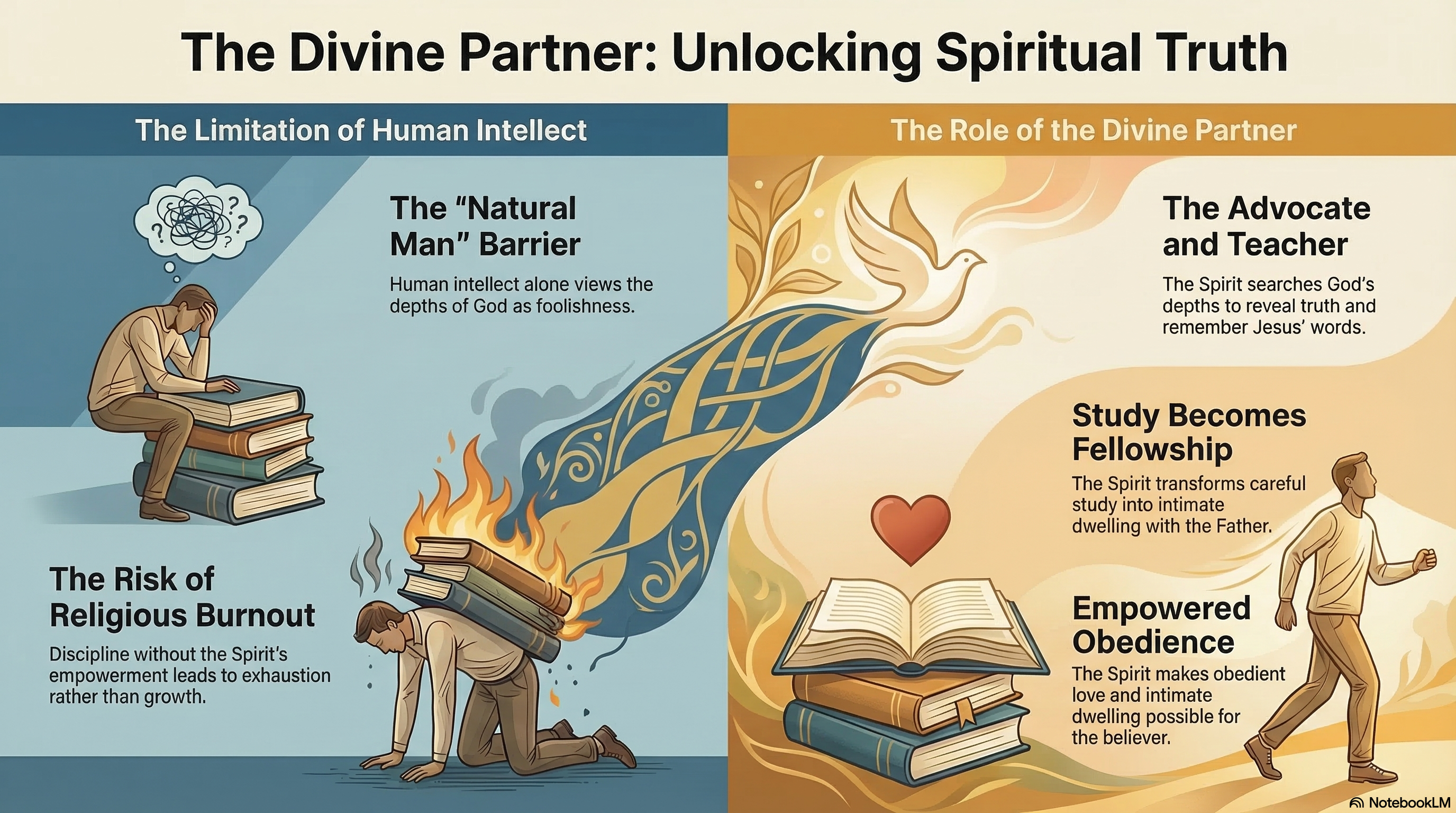
Discipline without the Spirit leads to religious burnout. When the Spirit illuminates the text, study becomes fellowship. We are not alone in our effort to obey. We are empowered by the Spirit of Truth.
The Great Commission: Discipleship as Teaching the Skills
The missional goal of the Abide program is to produce reproducing disciples. Jesus' final command was to "make disciples... teaching them to keep all that I commanded." This is the difference between handing someone a fish and teaching them to fish for themselves.
18 And Jesus came up and spoke to them, saying, "All authority has been given to Me in heaven and on earth. 19 "Go therefore and make disciples of all the nations, baptizing them in the name of the Father and the Son and the Holy Spirit, 20 "teaching them to keep all that I commanded you; and behold, I am with you always, even to the end of the age."
We fulfill the Great Commission by mastering and then transferring the three action pairs — the specific rhythms of spiritual self-nourishment:
- Meditate and Obey: Drawing on the ancient practice of hagah, filling the mind with God's truth and letting it shape how we live.
- Study and Apply: Moving from receiving God's Word to living it out, drawing meaning from the text and carrying it into daily life.
- Hear and Do: Breaking the gap between knowing and doing, so the house of the disciple is built on the Rock.
Engage the Text: Matthew 28:18–20
- Before giving any commands, Jesus makes a foundational claim in verse 18. What is it?
- Jesus gives three commands in verses 19–20. List all three. Which one is the main verb, and which two are supporting actions?
- What is the specific content of the "teaching" command — not just what to teach, but what disciples are to do with what they are taught?
- What promise does Jesus close with?
- What does the "authority" of Jesus (v. 18) imply about our responsibility to "keep" His commands?
- Why does "making disciples" require "teaching them to keep (obey)" rather than just "teaching them to know"?
- How does the promise of Jesus' presence ("I am with you always") support the difficult task of making disciples?
- What is the significance of baptizing in the name (singular) of the Father, Son, and Holy Spirit?
- Who in your life is God calling you to "make a disciple" of right now? What is the first "skill" you could teach them?
- In which area of your life are you currently "knowing" Jesus' commands but not "keeping" them?
- How does the reality of Jesus' authority change your fear of sharing your faith with others this week?
Discipleship is the transfer of skills. By equipping believers to engage the Word with their whole mind and heart — to draw meaning from the text and act on what they find — we move the church from being consumers of pre-chewed food to being self-sustaining followers of Christ who can feed others.
The Proven Mandate: What Scripture Demands of Every Disciple
The biblical case is now complete. From John 1 to Matthew 28, from the ancient Shema of Deuteronomy to the vine and branches of John 15, the testimony of Scripture is unified and clear. The Abide program does not rest on a strategy or a trend. It rests on God's own design for how His people flourish.
That design is expressed in a single conviction: Discipleship is teaching disciples to prayerfully read, study, and meditate on God's Word, and to interpret, apply, and obey it, empowered by the Holy Spirit.
6 Seek Yahweh while He may be found; Call upon Him while He is near. 7 Let the wicked forsake his way And the unrighteous man his thoughts; And let him return to Yahweh, And He will have compassion on him, And to our God, For He will abundantly pardon. 8 "For My thoughts are not your thoughts, Nor are your ways My ways," declares Yahweh. 9 "For as the heavens are higher than the earth, So are My ways higher than your ways And My thoughts than your thoughts. 10 "For as the rain and the snow come down from heaven, And do not return there without watering the earth And making it bear and sprout, And giving seed to the sower and bread to the eater, 11 So will My word be which goes forth from My mouth; It will not return to Me empty, Without accomplishing what pleases Me, And without succeeding in the matter for which I sent it.
Engage the Text: Isaiah 55:6–11
- What does the prophet command the seeker to do in verse 6?
- What should the wicked and unrighteous person do in verse 7? What is the promised result?
- What analogy does God use in verses 10–11 to describe the effectiveness of His Word?
- Why does God emphasize that His thoughts and ways are "higher" than ours (v. 8–9)? How does this humble our approach to Bible study?
- What does it mean that God's Word "will not return to Me empty" (v. 11)?
- What is the "matter" or "purpose" for which God sends His Word?
- Is there a "way" or "thought" (v. 7) you need to forsake today to better "return to Yahweh"?
- When you feel like your Bible study is "empty" or unproductive, how does verse 11 encourage you?
- How can you "seek Yahweh while He may be found" in your current season of life?
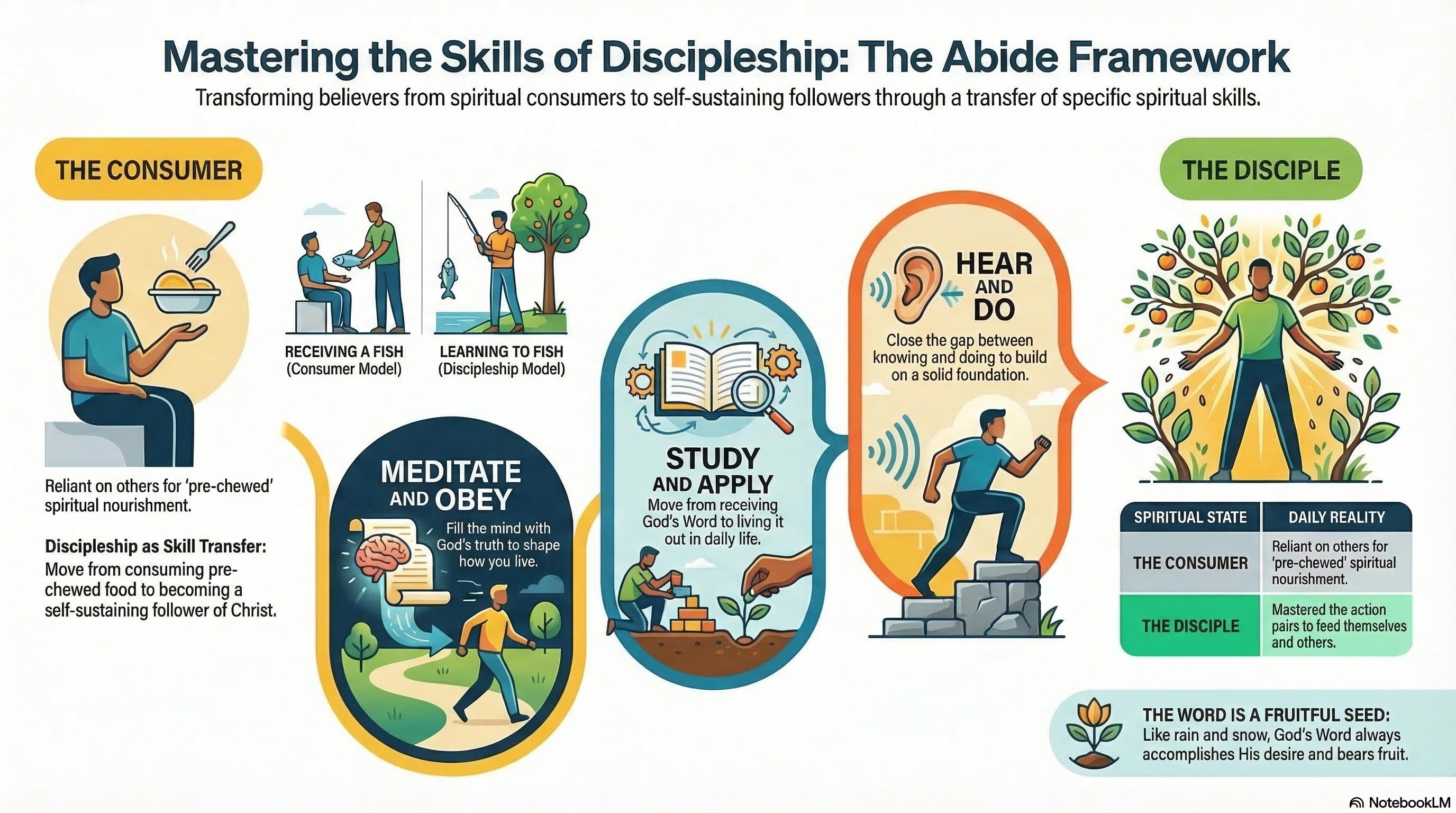
Yahweh declares through the prophet Isaiah: "Just as the rain and the snow come down from heaven and do not return there without watering the earth, making it bear and sprout, so will My word be which goes forth from My mouth; it will not return to Me empty, without accomplishing what I desire." His Word is a seed. It does not fail.
The question for every disciple, and for every leader preparing to guide others, is this: What patch of soil in your own life are you currently withholding from being planted? Step out in grace, lean into the joy of obedience, and let the Word take root.
May you find the deep joy and redemptive favor of God, the true Ashrei, as you delight in His Word and walk in His ways. Meditate and Obey. Study and Apply. Hear and Do. This is how we abide in Christ. This is how we demonstrate our love for God.