Study to be Approved to God as a Workman
Why we need to be taught how to accurately handle the word of truth, and the tools every disciple needs to bridge the ancient world to the here and now.
The Foundation: A Call to Diligence
In our journey of faith, we often treat Bible study as a dusty academic requirement or an intellectual box to check. But within the Abide program, we view the Scriptures through a much more vibrant lens. To "abide" in the Vine is to have His words literally make their home in us, turning ancient ink into a living, breathing reality. Study is not an end in itself; it is a vital part of our relational partnership with Jesus.
15 Be diligent to present yourself approved to God as a workman who does not need to be ashamed, accurately handling the word of truth.
Engage the Text: 2 Timothy 2:15
- What is the primary command given to the individual in this verse?
- What two descriptions are given for the person who is "approved"?
- What specific phrase describes the goal or standard of the workman's effort?
- What does it mean to "present yourself" to God? How is this different from seeking the approval of other people?
- Why is the image of a "workman" used? What does it imply about the nature of Bible study?
- The phrase "accurately handling" literally means "to cut a straight line." What does this suggest about the danger or result of careless study?
- Do you currently feel more like a "workman" or a "passive reader" when you open your Bible? What is the first shift you could make?
- In what area of your current spiritual life do you feel most "ashamed" or ill-equipped? How does this verse offer a path forward?
- What is one practical way you can be more "diligent" in your handling of the Word this week?
We have all had that "stranger in a foreign land" experience. Imagine it's a Tuesday afternoon. The hum of the refrigerator is the only sound in your kitchen. You open the Bible, desperate for a word from God, but you find yourself reading about bronze altars, strange genealogies, or ancient Near Eastern boundary markers. You know the words are holy, but you struggle to see how they connect to your 2:00 PM meeting or your mounting bills.
The core conviction of Abide is that discipleship is a collaborative effort — a partnership between your diligent heart and the empowering Holy Spirit. We want to teach you how to "fish" for the depths of God's wisdom yourself. To do this, we use three Action Pairs that turn reading into relationship:
- Meditate and Obey
- Study and Apply
- Hear and Do
1 How blessed are those whose way is blameless, Who walk in the law of Yahweh. 2 How blessed are those who observe His testimonies, They seek Him with all their heart.
Engage the Text: Psalm 119:1–2
- What is the condition for being "blessed" in verse 1?
- What two specific actions are described in verse 2?
- What is the target or goal of the "search" in verse 2?
- What is the relationship between a "blameless way" and "walking in the law"? Which one causes the other?
- Why does "observing testimonies" lead to "seeking Him"? How does the Word point beyond itself to a Person?
- What is the difference between seeking God with a "whole heart" versus a divided heart?
- Would you describe your current path as "blameless" in the way described here? If not, what is the primary obstacle?
- How can you practically "observe His testimonies" in a way that leads to deeper seeking rather than just gathering information?
- What does seeking Him with "all your heart" look like in your current daily schedule?
The goal of this lesson is not to make you feel overwhelmed by how much you don't know. It is to give you a map. The Bible is not locked against you — it was written to be understood. God calls you to diligence, and He promises to meet that diligence with His presence.
The Workman's Mandate: Accurately Handling the Truth
To grow as a disciple, you must embrace the role of a "workman." Paul's exhortation in 2 Timothy 2:15 tells us to be "diligent" — a word that implies an active, focused intensity. We strive to be "approved," not to earn God's love (which is already ours in Christ), but to honor the weight of the Truth we carry.
When Paul speaks of "accurately handling" the Word, he is using a term that describes a craftsman cutting a straight line. Think of a master builder whose muscle memory allows him to join two beams so perfectly they become one, or a tailor who cuts fabric with such precision that there is no waste. This is Paideia — the type of training that forms character and habits over time.
Why do we handle the Word with such reverence? Because of its nature:
16 All Scripture is God-breathed and profitable for teaching, for reproof, for correction, for training in righteousness, 17 so that the man of God may be equipped, having been thoroughly equipped for every good work.
Every word came directly from the mouth of God — His very breath. We study so that we can be "adequate," fully equipped and capable for the "good work" God has prepared for us.
Engage the Text: 2 Timothy 3:16–17
- What does "God-breathed" imply about the origin of Scripture according to verse 16?
- List the four things for which Scripture is said to be profitable.
- What is the ultimate goal or result for the "man of God" mentioned in verse 17?
- How does the concept of "reproof" differ from "correction" in a practical sense?
- What does it mean to be "thoroughly equipped"? How does this speak to the sufficiency of Scripture?
- Why is "training in righteousness" necessary even after one has been "taught" and "corrected"?
- In which of the four profitable areas do you most need the Word to work in your life right now?
- What is a "good work" you feel ill-equipped for? How can you look to Scripture to equip you?
- How does knowing the Bible is "God-breathed" change the posture of your heart when you sit down to read?
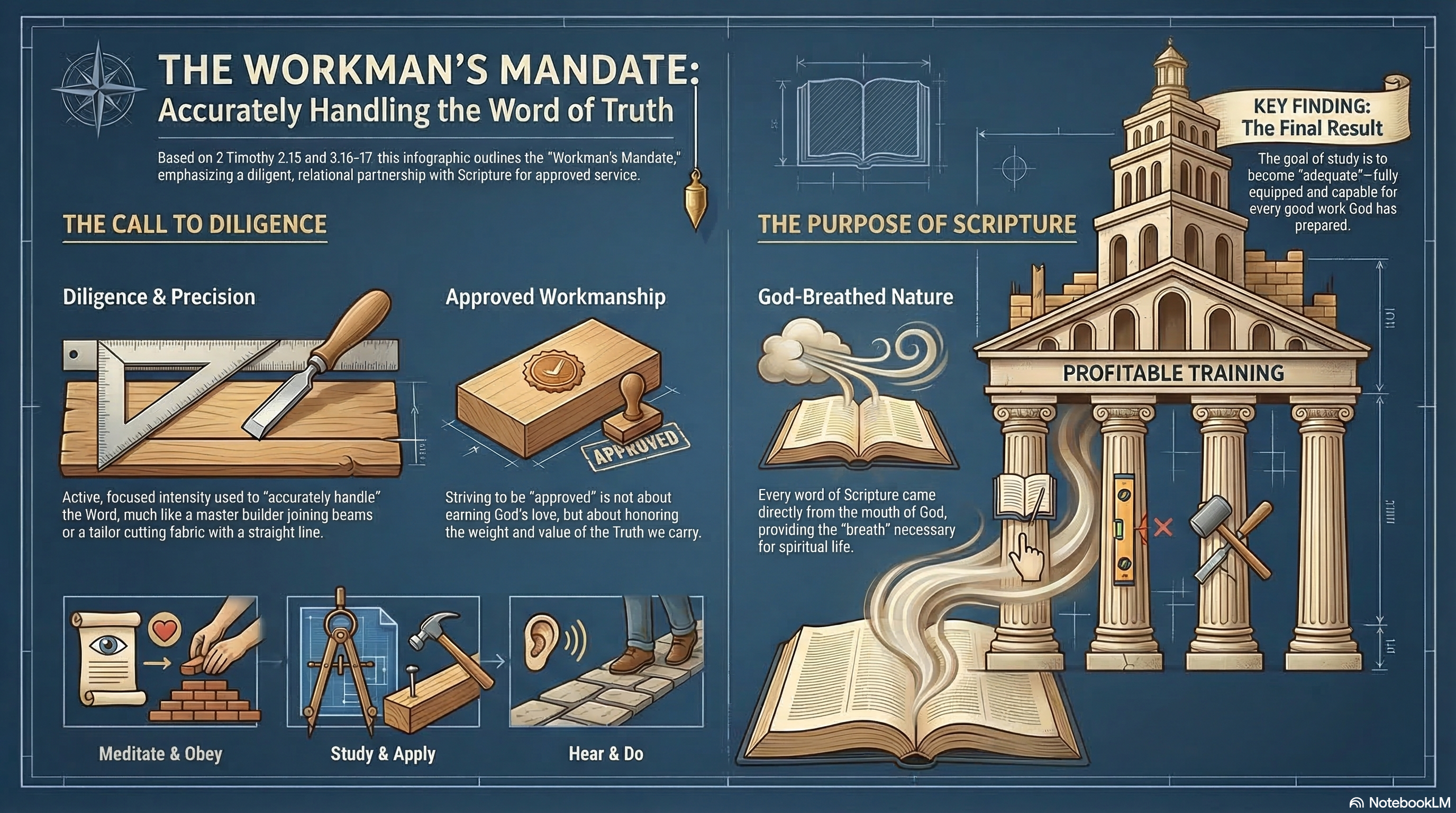
The Bible is not just a book of inspiration — it is a God-breathed instrument designed to teach, diagnose, restore, and train you. To handle it carelessly is to miss its purpose. To handle it well is to become the person God equipped you to be.
Two Worlds: Understanding the Great Divide
If we read the Bible assuming the authors thought exactly like 21st-century Westerners, we will inevitably distort God's heart. Recognizing cultural distance is the first step toward accurate interpretation.
| Feature | The World of the Bible | Our World |
|---|---|---|
| Culture | Covenantal: Based on relational commitment. | Contractual: Based on legal/commercial agreements. |
| Society | Agrarian: Focused on farming, livestock, and the land. | Industrial/Digital: Focused on technology and manufacturing. |
| Communication | Oral Tradition: Messages spoken, heard, and memorized. | Literate Culture: Messages are read, printed, and digital. |
| Structure | Patriarchal: Male-led family and social structures. | Egalitarian: Focused on equality and shared roles. |
| Logic | Religious Ritual: Focused on temple and purity. | Rational Thought: Focused on scientific/logical reasoning. |
Learning to Fish: When you read the word "Covenant," your modern mind might think of a cell phone "contract" — something you can cancel if the service is bad. But in the Bible, a Covenant is more like a marriage — a deep, permanent, relational bond. When we read a covenantal text through a contractual lens, we start viewing God as a business partner we can sue rather than a Father we can trust.
Cultural Gap Reflection
- Which difference between the biblical world and our world feels most surprising or foreign to you?
- How does reading a "covenant" as a "contract" change how you understand God's relationship with His people? What gets lost?
- The Bible was written in an oral culture — messages were proclaimed aloud and memorized communally. How might that change the way you read or hear a passage like Paul's letters?
- Pick one row from the table and describe a biblical passage that makes more sense once you understand that cultural difference.
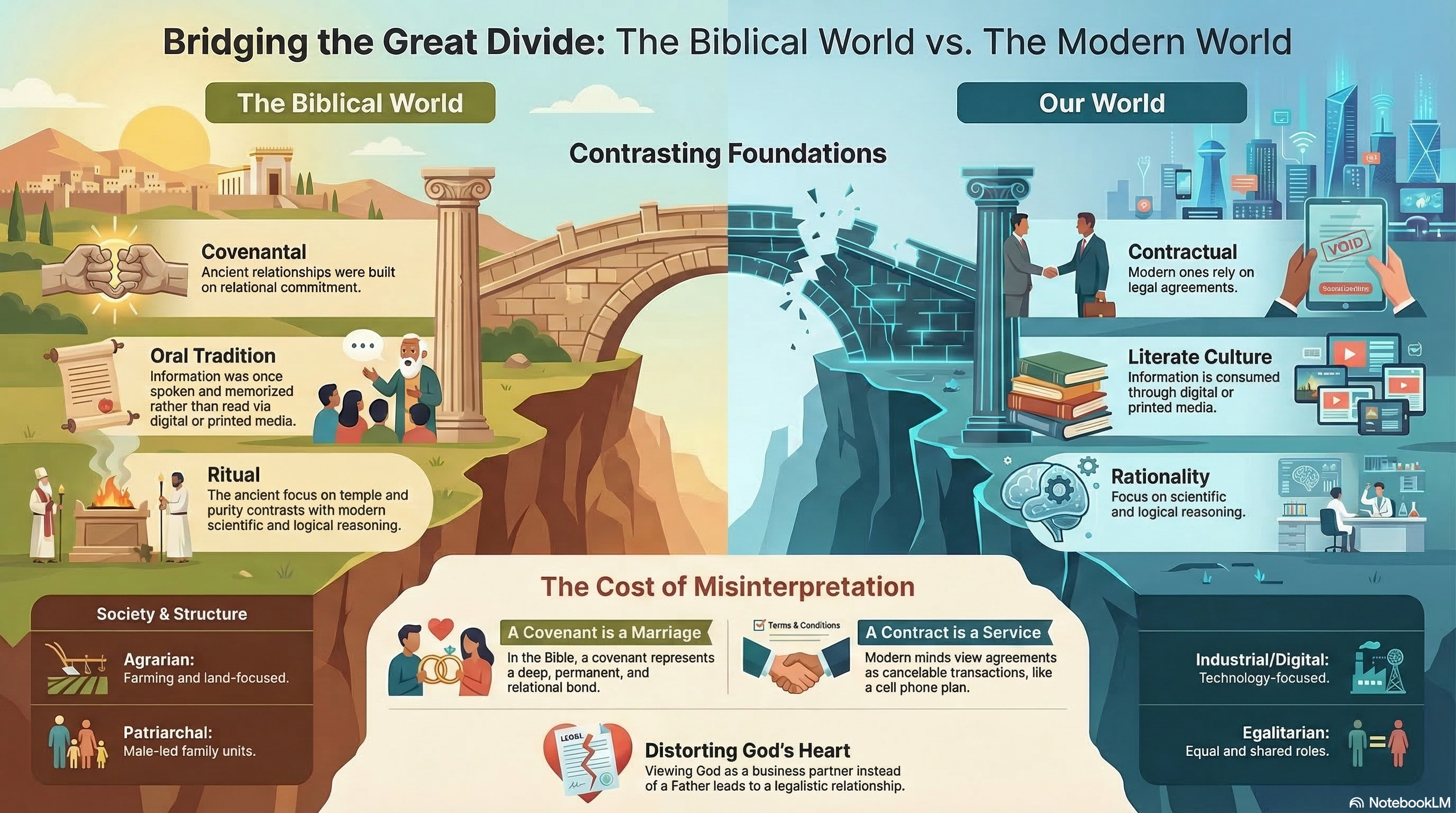
The cultural distance between the Bible's world and ours is not a problem to be afraid of — it is a doorway into deeper understanding. Every time you cross one of these differences, you come closer to hearing what God actually said, rather than what your modern assumptions told you He said.
Bridging the Gaps: Tools for Interpretation
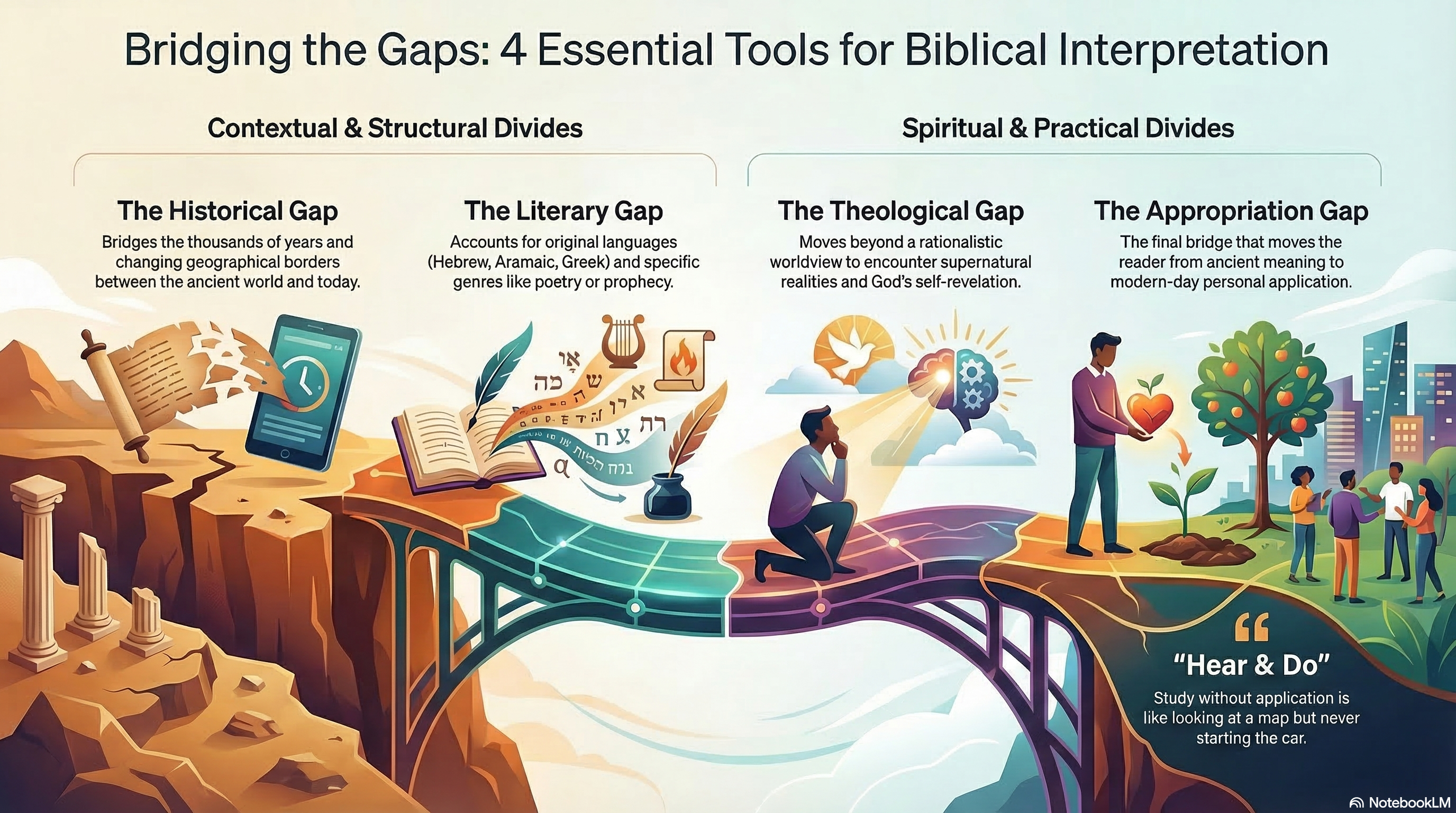
The "gaps" between our worlds are not barriers to keep us out; they are invitations to dive deeper into God's heart. To be a skilled workman, you must learn to cross four major divides:
- The Historical Gap (Time and Geography): The Bible took place thousands of years ago in lands like Israel and Mesopotamia. We must understand the original setting to avoid taking stories out of context.
- The Literary Gap (Language and Genre): The Bible was penned in Hebrew, Aramaic, and a form of Greek. It also uses many genres — poetry, prophecy, letters, history. Just as you wouldn't read a love poem the same way you read a car repair manual, we must respect the literary style God chose.
- The Theological Gap (Supernatural vs. Natural): We live in a rationalistic world, but the Bible is God's self-revelation of supernatural realities. We must read it expecting to encounter truths that transcend our natural experience.
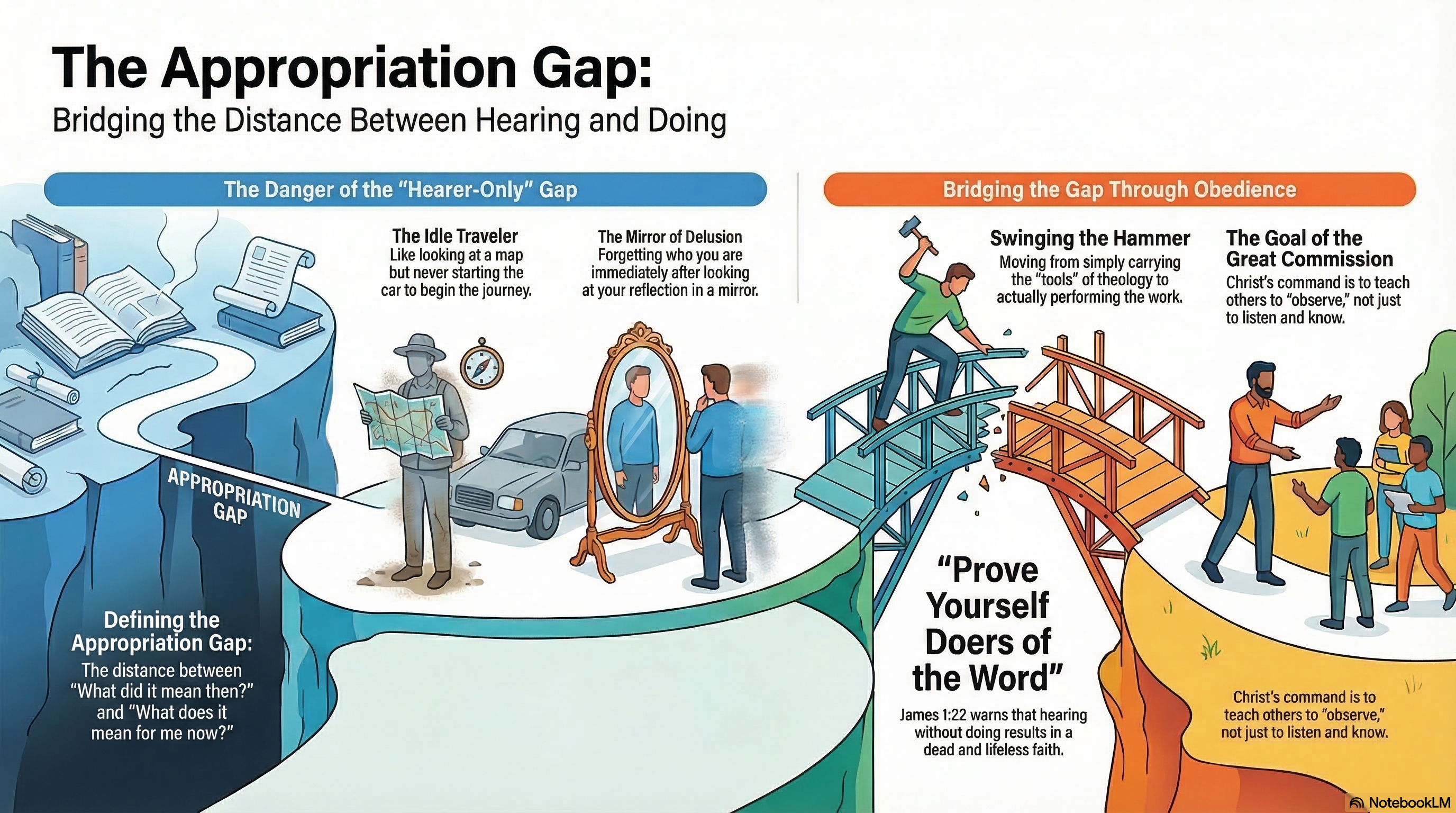
- The Appropriation Gap (Interpretation to Application): This is the most crucial bridge — and the one most often left uncrossed. It moves us from "What did it mean then?" to "What does it mean for me, in the here and now?"
22 But become doers of the word, and not merely hearers who delude themselves. 23 For if anyone is a hearer of the word and not a doer, he is like a man who looks at his natural face in a mirror; 24 for once he looked at himself and has gone away, he immediately forgot what kind of person he was. 25 But one who looks intently at the perfect law, the law of freedom, and abides by it, not having become a forgetful hearer but a doer of the work, this man will be blessed in what he does.
Engage the Text: James 1:22–25
- What is the warning given to those who are "hearers only"?
- What analogy does James use to describe the person who hears but does not do?
- What does the person in the mirror analogy "immediately forget"?
- What three-part action is described in verse 25 regarding the "perfect law"?
- Why does James call the law "the perfect law, the law of freedom"? How does obedience lead to freedom?
- What is the difference between "looking" (v. 23) and "looking intently" (v. 25)?
- In verse 25, what is the specific cause of the "blessing" mentioned? Is it the hearing or the doing?
- When you look into the "mirror" of Scripture, what is one area of spiritual fault you have noticed lately?
- Are you currently "abiding by" a specific truth you learned recently, or have you already forgotten it?
- What is one "work" (v. 25) you can do this week to move from being a hearer to a doer?
Every other gap is in service of the Appropriation Gap. Understanding ancient history, geography, language, and theology are all tools in the workman's belt. But if we never swing the hammer — if we never move from understanding to obedience — then we are hearers who delude themselves, exactly as James 1:22–25 warns.
This is not just a study technique. It is the heart of the Great Commission.
19 "Go therefore and make disciples of all the nations, baptizing them in the name of the Father and the Son and the Holy Spirit, 20 teaching them to keep all that I commanded you; and behold, I am with you always, even to the end of the age."
Engage the Text: Matthew 28:19–20
- What are the three main actions commanded by Jesus in these verses?
- In whose "name" are the disciples to be baptized?
- What is the specific focus of the "teaching" mentioned in verse 20?
- What promise does Jesus give at the very end of the passage?
- What is the difference between "teaching them to know" and "teaching them to keep" (observe)? Which one is harder?
- Why does "making disciples" involve both baptism and teaching? How do these two actions relate to the Appropriation Gap?
- How does the promise of Jesus' presence ("I am with you always") empower the task of making disciples?
- If you were to teach someone else to "keep" one command of Jesus this week, which one would it be?
- How does the reality of the Great Commission change the way you view your personal Bible study?
- In what way do you need to be reminded of Jesus' presence "to the end of the age" in your current circumstances?
Information alone does not produce transformation. Knowing what a passage meant to the Corinthians in AD 55 is valuable, but it only becomes life-changing when it crosses the Appropriation Gap into your Monday morning. That final step is where the Spirit does His deepest work.
The Pathway to Joy: Meditation and Obedience
Strategic discipleship is about transformation, not just information. This happens when we move beyond the "volition barrier" — the tendency to know the truth but refuse to act on it.
Meditate and Obey: The Hebrew word for meditate means to mutter or muse — to chew on a truth until it works its way into the will. It's like a builder talking to himself over the blueprints to ensure every measurement is right. We don't empty our minds; we fill them with the Word until it results in obedience.
In Ezekiel 33:30–32, God gives a sobering portrait of the failure to act. He tells Ezekiel that people gather to hear his words, even say to one another "Come hear what the word of the Lord is," but then the tragedy is revealed:
30 "As for you, son of man, your people who talk about you by the walls and in the doorways of the houses, speak to one another, each to his brother, saying, 'Come now and hear what the word is which comes forth from Yahweh.' 31 "And they come to you as people come and sit before you as My people and hear your words, but they do not do them, for they do the lustful desires of their mouth, and their heart goes after their unjust gain. 32 "And behold, you are to them like a lustful song of one who has a beautiful voice and plays well on an instrument; for they hear your words but they do not do them.
Engage the Text: Ezekiel 33:30–32
- Where are the people talking about the prophet in verse 30?
- What is the specific invitation they give to one another?
- How do the people "sit before" the prophet in verse 31?
- To what does God compare the prophet's words in verse 32?
- What does it mean to sit "as My people" and yet "not do them"? What does this reveal about the difference between religious activity and heart obedience?
- Why does God mention "lustful desires" and "unjust gain" (v. 31) in the context of hearing the Word? How do these things compete with the Word?
- Why is it a tragedy to be viewed like a "beautiful voice" or "beautiful song" if the hearers remain unchanged?
- Are there "walls" or "doorways" in your life (social circles, social media) where you talk about the Word but don't act on it?
- In what way have you treated a sermon or Bible study like a "beautiful song" (entertainment) rather than a command to be obeyed?
- What is one "unjust gain" or "lustful desire" that is currently distracting you from doing what you hear in the Word?
Treating God's Word like beautiful entertainment while remaining unchanged — that is the ultimate failure to bridge the Appropriation Gap. James 1:22–25 calls this "deluding yourself."
Real abiding — Meno — is a rich, multi-layered relationship. To abide means:
- Believing in Jesus as God's Son.
- Receiving Him as Savior and Lord.
- Obeying His commands.
- Relating in love to His people.
As Jesus taught in John 15:1–11, this obedience is not a heavy burden. It is the pathway to fruitfulness and the secret to having His joy remain in us until our joy is complete.
1 "I am the true vine, and My Father is the vine-grower. 2 "Every branch in Me that does not bear fruit, He takes away; and every branch that bears fruit, He cleans it so that it may bear more fruit. 3 "You are already clean because of the word which I have spoken to you. 4 "Abide in Me, and I in you. As the branch cannot bear fruit from itself unless it abides in the vine, so neither can you unless you abide in Me. 5 "I am the vine, you are the branches; he who abides in Me and I in him, he bears much fruit, for apart from Me you can do nothing. 6 "If anyone does not abide in Me, he is thrown away as a branch and dries up; and they gather them, and cast them into the fire and they are burned. 7 "If you abide in Me, and My words abide in you, ask whatever you wish, and it will be done for you. 8 "My Father is glorified by this, that you bear much fruit, and so prove to be My disciples. 9 "Just as the Father has loved Me, I have also loved you; abide in My love. 10 "If you keep My commandments, you will abide in My love; just as I have kept My Father's commandments and abide in His love. 11 "These things I have spoken to you so that My joy may be in you, and that your joy may be complete.
Engage the Text: John 15:1–11
- How does Jesus describe the relationship between the vine, the branches, and the Father?
- What happens to the branch that does not bear fruit, and what happens to the one that does?
- What is the promised result of Jesus' words abiding in a disciple (v. 7)?
- What is the ultimate goal mentioned in verse 11 for why Jesus spoke these things?
- What does it mean that we are "already clean because of the word" (v. 3)? How does the Word function as a "pruning" or "cleaning" agent?
- Why is it impossible to bear fruit "from itself" (v. 4)? What does this say about human effort vs. divine connection?
- How is "abiding in His love" (v. 9–10) directly connected to "keeping My commandments"?
- In what areas of your life are you currently trying to "bear fruit from yourself" instead of abiding?
- Can you identify a recent "pruning" (v. 2) in your life that led to greater fruitfulness?
- How can you practically ensure that Jesus' words "abide in you" (v. 7) during a busy workday?
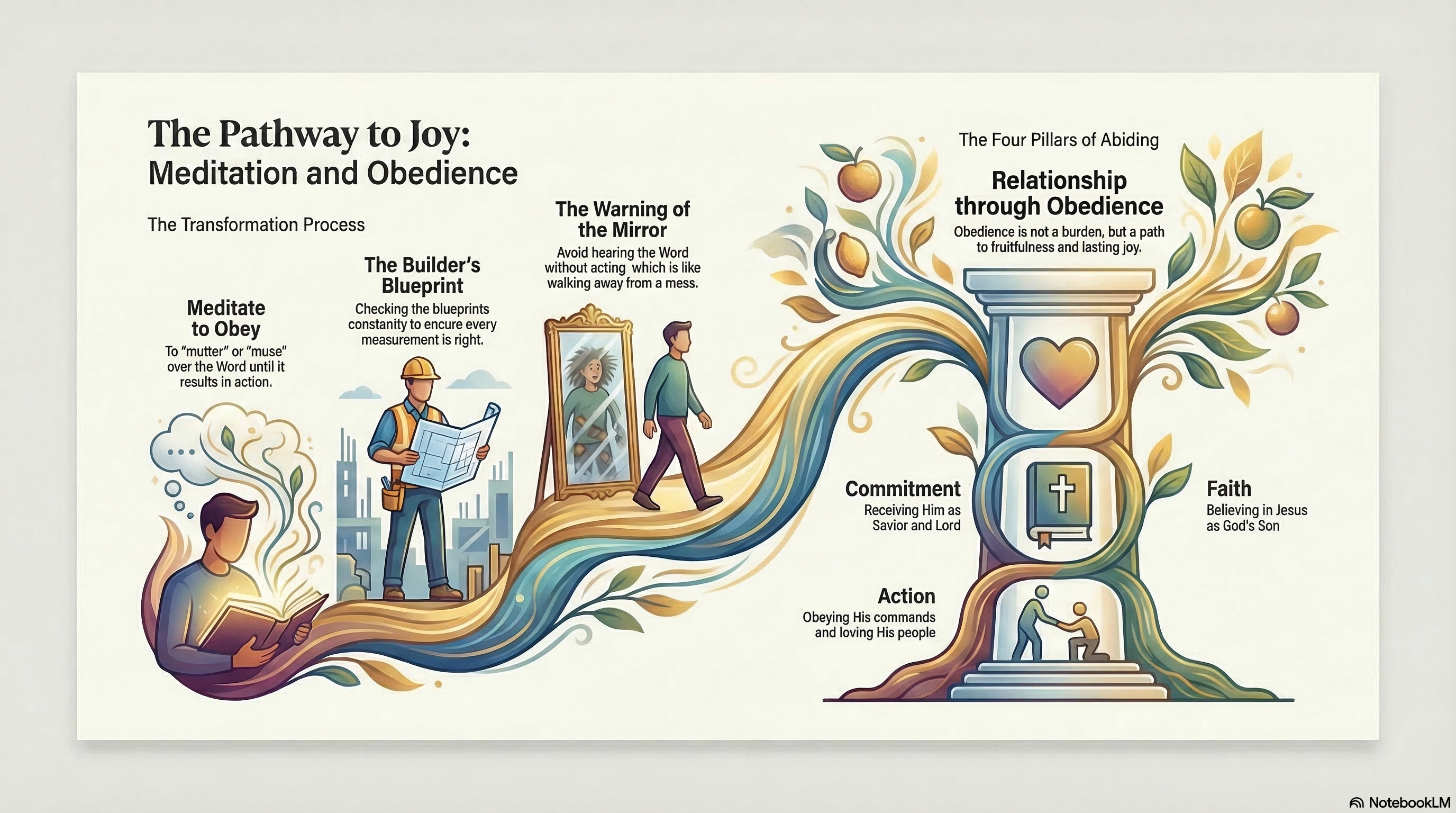
Obedience is not the price you pay to stay in God's good graces. It is the mechanism by which His joy flows into your life. Abiding — staying connected, filling the mind with His words, and letting those words shape what you do — is the rhythm of a life that bears fruit even in hard seasons.
The Promise: You Are Equipped and Invited
You are not on this journey of discovery by your own strength. God has provided the "Helper" to ensure you can understand Him.
As 1 Corinthians 2 reminds us, the Holy Spirit searches the very depths of God and reveals them to us. He is your Advocate and Teacher, bringing the words of Jesus to your remembrance.
10 But to us God revealed them through the Spirit, for the Spirit searches all things, even the depths of God. 11 For who among men knows the thoughts of a man except the spirit of the man which is in him? Even so the thoughts of God no one knows except the Spirit of God. 12 Now we have received, not the spirit of the world, but the Spirit who is from God, so that we may know the things freely given to us by God, 13 which things we also speak, not in words taught by human wisdom, but in those taught by the Spirit, combining spiritual thoughts with spiritual words. 14 But a natural man does not accept the things of the Spirit of God, for they are foolishness to him, and he cannot understand them, because they are spiritually examined.
Engage the Text: 1 Corinthians 2:10–14
- According to verse 10, what does the Spirit search?
- What analogy does Paul use in verse 11 to explain how the Spirit knows God? State both sides of the comparison.
- What did the believers receive in verse 12, and what did they not receive?
- How does the "natural man" (v. 14) view the things of the Spirit?
- Based on Paul's analogy, why is the Holy Spirit uniquely qualified to reveal the things of God — and why can no amount of human intelligence substitute for Him?
- What is the "spirit of the world" (v. 12), and how does it act as an obstacle to knowing the things of God?
- What does it mean that spiritual truths are "spiritually examined" (v. 14)? How does this change your approach to Bible study?
- In your own study, how often do you rely on "human wisdom" (v. 13) vs. the Spirit's teaching?
- What is one "thing freely given to us by God" (v. 12) that you have discovered lately?
- How can you practically "examine" a difficult passage spiritually rather than just intellectually?
25 "These things I have spoken to you while abiding with you. 26 "But the Advocate, the Holy Spirit, whom the Father will send in My name, He will teach you all things, and bring to your remembrance all that I said to you.
Engage the Text: John 14:25–26
- What was Jesus' status while speaking these things (v. 25)?
- Who does Jesus say the Father will send, and in whose name?
- What are the two specific tasks Jesus says the Spirit will perform in verse 26?
- The Spirit is called the "Advocate" (Helper). What kind of help does a disciple need when trying to "abide" in Jesus' words?
- Why is the Spirit's role of "remembrance" so vital for a disciple who wants to be a "doer" of the word?
- How does the Spirit's teaching (v. 26) complement the Spirit's searching (1 Cor 2:10)?
- When has the Holy Spirit recently "brought to your remembrance" a specific command or promise of Jesus?
- Is there a specific area where you feel you need the Spirit to "teach you" right now?
- How does knowing you have an "Advocate" change your confidence in your walk with God this week?
We want to leave you with a warm invitation: God wants to reveal Himself to you more than you want to know Him. When you open your Bible, you aren't just reading a text; you are meeting a Person.
Consider the final promise of Psalm 1:1–3 for the workman who delights in the Word:
1 How blessed is the man who does not walk in the counsel of the wicked, Nor stand in the way of sinners, Nor sit in the seat of scoffers! 2 But his delight is in the law of Yahweh, And in His law he meditates day and night. 3 And he will be like a tree firmly planted by streams of water, Which yields its fruit in its season And its leaf does not wither; And in whatever he does, he prospers.
Engage the Text: Psalm 1:1–3
- What three things does the "blessed man" NOT do?
- Where does the blessed man find his "delight"?
- To what does the Psalmist compare the man who meditates day and night?
- What happens to the leaf of the tree firmly planted by water?
- What does the progression from "walking" to "standing" to "sitting" suggest about the nature of influence?
- What is the relationship between "delight" and "meditation"? Can you have one without the other?
- What does it mean to yield fruit "in its season"? How does this temper our expectations for immediate results in Bible study?
- Whose "counsel" (podcasts, media, friends) has been most influential in your life lately? How does it compare to the Law of Yahweh?
- In what way do you need to be like a "tree firmly planted" during your current circumstances?
- What is one area where you are hoping to "prosper" spiritually through more consistent meditation?
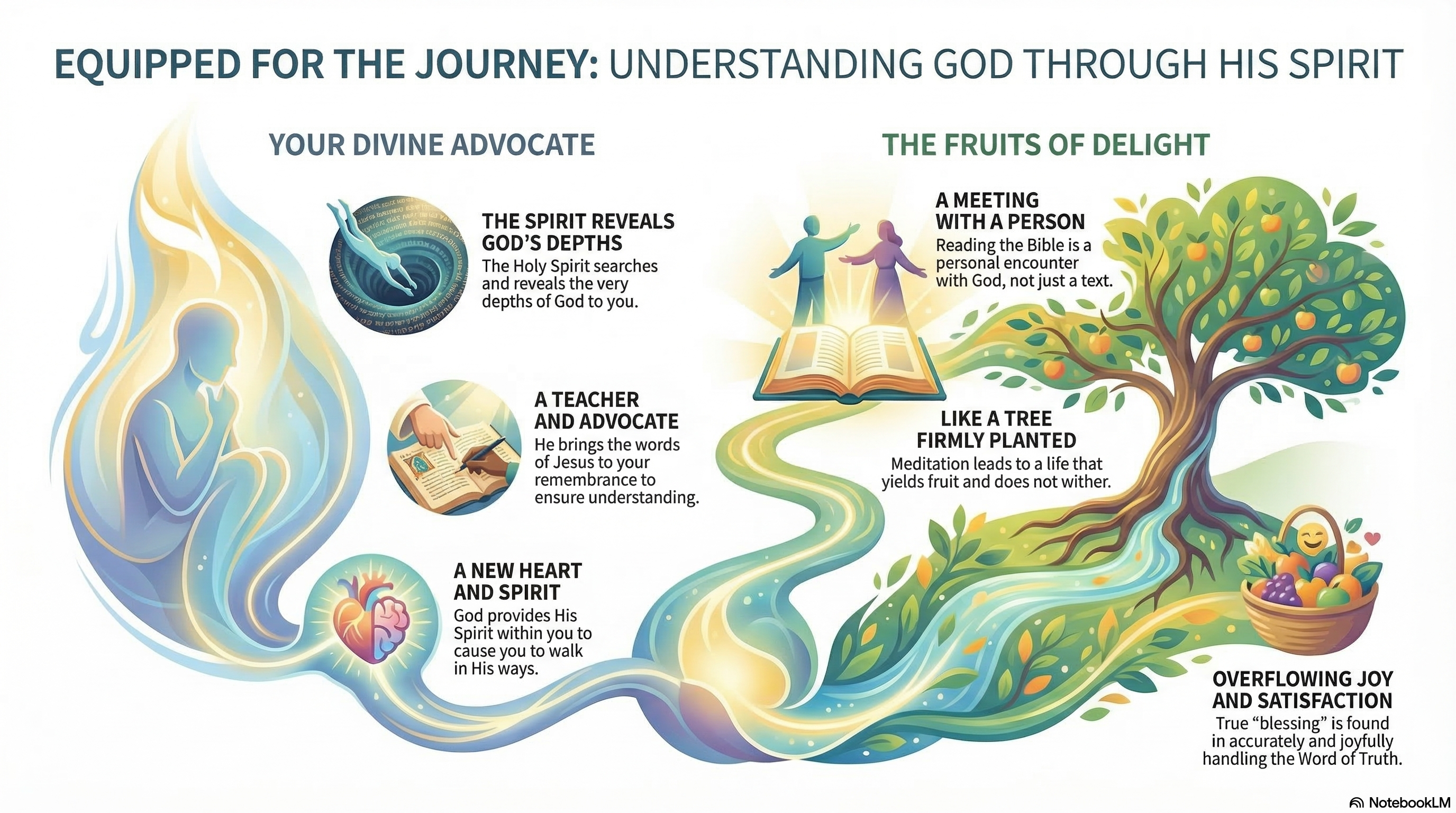
In the original Hebrew, that word "blessed" literally means "Oh the blessednesses!" — a deep, overflowing plurality of joy and satisfaction found only in God. May you find those blessednesses as you accurately and joyfully handle the Word of Truth.
May you find the deep joy and redemptive favor of God, the true Ashrei, as you delight in His Word and walk in His ways. Meditate and Obey. Study and Apply. Hear and Do. This is how we abide in Christ. This is how we demonstrate our love for God.