The One-Meaning Guardrail
How anchoring every interpretation to the author's original intent, honoring the one meaning God placed in the text, keeps us close to what He actually said.
The Heart of Abiding: An Invitation to the Word
Imagine you are sitting in a small group Bible study. The leader reads a verse aloud, and two people immediately offer their interpretations. One says the verse is a promise of material blessing. The other says it is clearly about spiritual contentment. Both are confident. Both sound sincere. And both cannot be right.
You sit quietly, wondering: Does Scripture actually have a fixed meaning? Or is the Bible one of those books where everyone gets to decide for themselves what it says?
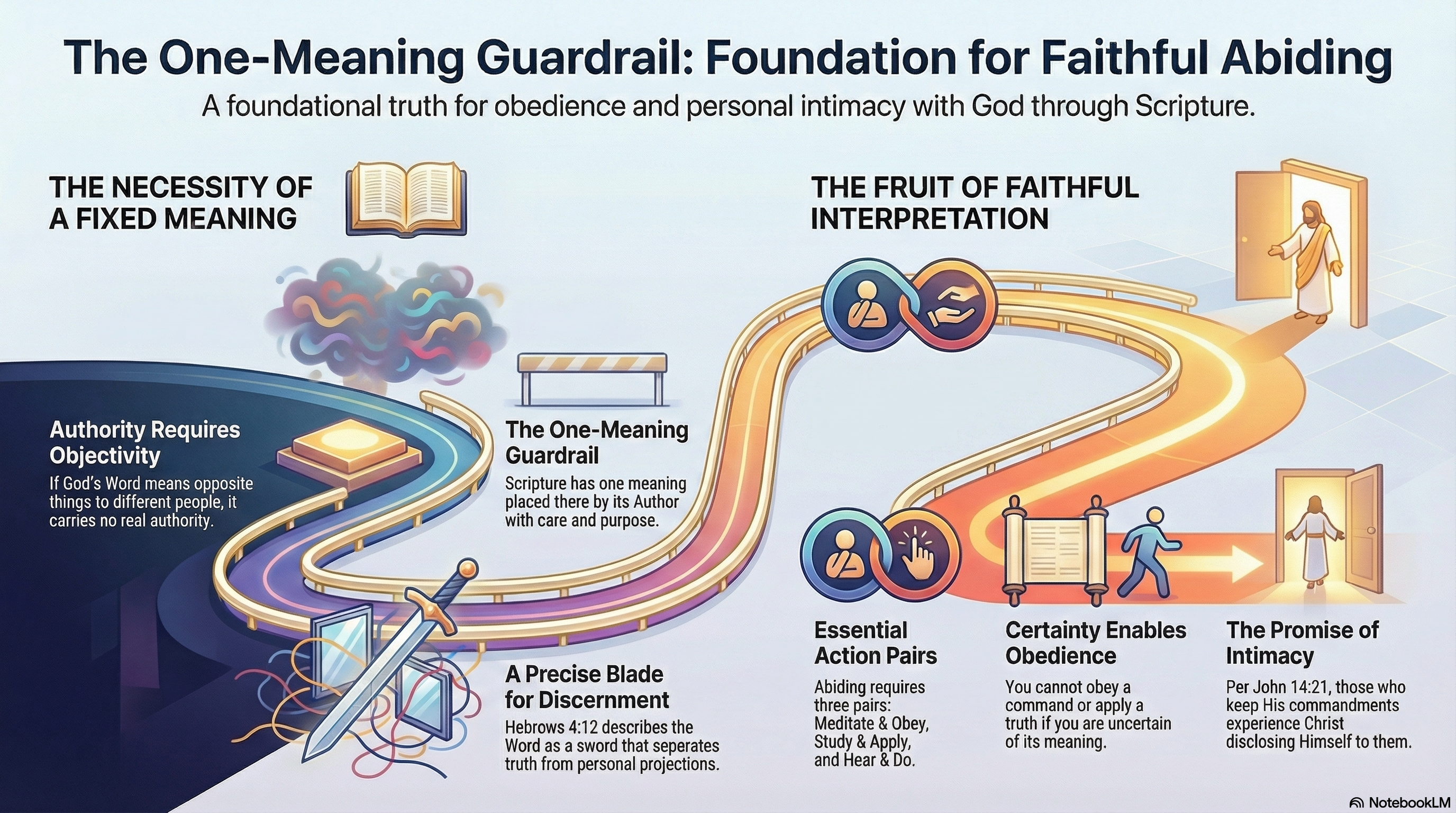
This moment, uncomfortable as it is, is precisely where the One-Meaning Guardrail does its most important work. If God's Word can mean opposite things to different people, it has no real authority over anyone. But if it has one meaning, placed there by its Author with care and purpose, then it can be trusted completely, and it can change a life.
This Abide Discovery Session introduces the guardrail that protects the foundation of everything we build. Our path is shaped by three essential action pairs: Meditate & Obey, Study & Apply, and Hear & Do. Each of these depends on knowing what God actually said. You cannot obey a command you are uncertain about. You cannot apply a truth you cannot identify. The One-Meaning Guardrail gives our obedience solid ground to stand on.
And the Word itself promises to do its work with precision. It is not a dull tool. It is a blade:
12 For the word of God is living and active and sharper than any two-edged sword, and piercing as far as the division of soul and spirit, of both joints and marrow, and able to judge the thoughts and intentions of the heart.
The Word does not merely inform; it divides and discerns. It separates what is of the soul, our own projections and wishes, from what is of the Spirit, the truth God actually placed in the text. A Word this precise deserves to be handled with equal precision.
And the reason for handling it well is not academic. It is relational:
21 "He who has My commandments and keeps them is the one who loves Me; and he who loves Me will be loved by My Father, and I will love him and will disclose Myself to him."
You can only keep a commandment whose meaning you know. The One-Meaning Guardrail is, at its heart, an act of love: the effort to hear what God actually said so that we can walk in it faithfully. And Jesus makes a breathtaking promise to those who do: He will disclose Himself to them. Intimacy with God is the fruit of faithful obedience, and faithful obedience begins with faithful interpretation.
- In Hebrews 4:12, what four descriptions does the author give to the Word of God? What ability does the verse say the Word has?
- In John 14:21, what two things does Jesus say the person who loves Him will do? What promise does He attach to that obedience?
- What does the phrase "disclose Myself to him" suggest about the relationship between obedience and intimacy with God?
- Hebrews 4:12 says the Word divides "soul and spirit." If the soul represents our own thoughts and the spirit represents God's truth, how does the One-Meaning Guardrail help us make that division when we read a passage?
- Jesus says the person who loves Him "has My commandments and keeps them." You can only keep a commandment whose meaning you know. How does this verse make the case that faithful interpretation is not a scholarly luxury but a loving necessity?
- The Word is described as "living and active," not static or passive. What does it mean that the Word works on us, not just that we work on it? How does the One-Meaning Guardrail position us to receive that work rather than resist it?
- When you sit down to read your Bible, do you approach it expecting the Word to do something in you, or do you approach it as information to be collected? What would change if you took Hebrews 4:12 seriously?
- Jesus promises to "disclose Himself" to the one who keeps His commandments. What is one area of your life where knowing the precise meaning of God's Word would help you obey more faithfully?
- What would it look like this week to read one passage slowly enough to ask: "What did the Author actually mean here, and what is He asking me to do with it?"
The Word of God is not a general impression. It is a living blade, precise enough to divide soul from spirit, and personal enough to disclose the heart of God to anyone who takes it seriously. The One-Meaning Guardrail is how we take it seriously.
The One-Meaning Guardrail: One Author, One Message
The One-Meaning Guardrail holds that a passage of Scripture has one main, correct meaning: the meaning intended by the original human author under the inspiration of the Holy Spirit. It does not mean that God's Word is rigid or cold. It means that God communicates with purpose and precision, and that His message can be known.
This guardrail guards against a subtle but serious drift: the tendency to treat personal interpretation as a right. In a culture that celebrates self-expression, it can feel natural to say, "That verse means something different to me." But meaning does not work that way. When a father writes a letter to his child, the child can apply that letter's wisdom to many situations across many years. But the father had a specific message in mind. That message does not change based on how the child feels.
Two things are worth holding clearly:
- Single Meaning: What the text actually said and meant to its original audience, as intended by the human author and the Holy Spirit who inspired him.
- Many Applications: How that stable, unchanging truth lives itself out across different lives, cultures, and circumstances today. In Abide, we call these timeless truths abiding principles.
The meaning does not change. The applications are wonderfully diverse. This distinction is the heartbeat of the One-Meaning Guardrail, and it is what makes Scripture both trustworthy and inexhaustibly relevant.
Peter makes the foundation plain:
20 Know this first of all, that no prophecy of Scripture comes by one's own interpretation. 21 For no prophecy was ever made by an act of human will, but men moved by the Holy Spirit spoke from God.
Notice what Peter is saying. Scripture did not originate in the minds of its human authors. It came from God, carried by men who were moved by the Holy Spirit. The meaning belongs to the One who sent it. Our task is not to create an interpretation; it is to receive the one that is already there.
If two people read the same verse and arrive at contradictory conclusions, they cannot both be right. God is a God of truth, not confusion. He does not say two opposite things at once. Our goal is to discover His specific message, not to invent our own.
- In verse 20, what does Peter say prophecy of Scripture does not come from? What is the force of the phrase "first of all" at the opening?
- In verse 21, what two things does Peter say prophecy was not made by? What action does he use to describe the human authors?
- What is the ultimate source of Scripture, according to verse 21? Who moved whom?
- If no prophecy comes by "one's own interpretation," what does that say about the relationship between the reader and the Author? Who holds the meaning?
- Peter says the human authors were "moved" by the Holy Spirit. How does knowing that a single divine Author stands behind the many human authors support the idea that each passage has one unified, intentional meaning?
- A common assumption today is that interpretation is personal, that the text means "what it means to me." How does 2 Peter 1:20–21 challenge that assumption at its foundation?
- Have you ever settled on an interpretation of a verse primarily because it fit your situation rather than because you examined what the author intended? What guardrail could have helped?
- Knowing that the meaning belongs to the Author, what posture do you bring to a passage that says something you did not expect or did not want to hear?
- What is one step you could take this week to read a familiar verse with fresh eyes, asking "What did the author intend?" rather than "What does this mean to me?"
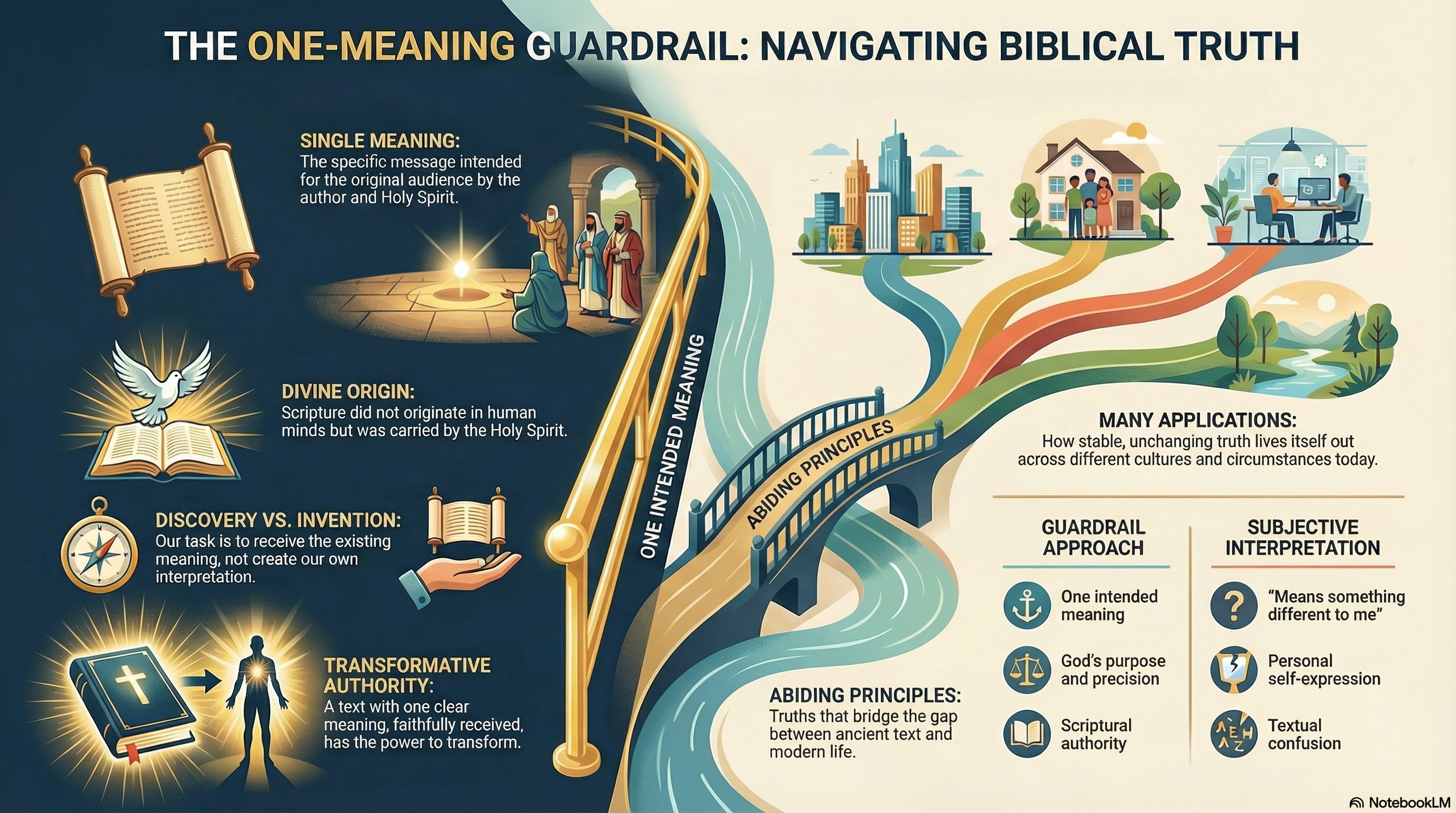
The meaning of Scripture does not belong to us to invent. It belongs to the One who breathed it out. The One-Meaning Guardrail is simply our commitment to honor that fact every time we open our Bibles. A text with a thousand meanings has no real authority over anyone. A text with one clear meaning, faithfully received, can transform a life.
One Meaning in Every Genre
Now, this does not mean the Bible is rigid. There are two important nuances to remember. First, in prophecy, God sometimes reveals a "fuller sense" or a deeper meaning than what the human author may have fully understood at the time. Second, some words are used figuratively, like in a metaphor, and can carry several overlapping ideas at once without contradicting the main meaning.
The main point is that the Bible is a book of truth, and God has a specific message for us in each passage. By following the One-Meaning Guardrail, we can be confident that our interpretations are not just our own ideas but are rooted in what God's Word actually says. This is how we avoid confusion and honor the authority of Scripture.
You might wonder whether the One-Meaning Guardrail is too rigid for a library as diverse as the Bible. After all, as we learned in the Literal Guardrail lesson, the Bible contains history, poetry, prophecy, parable, wisdom, and epistle. Can a single guardrail truly handle all of them?
The answer is yes. The guardrail does not demand that every genre communicates in the same way. It simply insists that every passage, regardless of genre, communicates one main thing. A poem communicates differently than a letter, but both the poet and the letter-writer had a specific message in mind.
Consider one of the most vivid metaphors in all of Scripture:
7 So Jesus said to them again, "Truly, truly, I say to you, I am the door of the sheep. 8 "All who came before Me are thieves and robbers, but the sheep did not hear them. 9 "I am the door; if anyone enters through Me, he will be saved, and will go in and out and find pasture. 10 "The thief comes only to steal and kill and destroy; I came that they may have life, and have it abundantly."
Jesus is obviously not a literal door made of wood and hinges. This is a metaphor. But does the figurative language break the One-Meaning Guardrail? No. When Jesus says "I am the door," the metaphor carries one unified meaning: He is the exclusive means of access to salvation, to God, to abundant life. The imagery is rich, carrying layers of protection, access, safety, and provision. But they all point in one direction. The guardrail keeps us from saying, "Well, it is a metaphor, so it can mean anything I want it to mean." It means what Jesus intended it to mean.
This is an important distinction: figurative language is not a loophole in the One-Meaning Guardrail. A metaphor can carry overlapping layers of imagery, but they all serve one core meaning. The guardrail protects us from drifting into vague spiritualizing, where a passage "means everything" and therefore means nothing.
- How many times does Jesus use the phrase "I am the door" in this passage? What does the repetition emphasize?
- What three actions does Jesus attribute to "the thief" in verse 10? What does He contrast those actions with?
- What specific outcomes does Jesus promise to the one who "enters through Me" in verse 9?
- Jesus uses a metaphor: "I am the door." If someone were to say, "Since it is figurative, the verse can mean whatever speaks to me personally," how would the One-Meaning Guardrail correct that reading? What does Jesus actually claim to be?
- The imagery of a door carries several associations: protection from danger, access to provision, and exclusivity of entry. Do these overlapping images produce multiple meanings, or do they support one unified meaning from multiple angles? What is the difference?
- How does the Literal Guardrail (reading according to genre) work alongside the One-Meaning Guardrail here? What would happen if you ignored genre and read "I am the door" as a literal statement?
- Jesus says He came that we may have life "abundantly." In the context of this passage, what kind of abundance is He describing: material prosperity, or the security and provision of belonging to the Good Shepherd?
- Is there a verse in your life that you have treated as figurative in a way that lets you avoid its specific claim? What would the One-Meaning Guardrail reveal if you applied it?
- Jesus draws a sharp line between the thief and the shepherd. What voices in your life compete with the Shepherd's voice, and how does knowing His one intended message help you distinguish them?
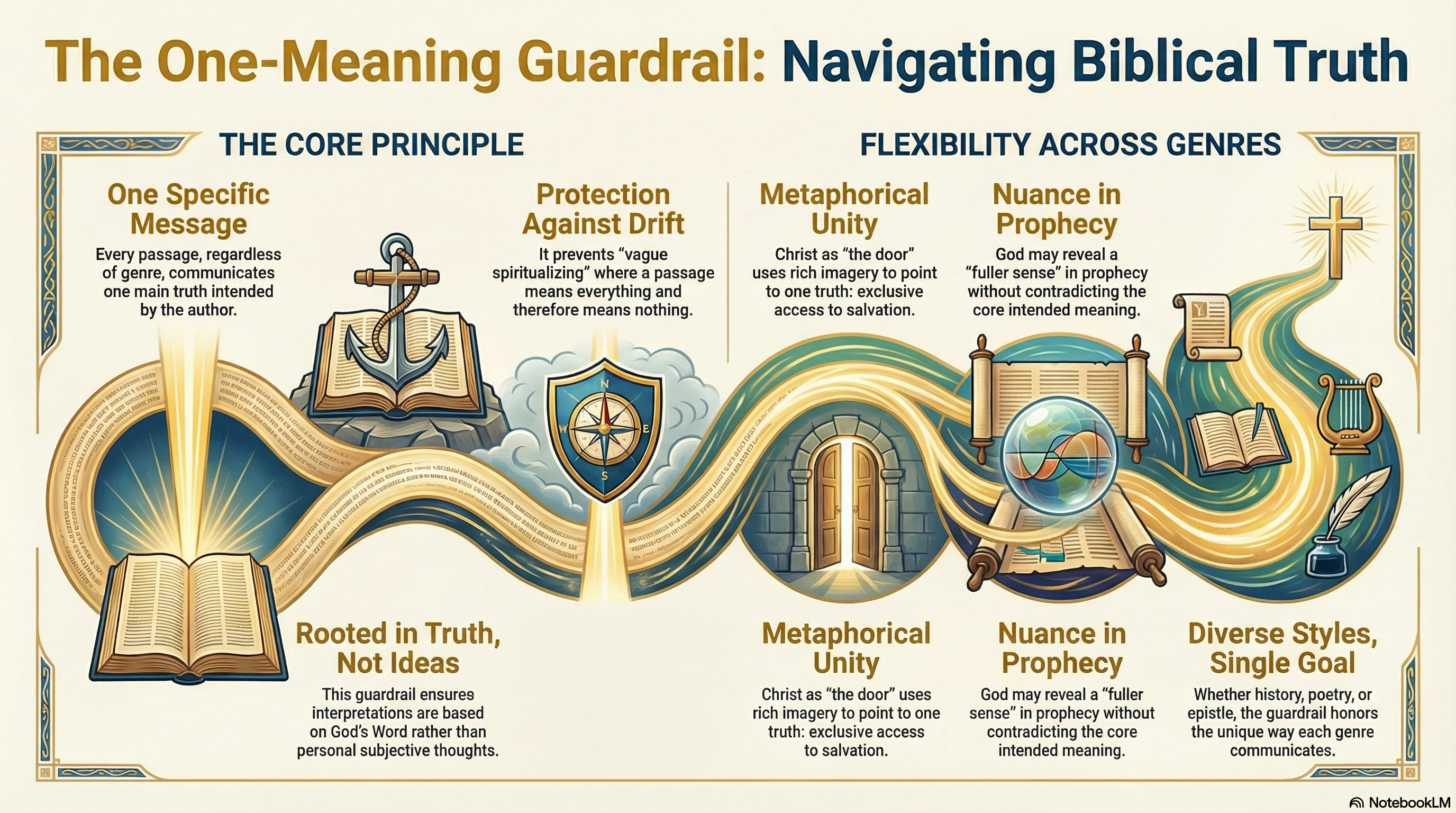
Figurative language is not a loophole. A metaphor with rich imagery still points to one truth. The One-Meaning Guardrail is flexible enough to honor every genre of Scripture, and firm enough to keep every genre from drifting into whatever-you-want-it-to-mean.
Practice Case 1: When Interpretations Compete (1 Corinthians 13:10 and Matthew 16:15–18)
The One-Meaning Guardrail does its clearest work when two or more interpretations are competing for the same verse, and we must decide: can they all be right?
1 Corinthians 13:10: What Is "The Perfect"?
8 Love never fails; but if there are gifts of prophecy, they will be done away; if there are tongues, they will cease; if there is knowledge, it will be done away. 9 For we know in part and we prophesy in part, 10 but when the perfect comes, the partial will be done away.
This passage has been interpreted in several different ways. Some scholars believe "the perfect" refers to the completion of the Bible, the New Testament. In this view, once the Bible was complete, the "partial" gifts like prophecy and speaking in tongues would stop. Others have a different view. They believe Paul is talking about the return of Jesus. When Christ returns, everything will be made perfect, and the need for gifts like prophecy will be gone. And still others believe it refers to the culmination of human history in the New Heavens and New Earth.
Now apply the One-Meaning Guardrail. Can all of these interpretations be correct at the same time? They cannot. Paul could not have meant for "the perfect" to refer to three different events all at once. The principle suggests that while a single word can have a somewhat broad meaning, it ultimately points to one specific event or reality. Either "the perfect" refers to the completion of the New Testament, or the Second Coming, or the New Heavens and New Earth, or it could be something else. One of these options is correct, and the others are incorrect.
This is what the One-Meaning Guardrail does for us. It helps us avoid interpretations that are just our own ideas, and it keeps us grounded in the author's intended message. It is a guardrail that prevents us from falling into confusion by forcing us to seek a single, unified truth from the text, just as the original author intended.
Another principle coming up, the Progressive Guardrail, will help us rule out one of these interpretations, which leaves us with two other possible meanings. And the other six guardrails, when they function together, will help us discern the more likely meaning for many passages. But sometimes, like with 1 Corinthians 13:10, we can narrow the options but may be left with two plausible interpretations. That is okay. The other guardrails can help us narrow the options, but the One-Meaning Guardrail reminds us to keep searching rather than settling for "everyone is right."
- What three spiritual gifts does Paul name in verse 8? What does he say will happen to each of them?
- What is the stated reason in verse 9 for the partiality Paul describes?
- What contrast does Paul draw in verse 10? What two things does he place on either side of the word "when"?
- Three different interpretations of "the perfect" have been offered. Can all three be correct at the same time? What does the One-Meaning Guardrail tell us about competing interpretations, even when each one sounds plausible?
- The guardrail tells us there is one correct answer, but it does not guarantee we will always identify it with certainty. What is the difference between that honest humility and the relativism that says "everyone's interpretation is equally valid"?
- How might the other guardrails, the Contextual (what is Paul's argument across all of 1 Corinthians 12–14?), the Progressive (where does full revelation arrive in the biblical story?), and the Harmony Guardrail, help narrow the options when one guardrail alone leaves us uncertain?
- Is there a passage you have quietly given up trying to interpret because the debate felt too complicated? What would it look like to re-engage it with fresh humility and better tools?
- Paul says we "know in part" in this age. How does that honest acknowledgment free you to study with confidence rather than demanding certainty before you trust?
- The One-Meaning Guardrail invites us to remain teachable. Is there a conviction you hold about Scripture that you have stopped examining? What would it look like to hold it with open hands?
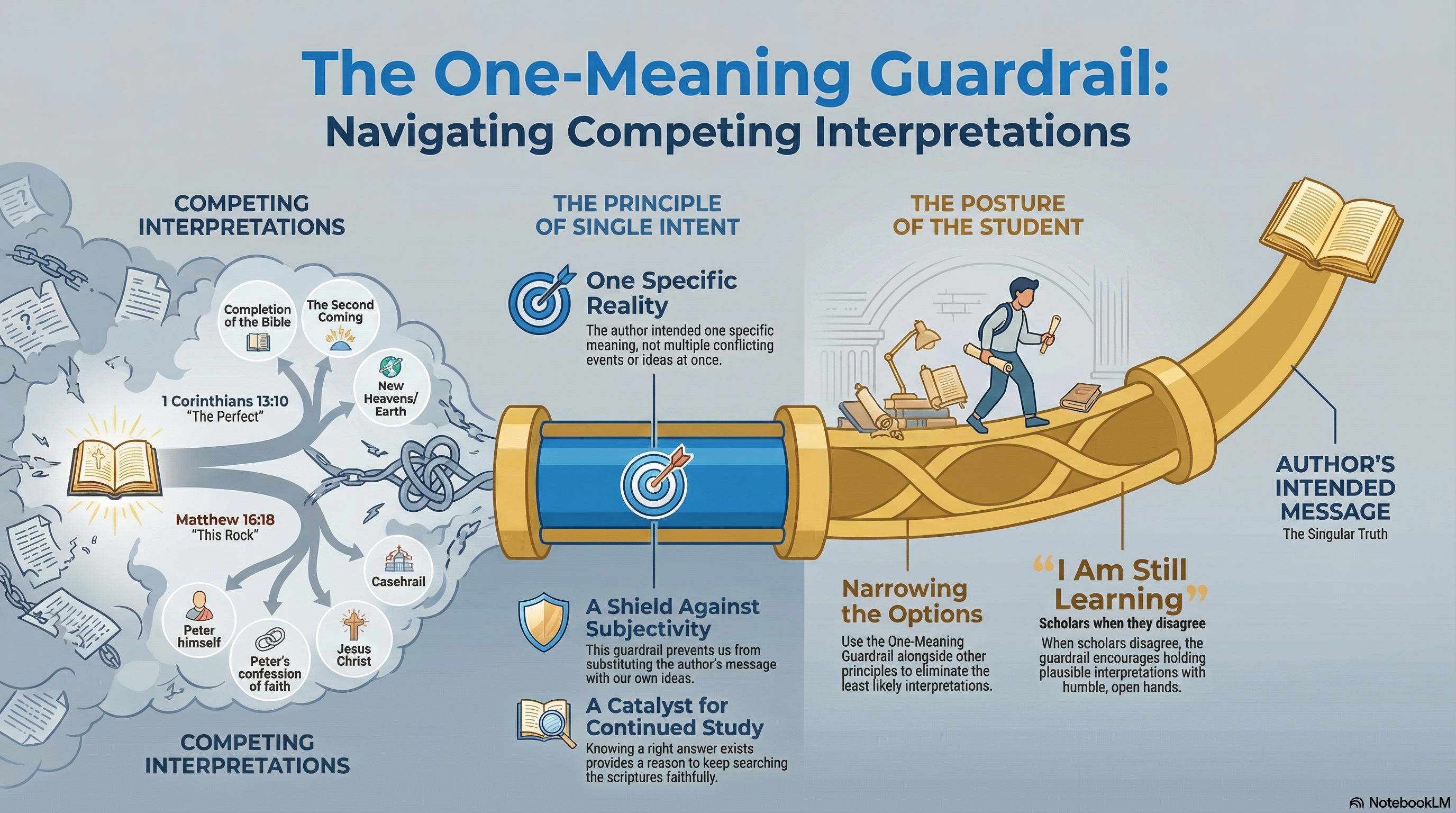
The One-Meaning Guardrail does not promise to resolve every debate. It promises something better: a reason to keep searching faithfully. Because there is one right answer, the search is always worth it.
Matthew 16:15–18: When Godly Scholars Disagree
A second case deepens this same lesson in humility:
15 He said to them, "But who do you say that I am?" 16 And Simon Peter answered and said, "You are the Christ, the Son of the living God." 17 And Jesus answered and said to him, "Blessed are you, Simon Bar-Jonah, because flesh and blood did not reveal this to you, but My Father who is in heaven. 18 "And I also say to you that you are Peter, and upon this rock I will build My church; and the gates of Hades will not overpower it."
"Upon this rock I will build My church." What is the rock? Christians have debated this for centuries. Some say the rock is Peter himself. Others say it is Peter's confession, "You are the Christ." And still others say Christ Himself is the rock.
Now apply the One-Meaning Guardrail. Can Jesus have meant all three at the same time? No. He meant one thing. But here is the honest reality: faithful, godly scholars have studied this passage carefully and prayerfully and have still landed in different places. The other guardrails can help us narrow the options, but this may be a passage where we hold our interpretation humbly, not dogmatically. The One-Meaning Guardrail tells us there is a correct answer. It does not guarantee that we will always arrive at it with certainty.
When that happens, we acknowledge the plausible interpretations and hold them with open hands. That is not weakness. It is not a failure of the method. It is the mark of a careful student who honors God's Word enough to say, "I am still learning."
- What question does Jesus ask His disciples in verse 15? What is the significance of the word "you" in His question?
- What specific claim does Peter make in his answer in verse 16?
- In verse 17, where does Jesus say this knowledge came from? What does that reveal about the nature of Peter's confession?
- Three interpretations of "this rock" exist: Peter, Peter's confession, or Christ Himself. The One-Meaning Guardrail tells us Jesus meant one thing. How does the guardrail keep us searching even when a definitive answer is difficult to reach?
- What is the difference between saying "I am not certain which interpretation is correct, but I know there is one" and saying "The verse can mean whatever resonates with you"? Why does this distinction matter for the authority of Scripture?
- How does the posture of humble teachability, holding a view openly rather than dogmatically, actually strengthen your approach to Bible study rather than weaken it?
- Is there a passage in your life where you have held your interpretation too tightly, refusing to reconsider? What would it look like to hold it with the kind of humility this passage invites?
- Peter's answer came not from "flesh and blood" but from the Father. When you study a difficult passage, do you ask the Father to reveal His meaning, or do you rely only on your own reasoning?
- How does knowing that even godly scholars can disagree on a passage encourage you, rather than discourage you, in your own study?
Humility is not a failure of the guardrail. It is a feature. The One-Meaning Guardrail tells us to keep searching, not to stop caring. And when certainty is elusive, the posture of "I am still learning" honors God more than the posture of "I have nothing left to learn."
Practice Case 2: The Fuller Sense in Prophecy (Isaiah 7:14)
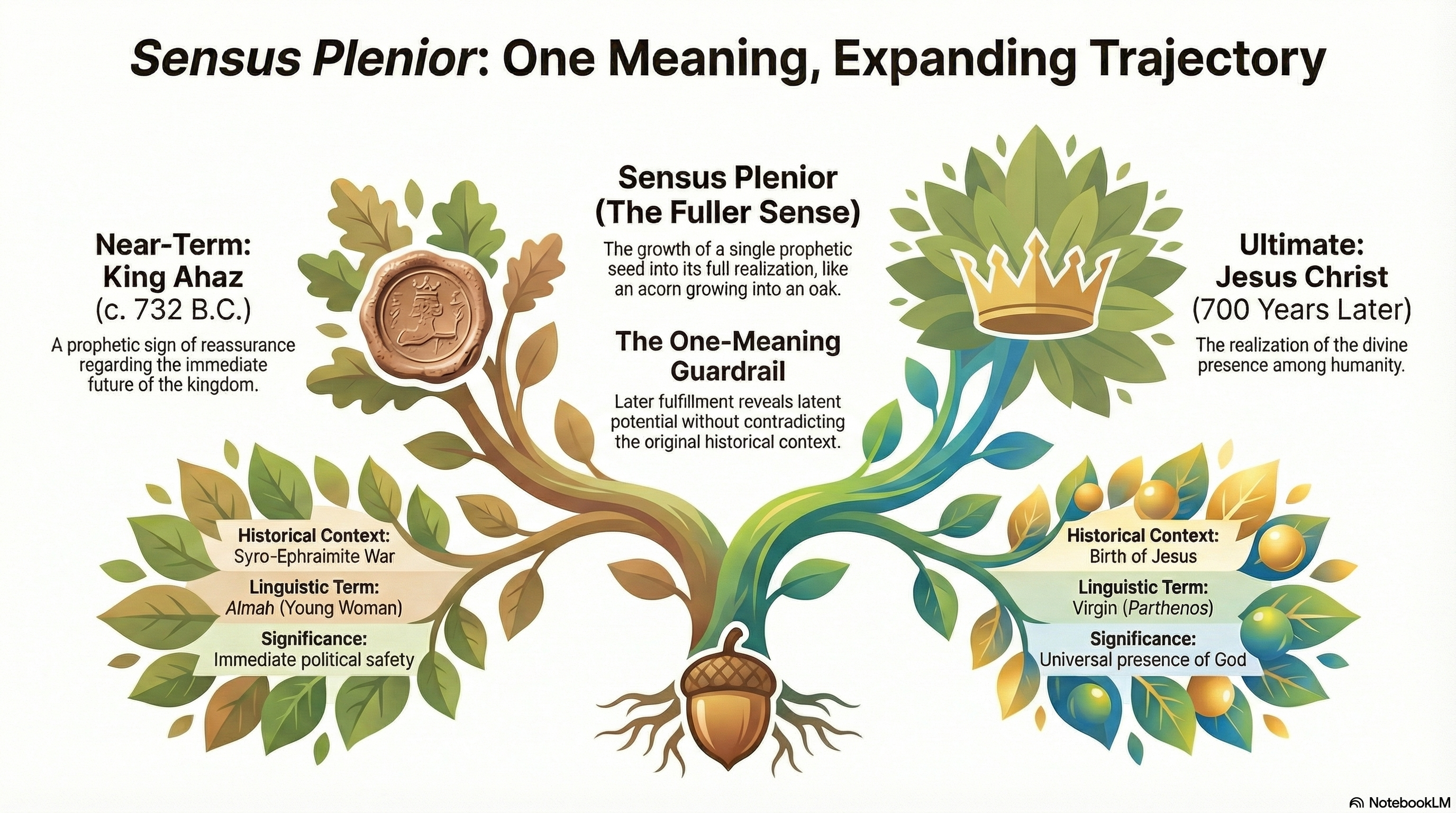
One of the most remarkable features of biblical prophecy is the phenomenon that theologians call sensus plenior, a Latin phrase meaning "the fuller sense." It refers to the capacity of some prophecies to carry a near-term meaning for their original audience and a larger, more complete fulfillment that only later revelation fully reveals.
Does this mean that prophetic texts have two meanings? No. It means they carry one meaning with an expanding trajectory. Think of it like an acorn. Inside the acorn is the full identity and genetic blueprint of a massive oak tree. The oak is not a different thing from the acorn. It is the same life, grown to its full stature. The later fulfillment does not contradict the earlier meaning. It is the flower of a seed the Spirit planted from the beginning.
The most significant example in all of Scripture is Isaiah 7:14.
14 "Therefore the Lord Himself will give you a sign: Behold, the virgin will be with child and bear a son, and she will call His name Immanuel.
This prophecy operates on two distinct levels. In its original context during King Ahaz's reign (around 732–716 B.C.), it addressed an immediate historical crisis known as the Syro-Ephraimite War. Two enemy kings were threatening to destroy Judah and remove the house of David from the throne. The sign was meant to reassure Ahaz that God was in control. Before a child born in that season was old enough to know right from wrong, the threatening nations would be destroyed.
Notice that the Hebrew word used here is almah, meaning "young woman," rather than betulah, the more specific word for "virgin." That ambiguity is important. In the near term, a young woman would bear a son as a sign of safety. Isaiah 8:3–4 describes what appears to be this immediate fulfillment.
But here is what is remarkable: the prophet, under divine inspiration, neither emphasized nor dismissed virginity in his word choice, allowing this prophecy to function with a dual focus. In the short term, the significance lay in a child who would still be immature when the threatening nations were destroyed. But a merely human child born in Ahaz's day would not genuinely signify God's continuing presence, Immanuel, "God with us." A virgin overshadowed by God's Spirit, however, would constitute not merely a sign but the reality of God's presence, a truth extending beyond that moment into universal significance.
Seven hundred years later, Matthew reads it under the direction of the Holy Spirit and sees the fulfillment:
22 Now all this took place in order that what was spoken by the Lord through the prophet would be fulfilled, saying, 23 "BEHOLD, THE VIRGIN SHALL BE WITH CHILD AND SHALL BEAR A SON, AND THEY SHALL CALL HIS NAME IMMANUEL," which translated means, "GOD WITH US."
So is this two meanings? No. This is what theologians call sensus plenior: the principle that prophecies often contain typological fulfillment, with an immediate application in the prophet's historical context and a fuller, more impactful fulfillment at a later date. The Holy Spirit, who inspired Isaiah, intended a prophetic trajectory: a near-term type (a child born in Ahaz's day) and its ultimate fulfillment (the virgin birth of Christ). It is one meaning with an expanded, larger fulfillment.
Matthew's application of Isaiah 7:14 to Jesus' birth, over seven hundred years later, represents this fuller fulfillment, where the language's latent potential becomes manifest in ways Isaiah's original audience likely could not have anticipated, yet which the text's own wording permits.
The One-Meaning Guardrail still holds. We are not saying the passage means whatever we want. We are recognizing that in prophecy, God sometimes reveals a depth of meaning that goes beyond what the human author fully grasped at the time. The guardrail keeps us anchored to what the text actually says while allowing us to see how God's plan unfolds across Scripture.
- In Isaiah 7:14, what does Yahweh promise to give, and what will be the child's name? What does the name "Immanuel" mean?
- In Matthew 1:22–23, what does Matthew say was the purpose of the events surrounding Jesus' birth? What Old Testament passage does he quote?
- How does Matthew describe the mother in verse 23? What is the significance of his word choice compared to Isaiah's?
- Isaiah's near-term meaning addressed Ahaz's military crisis. Matthew's fulfillment announces the arrival of the Son of God. Does having two historical moments of fulfillment mean the verse has two different meanings, or does it mean one meaning has expanded to its fullest expression? How does the acorn-to-oak illustration help you answer?
- The Spirit chose the word almah rather than betulah. How does this word choice demonstrate that the Spirit, as the ultimate Author, built the trajectory of the fuller fulfillment into the text from the beginning?
- The One-Meaning Guardrail keeps us from saying the passage "means whatever later readers want it to mean." What anchors the Matthew fulfillment to the genuine intention of the original text rather than reading something foreign into it?
- Have you ever felt confused by a New Testament author quoting an Old Testament passage in a way that seemed to stretch its meaning? How does the concept of sensus plenior help you understand those connections without breaking the guardrail?
- The name "Immanuel" means "God with us." How does knowing that this promise moved from a near-term sign of divine protection to the literal arrival of God in human flesh change the weight it carries in your life today?
- Where in your life right now do you most need to hear that God is with you, not as a comforting idea, but as the deep truth of Immanuel?
Sensus plenior does not break the One-Meaning Guardrail. It reveals how remarkably deep a single meaning can be when the Holy Spirit is the One who planted it. The same Word that reassured a frightened king ultimately announced the arrival of the King. One purpose. One trajectory. One God.
Practice Case 3: When a Word Has More Than One Meaning (John 3:3–5)
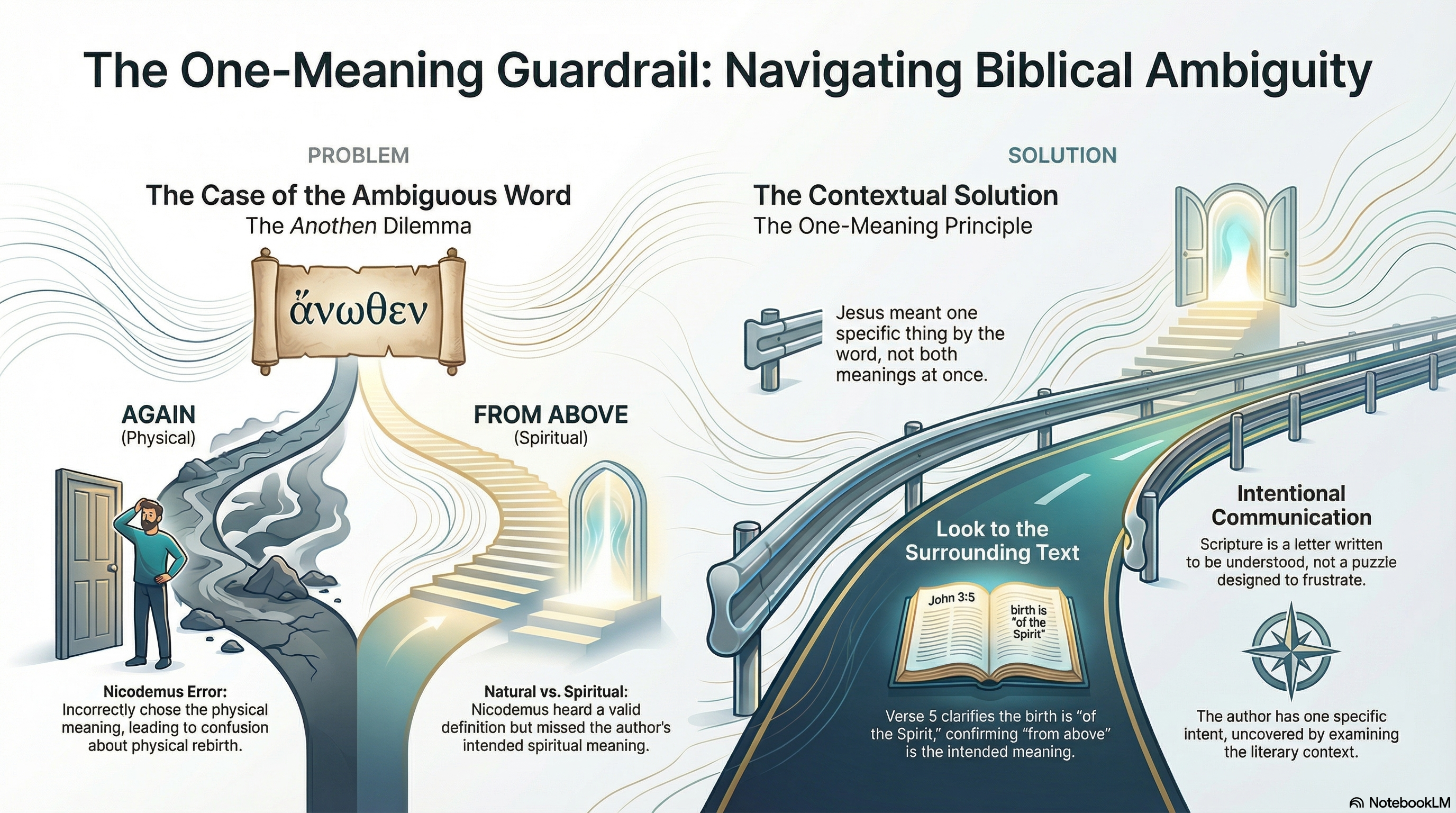
The One-Meaning Guardrail also helps us when a text contains a word that carries more than one possible meaning in its original language. In those moments, the guardrail does not leave us to guess. It points us to the surrounding literary context as the tool that resolves the ambiguity and locates the author's intent.
One of the most famous examples occurs in a nighttime conversation between Jesus and a Pharisee named Nicodemus.
3 Jesus answered and said to him, "Truly, truly, I say to you, unless one is born again he cannot see the kingdom of God." 4 Nicodemus said to Him, "How can a man be born when he is old? Can he enter a second time into his mother's womb and be born?" 5 Jesus answered, "Truly, truly, I say to you, unless one is born of water and the Spirit he cannot enter into the kingdom of God."
Here is a fascinating case. The Greek word that gets translated "again" is anothen. It can mean "again" or "from above." Nicodemus heard "again" and responded with a logical but deeply physical question: Can a grown man be born a second time from his mother's womb? He was not being foolish. He was hearing one valid meaning of the word. But he was hearing the wrong one.
Jesus immediately clarifies in verse 5. This birth is "of water and the Spirit." It is a spiritual birth from above, a work of the Holy Spirit, initiated not by human effort or natural process but by the action of God. The context answers the question that the ambiguous word left open.
The One-Meaning Guardrail helps us here. It tells us: Jesus meant one thing by this word, not both at the same time. Which one? Context tells us. Jesus goes on to explain that this birth is "of the Spirit" (verses 5–8). The guardrail narrows us to the author's intended meaning even when the original word is ambiguous. Nicodemus got it wrong because he grabbed the wrong meaning. The contextual guardrail steers us to the right one.
This is exactly what the One-Meaning Guardrail does in its partnership with the Contextual Guardrail. When a word carries more than one possible meaning, the guardrail does not tell us to choose our favorite. It points us to the context, the surrounding conversation, the literary setting, and the broader teaching of the author, and says: the answer is in there. Look for it.
- What claim does Jesus make in verse 3 about being "born again"? What does He say it is necessary for?
- What question does Nicodemus ask in verse 4? What does his question reveal about how he understood Jesus' words?
- How does Jesus clarify His meaning in verse 5? What two elements does He name as the source of the birth He is describing?
- The Greek word anothen can mean "again" or "from above." Nicodemus understood "again." The context of verse 5 reveals Jesus meant "from above." How does the One-Meaning Guardrail, working alongside the Contextual Guardrail, resolve the ambiguity without requiring us to simply choose our preferred translation?
- Nicodemus was not careless. He was hearing a real, grammatically valid meaning of the word. But he was hearing the wrong one. What does this tell us about the limits of reading a single word in isolation, without the guardrail?
- If someone today reads John 3:3 and concludes that Jesus is teaching about a second physical birth, how would the One-Meaning Guardrail, applied with the help of the surrounding context, correct that reading?
- Nicodemus came to Jesus at night and walked away confused. But the conversation was not the end of his story (see John 19:39, where Nicodemus appears at the cross with burial spices for Jesus). What does that detail suggest about what eventually happened in his heart?
- Have you ever walked away from a passage confused, feeling like you missed something? How does knowing that the One-Meaning Guardrail is there, pointing you back to the context, change how you respond to that confusion?
- Jesus says that unless one is born of the Spirit, he cannot enter the kingdom of God. What does this mean for how you understand your own spiritual life? Is this a birth you have experienced?
When a word has more than one meaning, the guardrail does not leave you guessing. It directs you to the surrounding context, where the Author already left the answer. The text is not a puzzle designed to frustrate you. It is a letter written to be understood, by a God who wants to be known.
How the Guardrails Work Together: A Preview of the Progressive Guardrail (Psalm 22)
We have now seen the One-Meaning Guardrail at work across several different types of passages: an epistle (1 Corinthians 13), a statement of theological significance (Matthew 16), prophecy (Isaiah 7), figurative language (John 10), and a gospel conversation (John 3). In every case, the guardrail does the same thing: it tells us the author meant one thing, and our job is to discover that meaning rather than invent our own.
Sometimes, like with 1 Corinthians 13:10, we can narrow the options but may be left with two plausible interpretations. That is okay. The other six guardrails, when they function together, will help us discern the more likely meaning for many passages. And for the ones where we are still left with honest questions? We remain humble and not dogmatic, recognizing the plausible interpretations and holding them with open hands. That posture is not a failure of the method. It is the mark of a careful student of God's Word.
But there is one more category of passage that stretches the guardrail in a way that requires a different tool to handle fully. Consider a passage that has one clear meaning in its original context, yet contains details so strikingly parallel to a later event that the connection cannot be coincidence.
1 My God, my God, why have You forsaken me? Far from my salvation are the words of my groaning.
16 For dogs have surrounded me; A band of evildoers has encompassed me; They pierced my hands and my feet. 17 I count all my bones. They look, they stare at me; 18 They divide my garments among them, And for my clothing they cast lots.
David wrote this psalm from a place of deep personal suffering. That is the one meaning in David's immediate context: a cry of anguish to God. The One-Meaning Guardrail tells us David wrote with one meaning in mind, his own suffering.
But look at the specific details: pierced hands and feet, garments divided, lots cast for clothing. Now listen to what happened at the crucifixion:
35 And when they had crucified Him, they divided up His garments among themselves by casting lots.
46 And about the ninth hour Jesus cried out with a loud voice, saying, "ELI, ELI, LAMA SABACHTHANI?" that is, "MY GOD, MY GOD, WHY HAVE YOU FORSAKEN ME?"
The One-Meaning Guardrail tells us David wrote with one meaning. But how do we account for the unmistakable parallels to Christ's crucifixion, written a thousand years before it happened? This is where the Progressive Guardrail will help us. In a future lesson, we will see how God progressively reveals His plan across Scripture so that earlier passages take on deeper significance in light of later revelation. For now, just notice this: the One-Meaning Guardrail does not shut down these connections. It simply tells us we need a principled way to handle them rather than reading whatever we want into the text.
The guardrails are designed to work together, each one handling what it was built for and handing off what it was not:
- The Literal Guardrail taught us that figurative language still carries one meaning. We saw this in John 10:7–10, where "I am the door" is a metaphor with one unified truth.
- The Contextual Guardrail taught us that context resolves ambiguity. We saw this in John 3:3–5, where the surrounding conversation revealed that anothen meant "from above," not "again."
- The One-Meaning Guardrail taught us today that the author intended one meaning, and our job is to discover it, not invent it.
- The Progressive Guardrail (coming soon) will teach us how God's unfolding story illuminates earlier passages, explaining connections like the one between Psalm 22 and the crucifixion.
None of the guardrails works in isolation. Together, they form a complete framework for reading God's Word faithfully. And behind all of them stands the Teacher who makes the whole system come alive:
13 "But when He, the Spirit of truth, comes, He will guide you into all the truth; for He will not speak from Himself, but whatever He hears, He will speak; and He will disclose to you what is to come."
The Spirit of truth is your guide into all the truth: including the truths hidden inside the right reading of genre, context, authorial intent, and prophetic fulfillment. Every time you sit down with a passage and apply the One-Meaning Guardrail, you are partnering with the very One who inspired those words in the first place.
And this partnership is not temporary. It is a covenant promise:
21 "As for Me, this is My covenant with them," says Yahweh: "My Spirit which is upon you, and My words which I have put in your mouth, shall not depart from your mouth, nor from the mouth of your seed, nor from the mouth of your seed's seed," says Yahweh, "from now and forever."
God's Spirit and God's words, together, in every generation, forever. You are not alone in this work.
- In Psalm 22:1, what question does David cry out? What emotion does the verse convey about his situation?
- In Psalm 22:16–18, what specific physical details does David describe? List at least three.
- In Matthew 27:35, what did the soldiers do with Jesus' garments? In Matthew 27:46, what words did Jesus cry out from the cross?
- The One-Meaning Guardrail tells us David wrote about his own suffering. But the details of Psalm 22 match the crucifixion so precisely that the connection is unmistakable. How do these two truths sit together? What does this tell us about the need for the guardrails to work as a team?
- The Literal Guardrail, the Contextual Guardrail, and the One-Meaning Guardrail can each explain part of what Psalm 22 is doing. But only the Progressive Guardrail (coming in a future lesson) can explain the full picture. What does that tell us about the danger of relying on any single guardrail in isolation?
- Jesus quoted Psalm 22:1 from the cross. How does that quotation, spoken by the Author of all Scripture, affect how you read the rest of the psalm? What does it reveal about who the Spirit had in view when David first wrote these words?
- Isaiah 59:21 promises that God's Spirit and God's words will never depart from His people. How does that covenant promise give you confidence as you apply the guardrails, even when a passage is difficult to fully understand?
- Psalm 22 demonstrates that God sometimes places more in a text than the human author could fully see. How does that reality increase your sense of wonder when you sit down to study a familiar passage?
- The guardrails are designed to work together, not in isolation. Are you tempted to lean heavily on one guardrail and neglect the others? Which one might you need to strengthen in your own study?
- John 16:13 says the Spirit will guide you into "all the truth." Is there a passage you have been avoiding because it felt too difficult? What would it look like to invite the Spirit into that study this week?
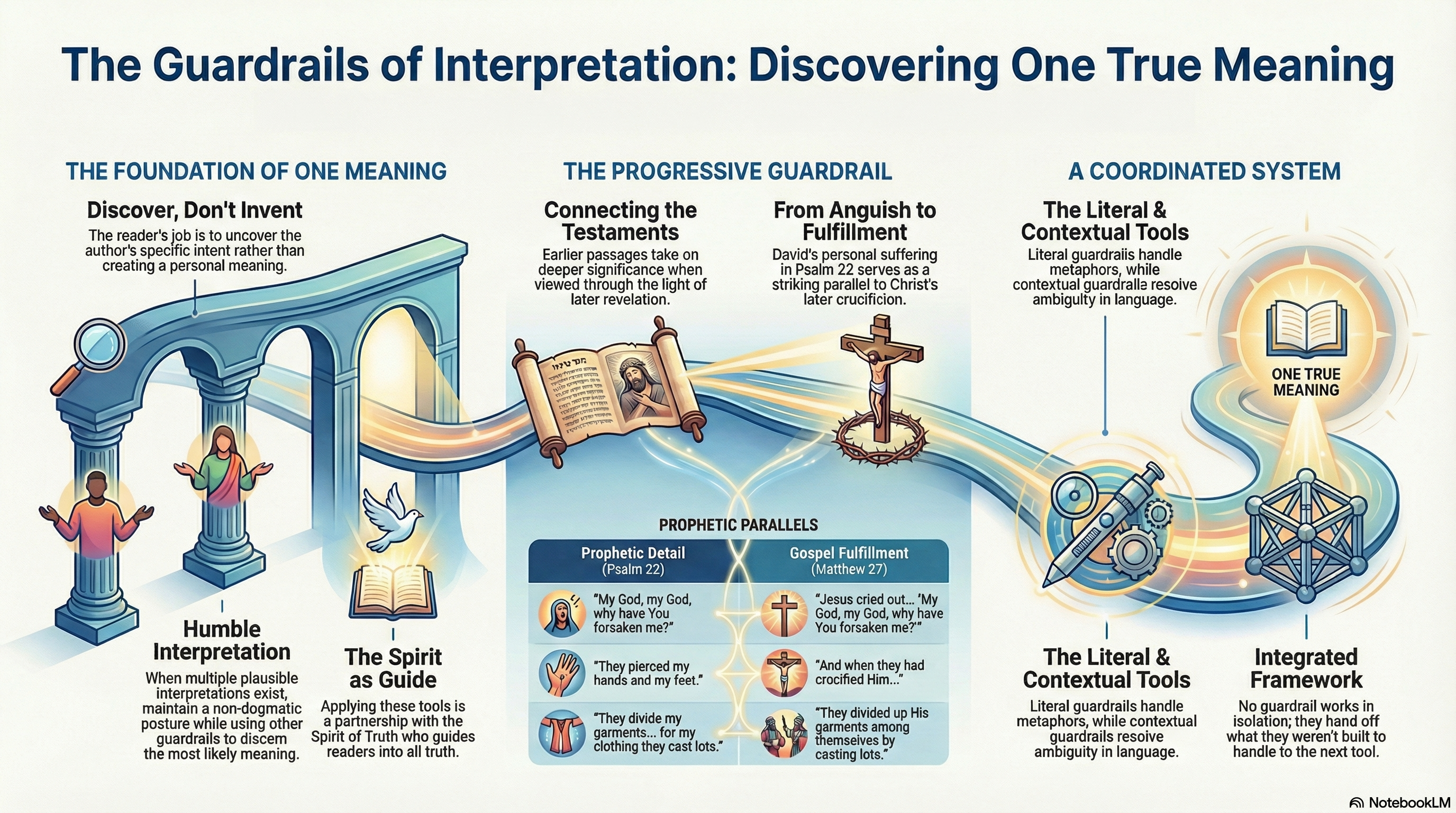
The guardrails are not seven isolated tools in a drawer. They are one coordinated system, each one handling what it was built for and handing off what it was not. The One-Meaning Guardrail tells us the author meant one thing. The other guardrails help us find it. And the Spirit of truth walks with us through all of it.
Final Invitation: The Joy of Hearing Him Clearly
The purpose of the One-Meaning Guardrail is not precision for its own sake. It is intimacy. The more faithfully we hear what God actually said, the more closely we can walk with the God who said it.
God deeply desires to be known by you. He wants to reveal Himself to you more than you want to know Him. That is not a platitude. It is grounded in the nature of His Word and the covenant promises He has made.
There is a Hebrew word that describes the life this produces: Ashrei, often translated "blessed," but carrying an intensity a single English word cannot hold: "Oh, the blessednesses." It is the deep joy, contentment, and flourishing of the person who has built their life on what God actually said, and who walks in it day by day:
1 Praise Yah! How blessed is the man who fears Yahweh, Who greatly delights in His commandments.
The blessed person does not merely acknowledge God's commandments. He greatly delights in them. That kind of delight is only possible when you trust the commands to mean something real, when you know that behind every word stands a God who spoke with intention and who rewards those who seek Him.
25 But one who looks intently at the perfect law, the law of freedom, and abides by it, not having become a forgetful hearer but a doer of the work, this man will be blessed in what he does.
The doer of the Word looks intently. Not glancing. Not browsing. Looking with the kind of careful attention that the One-Meaning Guardrail trains us to bring. And this person is blessed "in what he does," not eventually, but in the doing itself.
28 But He said, "On the contrary, blessed are those who hear the word of God and keep it."
- In Psalm 112:1, what two things characterize the blessed man? What does the word "greatly" add to the second one?
- In James 1:25, what does the man who is blessed do with "the perfect law, the law of freedom"? What three things does he not become?
- In Luke 11:28, what two actions does Jesus link to blessedness? How does His phrase "on the contrary" reframe what came before?
- These three passages span three different genres: psalm, epistle, and gospel. Apply the One-Meaning Guardrail to each one individually: what does each passage specifically say in its own voice? Now consider: what unified theme emerges when you hold all three together?
- James says the blessed person looks "intently" rather than glancing. The One-Meaning Guardrail is a tool for looking intently. How does the guardrail enable the kind of focused, sustained attention James is describing?
- The Psalmist says the blessed man "greatly delights" in God's commandments. Jesus says the blessed person "hears the word of God and keeps it." James says the blessed person "abides by it." Using the Progressive Guardrail's logic, how does this theme build across the Old and New Testaments into one consistent picture of what it means to be blessed?
- James describes a "forgetful hearer," someone who encounters the Word but does not let it change them. Is there a truth from this lesson that God has already put in front of you? What would it mean to move from hearing to doing?
- The Psalmist says the blessed man "greatly delights" in God's commandments. Does that describe your posture toward Scripture? What is one practice that could move you from duty toward delight?
- The ultimate goal of the One-Meaning Guardrail is not information but Ashrei, the deep blessedness of a life built on what God actually said. What is one step you could take today toward that kind of life?
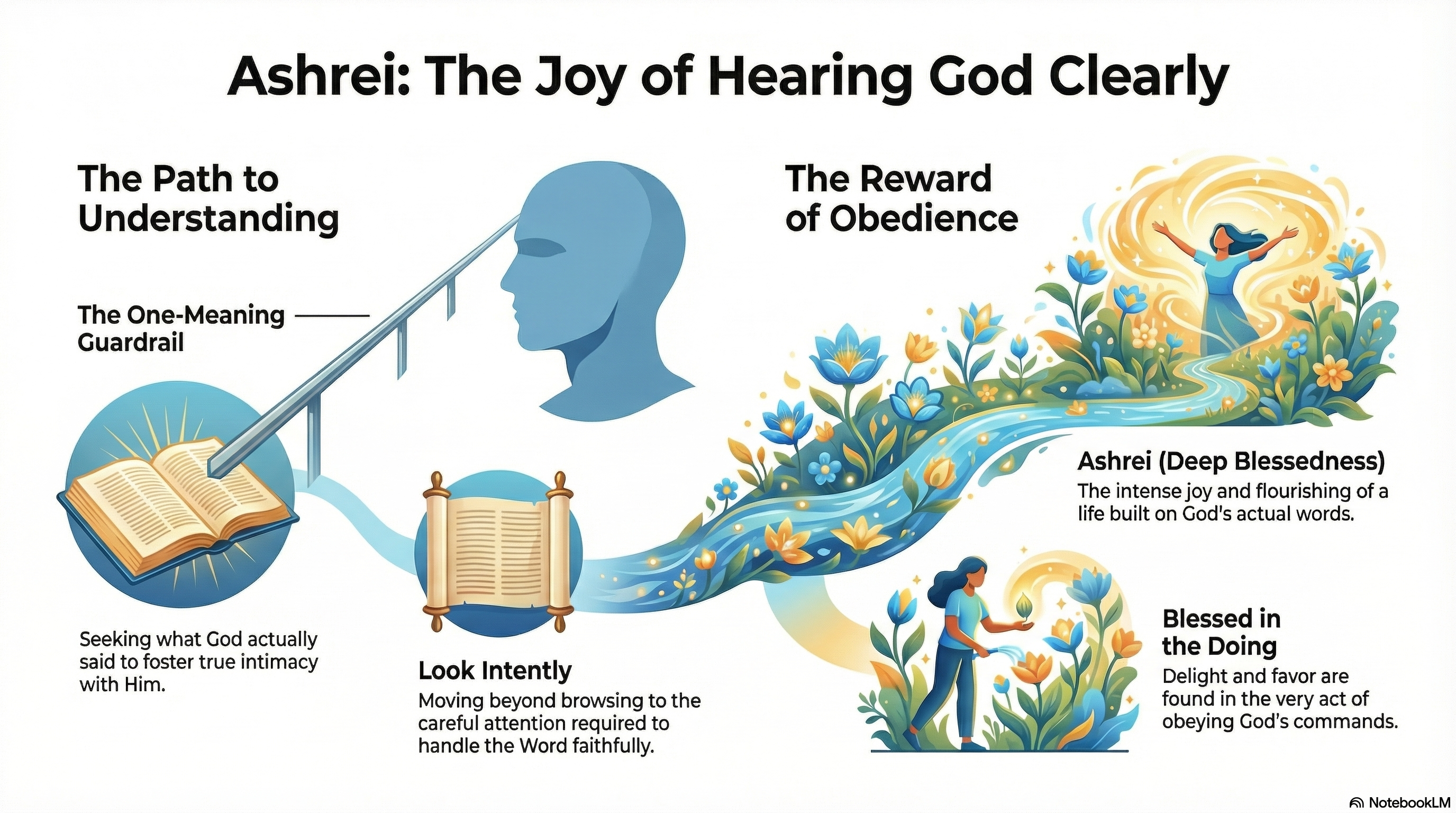
May you find the deep satisfaction and redemptive favor of God, the true Ashrei, as you delight in His Word, handle it carefully, and walk in His ways.
Meditate and Obey. Study and Apply. Hear and Do.
This is how we abide in Christ. This is how we demonstrate our love for God.
Scripture quotations taken from the (LSB®) Legacy Standard Bible®, Copyright © 2021 by The Lockman Foundation. Used by permission. All rights reserved. Managed in partnership with Three Sixteen Publishing Inc. LSBible.org and 316publishing.com.
Bibliography & Sources © 2026 Jeffrey Benson. All rights reserved.