Study to be Approved to God as a Workman
Why we need to be taught how to accurately handle the word of truth, and the tools every disciple needs to bridge the ancient world to the here and now.
The Workman: Handling the Word of Truth
Imagine it's a Tuesday afternoon. The hum of the refrigerator is the only sound in your kitchen. You open your Bible, hungry for a word from God, and land on bronze altars, long genealogies, or a law about boundary markers. You know the words are holy, but you can't see how they connect to your 2:00 PM meeting or the bills on the counter. If you have ever felt like a stranger in a foreign land while reading the Bible, you are not alone, and you are not doing it wrong. The Bible was written in a world very different from ours, so reading it well takes some work. That is good news. It means there is far more waiting for you in God's Word than a quick glance can find, and in this lesson you will pick up the tools to find it.
Scripture itself expects that work. Near the end of his life, Paul wrote from prison in Rome to Timothy, the younger coworker he called his son in the faith. Paul knew his time was short: "I am already being poured out like a drink offering, and the time of my departure is at hand" (2 Timothy 4:6, BSB). Timothy was most likely still in Ephesus, where Paul had left him to stop "certain men" from teaching "false doctrines" (1 Timothy 1:3, BSB). Some there were "quarreling over words," and two teachers, Hymenaeus and Philetus, were saying "that the resurrection has already occurred" (2 Timothy 2:14, 18, BSB). Into that setting, Paul wrote the verse at the center of this lesson.
14 Remind the believers of these things, charging them before God to avoid quarreling over words, which succeeds only in leading the listeners to ruin. 15 Make every effort to present yourself approved to God, an unashamed workman who accurately handles the word of truth. 16 But avoid irreverent, empty chatter, which will only lead to more ungodliness, 17 and the talk of such men will spread like gangrene. Among them are Hymenaeus and Philetus, 18 who have deviated from the truth. They say that the resurrection has already occurred, and they undermine the faith of some.
Where the MSB (Majority Text) differs: verse 14, "charging them before the Lord" (BSB "before God").
Two words carry the verse. "Make every effort" (v. 15, BSB) translates a Greek verb (spoudazō) that means "to do something with intense effort and motivation." This is not a casual glance at a verse of the day. Paul uses the same verb later in the letter when he begs Timothy, "Make every effort to come to me quickly" (2 Timothy 4:9, BSB). He cared about both.
"Accurately handles" (v. 15, BSB) translates orthotomeō, which a standard Greek dictionary defines as "to teach correctly, to expound rightly." The word was built from "straight" and "cut," and the Greek translation of the Old Testament uses it for straight paths: "He will make your paths straight" (Proverbs 3:6, BSB). Picture a road crew cutting a straight road through rough country. That picture is an illustration, not the point Paul is making. In 2 Timothy the contrast is with the false teachers: they "deviated from the truth" (v. 18, BSB), while Timothy is to handle the word of truth without bending it. One major reference work adds that Timothy handles the word rightly by living it, so that, unlike the false teachers, his life backs up what he teaches.
Notice whose approval matters. Timothy is to present himself "approved to God" (v. 15, BSB), not to the loudest voices in Ephesus. The workman who needs no shame is the one whose work holds up when God inspects it.
This charge was first given to a church leader facing false teaching. It does not stop with him. Paul told Timothy to entrust what he had heard "to faithful men who will be qualified to teach others as well" (2 Timothy 2:2, BSB), and that chain of faithful teaching reaches us. Every believer is called to grow in handling God's Word well.
- What does Paul tell Timothy to avoid in verses 14 and 16, and where does each lead?
- What does verse 15 tell Timothy to do? What words describe the workman?
- Who is named in verse 17, and what are they teaching (v. 18)?
- Verse 15 sits between two warnings. How does that setting help explain what it means to "accurately handle" the word of truth?
- Why might Paul tell Timothy to seek approval from God rather than from the people he leads?
- What does this passage teach about handling God's Word that is true for every believer, not only Timothy?
- How is God inviting you to live out this abiding principle this week?
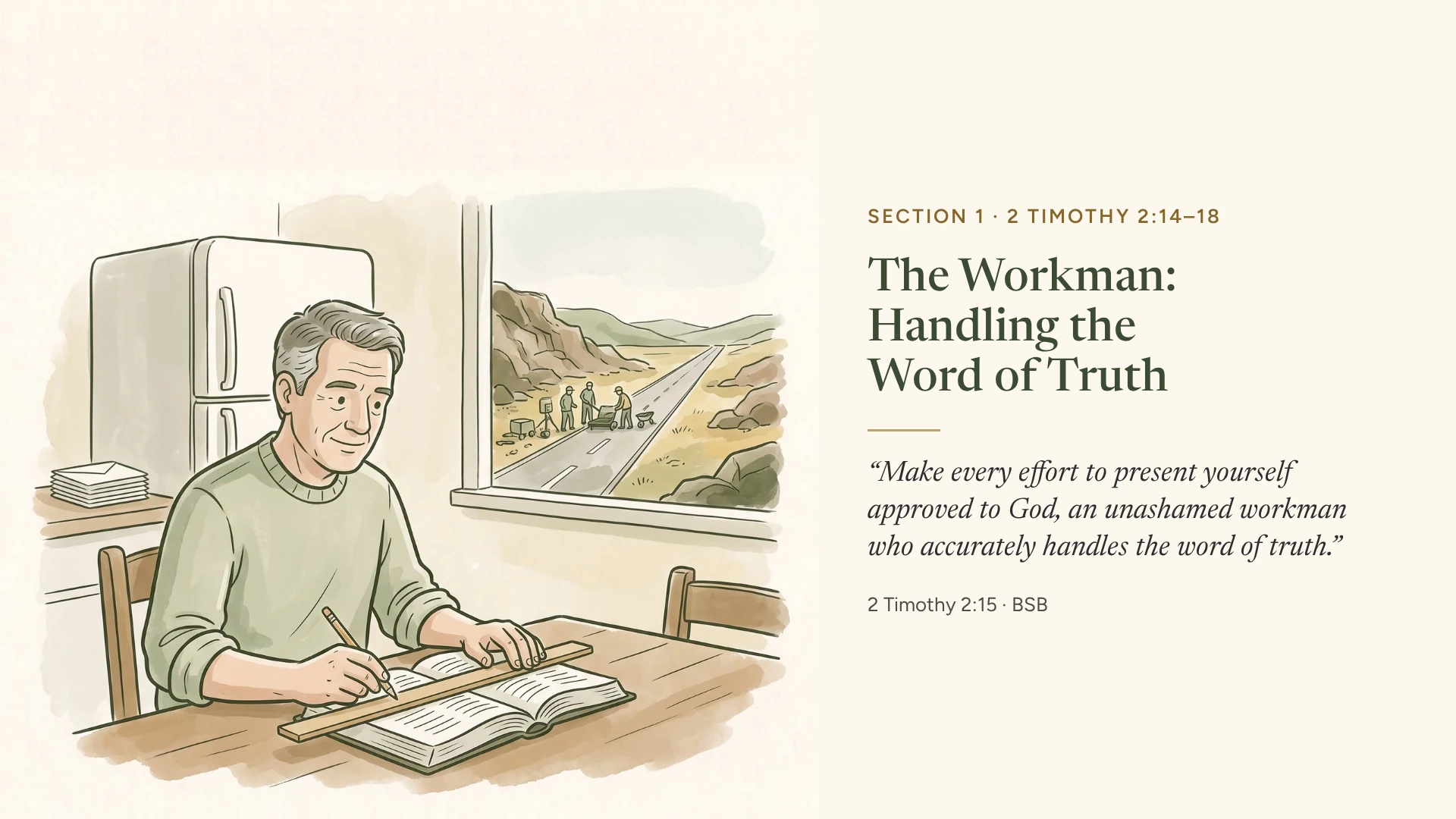
The workman's goal is not to be clever with the Bible but faithful to it. That takes effort, and the effort is worth it, because the One we want to please is God.
Meant to Be Understood: A Deep Well Close to the Surface
Here is the good news before we name a single challenge: the textbook behind the Abide program, Richard Fuhr and Andreas Köstenberger's Inductive Bible Study, describes the Bible as "a deep well whose waters lie close to the surface." Scholars spend whole careers on narrow corners of it, "while a five-year-old can understand the basic message of the gospel and be saved." You do not have to reach the bottom of the well to drink from it. As the authors put it, "along that pathway of discovery you'll find enrichment and growth from day one."
Israel's psalmist knew this joy. Psalm 119, the long song of love for the Law the LORD gave His people, which opened lesson 1, comes near its end with these words:
129 Wonderful are Your testimonies; therefore I obey them. 130 The unfolding of Your words gives light; it informs the simple.
Notice who receives the light in verse 130: not the experts, but "the simple" (v. 130, BSB). The Hebrew word (petî) describes someone "not having developed a discriminating judgment." In Proverbs that is often a warning about being easily misled, but here it is good news: God's words give light to beginners. The ancient Greek translation of the Old Testament even renders the word in this verse with the Greek word for a child. God's words were given to be understood.
So why does the Bible sometimes feel hard? Because of how God chose to speak. Rather than "dictating a set of laws and propositions," Fuhr and Köstenberger write, "God chose to reveal his Word in and through human affairs." He inspired real authors living in real times and places, writing in their own languages and styles to readers as far from us as the authors themselves. That distance creates what the textbook calls gaps, and this lesson walks you across each one:
- Historical gaps: time, geography and culture
- Literary gaps: language and genre
- Theological gaps: the supernatural and God's self-revelation
- The appropriation gap: carrying the message from then and there to here and now
If that list feels like a lot, take heart. The authors compare Bible study to building a shed in your backyard: count the cost, get the right tools, and follow the instructions of someone who has done it before. Then they add what no shed project has: "When it comes to Bible interpretation, believers have the Holy Spirit guiding and equipping them every step of the way." Their advice for the road ahead: "remain undaunted: you can get the job done!"
- What does the psalmist call God's testimonies in verse 129, and what does he do because of it?
- What does the unfolding of God's words give, and whom does it inform (v. 130)?
- Why might the psalmist connect "wonderful" with "therefore I obey them"?
- The psalmist speaks of the "unfolding" of God's words. What does that picture suggest about how understanding grows?
- What do these verses teach about who can understand God's Word?
- How is God inviting you to live out this abiding principle this week?
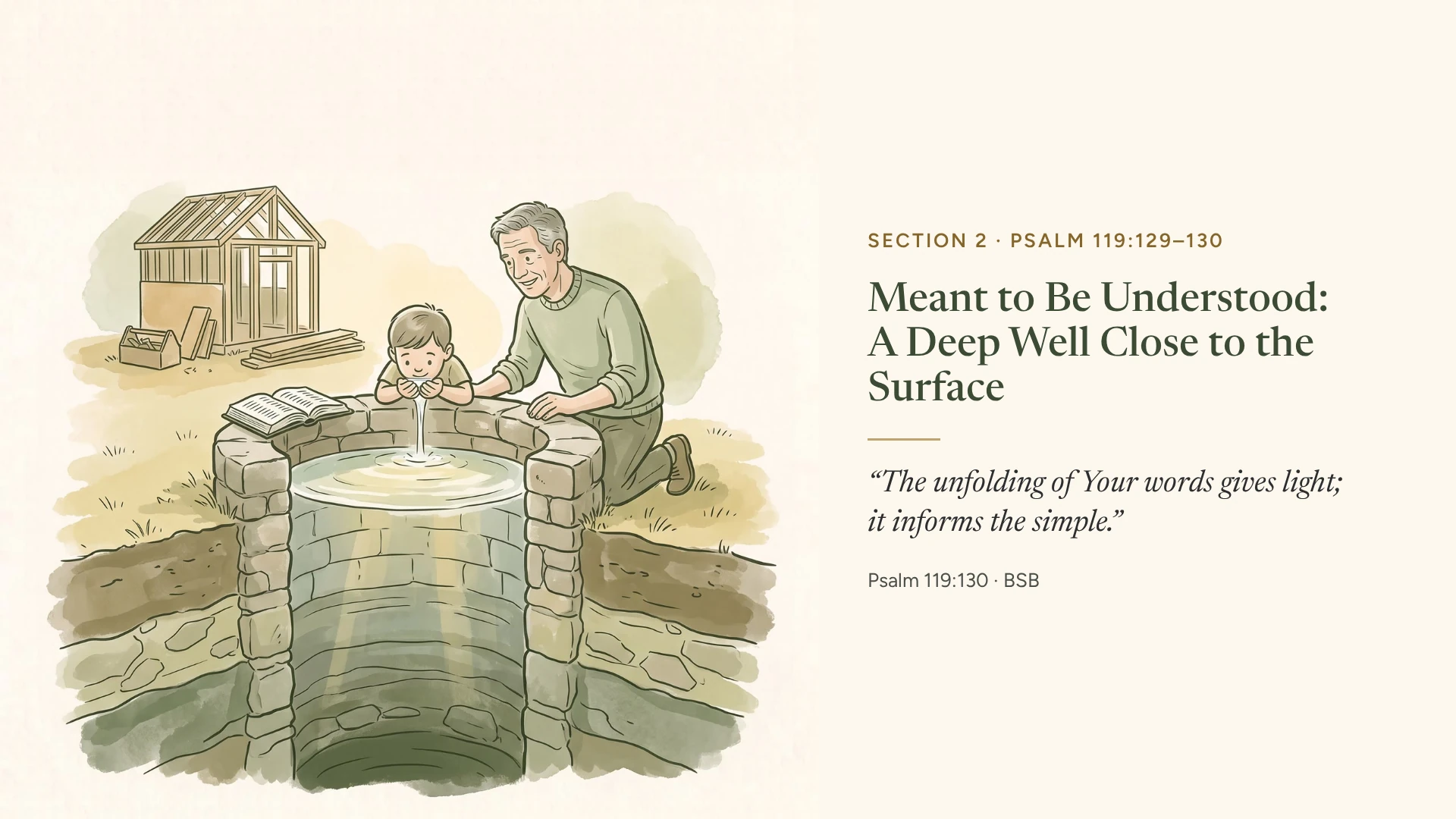
The Bible was meant to be understood. Every gap in this lesson has a bridge, and you never cross it alone.
Historical Gaps: Time, Place and Culture
Here is an exciting truth: you are invited into the story. Fuhr and Köstenberger write that when we open Scripture we are "invited to walk alongside these figures, to step into their shoes and experience the challenges they faced with them, with historical imagination and emotional empathy." Three gaps of history stand between us and those shoes, and each one has a bridge.
The time gap. Imagine picking up a London newspaper from the fall of 1940. A Londoner living then would know every name on the front page: Churchill, the Luftwaffe, the Royal Air Force, the Battle of Britain. Many readers today would miss the details. The Bible's first readers knew names like Sennacherib, Nebuchadnezzar, Cyrus and Herod the same way. For most of us, as the authors put it, "The distance is palpable."
The bridge: learn a little of the history behind the book you are reading. The introduction in a good study Bible is a great place to start.
The place gap. The Bible's events unfold across the Middle East, Persia, Egypt and the Mediterranean, with the land of Israel at the center, and its geography holds surprises. The textbook points out that the drop from Jerusalem down to the Dead Sea is steeper than the drive from Denver up to the Colorado ski resorts, and that the Sea of Galilee lies lower than Death Valley. Andreas Köstenberger once traced every movement of Jesus and His followers in John's Gospel on a map. It helped him, he writes, "to appreciate the distance Jesus and his followers traveled."
The bridge: keep a Bible atlas, or the maps in the back of your Bible, open as you read.
The culture gap. This is where misunderstanding comes easiest. Paul closes Romans with "Greet one another with a holy kiss" (Romans 16:16, BSB), and the textbook counts five New Testament letters that end this way. Try that greeting at work today, the authors warn, and it "may land you in jail, divorce court, or the unemployment line!" We cannot become first-century people, but "with a healthy dose of humility," they write, we can understand the Bible's cultures far better than we do now.
The Bible's first readers lived in a world very different from much of today's. If you live in a culture that still farms the land, honors its elders or passes its stories down by word of mouth, parts of the left-hand column may feel familiar. That is a gift: you already stand closer to the Bible's world than many readers do. For everyone else, each row is a doorway into how the first hearers heard God's Word.
| The World of the Bible | Much of Today's World | |
|---|---|---|
| Belonging | The group came first: large households led by the father, within a clan and a tribe. Land and family name passed down through the father's house. | The individual comes first: smaller households, personal choice, roles often worked out together. |
| Commitments | Covenants: sworn, lasting bonds that made two parties like family, with legal terms and ritual. | Contracts: agreements that spell out what each side owes, often for a set time. |
| Making a living | Most people farmed or herded, and one bad rainy season could mean famine. | A few farmers feed everyone; most people work in offices, shops, factories or on screens. |
| Communication | Mostly spoken, heard and memorized. Writing was costly, and texts were read aloud. | Mostly read, often silently, in print and on screens. |
| Time | Looked to the past: tradition, family stories and genealogies told you who you were. | Looks to the future: innovation and change matter more than tradition. |
| Age | The elderly were honored and held authority (Leviticus 19:32). | Youth is prized, and the newest voice often gets the most attention. |
| Worship | Shown through temple, sacrifice and purity rules: how to come near a holy God. | Mostly explained in words: sermons, books and studies. |
| The unseen world | Everyone assumed it was real. The question was not whether God would act, but how. | Many look first for a natural explanation and doubt the supernatural. |
Seeing all three gaps at once. An expert in the law, wanting to justify himself, asked Jesus, "And who is my neighbor?" (Luke 10:29, BSB). Jesus answered with a story.
30 Jesus took up this question and said, “A man was going down from Jerusalem to Jericho when he fell into the hands of robbers. They stripped him, beat him, and went away, leaving him half dead. 31 Now by chance a priest was going down the same road, but when he saw him, he passed by on the other side. 32 So too, when a Levite came to that spot and saw him, he passed by on the other side. 33 But a Samaritan on a journey came upon him, and when he saw him, he had compassion. 34 He went to him and bandaged his wounds, pouring on oil and wine. Then he put him on his own animal, brought him to an inn, and took care of him. 35 The next day he took out two denarii and gave them to the innkeeper. ‘Take care of him,’ he said, ‘and on my return I will repay you for any additional expense.’ 36 Which of these three do you think was a neighbor to the man who fell into the hands of robbers?” 37 “The one who showed him mercy,” replied the expert in the law. Then Jesus told him, “Go and do likewise.”
Where the MSB (Majority Text) differs: verse 35, "The next day when he departed he took out two denarii" (BSB "The next day he took out two denarii"); verse 36, "So which of these three" (BSB "Which of these three").
Watch the story sharpen as each gap closes.
- Place: "going down from Jerusalem to Jericho" (v. 30, BSB) is real geography. The road, New Testament scholar James Edwards writes, "descended 3,400 feet (1,040 m) through steep and rugged hill country pockmarked with caves," hiding places for robbers. Jesus' first listeners could picture that road.
- Time: priests and Levites served at the temple in Jerusalem, and many priests lived in Jericho. A wounded man would hope that men who served God in the temple would serve him on the roadside. Both pass by, Edwards notes, "for reasons we are not told."
- Culture: "Jews do not associate with Samaritans" (John 4:9, BSB). As one Bible dictionary explains, to most Jews of Jesus' day a good Samaritan "would have been a contradiction in terms" because of "centuries-long mutual hostility between Jews and Samaritans." When Jesus asks who was a neighbor, the expert answers, "The one who showed him mercy" (v. 37, BSB). As Edwards observes, he cannot bring himself to name the Samaritan.
Crossing the gaps did not make the story smaller. It made it hit harder, just as it did for the first listeners. And Jesus' last words cut deeper: "Go and do likewise" (v. 37, BSB).
- Where is the man traveling, and what happens to him (v. 30)?
- Who sees the man in verses 31–33, and what does each one do?
- List everything the Samaritan does for the man in verses 34–35.
- The expert asked, "And who is my neighbor?" (v. 29). How is Jesus' question in verse 36 different?
- Why might Jesus have made the hero of the story a Samaritan?
- What does this parable teach about loving your neighbor that is true for every believer?
- How is God inviting you to live out this abiding principle this week?
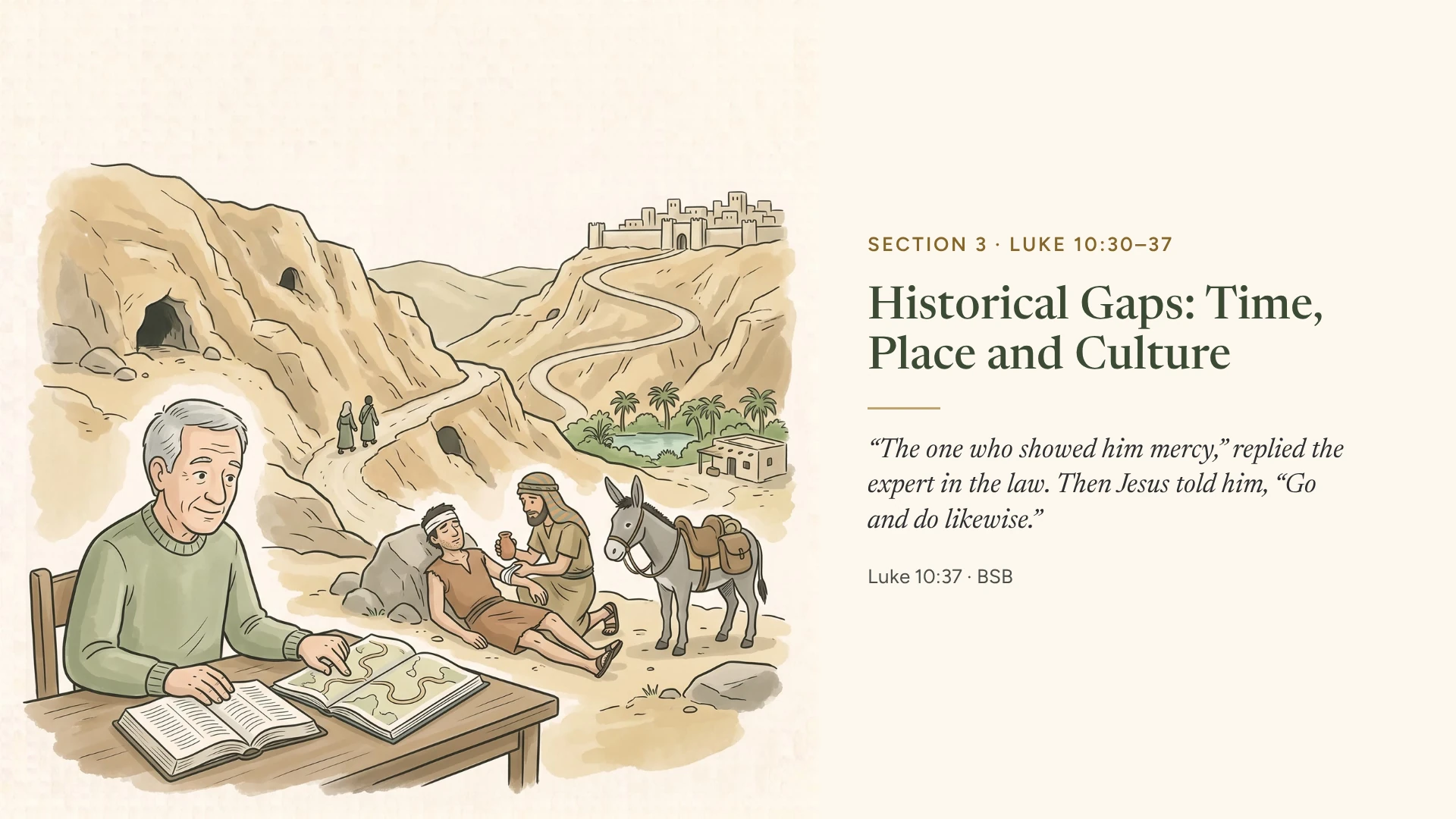
Every gap you cross brings you closer to hearing the Bible the way its first listeners heard it. History, maps and culture do not make the Bible smaller. They bring it to life.
Literary and Theological Gaps: How God Chose to Speak
The Bible is more than history. It is also literature, and above all it is God's own message to us. Each of those brings a gap, and each gap holds a gift. The opening lines of Hebrews, written to believers who knew Israel's prophets well, name both at once:
1 On many past occasions and in many different ways, God spoke to our fathers through the prophets. 2 But in these last days He has spoken to us by His Son, whom He appointed heir of all things, and through whom He made the universe.
"In many different ways" (v. 1, BSB): that is the literary side of the Bible. "He has spoken to us by His Son" (v. 2, BSB): that is the theological side, God making Himself known.
The language gap. The Old Testament was written mostly in Hebrew, with small parts in Aramaic, and the New Testament in Koine, the everyday Greek of the first century. Fuhr and Köstenberger are honest that "translations, while bridging the language gap, do so imperfectly." But they are just as clear that "quality Bible study can be performed through modern translations." You have already crossed this gap twice in this lesson, with spoudazō in 2 Timothy and petî in Psalm 119.
The bridge: compare a few good translations, and use simple word-study tools. Lesson 7 shows you how.
The genre gap. The Bible is a library, written by dozens of authors in "a dozen or so primary genres and many more subgenres": law, history, poetry, wisdom, prophecy, gospel, letter and more. Each kind of writing has its own rules, "just as you shouldn't read an opinion page the same way you read actual news." The authors add a word of joy: "God could have chosen to reveal a less complex Word, but he didn't." The variety is a gift.
The bridge: before you read a passage, ask what kind of writing it is. Lesson 5 walks you through the main genres.
The supernatural gap. "The Bible nowhere defends the existence of God; it assumes it." Its first readers expected God to act; for them, "the question was not whether God would intervene in the affairs of human history, but how." Many readers today look first for a natural explanation.
The bridge is faith: read the Bible as a book in which God is really present and really at work.
The theological gap. Above all, the Bible is God revealing Himself. Across sixty-six books the textbook finds an "unparalleled continuity of story, thought, and message," one story that grows clearer from Genesis to Revelation and finds its high point in the Son. No one ever masters God or His Word; we "bridge this theological gap increasingly, but never completely." That is not a reason to be discouraged. It means there is always more of God to know, and you begin knowing Him, the authors promise, "from the very first day that they open the pages of Scripture."
- According to verse 1, when, how and through whom did God speak in the past?
- How has God spoken "in these last days" (v. 2)?
- What does verse 2 say about the Son?
- What kinds of writing might "in many different ways" include, given what you know of the Old Testament?
- Why would God's speaking through His Son be the high point of all His speaking?
- What do these verses teach about how God makes Himself known?
- How is God inviting you to live out this abiding principle this week?
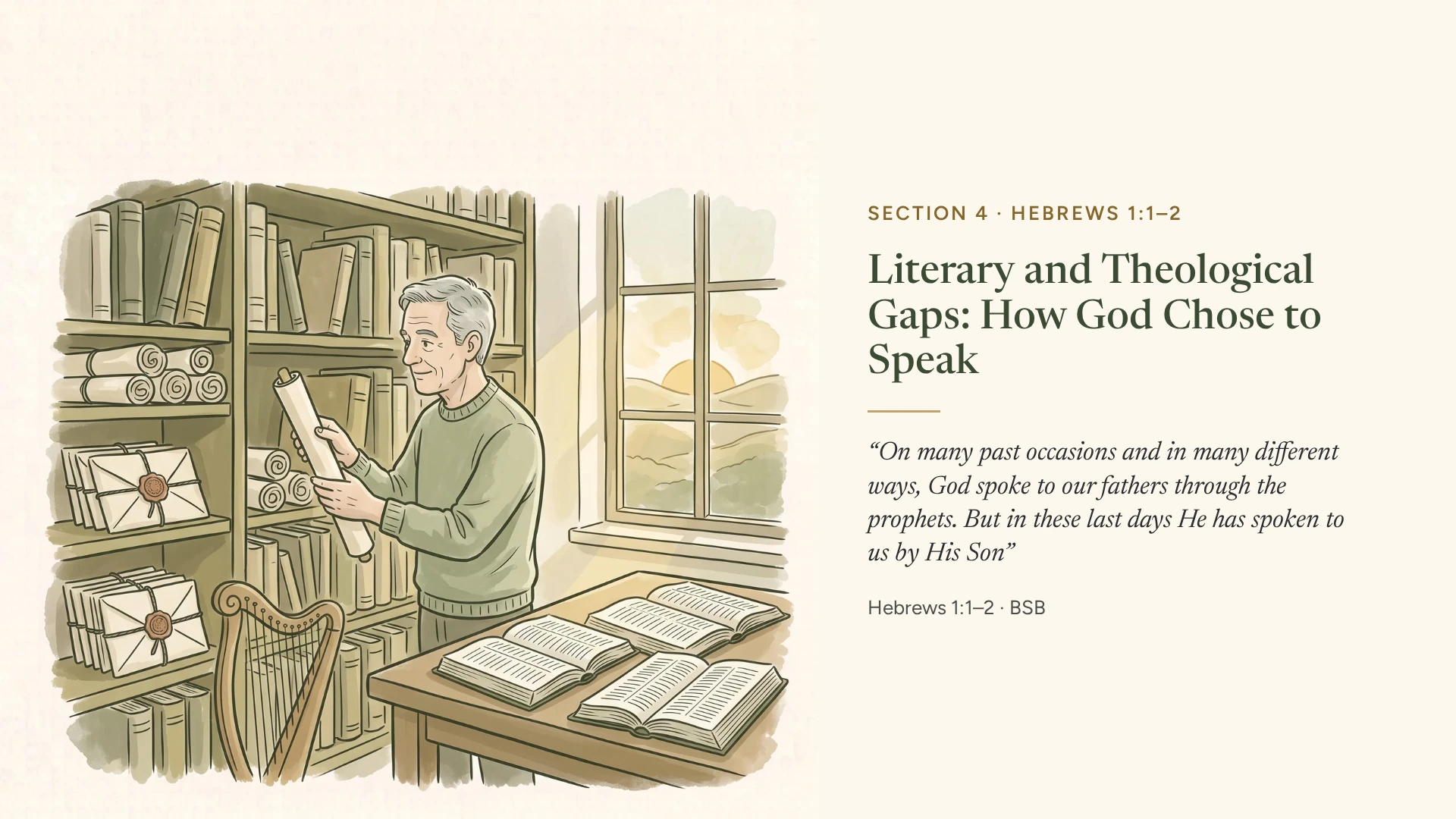
God spoke in many ways so that we could know Him, and He spoke fully in His Son. Every tool you pick up for the language, the genres and the big story of Scripture helps you hear Him more clearly.
The Appropriation Gap: From Then and There to Here and Now
Now we come to the gap that matters most, and the most exciting one, because this is where the Bible starts changing your life. Fuhr and Köstenberger put it plainly: "one of the primary challenges facing us today is not correct interpretation but appropriate application." Even after we understand what a passage meant then and there, we still have to carry its message to the here and now.
The prophet Ezekiel saw what happens when that gap goes uncrossed. He lived among Israel's exiles in Babylon. When news came that Jerusalem had fallen, "The city has been taken!" (Ezekiel 33:21, BSB), the people finally wanted to hear the prophet God had sent them. Listen to what God told Ezekiel next:
30 As for you, son of man, your people are talking about you near the city walls and in the doorways of their houses. One speaks to another, each saying to his brother, ‘Come and hear the message that has come from the LORD!’ 31 So My people come to you as usual, sit before you, and hear your words; but they do not put them into practice. Although they express love with their mouths, their hearts pursue dishonest gain. 32 Indeed, you are to them like a singer of love songs with a beautiful voice, who skillfully plays an instrument. They hear your words but do not put them into practice.
Ezekiel had become popular. One commentary compares his fame to "that of a pop star, whose declarations on spiritual matters may arouse curiosity but are scarcely accorded authoritative status. People may have been humming along to his tune, but they are paying no attention to the true meaning of his lyrics." Notice that these listeners had no trouble understanding Ezekiel. They knew exactly what he said. Their gap was not interpretation but obedience: twice God says they "do not put them into practice" (vv. 31–32, BSB). Lesson 1's mirror in James 1:22–25 makes the same point. Hearing is not the finish line.
So how do we carry a passage across? The textbook gives us a helpful map. "Some commandments, exhortations, examples, and instructions in Scripture are directly transferable, while others are historically or theologically constrained and don't apply to us directly." In between, "many degrees of application are possible, including finding cultural equivalents and drawing principles from the text, both practical and spiritual." Here is what that looks like with passages from this lesson:
- Directly transferable: "Love your neighbor as yourself" (Luke 10:27, BSB) and Jesus' "Go and do likewise" (Luke 10:37, BSB) apply to every believer, just as they stand.
- A cultural equivalent: "Greet one another with a holy kiss" (Romans 16:16, BSB). The principle is warm, family affection among believers. In many places today, a handshake, a hug or a warm word carries that same meaning.
- Tied to its first setting: "bring the cloak that I left with Carpus at Troas" (2 Timothy 4:13, BSB). No one today needs to travel to Troas! Yet even here, a principle shines through. Paul was asking Timothy to go out of his way, by way of Troas, to bring a cold prisoner his coat. When a brother or sister is in need, we can go out of our way to serve them too.
The authors call this "a nuanced art that requires not only interpretive skill but also spiritual seasoning and maturity." Do not let that discourage you. Every disciple grows into it, one step of obedience at a time, and the final step is one no one makes alone, as we will see.
- Where are the people talking about Ezekiel, and what do they say to one another (v. 30)?
- What do the people do when they come, and what do they not do (v. 31)?
- To what does God compare Ezekiel in verse 32?
- The people understood Ezekiel's words. What was their real gap?
- Why is a beautiful love song a fitting picture of hearing without doing?
- What does this passage teach about the difference between enjoying God's Word and obeying it?
- How is God inviting you to live out this abiding principle this week?
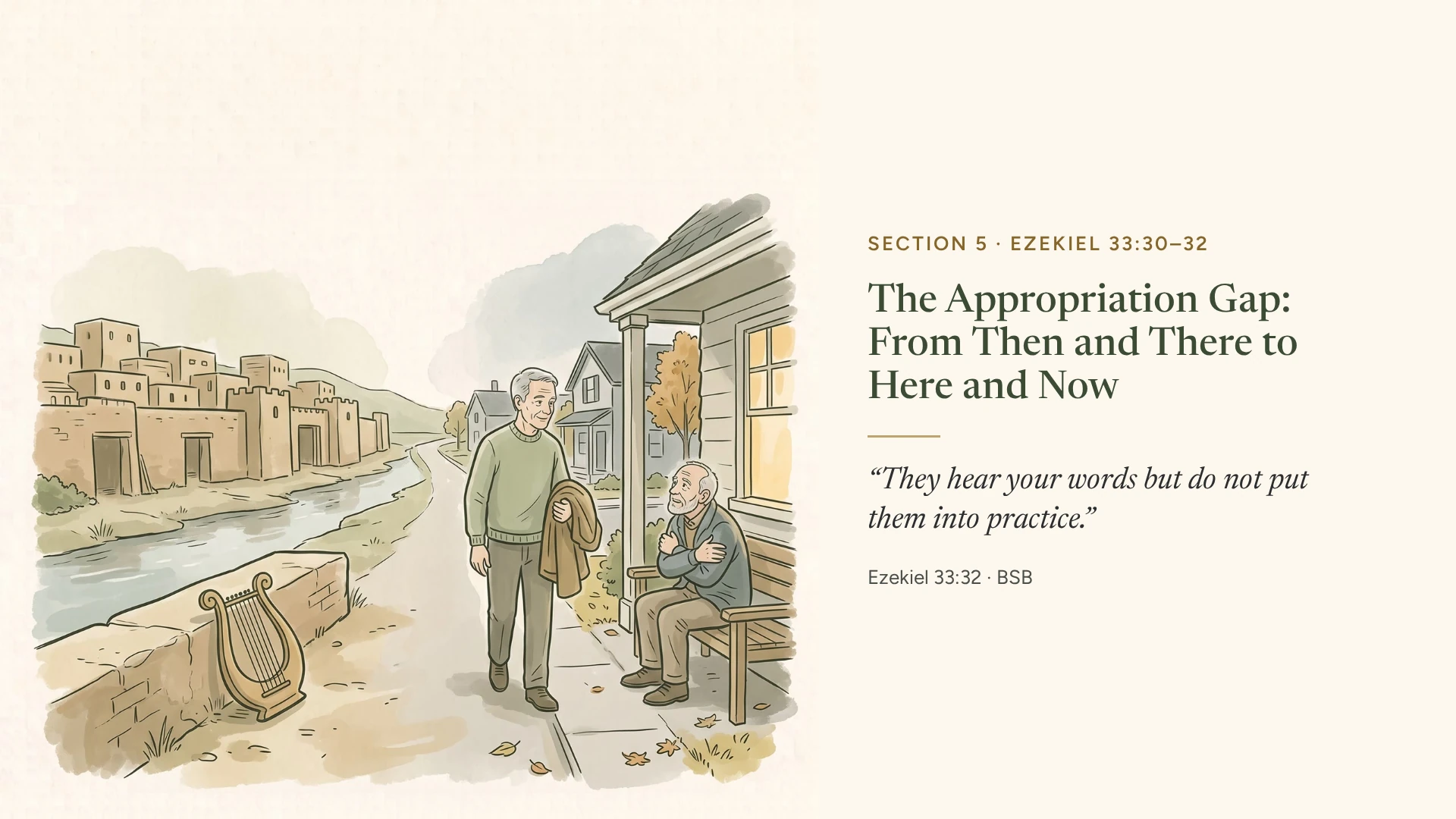
Understanding the Bible is a beginning, not the goal. The goal is a changed life. Every passage you study is waiting to cross into your here and now.
Crossing the Gaps: Know the Book Before You Read It
You now know the gaps. Here is the good news: you do not have to cross them one verse at a time. Before you begin a book of the Bible, take a little time to learn its background: who wrote it, to whom, when, where, and why. A few questions asked at the start will light up every chapter that follows.
Start with Scripture itself. Many of the answers are right there in the book. Let's try it with 2 Timothy, the letter at the heart of this lesson:
- Who wrote it, and to whom? "Paul, an apostle of Christ Jesus by the will of God... To Timothy, my beloved child" (2 Timothy 1:1–2, BSB).
- Where is the author? In prison in Rome: Onesiphorus "was unashamed of my chains. Indeed, when he arrived in Rome, he searched diligently until he found me" (2 Timothy 1:16–17, BSB).
- What is happening? False teachers are spreading error (2:17–18), and Paul knows his life is nearly over (4:6).
- Why did he write? To pass the faith on to "faithful men who will be qualified to teach others as well" (2 Timothy 2:2, BSB), and to call his friend to his side.
Read Paul's closing requests with those answers in mind:
9 Make every effort to come to me quickly, 10 because Demas, in his love of this world, has deserted me and gone to Thessalonica. Crescens has gone to Galatia, and Titus to Dalmatia. 11 Only Luke is with me. Get Mark and bring him with you, because he is useful to me in the ministry. 12 Tychicus, however, I have sent to Ephesus. 13 When you come, bring the cloak that I left with Carpus at Troas, and my scrolls, especially the parchments.
Then consult wisely. Scripture does not answer every question. For the rest, Fuhr and Köstenberger recommend reference works: study Bibles, Bible dictionaries, Bible atlases, Bible introductions and good commentaries. Use them, they say, not as "a crutch," but as "a complement to one's own study." And because "commentators are not inspired," they suggest "using at least three to five sources in any serious study of Scripture," remembering the wisdom of Proverbs: "The first to state his case seems right until another comes and cross-examines him" (Proverbs 18:17, BSB).
You can see why with 2 Timothy. One handbook dates the letter "around AD 66," another "the fall of A.D. 67." On where Timothy was, one says "There is no definite indication in this letter," while another says he "evidently was in Ephesus" and points to 1:18 and 4:19 as its reasons. Neither is careless. Weigh their reasons, and hold your conclusion with humility. In the authors' words, "consultation is conversation." Listen to your sources, but do not simply give in to them.
Your book background guide. Use these questions each time you begin a new book. Each one helps you cross one of the gaps:
- Author and time (the time gap): Who wrote this book, and when? What was happening in the world then?
- First readers (the culture gap): Who first received it? What were their background, beliefs and struggles? What did they already know?
- Occasion and purpose: Why was it written? What did the author want his readers to know, believe or do?
- Kind of writing (the genre gap): Is it narrative (history, gospel, parable, genealogy), poetry (songs, wisdom, prophecy), prose discourse (law, sermons, letters) or apocalyptic (visions full of symbols, as in Daniel and Revelation)? Most books mix them. Scholars name many more kinds; these are the main ones to learn to recognize.
- Place (the place gap): Where were the author and the readers? Who ruled, and what was the land like?
- Place in God's story (the theological gap): What had God already revealed by the time this book was written? What did He reveal later that its first readers did not yet know? Where does this book fit in the story of God's plan of salvation?
The class handout includes this guide as a worksheet. In lesson 6 you will learn to look at the context of each passage, too. For now, start with the book.
- Who has left Paul, and where has each one gone (v. 10)? Who is still with him (v. 11)?
- What does Paul ask Timothy to do and to bring (vv. 9, 11, 13)?
- What do these verses tell you about Paul's situation as he writes?
- How does knowing this background change the way you read the rest of 2 Timothy?
- What do these verses teach about how God's servants need one another?
- How is God inviting you to live out this abiding principle this week?
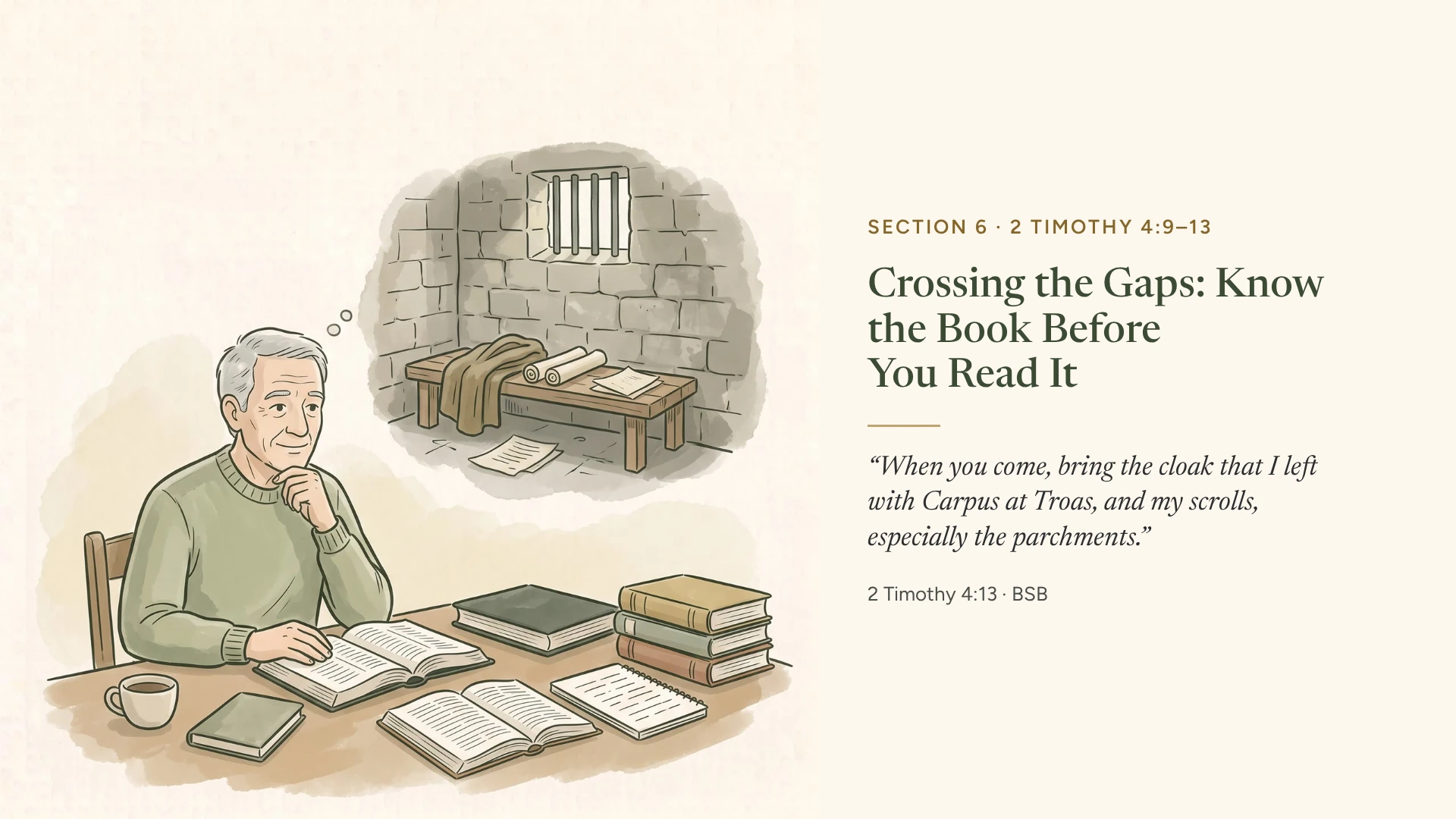
A few good questions at the start of a book open up everything that follows. Let Scripture answer first, then talk with trusted guides, and you will be well on your way across the gaps.
The Spirit Bridges the Last Gap: An Invitation
Here is the best news of all. You do not cross the last gap by yourself. Fuhr and Köstenberger write, "Hard work and study alone will never bridge the appropriation gap. Only the Spirit of God working effectively in the life of the believer will transfer the message of the text from the mind to the heart." They add a word of grace for every beginner: "the Holy Spirit will use God's Word in the life of the Spirit-filled believer in spite of his or her misunderstanding and even misinterpretation." So we come to the Bible "with reverence and humility," and with hope.
Paul held both sides together when he wrote to the believers at Philippi, whom he could not visit in person:
12 Therefore, my beloved, just as you have always obeyed, not only in my presence, but now even more in my absence, continue to work out your salvation with fear and trembling. 13 For it is God who works in you to will and to act on behalf of His good purpose.
The believers keep working, and God is at work in them: "to will and to act" (v. 13, BSB), both the wanting and the doing. That is the workman of Section 1. We "make every effort" (2 Timothy 2:15, BSB), and God does in us what our effort alone never could. In lesson 1 we saw how Jesus promised the Spirit as Teacher (John 14:26), and how the Spirit helps believers understand what God has given (1 Corinthians 2:12). The same God who gave His Word is at work in you to understand it and live it.
So here is our invitation, in the words that close the textbook's first chapter: "God is more intent on revealing himself to you than you are to get to know him." And again: "Not only are we convinced that the Bible can be understood, we can say with confidence that it was meant to be understood." Come to it with humble confidence: humble, because the gaps are real; confident, because God wants to meet you there.
Make the psalmist's prayer your own each time you open your Bible: "Open my eyes that I may see wondrous things from Your law" (Psalm 119:18, BSB).
- How does Paul describe the Philippians' obedience so far (v. 12)?
- What does Paul tell them to continue doing, and in what manner?
- Who is at work in them, and to do what (v. 13)?
- How do verses 12 and 13 fit together? Who is doing the work?
- Why might it matter to Paul that they keep obeying "even more in my absence"?
- What do these verses teach about our effort and God's work as we live out His Word?
- How is God inviting you to live out this abiding principle this week?
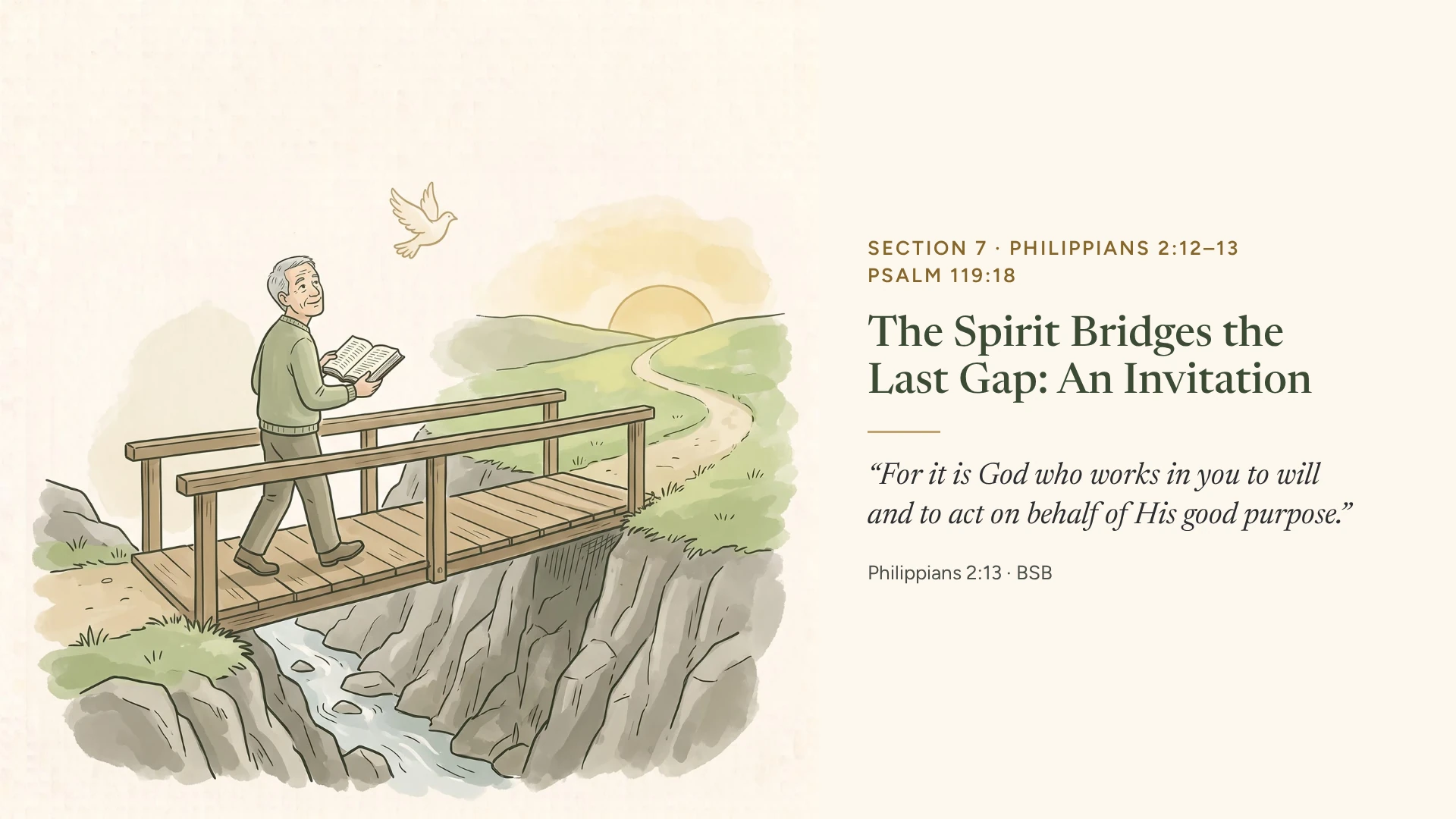
You are not crossing the gaps alone. Make every effort, use the tools, ask good questions, and trust the God who is at work in you. He wants to be known, and His Word was meant to be understood.
Meditate and Obey. Study and Apply. Hear and Do.
This is how we abide in Christ. This is how we demonstrate our love for God.
Sources
- Fuhr, Richard Alan, Jr., and Andreas J. Köstenberger. Inductive Bible Study: Observation, Interpretation, and Application through the Lenses of History, Literature, and Theology. Nashville: B&H Academic, 2016. Ch. 1, "Bridging the Gaps," 2–19; ch. 12, "Consultation," 270–288.
- Averbeck, Richard E. "Sacrifices and Offerings." In Dictionary of the Old Testament: Pentateuch, edited by T. Desmond Alexander and David W. Baker, 706–733. Downers Grove, IL: InterVarsity Press, 2003.
- B&H Editorial Staff. Holman Illustrated Bible Handbook. Nashville: Holman Bible Publishers, 2012, 424–430.
- Beetham, Christopher A., and Nathan L. Erickson, eds. The NIV Application Commentary on the Bible. One-volume ed. Grand Rapids: Zondervan Academic, 2024, 649–650.
- Blomberg, Craig L. "The Historical-Critical/Grammatical View." In Biblical Hermeneutics: Five Views, edited by Stanley E. Porter and Beth M. Stovell, 29–38. Downers Grove, IL: IVP Academic, 2012.
- Cooper, Lamar E. Ezekiel. New American Commentary 17. Nashville: Broadman & Holman, 1994, 297–298.
- Drouhard, R. L. "Agriculture." In The Lexham Bible Dictionary, edited by John D. Barry et al. Bellingham, WA: Lexham Press, 2016.
- Dyer, Charles H. "Ezekiel." In The Bible Knowledge Commentary, edited by John F. Walvoord and Roy B. Zuck, 1:1293–1294. Wheaton: Victor Books, 1985.
- Edwards, James R. The Gospel according to Luke. Pillar New Testament Commentary. Grand Rapids: Eerdmans; Nottingham: Apollos, 2015, 320–324.
- Gamble, Harry Y. "Literacy and Book Culture." In Dictionary of New Testament Background, edited by Craig A. Evans and Stanley E. Porter, 646–648. Downers Grove, IL: InterVarsity Press, 2000.
- Hahn, Scott. "Covenant." In The Lexham Bible Dictionary, edited by John D. Barry et al. Bellingham, WA: Lexham Press, 2016.
- Har-El, Menashe. Understanding the Geography of the Bible: An Introductory Atlas. Edited by Paul H. Wright. Jerusalem: Carta, 2019, 12–14.
- Harris, R. Laird, Gleason L. Archer Jr., and Bruce K. Waltke, eds. Theological Wordbook of the Old Testament. Electronic ed. Chicago: Moody Press, 1999. Entry 1853a, 742–743.
- Hess, Richard S. "Oral Tradition and Written Tradition." In Dictionary of the Old Testament: Historical Books, edited by Bill T. Arnold and H. G. M. Williamson, 764–767. Downers Grove, IL: InterVarsity Press, 2005.
- Jones, M. R. "Covenant." In Lexham Theological Wordbook, edited by Douglas Mangum et al. Bellingham, WA: Lexham Press, 2014.
- Keener, Craig S. The Historical Jesus of the Gospels. Grand Rapids: Eerdmans, 2009, 140–152.
- Kittel, Gerhard, Gerhard Friedrich, and Geoffrey W. Bromiley, eds. Theological Dictionary of the New Testament, Abridged in One Volume. Grand Rapids: Eerdmans, 1985, 1069–1070, 1169–1170.
- Lennox, Stephen J. God's Story Revealed: A Guide for Understanding the Old Testament. Indianapolis: Wesleyan Publishing House, 2009, 37–45.
- The Lexham Analytical Lexicon of the Hebrew Bible. Bellingham, WA: Lexham Press, 2017. S.v. פֶּתִי.
- The Lexham Analytical Lexicon of the Septuagint. Bellingham, WA: Lexham Press, 2012. S.v. ὀρθοτομέω.
- Liddell, H. G., R. Scott, H. S. Jones, and R. McKenzie. A Greek-English Lexicon. Oxford: Clarendon Press, 1996, 1250.
- Louw, J. P., and E. A. Nida. Greek-English Lexicon of the New Testament: Based on Semantic Domains. 2nd ed. New York: United Bible Societies, 1996. Vol. 1: p. 414, entry 33.234; pp. 661–662, entry 68.63.
- Milinovich, T. "Religious and Ritual Objects." In The Lexham Bible Dictionary, edited by John D. Barry et al. Bellingham, WA: Lexham Press, 2016.
- Powell, Mark Allan, ed. "Good Samaritan, parable of the." In The HarperCollins Bible Dictionary, 3rd ed., 336. New York: HarperOne, 2011.
- Wilkinson, Bruce, and Kenneth Boa. Talk thru the Bible. Nashville: Thomas Nelson, 1983, 432–437.
Scripture quotations marked Berean Standard Bible (BSB) or Majority Standard Bible (MSB) are taken from texts that have been dedicated to the public domain. Free resources are available at BereanBible.com and MajorityBible.com.
Scripture quotations taken from the (LSB®) Legacy Standard Bible®, Copyright © 2021 by The Lockman Foundation. Used by permission. All rights reserved. Managed in partnership with Three Sixteen Publishing Inc. LSBible.org and 316publishing.com.