The Guardrails of Biblical Interpretation
Seven principles that protect how we read God's Word, keeping us on the road between two cliffs: adding to what God said and taking away from it.
From Gaps to Guardrails
Picture a two-lane road climbing a mountain at night. Fog has rolled in, your headlights reach maybe twenty feet, and on both sides the ground drops away into the dark. You can't see the cliffs, but you know they are there. What you can see is the guardrail: a ribbon of steel with little reflectors catching your lights, curve after curve. Nobody resents that guardrail or pulls over to complain that it limits their freedom. It is the reason you can keep driving, and the reason you can relax and enjoy the view when the fog lifts.
In lesson 1 we saw why we read the Bible at all: to know God, to abide in Christ, and to hear and do His Word. In lesson 2 we saw why reading it well takes effort: there are gaps of history, language and theology between the Bible's world and ours, plus the gap between understanding a passage and living it. This lesson gives you the guardrails for the road across those gaps.
Scholars have a name for this subject: hermeneutics (her-muh-NOO-tiks). You'll hear it in Bible classes and on podcasts, so it's worth knowing once. The textbook behind Abide, Fuhr and Köstenberger's Inductive Bible Study, defines it simply as "the science and art of Bible interpretation." The science is a short list of "sensible principles" that guide our thinking. The art is a method that becomes natural "with practice." In Abide we call those principles guardrails, and from here on that's the word we'll use.
Every road like this has two edges. Off one side, we add to the Bible: we read into a verse what its author never put there, until it says whatever we wanted it to say. Off the other side, we subtract: we skip what we don't understand or don't like, or explain away what the text clearly says. Scripture names both dangers. As Israel camped east of the Jordan, ready to enter the land, Moses "began to explain this law" (Deuteronomy 1:5, BSB) and gave this charge:
1 Hear now, O Israel, the statutes and ordinances I am teaching you to follow, so that you may live and may enter and take possession of the land that the LORD, the God of your fathers, is giving you. 2 You must not add to or subtract from what I command you, so that you may keep the commandments of the LORD your God that I am giving you.
Moses wasn't teaching Israel a way of reading. He was telling them to keep God's commands exactly as given, "so that you may live" (v. 1, BSB). God's words were given for life, and His people were to receive them with nothing added and nothing taken away. Every time we open the Bible, we face the same two dangers: adding our own ideas to God's Word, or quietly leaving parts of it out.
The textbook gives seven guardrails, its "Seven Sensible Principles for Thinking through Scripture." Each one keeps us away from a particular cliff. In this lesson you'll meet all seven: what each says, the question it teaches you to ask, the cliff on either side, and one example. Lesson 4 shows how they work together, and lessons 5 through 11 each take one guardrail deeper. Don't worry about memorizing them today. As the next section shows, you already use most of them every day.
- Who is being addressed in verse 1, and what are they being taught?
- What two things does verse 2 say not to do?
- What purpose ("so that") does each verse give?
- Why might adding to God's commands be as dangerous as taking away from them?
- What does this passage teach about how God's people should receive His words?
- How is God inviting you to live out this abiding principle this week?
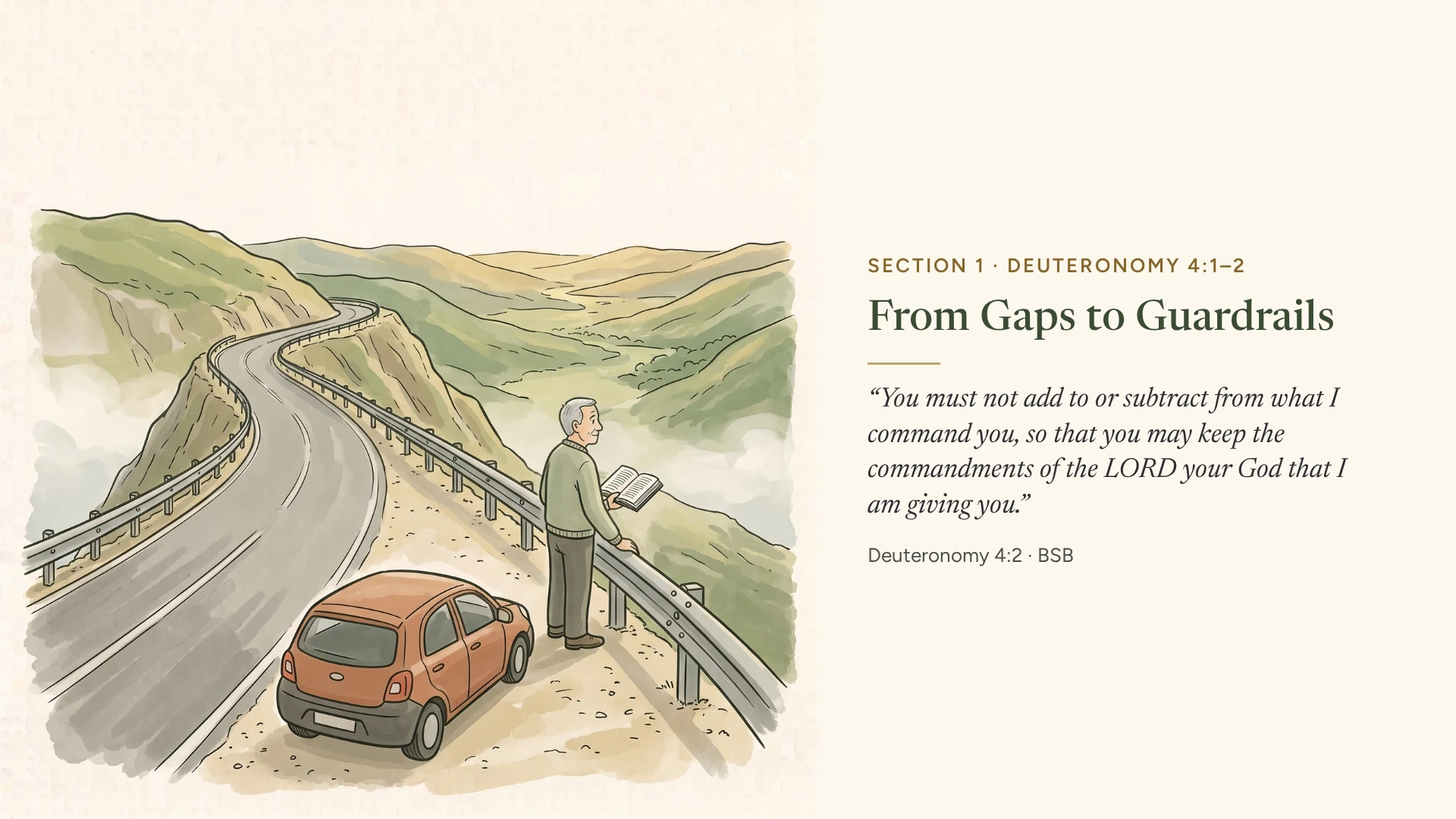
Guardrails don't take away your freedom on the road; they keep you on it. God's Word was given for life, and the guardrails help us receive it as it was given, with nothing added and nothing taken away.
You Already Read This Way
Imagine a shoebox in your closet, full of letters from your grandmother. She wrote them over forty years, from before you were born until last Christmas. The oldest ones are in Spanish, her first language; the newer ones are in English, in the same looping handwriting. You've read them all more than once. And without ever taking a class, you read them well.
You read a birthday card differently from the letter about selling the farm. When she wrote, "I'm drowning in tomatoes this summer," you didn't worry she was in danger; you pictured her kitchen counter.
You read each letter knowing when she wrote it: the year Grandpa was sick, the year she moved to town. You remember what came in the letter before and the one after.
When your cousin's English translation of an early letter sounded odd, you went back to her Spanish to see what she actually said.
You let her say what she said. You didn't turn a gentle warning into a compliment because you wished it were one.
When she wrote, "Don't forget to call your brother," she meant one thing, even if that one sentence has shaped how you treat family ever since.
In one letter she mentioned "a hard season" and said no more. Twenty years later another letter told the whole story, and now the first one makes sense.
And when one letter sounds unlike her, you don't decide she became a different person. You read it in light of the whole box, because you know her.
Without knowing it, you just used all seven guardrails: Literal, Contextual, Linguistic, Exegetical, One-Meaning, Progressive and Harmony. That's no accident. Fuhr and Köstenberger note that "most of the following principles are universal and pertain to all forms of written communication." Good readers of any letter do these things by instinct.
The Bible is a far larger collection, written by many authors over many centuries. It has one difference that changes everything: behind every human writer stands one divine Author. The textbook says some of the principles are "in force only in view of the Bible's unique character as the inspired, inerrant Word of God." That one Author shapes every guardrail, and you can see it most clearly in the last three: one meaning, because He meant what He said; progressive, because He revealed His plan step by step; harmony, because He does not contradict Himself. So the guardrails aren't a foreign skill. They are how you already read the people you love, applied with care to the God who loves you.
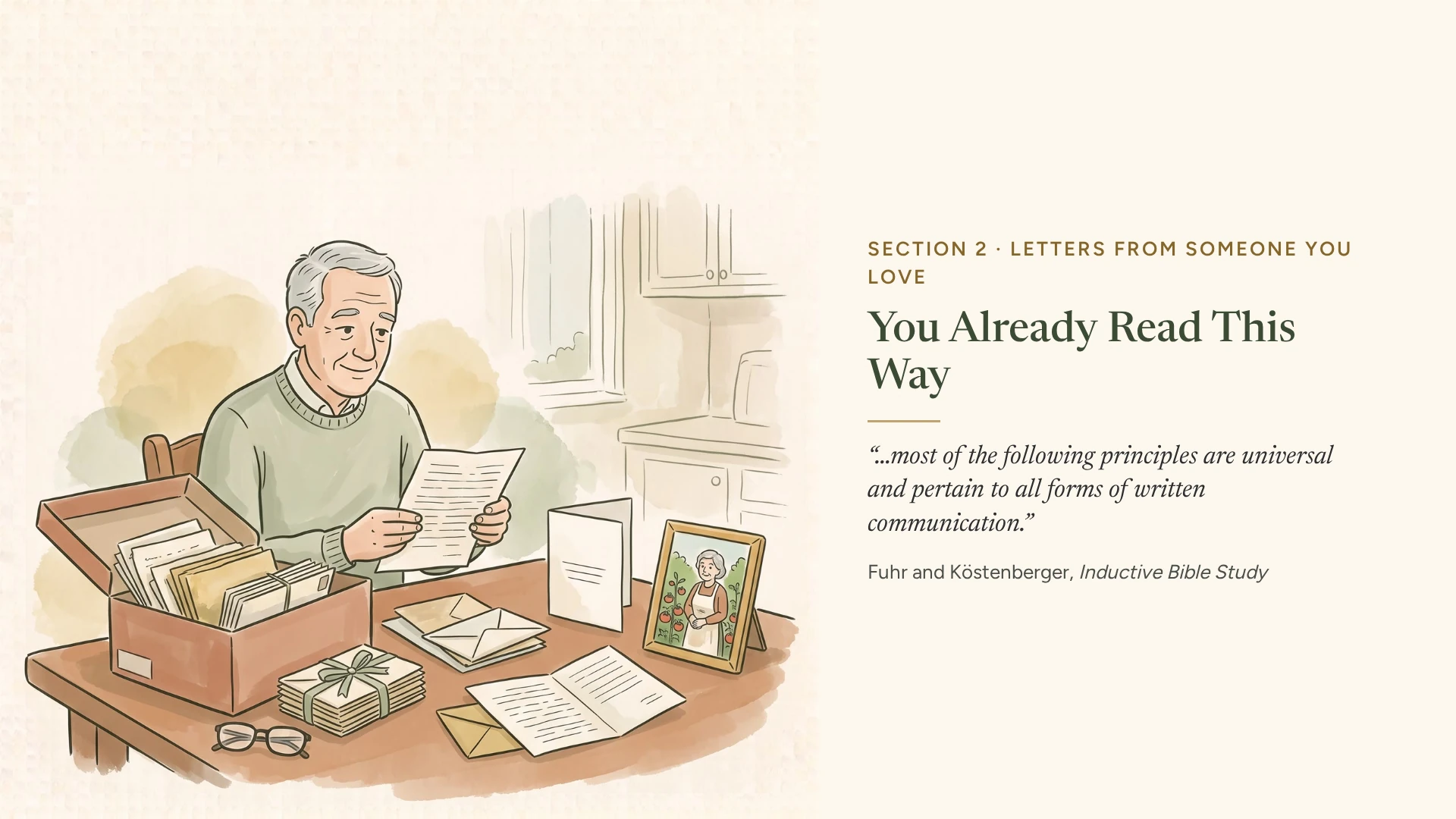
You don't have to be a Bible scholar to read the Bible well. You already know how to read letters from someone you love. The guardrails help you do it with care, because these letters are ancient, and their Author is God.
The Literal Guardrail: Read It the Way It Was Written
What genre is this, and what does it actually say in that genre?
Here's a word worth rescuing. In everyday talk, "literally" has come to mean "really, truly, no exaggeration," and we even use it for things that never happened: "I literally died laughing." So when someone says they read the Bible literally, we picture a person who takes every word as flat fact, with no poetry and no figures of speech, as if the whole Bible were a newspaper article. That has never been what it means in Bible study. Reading the Bible literally means reading each passage according to the kind of literature it is. A story is read as a story. A poem is read as a poem. A letter is read as a letter. When we ignore genre, we risk missing the message entirely.
Here's a memory hook. In English, "literal" and "literature" are cousins: both grow from the Latin word littera, a letter of the alphabet, the building block of writing. That word history doesn't prove anything about the Bible, but it points the right way, and R. C. Sproul makes the connection in one line: "To interpret the Bible literally is to interpret it as literature."
You already know this from any bookstore. BibleProject's Tim Mackie puts it this way: "Think of it like walking into a bookstore where every aisle has a different kind of literature." Nobody reads the poetry aisle the way they read the history aisle. The Bible works the same way. By BibleProject's count it is about 43 percent narrative, 33 percent poetry and 24 percent prose discourse (teaching, law and letters), and "if you don't pay attention to what style it's written in, you will miss out on the brilliance of each book."
That's the heart of the Literal guardrail: read the Bible's words at face value, in the kind of writing they come in. The textbook's short form is "Take the words of the Bible at face value. Avoid reading into the text what is not there." Face value includes figures of speech. If we say it's "soupy" outside on a humid day, nobody pictures "clam chowder or chicken noodles floating around the atmosphere." The Bible's authors use figures of speech the same way, and behind each one is a real meaning they intended.
The cliff on one side is the wooden reading: every word pressed flat, whatever the genre. God becomes a stone, and a proverb becomes a contract. The cliff on the other side is the hidden-meaning reading: ordinary words treated as a code. "Jesus went up to Jerusalem" (John 2:13, BSB) stops being a trip to the Passover and becomes a lesson about climbing to spiritual heights. The textbook warns that we "shouldn't allegorize the text or look for hidden meanings." That's the adding cliff from Section 1.
Here's a verse that shows both cliffs. David wrote Psalm 19 for Israel's worship ("For the choirmaster. A Psalm of David," Psalm 19:1, BSB). It moves from the skies that declare God's glory, to the law of the LORD, to a closing prayer:
14 May the words of my mouth and the meditation of my heart be pleasing in Your sight, O LORD, my Rock and my Redeemer.
Is God a rock? This is poetry, and poetry tells us how to hear it. David isn't describing what God is made of; he's saying what God is like. Another of David's psalms spells it out in its own words: "My God is my rock, in whom I take refuge" (Psalm 18:2, BSB). The wooden reading misses the comfort, and the hidden-meaning reading floats away from it. What David means is that God is solid and safe, a refuge, and David's Redeemer.
The same guardrail helps with wisdom: "Train up a child in the way he should go, and when he is old he will not depart from it" (Proverbs 22:6, BSB). A proverb tells how life usually works under God; it isn't a contract. That's good news for every parent who did their best. Lesson 5 goes deeper into the Bible's kinds of writing and how to read each one.
- What does David ask God to find pleasing?
- What two names does he give the LORD at the end of the verse?
- What genre is this, and what does it actually say in that genre?
- If someone read "my Rock" as a statement about what God is made of, which cliff would they be near? What about someone who said the verse hides a secret code?
- How is God inviting you to live out this abiding principle this week?
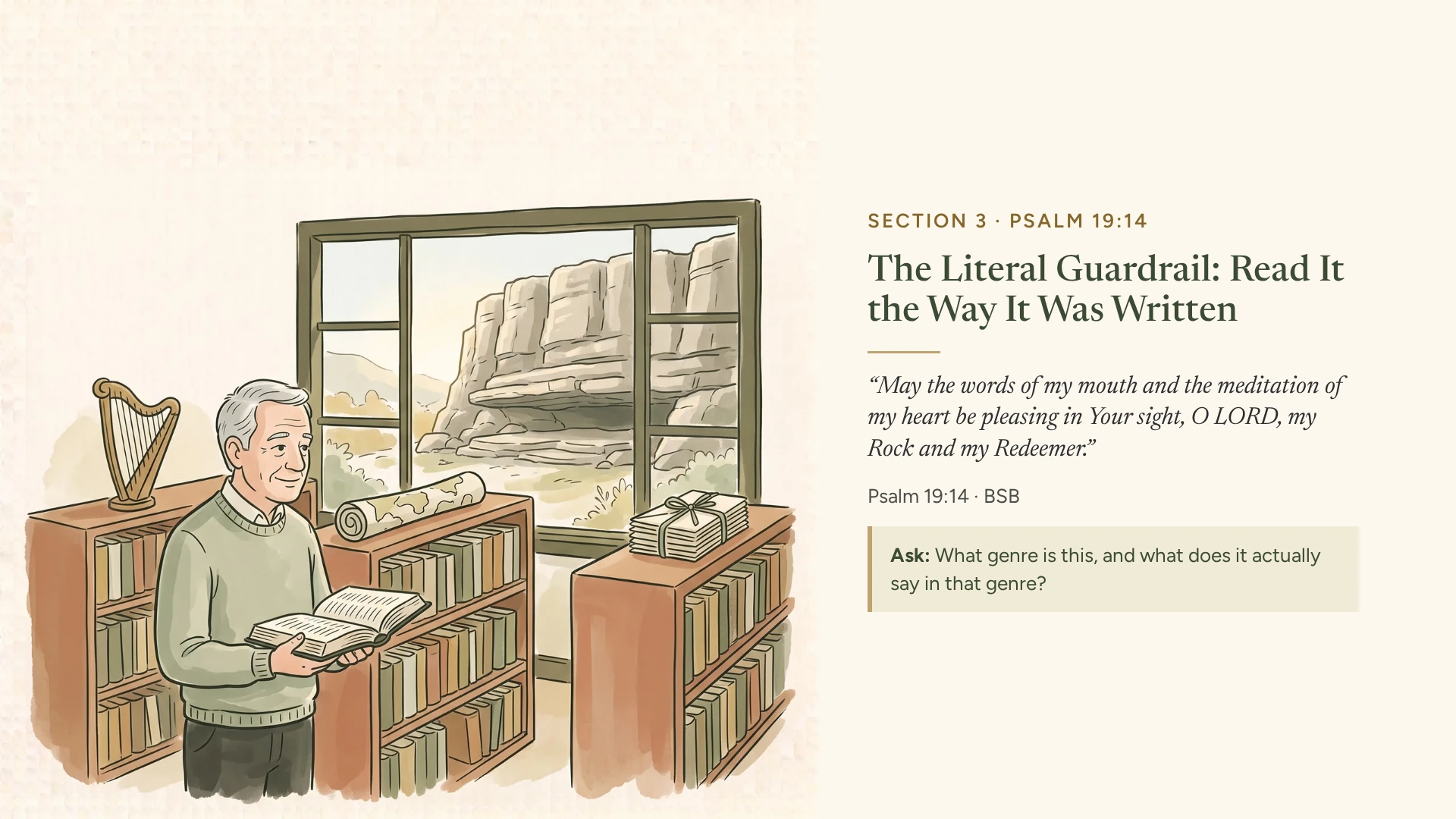
Reading the Bible literally means reading it as the kind of literature it is. The Literal guardrail doesn't flatten the Bible. It lets each part speak in its own voice: history as history, poetry as poetry, wisdom as wisdom.
The Contextual Guardrail: Read It Where It Lives
What surrounds it, what did the first readers know, and where does it sit in the whole story?
Have you ever overheard one side of a phone call? You catch "No, the blue one," then a laugh, then "Tell her I said yes," and you try to piece together what's going on. You might get some of it. You might also get it badly wrong. The textbook uses that same picture for reading a Bible letter without knowing the situation behind it: "Eavesdropping will provide some sense of what's going on, but the dangers of misunderstanding are obviously significant in such an encounter!"
That's why the textbook calls this guardrail "perhaps the most important principle to remember." The Contextual guardrail says every passage "must always be understood within the confines of its historical-cultural, literary, and theological-canonical context." In everyday words, that's three layers, and each one answers part of the guardrail's question:
- Historical-cultural: What did the first readers know? Who wrote this, to whom, and what was their world like?
- Literary: What surrounds it? Read the verses before and after, and the whole psalm, story, or letter.
- Theological-canonical: Where does it sit in the whole story? The Bible's books work together as one book, and each passage has its place in it.
The cliff on one side is the lonely verse: a line cut loose from everything around it, until it can carry whatever we load onto it. That's the adding cliff. The cliff on the other side is skipping layers: jumping straight to what a passage means for us, or to what later Scripture says, without first hearing what it meant to the people who received it. That quietly subtracts the first meaning. The guardrail keeps all three layers in view, starting with the first readers.
Few passages are better loved than Psalm 23, and few are more often read alone, on a card or a plaque. Let's read it where it lives.
A Psalm of David. 1 The LORD is my shepherd; I shall not want. 2 He makes me lie down in green pastures; He leads me beside quiet waters. 3 He restores my soul; He guides me in the paths of righteousness for the sake of His name. 4 Even though I walk through the valley of the shadow of death, I will fear no evil, for You are with me; Your rod and Your staff, they comfort me. 5 You prepare a table before me in the presence of my enemies. You anoint my head with oil; my cup overflows. 6 Surely goodness and mercy will follow me all the days of my life, and I will dwell in the house of the LORD forever.
The historical-cultural layer. The heading reads "A Psalm of David" (Psalm 23:1, BSB), and Scripture tells us who David was before he was king. When Samuel came to anoint one of Jesse's sons, the youngest was missing: "he is tending the sheep" (1 Samuel 16:11, BSB). Later David told King Saul what that work involved: "whenever a lion or a bear came and carried off a lamb from the flock, I went after it, struck it down, and delivered the lamb from its mouth" (1 Samuel 17:34–35, BSB). So when David calls the LORD his shepherd, he isn't borrowing a soft picture. He knows what a good shepherd does because he has done it, at the risk of his own life. God "took him from the sheepfolds" to "be shepherd of His people Jacob" (Psalm 78:70–71, BSB), and the man who shepherded Israel knew he needed a Shepherd of his own.
The literary layer. Now read the whole psalm. In verses 1–3, David talks about the LORD: He makes me lie down, He leads me, He restores my soul. Then, at the darkest point, "the valley of the shadow of death," David turns and talks to Him: "for You are with me" (Psalm 23:4, BSB). The closer the danger, the closer the Shepherd. In verse 5 the picture changes again, from a pasture to a table, from a shepherd to a host. The whole psalm also answers a question about verse 1. What does "I shall not want" mean (Psalm 23:1, BSB)? The verses that follow fill it in: rest, water, guidance, protection, a table, and a home with the LORD forever. It's the contentment of a sheep that lacks nothing it needs, not a promise of everything it wishes for.
The theological-canonical layer. David's psalm isn't alone in the Bible. The prophets return to the shepherd picture again and again (Isaiah 40:11; Jeremiah 23:3–5; Micah 5:4), and Ezekiel 34 brings it into sharp focus. Israel's leaders had fed themselves instead of the flock (Ezekiel 34:2), so God made a promise: "Behold, I Myself will search for My flock and seek them out" (Ezekiel 34:11, BSB). Listen for Psalm 23 in what follows: "I will tend My flock and make them lie down" (Ezekiel 34:15, BSB). Then, in the same chapter, God names a second shepherd: "I will appoint over them one shepherd, My servant David" (Ezekiel 34:23, BSB). Long after David died, a "David" was still coming. So Ezekiel holds out two hopes side by side: the LORD Himself will shepherd His people, and a new David will shepherd them.
Centuries later, Jesus said, "I am the good shepherd. The good shepherd lays down His life for the sheep" (John 10:11, BSB). BibleProject describes how the New Testament uses the Old: "When the apostles quote the Hebrew Scriptures, they are activating not just one verse but a whole network of hyperlinked themes." Jesus' words work the same way. The words good shepherd are a hyperlink back to Psalm 23 and Ezekiel 34, and the people listening knew those Scriptures. Later, at the Feast of Dedication, He was still speaking of His sheep (John 10:22–29) when He said, "I and the Father are one" (John 10:30, BSB). His hearers picked up stones, saying, "You, who are a man, make Yourself out to be God" (John 10:33, BSB). They understood the claim. Jesus was stepping into the work the LORD had promised to do Himself, as the promised David too.
Here the guardrail does careful work. David wasn't writing about Jesus, and we shouldn't make Psalm 23 say what David didn't say. David meant the LORD, the God of Israel, his own Shepherd. But read in the whole story, we see that very Shepherd come near in Jesus, who went further than David ever did for a lamb: He laid down His life. On the night of His arrest, Jesus applied the prophet Zechariah's words to Himself: "I will strike the Shepherd, and the sheep of the flock will be scattered" (Matthew 26:31, BSB; see Zechariah 13:7). The Good Shepherd would be struck for His sheep. Later light doesn't erase David's meaning; it shows how far that meaning reaches.
Read them together. This week, read Ezekiel 34:11–24 and John 10:1–21 alongside Psalm 23. Each passage helps fill in the picture of the others, and the path runs both ways: a study that starts in Psalm 23 leads to Ezekiel and John, and a study that starts in John 10 leads back to Ezekiel and Psalms. That's the Contextual guardrail working hand in hand with the Progressive guardrail you'll meet in Section 8.
If you want to follow the shepherd thread through the whole Bible, here's the trail:
- Genesis and the Psalms: Genesis 48:15; 49:24; Psalm 23; 28:9; 78:70–72; 80:1; 95:7; 100:3
- The Prophets: Isaiah 40:11; Jeremiah 23:1–6; 31:10; Ezekiel 34; 37:24; Micah 5:2–4; 7:14; Zechariah 11:4–17; 13:7
- The Gospels: Matthew 2:6; 9:36; 26:31 (Mark 14:27); Luke 15:3–7; John 10:1–30; 21:15–17
- The Letters and Revelation: Hebrews 13:20; 1 Peter 2:25; 5:4; Revelation 7:17
Lesson 6 goes deeper into all three layers and how to study each one.
- In verses 1–3, David talks about the LORD. Where does he start talking to Him, and what is happening in the psalm at that moment?
- List everything the Shepherd provides, from verse 1 to verse 6.
- What surrounds it, what did the first readers know, and where does it sit in the whole story?
- If someone read "I shall not want" as a promise that God will give them whatever they want, which cliff would they be near? What about someone who skipped David entirely and read the psalm only through John 10?
- How is God inviting you to live out this abiding principle this week?
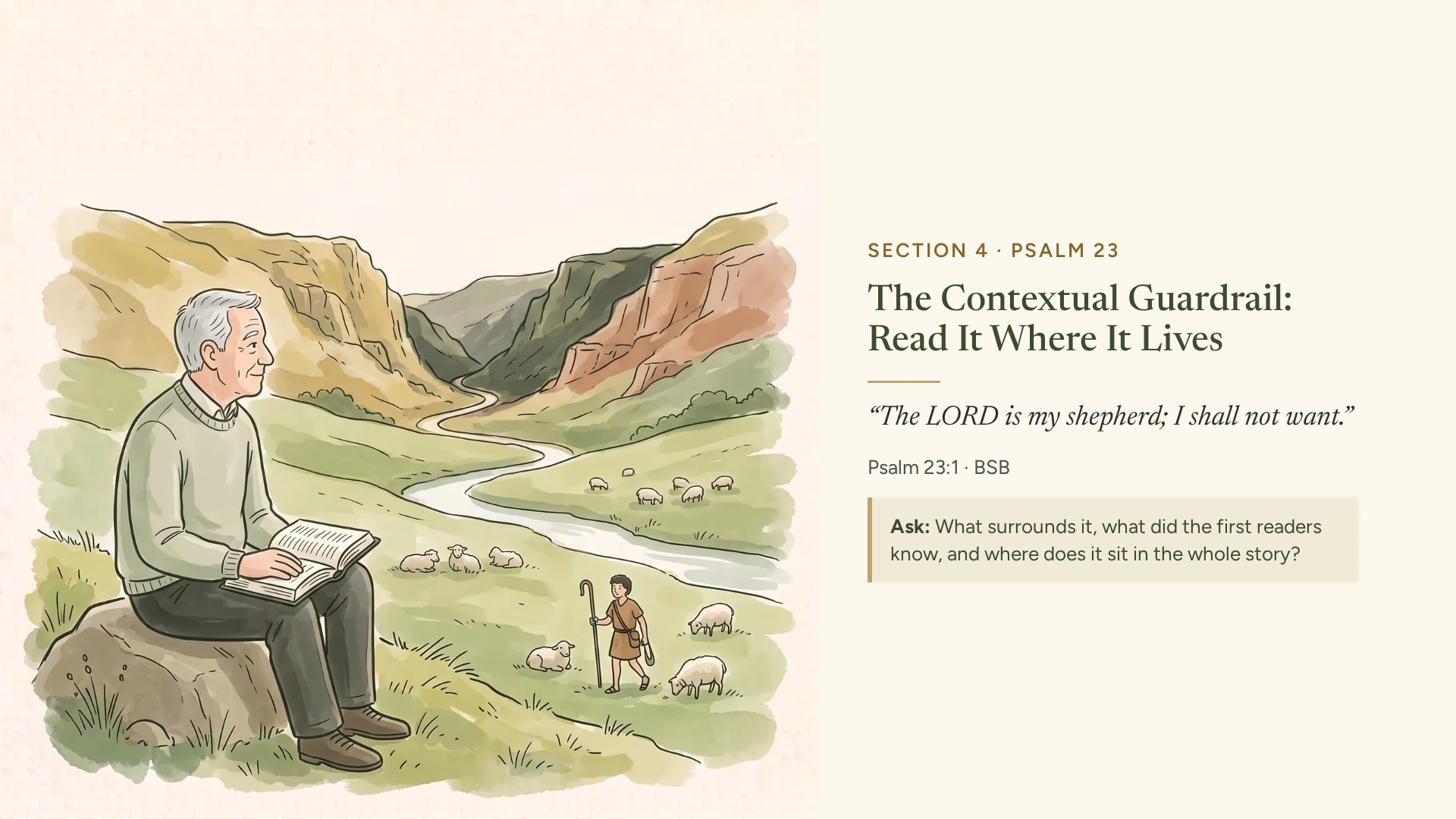
A verse read alone can be made to say almost anything. Read where it lives, it says what God meant, and often more than we first saw. Context doesn't make Bible study more complicated; it makes it come alive.
The Linguistic Guardrail: Hear It in Its First Language
Is there a word where the Hebrew or Greek adds nuance?
Remember your grandmother's Spanish letters? Suppose one of them says a big job was pan comido. Your cousin translates it word for word: "eaten bread." That sounds odd, so you ask someone who grew up speaking Spanish, and the puzzle is solved. Es pan comido is how Spanish says "it's a piece of cake." The job was easy. Every language has sayings like that, where the words point one way and the meaning goes another. A good translator carries the meaning across, not just the words.
The Bible was written in Hebrew and Greek, and the Linguistic guardrail says "the original languages of the Bible must take precedence over any given translation." That doesn't mean your English Bible can't be trusted. The textbook calls today's English translations "both accurate and readable," but adds that "some facets are nonetheless difficult to capture and retain in the translation process." Every translation also makes choices: "Translation invariably crosses into interpretation." So when a phrase sounds odd, or one word carries the weight of a passage, we look underneath the English to the words the author wrote. You don't have to learn Greek to do that, and good tools make it possible for anyone.
The cliff on one side is treating the English as if it were the original, so an ancient saying gets read like a modern sentence and its meaning slips away. That's the subtracting cliff. The cliff on the other side is the word-study show-off: digging up a word's history or every meaning a dictionary lists, and pouring it all into one verse. The textbook warns, "Context always takes precedence over lexical definitions. In biblical discourse, words mean what their authors intended them to mean, not what word studies, lexical entries, or exegetical dictionaries determine they could mean." That's the adding cliff.
Here's a saying from the Sermon on the Mount that sounds odd in English:
22 The eye is the lamp of the body. If your eyes are good, your whole body will be full of light. 23 But if your eyes are bad, your whole body will be full of darkness. If then the light within you is darkness, how great is that darkness!
In English, "good eyes" means you see well, or maybe that you have a good eye for decorating. But Jesus wasn't speaking English. Start with what surrounds it, as the Contextual guardrail teaches. Just before these verses, Jesus says, "Do not store up for yourselves treasures on earth," because "where your treasure is, there your heart will be also" (Matthew 6:19, 21, BSB). Just after, He says, "You cannot serve both God and money" (Matthew 6:24, BSB). Money on both sides. Why stop in the middle to talk about eyesight?
The Hebrew Scriptures Jesus' first hearers knew help answer that. There, the eye was a way to talk about generosity. "A generous man will be blessed, for he shares his bread with the poor" (Proverbs 22:9, BSB). Word for word, the Hebrew for a generous man is "good of eye." Its opposite, the "evil eye," describes the stingy: "A stingy man hastens after wealth and does not know that poverty awaits him" (Proverbs 28:22, BSB). BibleProject's scholars sum it up: "The 'good eye' Jesus alludes to finds its root in the Hebrew Bible, where authors use it idiomatically to talk about generosity." Commentator Charles Quarles agrees: "In Jewish writings, a good eye represented a generous attitude and a bad eye a stingy, miserly attitude."
Matthew's Gospel shows the same saying again. In a parable, a landowner pays the workers hired last the same as those hired first, and he asks the ones who grumble, "Or are you envious because I am generous?" (Matthew 20:15, BSB). Word for word, the Greek asks, "Is your eye evil because I am good?" It's the same Greek word for "bad" that we read in Matthew 6:23. In chapter 20 the BSB translates the saying into its meaning; in chapter 6 it keeps the picture. Comparing the two lets you see the idiom underneath.
This is the real challenge of the Linguistic guardrail. Most of us don't read Hebrew or Greek, and we don't know their idioms. Translators work hard to carry the meaning across, and when they do, a repeated word like "eye" can drop out of the English, along with the thread the author was weaving. Each translation makes different choices. The Legacy Standard Bible keeps the eye in the parable: "Or is your eye envious because I am generous?" (Matthew 20:15, LSB). But in Matthew 6:22 it reads, "if your eye is clear" (LSB), which leans toward the eyesight reading. No single translation shows everything, which is why the textbook advises, "In cases such as these, it's highly beneficial to use multiple translations." Read a passage in a word-for-word translation and a thought-for-thought one, and the places where they differ show you where to dig. Abide 102 teaches how.
So Jesus seems to be saying something like this: an eye that looks at others with generosity fills your whole life with light; a stingy, grasping eye fills it with darkness. How you look at your money shows where your treasure is. Not every reader takes it this way. John Calvin read it as a healthy eye versus a diseased one, and some read "good" as clear, focused sight. But with treasure before it and money after it, the generosity reading has strong support, and many careful commentators hold it. Notice, too, that the generosity reading wasn't found by digging in a dictionary. It came from the context first, and the language confirmed it. Lesson 7 goes deeper into word studies and how to use the tools well.
- What is Jesus talking about in Matthew 6:19–21 and in 6:24? What do those verses have in common?
- What happens to the "whole body" when the eyes are good? When they are bad?
- Look up Matthew 6:22 and 20:15 in two or three translations. Which ones keep the word "eye"? Which ones translate its meaning instead?
- Is there a word where the Hebrew or Greek adds nuance?
- If someone used these verses to teach about eyesight, which cliff would they be near? What about someone who poured every meaning of the Greek word for "good" into the verse?
- How is God inviting you to live out this abiding principle this week?
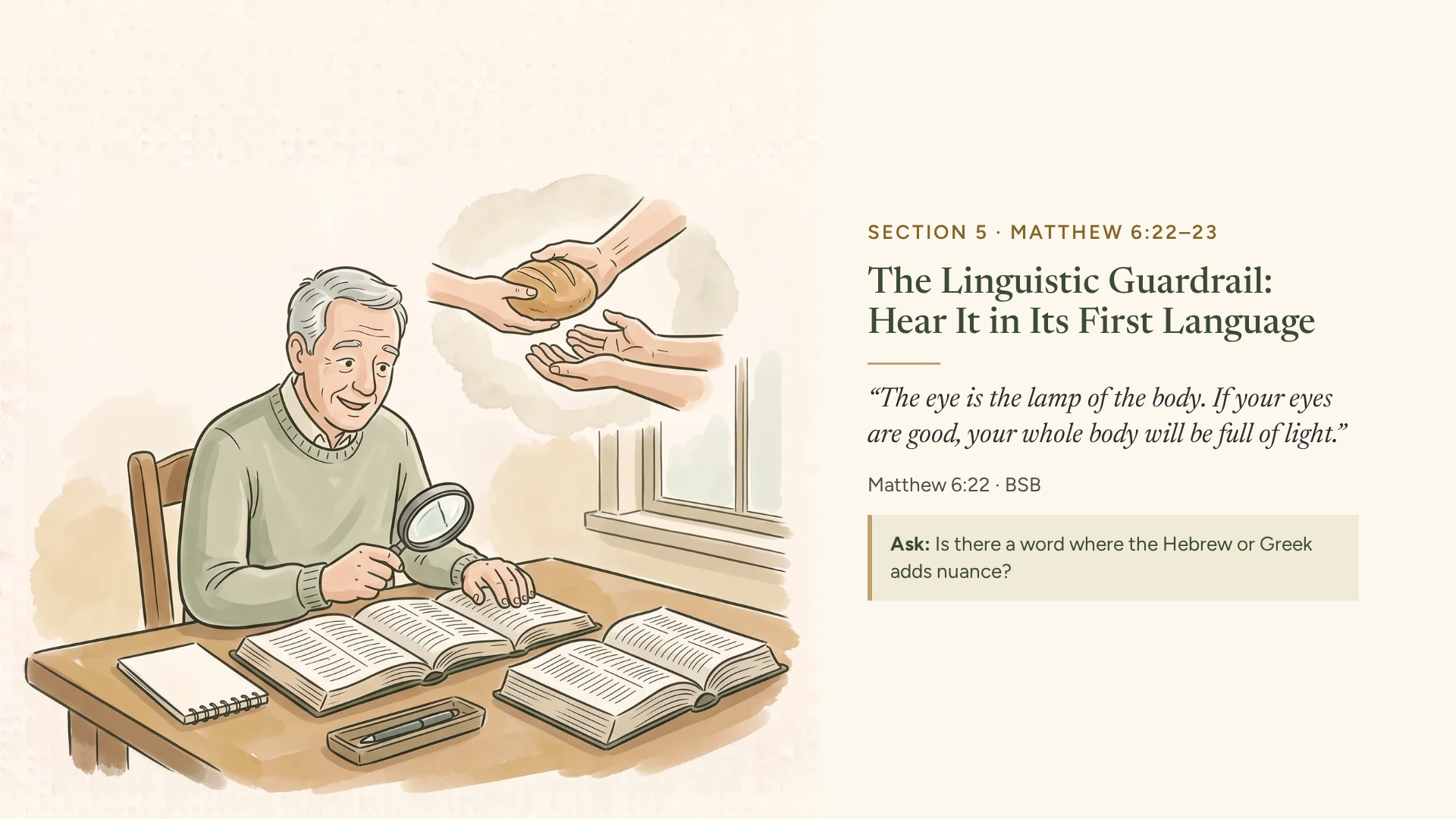
You don't need to read Hebrew or Greek to respect them. When a phrase sounds odd, slow down, read what surrounds it, and look underneath the English. Sometimes the original words turn a puzzling line about eyesight into a clear call to generosity.
The Exegetical Guardrail: Draw It Out, Don't Read It In
What is the Author saying in this passage to the original audience?
You text a friend about plans for Saturday, and the reply comes back: "ok." If you've been worried they're upset with you, that "ok" sounds cold. If your day has gone well, it sounds friendly. The word didn't change. What changed was what you brought to it. Every reader brings something to what they read, and Bible readers are no exception. BibleProject's Tim Mackie admits it: "We all tend to impose our own cultural assumptions onto the Bible."
The Exegetical guardrail says "the meaning of any biblical text must be drawn from the text rather than be ascribed to the text." Bible students have names for the two directions. Exegesis draws the meaning out of the text, the meaning the author put there. Eisegesis reads a meaning into the text that the author never put there. In the textbook's words, "the reader is responsible to discover the intent of the author in the text rather than imposing her understanding onto the text." It's the difference between digging for the gold God placed in the field and bringing our own jewelry to bury there.
That doesn't mean we have to empty our heads before we open the Bible. The textbook names two things every reader carries. Preunderstanding is everything we already think before we study a passage: sayings we've heard, what our culture assumes, what we hope a verse will say. "Preunderstanding won't always lead you astray, but it certainly has the potential to skew your understanding of the text." So we hold it loosely and let the text correct it. Presuppositions are our convictions about the Bible as a whole. The textbook gives three examples: the Bible is God's Word, true in everything it says; it never leads us astray; and it has the final word over what we believe and how we live. Those convictions, the textbook says, "do not need to be suppressed in your study of Scripture. Rather, we suggest you embrace them." Hold your presuppositions firmly and your preunderstanding loosely.
The cliff on one side is coming to the Bible with our minds made up and finding what we brought. The textbook warns that "often readers approach the Bible with an agenda, using it to support various doctrines (whether orthodox or heretical), proof texting along the way." Proof texting means grabbing verses to back up a point we've already decided. That's the adding cliff. The cliff on the other side is using a verse as a launching pad: "Others will use the Bible as a springboard for various points of interest, focusing on an aspect of the text without asking what the author was really trying to say in the original context." We keep the piece we like and lose the rest. That's the subtracting cliff.
You've probably heard someone say, "Money is the root of all evil." Many people think it's a Bible verse. Here's what Paul wrote:
6 Of course, godliness with contentment is great gain. 7 For we brought nothing into the world, so we cannot carry anything out of it. 8 But if we have food and clothing, we will be content with these. 9 Those who want to be rich, however, fall into temptation and become ensnared by many foolish and harmful desires that plunge them into ruin and destruction. 10 For the love of money is the root of all kinds of evil. By craving it, some have wandered away from the faith and pierced themselves with many sorrows.
Read what it says before deciding what it means. The saying leaves out three words, the love of, and those three words change everything. Paul doesn't blame money. He blames a heart that loves it. Verse 9 says the same thing another way: the trap is for "those who want to be rich" (1 Timothy 6:9, BSB), and verse 10 adds "By craving it" (1 Timothy 6:10, BSB). The problem is the wanting, not the having. This is preunderstanding at work. We've heard the saying so often that our ears fill in the verse before our eyes read it.
Now ask the guardrail's question: what was the Author saying to the original audience? Paul wrote this letter to Timothy, whom he had left in Ephesus "to instruct certain men not to teach false doctrines" (1 Timothy 1:3, BSB). Just before our passage, Paul describes those teachers: "These men regard godliness as a means of gain" (1 Timothy 6:5, BSB). They were using religion to get rich. Paul turns their own word around: "godliness with contentment is great gain" (1 Timothy 6:6, BSB). The real gain isn't money; it's a godly life content with what God provides. Timothy's church heard a warning about teachers who treated faith as a business, and about the craving that had already pulled some of them away from the faith.
Paul also wrote to believers in Ephesus who had money, and he didn't tell them their wealth was evil. A few verses later, he says, "Instruct those who are rich in the present age not to be conceited and not to put their hope in the uncertainty of wealth, but in God," and to "be generous and ready to share" (1 Timothy 6:17–18, BSB). Sound familiar? It's the same generosity Jesus called a good eye in Section 5.
Now we can see both cliffs in this one passage. The popular saying subtracts: it drops the love of, blames money itself, and condemns every believer who has some, which verse 17 doesn't do. It also lets the rest of us off the hook, because if money is the problem and we don't have much, the verse isn't about us. Paul's warning is for anyone who wants to be rich. The false teachers in Ephesus went over the other cliff. They added gain to godliness and taught that faith was a path to wealth. Anyone who teaches that today is reading into the Bible the very thing Paul warned Timothy about.
If what we bring to the text clashes with what the text says, the Exegetical guardrail asks us to change, not the Bible. Paul put it this way: "be transformed by the renewing of your mind" (Romans 12:2, BSB). Lesson 8 goes deeper into exegesis, preunderstanding, and how to let a passage speak for itself.
- In verse 9, who falls into temptation: those who are rich, or those who want to be rich?
- What does Paul call great gain in verse 6? Compare it with what the false teachers thought in verse 5.
- What is the Author saying in this passage to the original audience?
- If someone used the saying money is the root of all evil to say that having money is sinful, which cliff would they be near? What about a teacher who promises that faith will make you rich?
- How is God inviting you to live out this abiding principle this week?
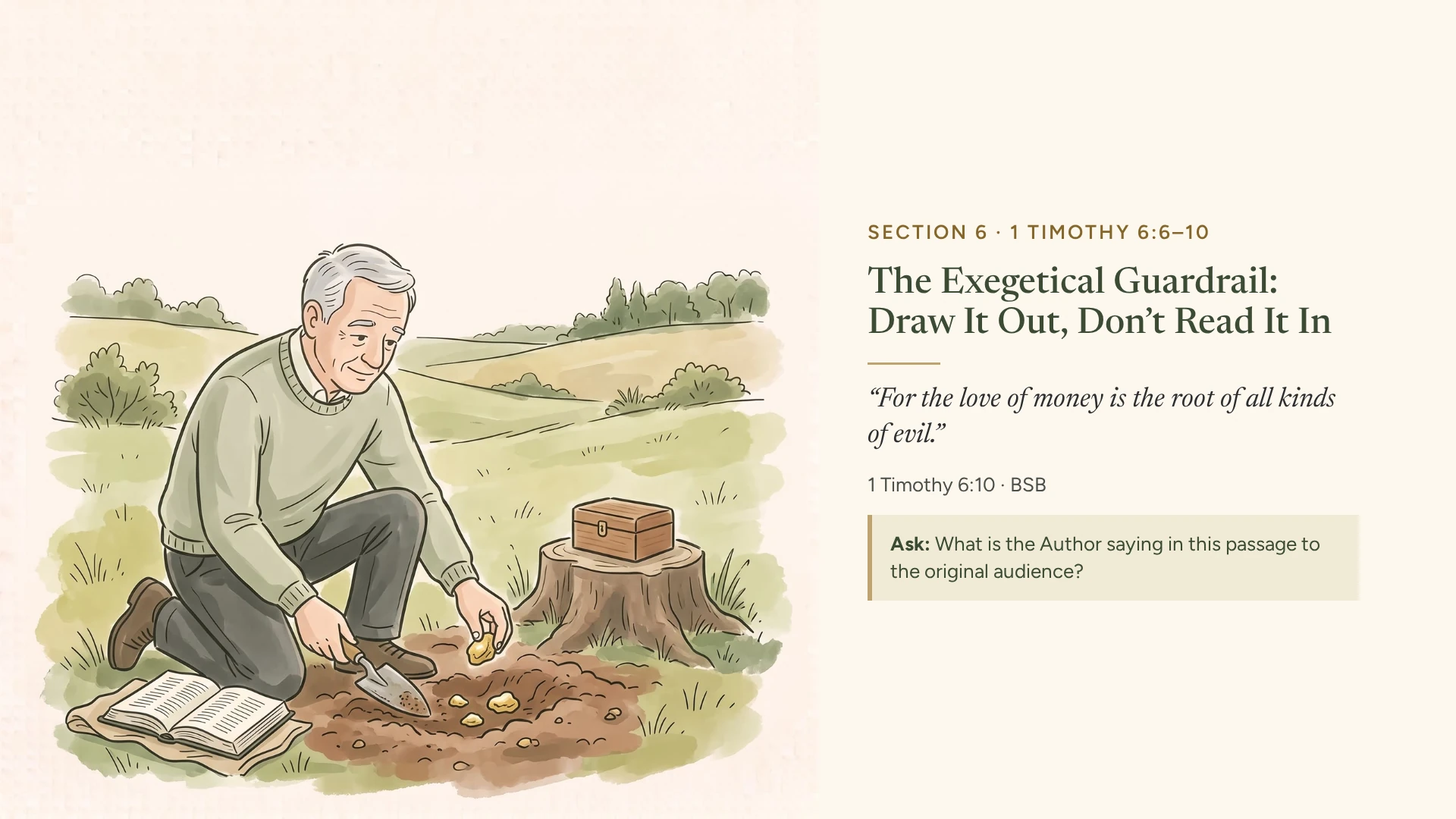
Every reader brings something to the Bible. The Exegetical guardrail doesn't ask you to empty your head. It asks you to let the text have the last word: read what it says before deciding what it means, and be ready for it to change you.
The One-Meaning Guardrail: One Meaning, Many Applications
What is the one thing this meant when it was first given, before later revelation illuminated it further?
Mom leaves a note on the fridge: "Take care of your brother while I'm at work." That note means one thing. Carrying it out could look like a dozen things: making him lunch, helping with his math, keeping him off the garage roof. But if you told Mom the note also meant you could borrow her car, she wouldn't be impressed. A message can be lived out in many ways, but it doesn't mean whatever we'd like it to mean.
The One-Meaning guardrail says that "any given portion of Scripture in any given context can have only one correct interpretation, although it may have multiple (yet not unlimited) applications." R. C. Sproul put it in one sentence: "Though a text may have a multitude of applications, it has only one correct meaning." The first four guardrails work together to help us observe carefully and hear the Author's voice. Literal asks what kind of writing this is, Contextual asks where it lives, Linguistic listens to its words, and Exegetical makes sure the meaning we find is the Author's, not ours. The One-Meaning guardrail brings all of that together. Like a detective lining up the clues, we ask what one meaning they all point to, and we hold to that meaning instead of letting it multiply. Lesson 4 shows how the steps connect, and how the process circles back as we go. The textbook adds a warning about our own wishes: "You can't simply 'will' the Bible to mean whatever you want it to mean."
The cliff on one side is piling meanings onto a text: hidden layers, secret codes, or the question "What does this verse mean to you?" where every reader's answer counts as true. That's the adding cliff. The cliff on the other side is deciding that because a passage's first setting looks nothing like ours, it has nothing to say to us. Paul told the churches, "Greet one another with a holy kiss" (1 Corinthians 16:20, BSB). We don't greet people that way at church, so it's tempting to skip it. But the one meaning still stands: believers should greet each other with warm, pure family affection. Lesson 2 showed how a handshake, a hug, or a warm word can carry that meaning today. Throwing the verse out subtracts what God said.
You met the Good Samaritan in Lesson 2. An expert in the law asked Jesus, "And who is my neighbor?" (Luke 10:29, BSB). Jesus told the story of the beaten man, the priest and Levite who passed by, and the Samaritan who stopped. Then He ended it this way:
36 Which of these three do you think was a neighbor to the man who fell into the hands of robbers?” 37 “The one who showed him mercy,” replied the expert in the law. Then Jesus told him, “Go and do likewise.”
Jesus gives the meaning Himself. The expert wanted to know who counted as his neighbor, so he could limit his love. Jesus turned the question around: don't ask who qualifies; be a neighbor to anyone who needs mercy, even someone you'd rather avoid. Then He told him to do it.
For more than a thousand years, many readers found much more in the story. New Testament scholar James Edwards describes how, in the third century, Origen turned the parable into an elaborate allegory. The man was Adam leaving Paradise (Jerusalem) for the world (Jericho). The robbers were evil powers. The Samaritan was Christ, the inn was the church, and the two coins were the Father and the Son. This reading spread so widely that even Martin Luther, who usually rejected allegory, preached it. Many of those ideas are true about the gospel. But they aren't what Jesus was teaching here, and they pull our eyes off His last words, "Go and do likewise" (Luke 10:37, BSB). John Calvin saw the problem. He said the early teachers had "devised this interpretation without regard to the true meaning of the Lord's words." Adding meanings can quietly bury the one meaning.
One meaning doesn't mean a shallow meaning. Go and do likewise will reach into your home, your school or job, your street, and the people you'd rather walk past, for the rest of your life. That's the depth: one meaning, lived out in more ways than you can count. The textbook also calls this guardrail "a general rule, not an irrefutable law," and names two exceptions. Some prophecy carries a "fuller sense" that later Scripture brings out. And a metaphor can carry several related ideas at once. When the psalmist calls God a rock, he means strong, sure, and lasting, but "it's quite unlikely that the psalmist intended to describe God as dense, heavy, or abrasive." Even the exceptions have limits.
Notice the guardrail's question ends with the words before later revelation illuminated it further. Settle the first meaning first. Section 8 shows how later revelation sheds more light on it without changing it. Lesson 9 goes deeper into the exceptions and the long history of reading Scripture for many meanings.
- What question does the expert ask in verse 29? What question does Jesus ask in verse 36? How are they different?
- What does Jesus tell the expert to do in verse 37?
- What is the one thing this meant when it was first given, before later revelation illuminated it further?
- If someone taught that the inn in the story stands for the church, which cliff would they be near? What about someone who said the parable is about an ancient road and has little to say to us today?
- How is God inviting you to live out this abiding principle this week?
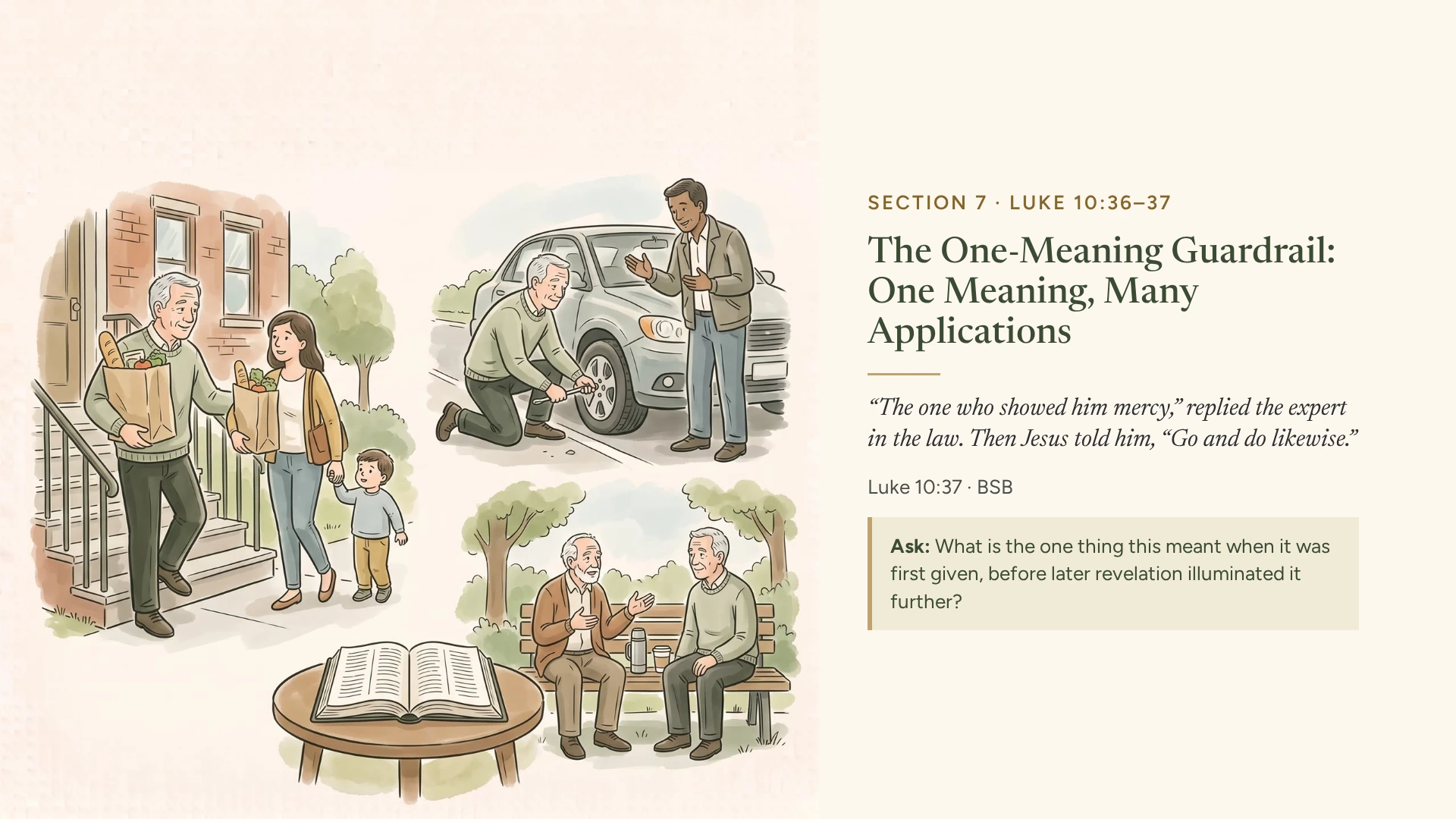
One meaning keeps the Bible from saying whatever we want. Many applications keep it speaking into every part of life. The well is deep, but it's one well, and its water is for drinking.
The Progressive Guardrail: Know Where You Are in the Story
Where does this sit in the unfolding story? What had God revealed by then, and what did He reveal later?
When you were five, the rule was "Hold my hand when we cross the street." At sixteen, your dad hands you the car keys. The rule changed, but your dad didn't contradict himself. You grew, and he gave you more. The old rule wasn't wrong, either. It was exactly right for a five-year-old.
The Progressive guardrail recognizes that "God didn't reveal his Word to humanity all at once, nor has he set forth the same conditions for humankind throughout history." Later revelation may "complete or clarify what was given earlier," and sometimes it replaces an earlier instruction. But the textbook adds, "a change or progression in Scripture doesn't imply that a contradiction is present." The book of Hebrews opens the same way: "On many past occasions and in many different ways, God spoke to our fathers through the prophets. But in these last days He has spoken to us by His Son" (Hebrews 1:1–2, BSB). The Contextual guardrail asked where a passage sits in the whole story. The Progressive guardrail adds time: God's people learned the story one page at a time, and we read each page knowing what came before it and what came after. Here's the short version: later revelation may complete, clarify, or replace an earlier instruction, but it never contradicts it.
The cliff on one side is freezing the story on an earlier page, as if nothing has happened since. We end up binding people to instructions God has already fulfilled or lifted. That's the adding cliff. The cliff on the other side is tearing out the earlier pages, as if the Old Testament were outdated and had nothing left to teach. Paul says the opposite: "everything that was written in the past was written for our instruction" (Romans 15:4, BSB). That's the subtracting cliff.
The textbook traces one thread through the whole Bible: what God's people were allowed to eat.
- Creation: "I have given you every seed-bearing plant on the face of all the earth, and every tree whose fruit contains seed. They will be yours for food" (Genesis 1:29, BSB). It appears the first humans ate only plants.
- After the flood: "Everything that lives and moves will be food for you; just as I gave you the green plants, I now give you all things" (Genesis 9:3, BSB).
- At Sinai: Leviticus 11 divides animals into clean and unclean for Israel, and gives the reason: "be holy, because I am holy" (Leviticus 11:45, BSB). God told Israel, "I have set you apart from the nations to be My own" (Leviticus 20:26, BSB). Every meal marked them as His.
- Jesus: In an argument about eating with unwashed hands (Mark 7:5), Jesus said this:
18 “Are you still so dull?” He asked. “Do you not understand? Nothing that enters a man from the outside can defile him, 19 because it does not enter his heart, but it goes into the stomach and then is eliminated.” (Thus all foods are clean.)
- The early church: In a vision, Peter heard, "Do not call anything impure that God has made clean" (Acts 10:15, BSB). The next day he walked into a Gentile's house and said, "God has shown me that I should not call any man impure or unclean" (Acts 10:28, BSB). The food laws had kept Israel separate from the nations. Now the gospel was going to the nations.
Does Mark 7 contradict Leviticus 11? No. Hold on to what Section 7 taught: Leviticus 11 meant what it said to Israel, and we don't reinterpret it. The Progressive guardrail shows where it sits. Paul calls food laws and festivals "a shadow of the things to come, but the body that casts it belongs to Christ" (Colossians 2:17, BSB). Jesus said of the Law and the Prophets, "I have not come to abolish them, but to fulfill them" (Matthew 5:17, BSB). And notice what carries forward. The food rules were lifted, but the reason behind them wasn't. Peter writes to the church, "Be holy, because I am holy" (1 Peter 1:16, BSB). The menu changed. The call to be God's set-apart people never did. That's why Leviticus still teaches us, even though we don't keep its food laws.
You've already seen this guardrail at work in Section 4, where Ezekiel's promised Shepherd came into view in Jesus. Lesson 10 goes deeper into how God's revelation unfolds across the covenants.
- Compare Genesis 1:29, Genesis 9:3, and Leviticus 11. What did God give His people to eat each time, and what changed?
- In Mark 7:18–19, what does Jesus say can't defile a person? What note does Mark add at the end?
- Where does this sit in the unfolding story? What had God revealed by then, and what did He reveal later?
- If someone taught that Christians must keep the food laws of Leviticus 11, which cliff would they be near? What about someone who said Leviticus has nothing to teach Christians?
- How is God inviting you to live out this abiding principle this week?
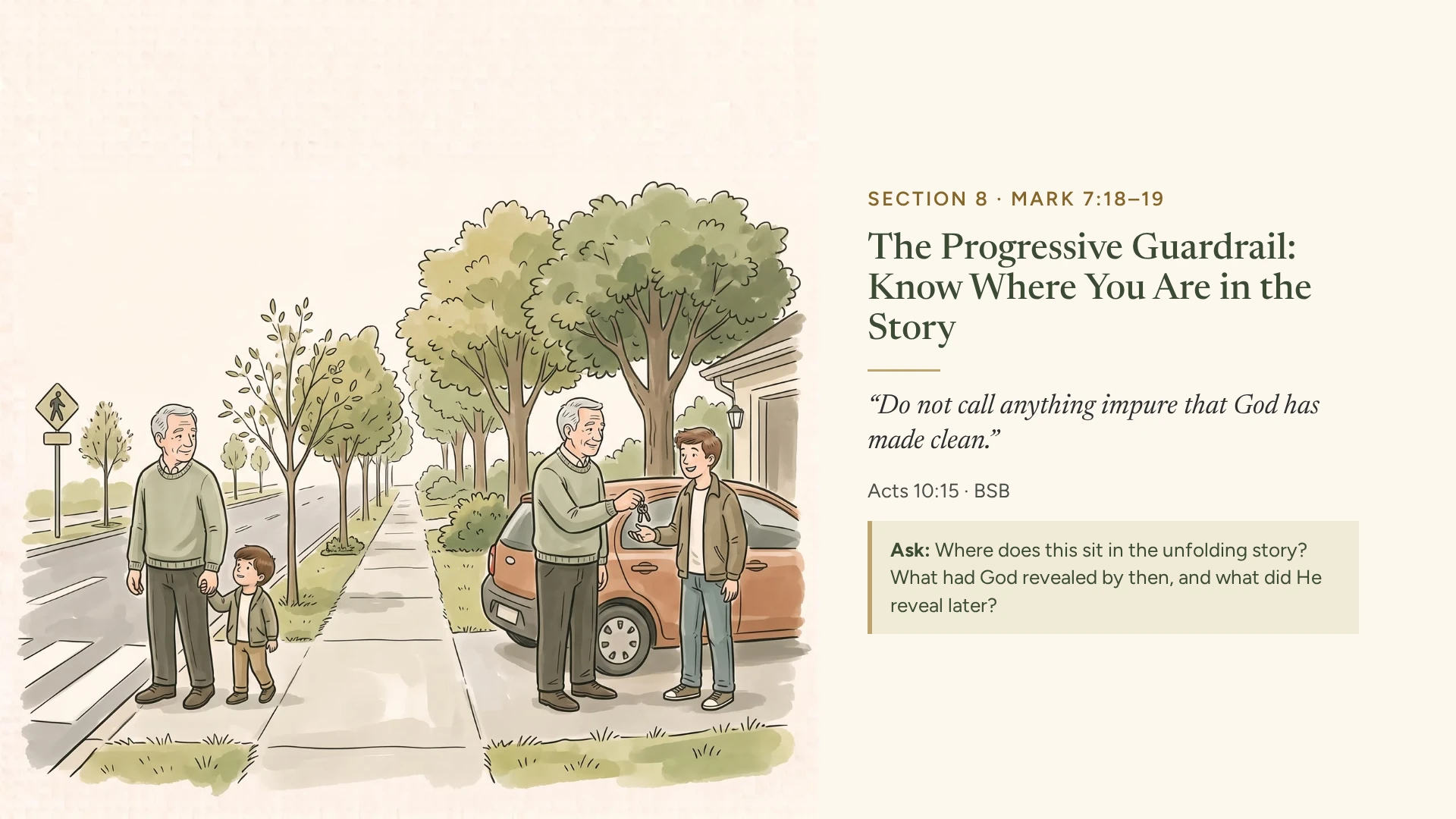
God didn't hand us His Word all at once. He unfolded it like a story, every page true and every page pointing forward to Christ. Know where a passage sits, and you'll neither tear out the early pages nor stop reading halfway.
The Harmony Guardrail: Let Scripture Explain Scripture
Do clear passages elsewhere agree with my reading?
Four friends tell you about the same football game. One describes the last-second touchdown, one talks about the rain, one quotes the coach, and one just gives you the final score. Their stories don't match word for word, but nobody thinks they went to different games. If one of them said the home team lost while the other three said it won, though, you'd know something was off, and you'd start asking questions.
The Harmony guardrail says "any given portion of the Bible can have only that meaning which harmonizes with the doctrine of the Bible as a whole." The reason goes back to Section 2: the Bible has many human writers but one Author. The textbook explains, "We wouldn't surmise that a single author would contradict himself in one and the same book," and the harmony principle extends that trust to the whole Bible "based on the premise that ultimately God is its single author." That doesn't make every writer sound the same. The textbook notes that harmony "allows for a certain amount of diversity," and it gives two examples: the four Gospels, and Paul and James. When we compare passages, "the Bible functions as its own best commentary."
You can see that diversity in the sign over the cross. Each Gospel words it a little differently: "THIS IS JESUS, THE KING OF THE JEWS" (Matthew 27:37, BSB), "THE KING OF THE JEWS" (Mark 15:26, BSB), "THIS IS THE KING OF THE JEWS" (Luke 23:38, BSB), and "JESUS OF NAZARETH, THE KING OF THE JEWS" (John 19:19, BSB). Like the four friends, each writer tells it his own way, and all four agree on what mattered: Jesus died charged as the King of the Jews.
The cliff on one side is building a teaching on one hard-to-understand verse when the rest of the Bible won't support it. That's the adding cliff. The cliff on the other side is cutting out the passages that don't seem to fit: keeping the verses we like and setting aside the ones that make us uncomfortable. That's the subtracting cliff. The Harmony guardrail keeps the whole Bible in the conversation, and it lets the clear passages shed light on the unclear ones.
Now the textbook's second example. Read these two verses side by side:
28 For we maintain that a man is justified by faith apart from works of the law.
24 As you can see, a man is justified by his deeds and not by faith alone.
At first glance, they seem to say opposite things. Christians have discussed how they fit together for centuries, and Lesson 11 looks at the question more closely. But the guardrails we've already learned go a long way.
Read each one where it lives. Paul is answering the question of how anyone, Jew or Gentile, can be made right with God, and his answer is not by "works of the law" (Romans 3:28, BSB). James is answering a different question. He asks about someone who "claims to have faith, but has no deeds? Can such faith save him?" (James 2:14, BSB). He's talking about a faith that's only words. "Even the demons believe that—and shudder" (James 2:19, BSB).
Look at the example they share. Both writers turn to Abraham, and both quote the same verse: "Abraham believed God, and it was credited to him as righteousness" (Romans 4:3; James 2:23, BSB; see Genesis 15:6). Paul points to the moment Abraham believed. James points to what Abraham did years later, when he offered Isaac, and says "his faith was working with his actions" (James 2:22, BSB). The same faith, seen at its root and then in its fruit.
Let clear passages speak. Paul himself holds both together: "For it is by grace you have been saved through faith, and this not from yourselves; it is the gift of God, not by works, so that no one can boast. For we are God's workmanship, created in Christ Jesus to do good works" (Ephesians 2:8–10, BSB). Paul fights against works as the way to earn God's favor. James fights against a faith that never changes anything. They aren't enemies. They're guarding the same road from opposite sides.
Harmony also works as a check on everything before it. If your reading of a passage clashes with clear passages elsewhere, don't force it. Go back around: check the genre, the context, the words, and whose meaning you're after. Lesson 4 shows how that loop works. Lesson 11 goes deeper into comparing Scripture with Scripture.
- In James 2:14, what kind of faith is James asking about? What words tell you?
- Paul (Romans 4:3) and James (James 2:23) quote the same verse about Abraham. What event in Abraham's life does James point to?
- Do clear passages elsewhere agree with my reading?
- If someone read Romans 3:28 alone and decided it doesn't matter how a Christian lives, which cliff would they be near, and which passages in this section would bring them back? What about someone who built a whole teaching on one hard-to-understand verse?
- How is God inviting you to live out this abiding principle this week?
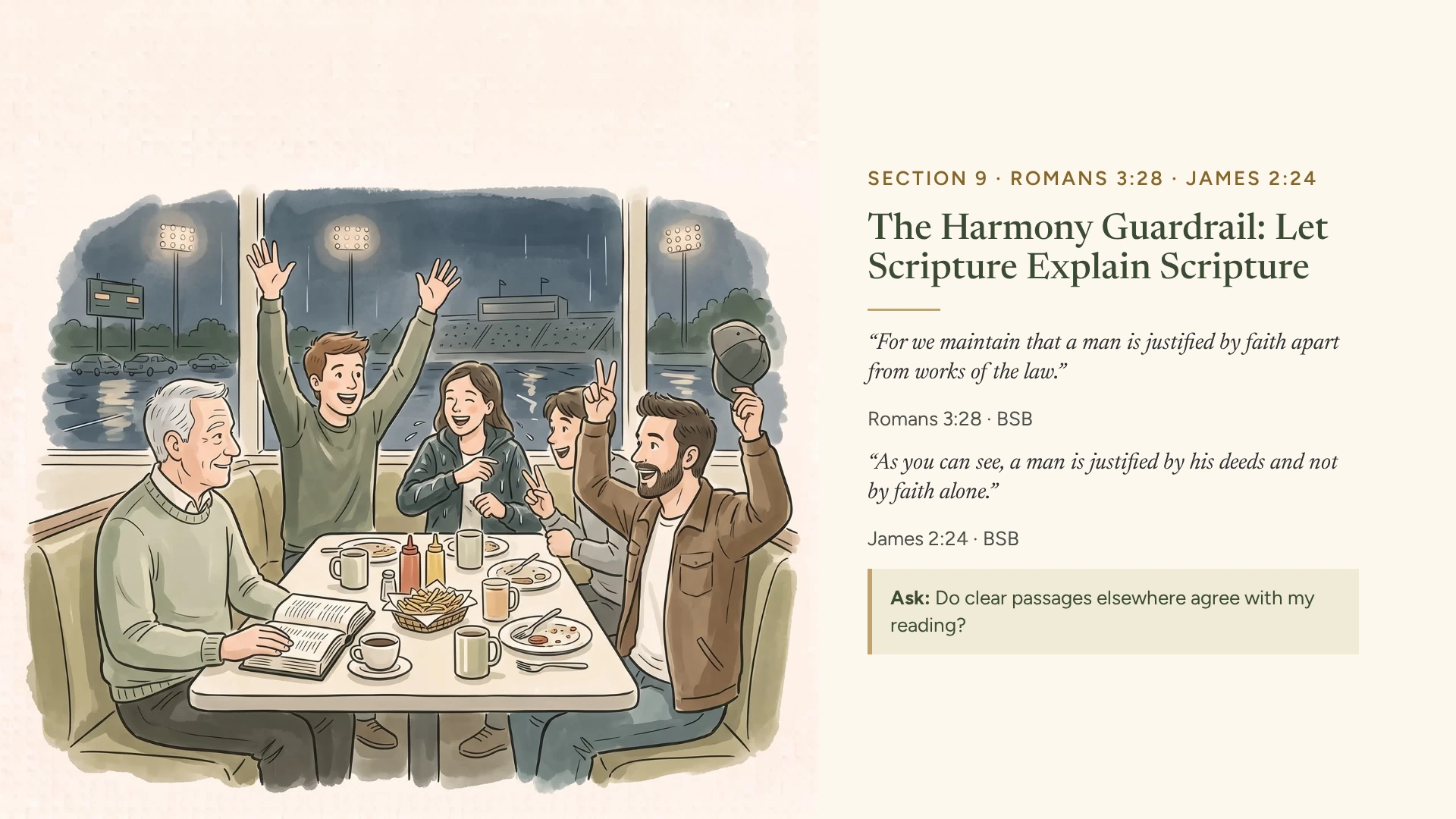
The Bible is one Word spoken in many voices over many centuries, and it holds together. When a passage puzzles you, you don't have to guess or choose sides. Let the clear passages help you understand the hard ones, and trust the Author not to contradict Himself.
Seven Rails, One Road
Think back to your grandmother's letters in Section 2. Without knowing it, you used all seven guardrails. You read a birthday card differently from the letter about selling the farm. You remembered when each letter was written. You went back to her Spanish when a translation sounded odd. You let her say what she said. You took one sentence to mean one thing. You let a later letter explain an earlier one. And you read the letter that sounded unlike her in light of the whole box. Now the guardrails have names, and each one has a question to ask of any passage:
| Guardrail | The question to ask | Goes deeper |
|---|---|---|
| Literal | What genre is this, and what does it actually say in that genre? | Lesson 5 |
| Contextual | What surrounds it, what did the first readers know, and where does it sit in the whole story? | Lesson 6 |
| Linguistic | Is there a word where the Hebrew or Greek adds nuance? | Lesson 7 |
| Exegetical | What is the Author saying in this passage to the original audience? | Lesson 8 |
| One-Meaning | What is the one thing this meant when it was first given, before later revelation illuminated it further? | Lesson 9 |
| Progressive | Where does this sit in the unfolding story? What had God revealed by then, and what did He reveal later? | Lesson 10 |
| Harmony | Do clear passages elsewhere agree with my reading? | Lesson 11 |
If you read the textbook, you'll notice it lists the guardrails in a different order, with One-Meaning third and Linguistic fifth. The textbook introduces them the way a teacher would. Abide puts them in the order a reader uses them: observe carefully first, then interpret. The first four help us see what's on the page and hear the Author's voice. One-Meaning brings what we've found together. Progressive and Harmony widen the view to the whole Bible.
The guardrails also work together. You saw it in every section. In Matthew 6, the verses about treasure and money came first, and the Hebrew idiom of the good eye confirmed what they pointed to. In 1 Timothy 6, reading carefully caught the three words the popular saying leaves out, the love of, and knowing the first audience explained why they mattered: teachers in Ephesus were using religion to get rich. Paul and James came together only when we read each one where it lives. A guardrail is one rail among seven, and together they line one road. Sometimes a later guardrail sends you back to an earlier one, and that's part of how they work. Lesson 4 shows how to use them in order, how the process circles back, and the two questions that come after them: what the abiding principle is, and how to live it out.
Section 1 began with Moses warning Israel not to add to God's words or take away from them. A little later in the same speech, he described the road:
32 So be careful to do as the LORD your God has commanded you; you are not to turn aside to the right or to the left. 33 You must walk in all the ways that the LORD your God has commanded you, so that you may live and prosper and prolong your days in the land that you will possess.
Not to the right or to the left: those are the two cliffs. But notice where Moses puts the weight. The point of staying on the road isn't the road itself. It's walking with God, "so that you may live" (Deuteronomy 5:33, BSB). We learn to read carefully so we can obey faithfully. Lesson 1 called this abiding: remaining in Jesus' love by keeping His commandments (John 15:10). And you don't walk this road alone. Jesus promised that the Holy Spirit "will teach you all things and will remind you of everything I have told you" (John 14:26, BSB).
- In verse 32, what two directions does Moses warn against?
- In verse 33, what does walking in God's ways lead to?
- Look back at the seven questions in the table. Which one do you tend to skip? Which one do you want to practice first?
- Think of a verse you've often heard quoted. Which cliff has it been pushed toward, and which guardrail would bring it back to the road?
- How is God inviting you to live out this abiding principle this week?
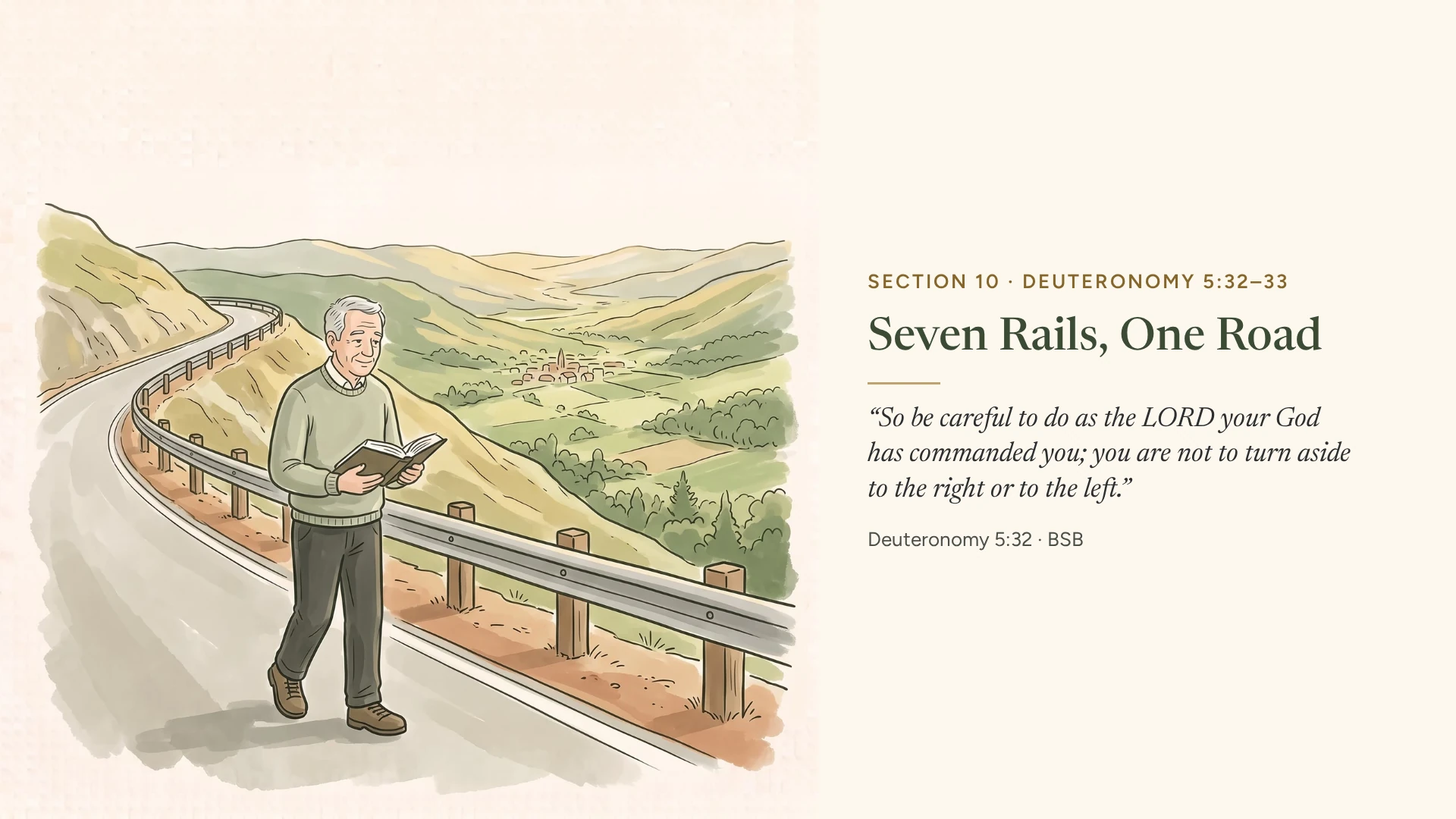
Seven rails, one road, one Author. The guardrails don't slow you down. They keep you on the road, so you can hear what God said and do it.
Meditate and Obey. Study and Apply. Hear and Do.
This is how we abide in Christ. This is how we demonstrate our love for God.
Sources
- Fuhr, Richard Alan, Jr., and Andreas J. Köstenberger. Inductive Bible Study: Observation, Interpretation, and Application through the Lenses of History, Literature, and Theology. Nashville: B&H Academic, 2016. Ch. 2, "Inductive Bible Study," 20–44; also 49–55, 191–194, 232–234.
- BibleProject. How to Read the Bible video series. Episode 3, "Literary Styles," and episode 4, "Ancient Jewish Meditation Literature." Tim Mackie and Jon Collins. bibleproject.com.
- BibleProject. "How Much Context Do We Really Need?" Podcast episode and show notes, August 10, 2020. https://bibleproject.com/podcasts/how-much-context-do-we-really-need/.
- BibleProject Scholarship Team. "What Matthew 6:22-23 (The Eye Is the Lamp of the Body) Means." September 2, 2024. https://bibleproject.com/articles/what-matthew-622-23-eye-lamp-body-means/.
- Brown, Francis, S. R. Driver, and Charles A. Briggs. Enhanced Brown-Driver-Briggs Hebrew and English Lexicon. Oxford: Clarendon Press, 1977. S.v. טוֹב, 373–375.
- Calvin, John. Commentary on a Harmony of the Evangelists, Matthew, Mark, and Luke. Translated by William Pringle. Vol. 1. Edinburgh: Calvin Translation Society, 1845, 335–337.
- Concise Oxford English Dictionary. 11th ed. Edited by Catherine Soanes and Angus Stevenson. Oxford: Oxford University Press, 2004. S.v. "literal."
- Edwards, James R. The Gospel according to Luke. Pillar New Testament Commentary. Grand Rapids: Eerdmans; Nottingham: Apollos, 2015, 320–324.
- Evans, Craig A. The Bible Knowledge Background Commentary: Matthew–Luke. Colorado Springs: David C Cook, 2003, 131–132.
- Quarles, Charles L. "Matthew." In Holman Illustrated Bible Commentary, 1017. Nashville: B&H, 2015.
- Sproul, R. C. Grace Unknown: The Heart of Reformed Theology. Grand Rapids: Baker Books, 2000, 55–57.
- Sproul, R. C. Knowing Scripture. Downers Grove, IL: InterVarsity Press, 2009, 53–54.
Scripture quotations marked Berean Standard Bible (BSB) or Majority Standard Bible (MSB) are taken from texts that have been dedicated to the public domain. Free resources are available at BereanBible.com and MajorityBible.com.
Scripture quotations taken from the (LSB®) Legacy Standard Bible®, Copyright © 2021 by The Lockman Foundation. Used by permission. All rights reserved. Managed in partnership with Three Sixteen Publishing Inc. LSBible.org and 316publishing.com.