Thinking Like Sherlock Holmes
Read the Bible like a good detective: gather the evidence before reaching a verdict, and let ten questions walk you from what the text says, through what it meant, to how God is inviting you to live it.
The Bad Detective and Sherlock Holmes
Every detective show has one. The bad detective walks into the room, takes one look at the butler, and decides on the spot: he did it. From then on, every clue gets bent to fit. Mud on the butler's shoes? Proof. A witness who saw him across town? She must be confused. A fingerprint that belongs to someone else? Probably planted. The case closes fast, and the wrong man goes to prison.
Then there's Sherlock Holmes. In "A Scandal in Bohemia," Arthur Conan Doyle's detective teases his friend Dr. Watson, who has climbed the stairs to their rooms hundreds of times but can't say how many steps there are. "You see, but you do not observe," Holmes tells him. Holmes knows: there are seventeen. A few lines later, handed a mysterious note, Holmes refuses to guess what it means: "It is a capital mistake to theorise before one has data. Insensibly one begins to twist facts to suit theories, instead of theories to suit facts." Holmes lets the clues lead him to the answer. The bad detective drags the clues to the answer he already picked.
Those two detectives are two ways to read the Bible. The textbook behind Abide, Fuhr and Köstenberger's Inductive Bible Study, calls them deduction and induction. It describes "inductive, or evidence-based, study" and "deductive, or assumption-based, study," and sums up the difference in a small table:
| Deduction | Induction |
|---|---|
| Assumption based | Evidence based |
| Moves from universals to particulars | Moves from particulars to universals |
| Begins with absolute premises and derives certain conclusions | Pieces the data together to derive meaning (probable conclusions) |
In everyday words, deduction starts with the answer and looks for support. Induction starts with the clues and builds toward the answer. With a deductive approach, the textbook says, "you begin with certain assumptions or beliefs and allow the Bible only room to support those assumptions or beliefs." With an inductive approach, "you explore the Bible and arrive at conclusions only once you've compiled all the evidence." (Holmes himself called his method "the science of deduction," the title Doyle gave a chapter of A Study in Scarlet, using the word in its everyday sense of reasoning things out. By the textbook's definitions, Holmes's habit of gathering the data before the theory is induction.)
You've probably seen the deductive posture in Bible study, or caught yourself in it. Someone opens the Bible to prove predestination, or to disprove it. Someone sets out to show that a true believer can never lose salvation, or that one can. Someone needs a verse for their side of a cultural debate. These are serious questions, and faithful Christians have studied them carefully and landed in different places. This lesson won't settle any of them. The question here is the posture, not the topic: did I come to the Bible to find out what it says, or to find support for what I had already decided? The textbook warns that a deductive approach "often presupposes conclusions before the evidence is gathered and fails to ask the critical questions pertaining to what the author intended to say through the text being studied." That's the proof texting you met in lesson 3, grabbing verses to back up a point we've already settled. It's the bad detective's method, and it works just as badly with the Bible as it does with the butler.
Before we point at anyone else, notice that the textbook's authors point at themselves. Fuhr and Köstenberger confess, "we're quite certain that there are cases where we, too, have not allowed the Bible to speak for itself, where we have imposed our own understanding upon the text before discovering its meaning through the process of inductive study." Every reader plays the bad detective sometimes. Induction begins with humility: being willing to let Scripture change a belief I already hold.
The wisdom behind this is old. Solomon gathered proverbs for Israel "to impart prudence to the simple and knowledge and discretion to the young" (Proverbs 1:4, BSB). In chapter 18, three proverbs about listening sit within a few verses of each other (verses 13, 15 and 17). Each proverb stands on its own, so read those three closely:
13 He who answers a matter before he hears it—this is folly and disgrace to him. 14 The spirit of a man can endure his sickness, but who can survive a broken spirit? 15 The heart of the discerning acquires knowledge, and the ear of the wise seeks it out. 16 A man’s gift opens doors for him, and brings him before great men. 17 The first to state his case seems right until another comes and cross-examines him.
Solomon is talking about listening to people: hearing someone out before you answer, and letting both sides speak before you settle a dispute. That is what these proverbs meant for Israel, and it's wisdom for every conversation you'll have this week. The same wisdom fits the way we read. If it's folly to answer a person "before he hears it" (Proverbs 18:13, BSB), it's folly to decide what God is saying before we have heard Him out.
- In verse 13, what does the person do before he hears? What does Solomon call it?
- In verse 17, what changes when "another comes"?
- Why might the first person to state a case seem right? What does verse 15 say the wise do instead?
- What do these proverbs teach about how a wise person reaches a judgment?
- How is God inviting you to live out this abiding principle this week?
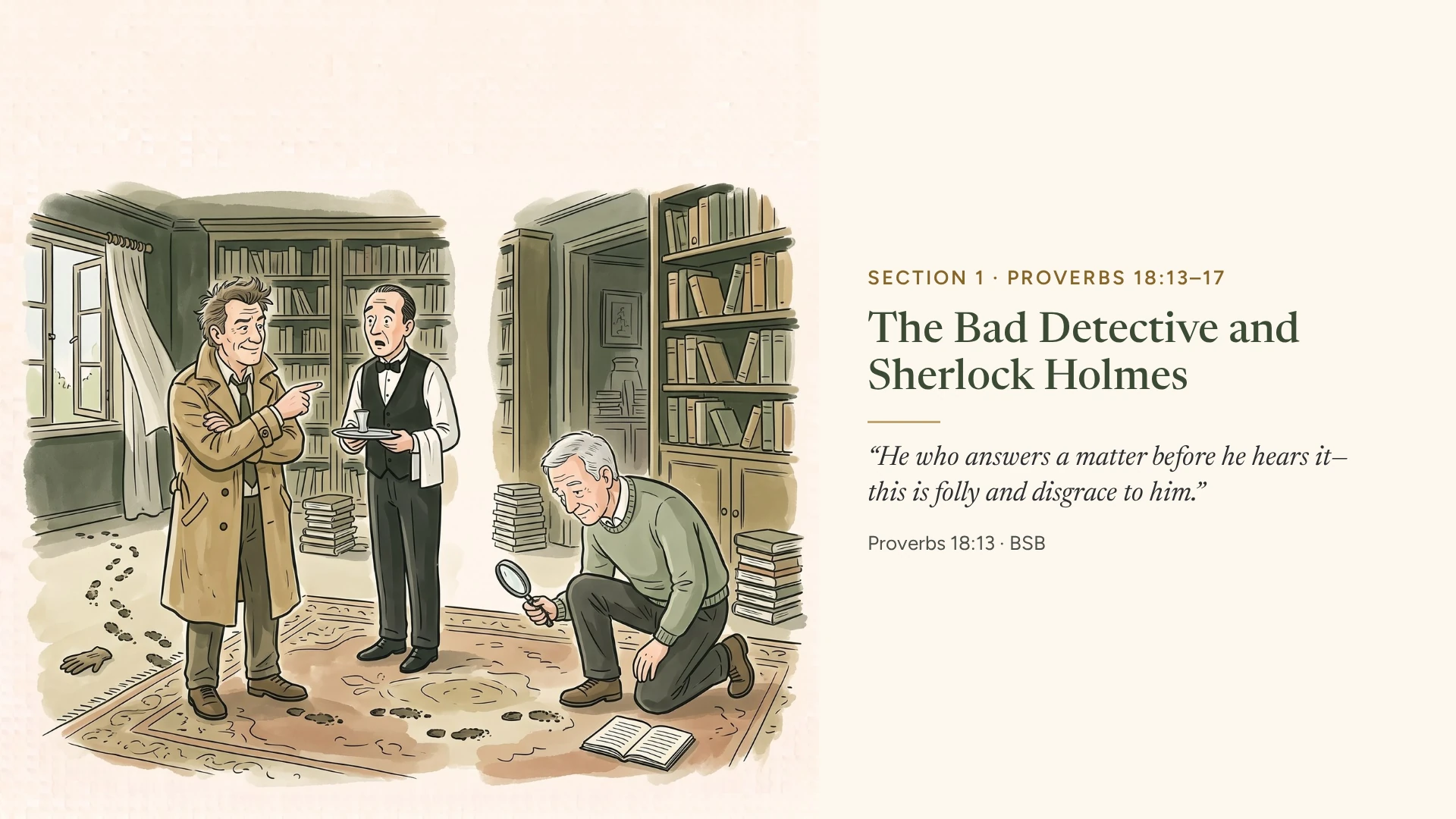
The bad detective decides first and looks for clues later. Holmes gathers the clues and lets them lead. Read the Bible like Holmes: observe before you conclude, and be willing for the evidence to change your mind.
Why the Inductive Mindset Matters
Think of the last time someone finished your sentence for you and got it wrong. You were halfway through a story, and they jumped in with the ending they expected. Maybe they meant well. But you walked away feeling unheard. When we read the Bible deductively, we do that to God. We finish His sentences for Him.
The inductive mindset is the opposite. It's how you listen to someone you respect. Here are three reasons it matters so much in Bible study, and a fourth that should encourage you.
It honors what the Bible is. In lesson 2 you saw the gaps between the Bible's world and ours: history, language, culture and theology. An ancient book from God deserves to be heard on its own terms, not ours. The textbook puts it this way: "Induction is discovery, and we believe that approaching the Bible with an attitude of seeking to discover the meaning of the text is most compatible with the Bible as intentional communication from God to us." The guardrails from lesson 3 tell us where the edges of the road are. The inductive mindset is how we drive it: carefully, with our eyes open.
It keeps us from bending the Bible. We don't want to bend the Bible to fit our beliefs. We want our beliefs, and the way we live, to be shaped by the Bible. That doesn't mean Christians can't hold firm convictions. The textbook says deduction "is not inferior or negative in and of itself," and admits that when scholars teach a full system of doctrine, "deduction is often evident in the presentation." The difference is the order. Doctrine comes last, built up from the texts, not first, deciding what the texts are allowed to say.
It grows discernment. In lesson 1 you met the Bereans, who checked even the apostle Paul's teaching against the Scriptures (Acts 17:11). The textbook says the inductive method "encourages consultation while also equipping you to be more discerning in how to use sources." It even prepares you "to disagree with the conclusions of others when the evidence doesn't support those conclusions." That isn't suspicion of your pastor or your favorite teacher. Good teachers want you to check them. It's the Bereans' habit: weigh every voice against Scripture, including this one.
And you can start now. The textbook says the method fits anyone, "completely new to the Bible or seasoned by decades of exposure," and it bends to the time you have, "whether reading a devotion at the breakfast table or preparing next week's sermon at the office." You don't need a seminary degree. You need curiosity, and a willingness to keep looking.
Scripture has a picture for that curiosity. In Proverbs, a father teaches his son: "Listen, my son, to your father's instruction" (Proverbs 1:8, BSB). In chapter 2 he describes how to go after wisdom:
1 My son, if you accept my words and hide my commandments within you, 2 if you incline your ear to wisdom and direct your heart to understanding, 3 if you truly call out to insight and lift your voice to understanding, 4 if you seek it like silver and search it out like hidden treasure, 5 then you will discern the fear of the LORD and discover the knowledge of God.
The father isn't describing a casual glance. He piles up verbs: accept, hide, incline, direct, call out, lift your voice, seek, search. Then he names the prize. It isn't just information. It's "the knowledge of God" (Proverbs 2:5, BSB), because "the LORD gives wisdom; from His mouth come knowledge and understanding" (Proverbs 2:6, BSB). That's the inductive spirit: a holy curiosity that keeps digging because it knows there's treasure in the ground, and the treasure is knowing God.
- List the "if" phrases in verses 1–4. What does each one ask the son to do?
- What does verse 5 promise, and what word does it begin with?
- Why would the father compare wisdom to silver and hidden treasure? What does that say about its value, and about the effort it takes?
- What does this passage teach about the kind of seeking God honors?
- How is God inviting you to live out this abiding principle this week?
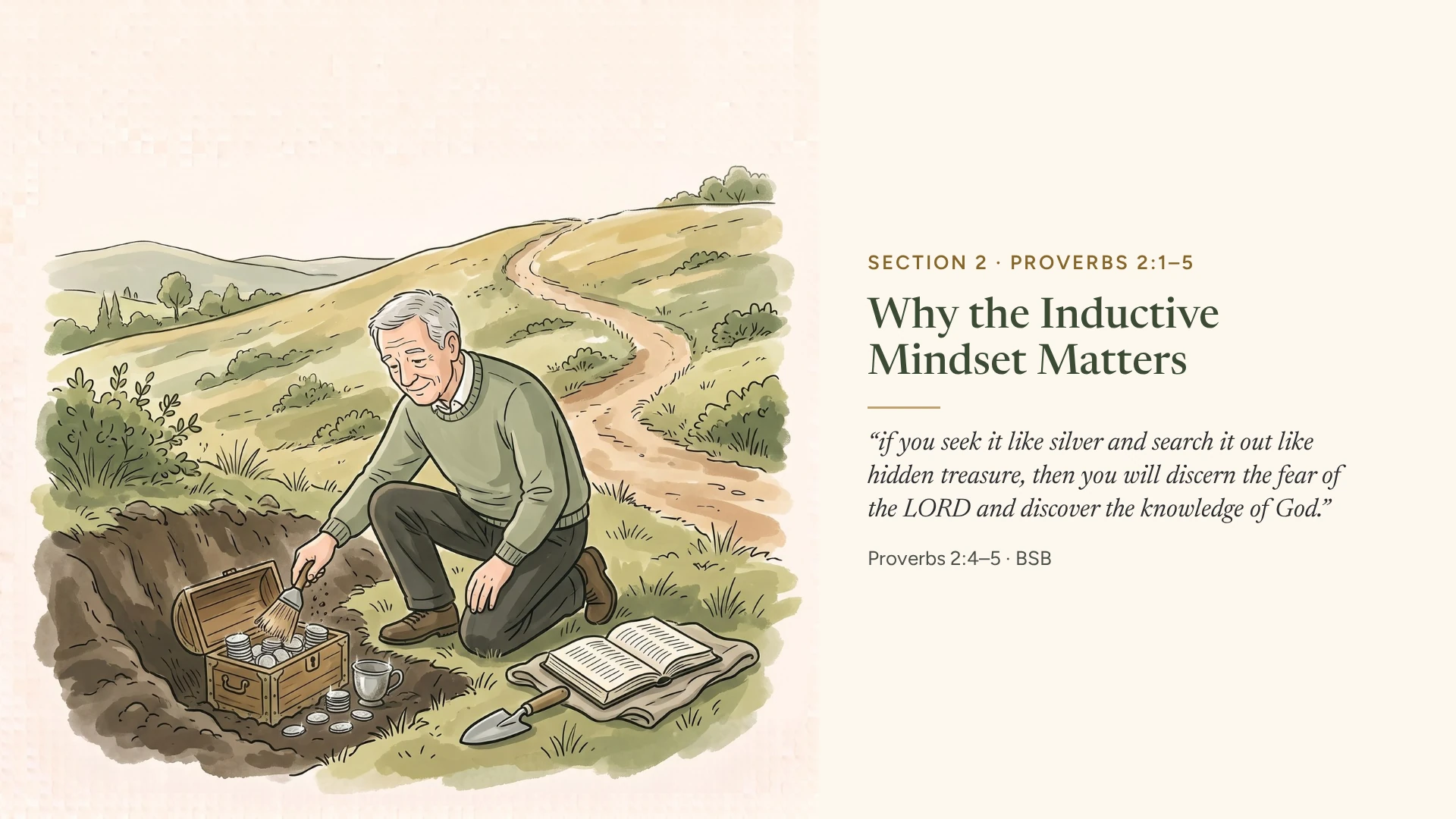
The inductive mindset isn't a technique for experts. It's a posture of respect toward God's Word: let it speak, let it shape you, and keep searching like someone who knows the treasure is real.
Three Stretches of Road: Observation, Interpretation, Application
Holmes solves every case in three moves. First he observes the scene: the mud, the ash, the worn sleeve. Then he puts the clues together and works out what happened. Then he acts on it. Bible study has the same three moves. The textbook calls them a "traditional three-step framework: observation, interpretation, and application," and says it is "strikingly simple yet has the capacity to integrate very complex procedures." A new believer can use it this week, and scholars use the same steps for their most careful work.
Picture the road from the page to your life in three stretches. Each one stands on the one before it, like the steps of a staircase.
Observation: What does it say? The textbook says observation "seeks to establish a foundational knowledge of what the text is saying." It's Holmes counting the stairs. You read slowly, notice who is speaking and to whom, what repeats, what connects, and what surprises you, and you write down your questions. Observation doesn't solve the case yet: "Observation may not put all the pieces together, but that is not the goal of observation. Simply put, good observation will ensure that all the pieces are available." The first guardrails you met in lesson 3 work mostly here: what kind of writing is this, what surrounds it, which words matter, and what is the Author saying.
Interpretation: What did it mean? Now the detective puts the clues together. Interpretation "seeks to understand the meaning of the text at its exegetical level, that is, what the text was intended to convey by its original author to his original audience." That's why it waits for observation: "thorough interpretation is possible only once the process of observation is completed." Here we read the passage in its context, compare it with other passages, "allowing the Bible to function as its own best commentary," and consult good tools like study Bibles and commentaries. The textbook adds a wise word about those tools: "in an inductive approach, we don't simply rely on commentaries but rather engage with them."
Application: How do we live it? Last, we carry the meaning into life. The textbook insists that "valid application must have its basis in an accurate interpretation of the text," and it asks a fair question: "how often does the tail wag the dog and we start with application?" Application works on two levels. First, what does this passage mean for God's people today? Then, what does it mean for me? That second level is where the Holy Spirit presses the Word into one person's heart (Hebrews 4:12).
Between interpretation and application there's a bridge. The textbook says application begins "by finding sensible parallels between interpretation and application." In Abide we call that bridge the abiding principle: the timeless truth in a passage that holds for God's people in every age. You've been walking this road since lesson 1. Most Engage the Text blocks so far have used these labels: Observation, Interpretation, Abiding Principle, Application. Now the road has a name. Abide 103 will teach the steps inside each stretch in more detail; this lesson gives you the map.
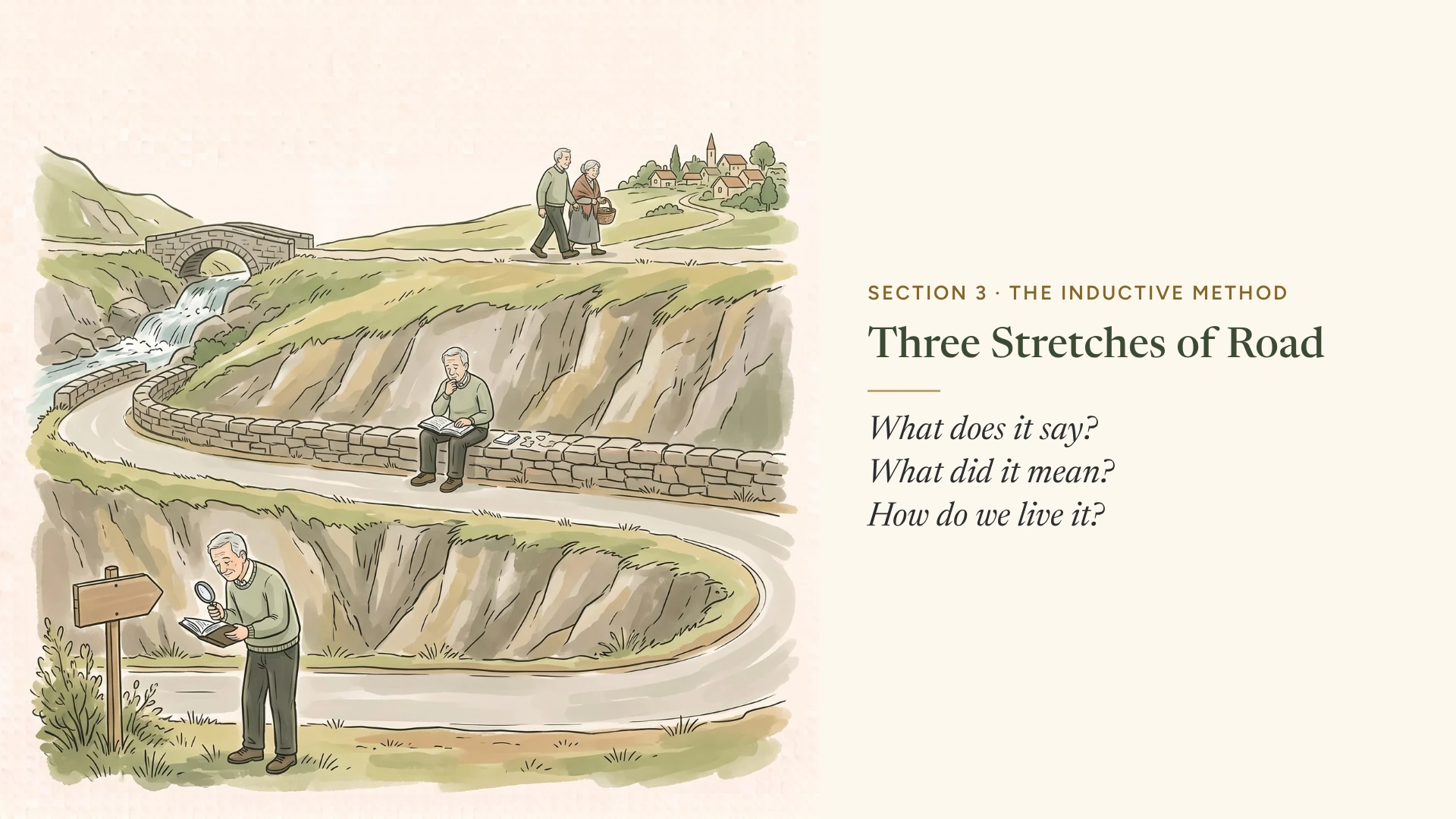
Observation asks what it says. Interpretation asks what it meant. Application asks how to live it. Take them in that order, and you won't start building a life on a verse you haven't yet understood.
Ten Questions for the Road
Airline pilots with thousands of hours in the air still run a checklist before every takeoff. They haven't forgotten how to fly. The checklist catches what experience skips on a busy morning.
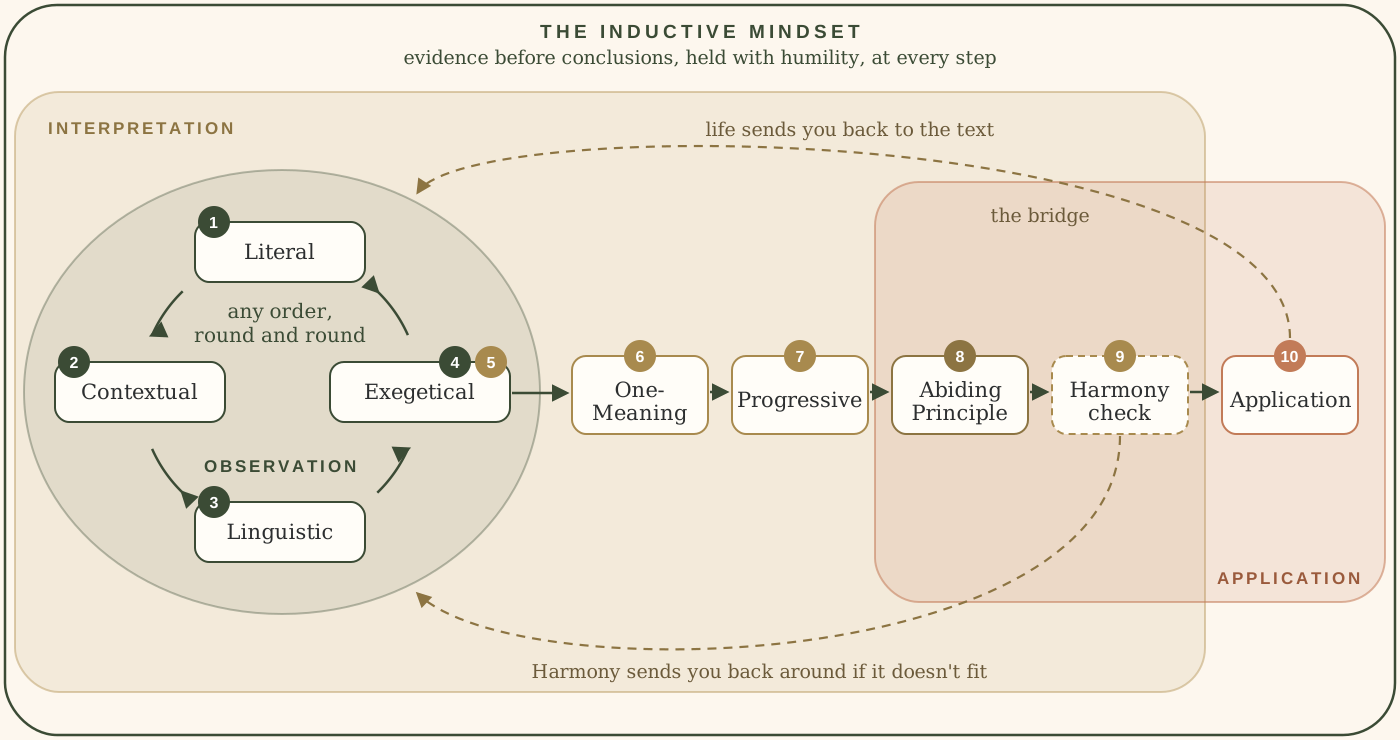
Abide has a checklist for the road too: ten questions. They aren't from the textbook; they are Abide's own tool, built from the guardrails. Lesson 3 gave you seven of them, one for each guardrail. This lesson adds three: a second question for the Exegetical guardrail, a question for the abiding principle, and the application question you've been answering since lesson 1. Here's how they fit together.
The first four questions form a circle. You'll notice the genre, the context and the key words in the same careful reading, in any order, round and round, and each one corrects the others. Question 4 pulls them together, and when the meaning comes clear, the road runs on through the rest. Notice that the Observation circle sits inside Interpretation: as the textbook says, "one can't help but draw interpretive inferences during the process of observation." And the abiding principle and the Harmony check sit where Interpretation and Application overlap, because they belong to both. And the whole road sits inside the frame of Section 1: the inductive mindset, evidence before conclusions, held with humility at every step, from the first observation to this week's obedience.
Inductive Bible Study
A time-tested method for handling "the word of truth" accurately (2 Timothy 2:15, BSB)
| # | The question to ask | Stage | Guardrail |
|---|---|---|---|
| 1 | What genre is this, and what does it actually say in that genre? | Observation | Literal |
| 2 | What surrounds it, what did the first readers know, and where does it sit in the whole story? | Observation | Contextual |
| 3 | Is there a word where the Hebrew or Greek adds nuance? | Observation | Linguistic |
| 4 | What is the Author saying in this passage to the original audience? | Observation, turning into Interpretation | Exegetical: drawing the meaning out |
| 5 | What am I bringing to this text that I need to let go of? | Interpretation: a posture check | Exegetical: not reading a meaning in |
| 6 | What is the one thing this meant when it was first given, before later revelation illuminated it further? | Interpretation | One-Meaning |
| 7 | Where does this sit in the unfolding story? What had God revealed by then, and what did He reveal later? | Interpretation | Progressive |
| 8 | What is the timeless, abiding principle that applies to us today? | The bridge to Application | Abiding principle |
| 9 | Do clear passages elsewhere agree with my reading? | A check on the meaning and the principle | Harmony |
| 10 | How might we apply this abiding principle to our lives today? How is God inviting you to live out this abiding principle this week? | Application | Application |
The order is on purpose. Here's why.
- Observe before you interpret. Questions 1 to 4 gather the clues. The first three often happen together, and a key word (question 3) often helps you hear what the Author is saying (question 4), so question 4 comes last of the four.
- The Exegetical guardrail gets two questions. Question 4 draws the meaning out. Question 5 checks that we aren't reading our own meaning in. It's written with "I" on purpose. It isn't an accusation; it's a mirror.
- "Saying" becomes "meant." Question 4 asks what the Author is saying; question 6 asks what it meant. That small change in the verb is the handoff from observation to interpretation.
- The first meaning before the later light. Question 6 names the first meaning before question 7 brings in what God revealed later. Asked the other way around, later revelation can hide what the first readers heard. Name the acorn before you admire the oak.
- Harmony checks the principle too. In lesson 3, Harmony was the seventh guardrail. In the questions it comes ninth, after the abiding principle, because the principle is where readers drift most. Lesson 3 showed how a proverb about raising children can get turned into a guarantee. Harmony tests the meaning and the principle against clear passages before anyone acts on them.
- Apply last. Nothing gets applied until the meaning is stated, the principle is drawn, and the rest of Scripture has confirmed both. Then question 10 turns personal, in bold, the way every Engage block in Abide ends.
You won't always need all ten at full length. On a busy morning, they can run in five quiet minutes; in a deep study, they can fill a notebook. Either way, the order keeps you honest.
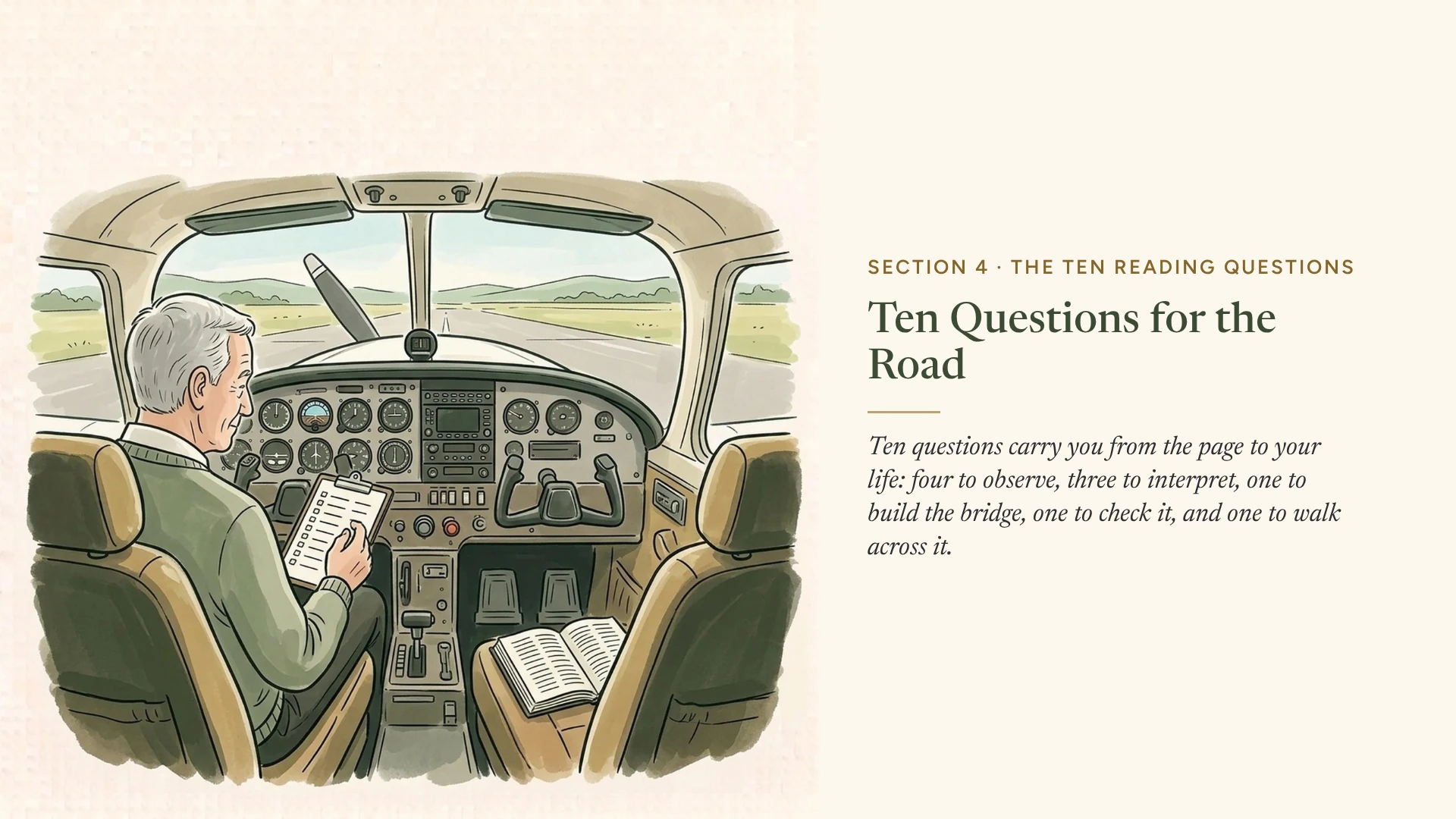
Ten questions carry you from the page to your life: four to observe, three to interpret, one to build the bridge, one to check it, and one to walk across it.
The Road Circles Back
Some mountain roads don't climb straight up. They switch back and forth across the mountainside. Again and again the road turns, and you pass above the same valley you saw a few minutes ago. You haven't gone backward. You're higher, and you see more of the valley each time.
Bible study works the same way. The ten questions run in order, but the road circles back. The textbook says so: "There will inevitably be movement back and forth between these steps, but the general flow will be linear." It calls the method "a process that benefits from order yet also encourages flexibility," with steps "integrated in a cyclical fashion as well as a linear one." It gives examples: "one can't help but draw interpretive inferences during the process of observation," and "application sometimes poses new questions that have a bearing on the interpretation of the text."
Here are the three places the road most often circles back:
- A word sends you back to the context. Question 3 finds a word with a range of meanings, and the dictionary can't choose between them. So you go back to question 2: what surrounds it? In lesson 3, the "good eye" of Matthew 6:22 made sense only when you read the verses about treasure and money on either side.
- Harmony sends you back to the start. If your reading clashes with clear passages elsewhere (question 9), don't force it. Go back around: check the genre, the context, the words, and whose meaning you're after. Lesson 3 promised that lesson 4 would show how that loop works; you'll see it in the next two sections.
- Life sends you back to the text. You try to apply a passage (question 10), and a real situation raises a question you hadn't asked. That sends you back to interpretation, and often back to observation, to look again.
Each pass goes deeper. That's why a passage you've read for twenty years can still surprise you. BibleProject's Tim Mackie says it well: "you're actually not expected to notice all of this by yourself or all at once." The Bible invites "a lifetime of reading and re-reading." The process is a spiral: in order, yet circling back, and climbing all the time.
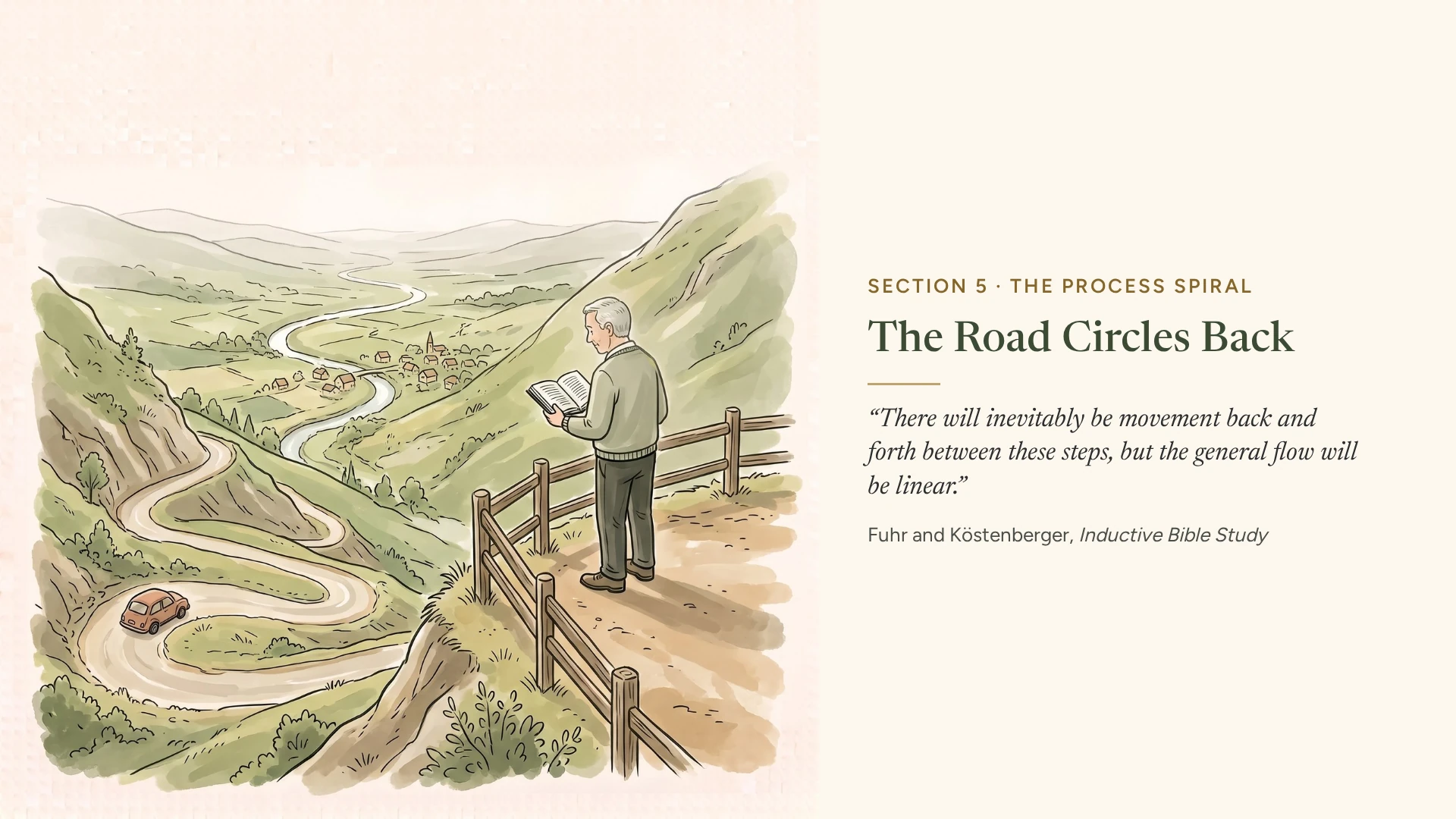
Going back isn't failure. It's how the road climbs. Follow the questions in order, expect to circle back, and each time around you'll see more of the view.
The Drive, Part 1: Observing Matthew 7:1–6
If there's one verse people know who don't read the Bible, it may be this one. In his commentary on the Sermon on the Mount, Daniel Akin calls Matthew 7:1 "one of the most well-known and often quoted verses from the Bible in the twenty-first century," and adds, "People who know little of the Bible's content know this verse." It gets used in two opposite ways. Some quote it to shut down any moral conversation at all: Who are you to judge? Others, Christians included, rarely think about it and stay quick to criticize. One reading pushes the verse past what Jesus said; the other quietly leaves His words out. Two cliffs.
So let's take the drive. We'll walk the ten questions through Matthew 7:1–6 in order, and we'll mark the places where the road circles back. Before you start, read the whole Sermon on the Mount, Matthew 5–7, in one sitting. Then read the passage:
1 “Do not judge, or you will be judged. 2 For with the same judgment you pronounce, you will be judged, and with the measure you use, it will be measured to you. 3 Why do you look at the speck in your brother’s eye but fail to notice the beam in your own eye? 4 How can you say to your brother, ‘Let me take the speck out of your eye,’ while there is still a beam in your own eye? 5 You hypocrite! First take the beam out of your own eye, and then you will see clearly to remove the speck from your brother’s eye. 6 Do not give dogs what is holy; do not throw your pearls before swine. If you do, they may trample them under their feet, and then turn and tear you to pieces.
1. What genre is this, and what does it actually say in that genre? (Literal) Matthew's Gospel tells the story of Jesus, and inside the story Jesus teaches. Matthew frames this teaching clearly: "He began to teach them" (Matthew 5:2, BSB), and at the end, "When Jesus had finished saying these things" (Matthew 7:28, BSB). It's a sermon, full of short, memorable sayings and vivid pictures. And the picture in verses 3–5 is meant to be funny. The "speck" is a tiny bit of wood or straw; the "beam" is the kind of timber that holds up a roof. Commentator Craig Keener asks us to "consider the absurdity of one's walking around with a thick roof beam protruding from one's eye." Craig Evans says the picture "surely sparked laughter." Jesus uses exaggeration on purpose, so the point sticks. The dogs, pigs and pearls in verse 6 are pictures too. So what does it actually say? Jesus is making a serious point with humor and hyperbole, and nobody is meant to go looking for lumber.
2. What surrounds it, what did the first readers know, and where does it sit in the whole story? (Contextual) Take the three layers from lesson 3.
- What surrounds it. The sermon opens with blessings, including "Blessed are the merciful, for they will be shown mercy" (Matthew 5:7, BSB). In the Lord's Prayer and right after it, Jesus ties God's forgiveness to ours: "if you forgive men their trespasses, your heavenly Father will also forgive you" (Matthew 6:14, BSB). Three times in chapter 6 He warns against acting "like the hypocrites" (Matthew 6:5, BSB; see 6:2, 16), and now He calls the beam-eyed critic "You hypocrite!" (Matthew 7:5, BSB). Just after our passage come two more clues. The Golden Rule, "do to others as you would have them do to you" (Matthew 7:12, BSB), echoes the measure of verse 2; Keener calls it a frame around this whole section. And a few verses later Jesus says of false prophets, "By their fruit you will recognize them" (Matthew 7:16, BSB). Recognizing a false prophet takes evaluation. Hold on to that clue.
- What the first readers knew. Matthew sets the scene: "When Jesus saw the crowds, He went up on the mountain and sat down. His disciples came to Him" (Matthew 5:1, BSB). Jesus taught His disciples, with large crowds from Galilee, Jerusalem, Judea and beyond listening in (Matthew 4:25; 7:28). They knew the Law of Moses well enough that Jesus could say, again and again, "You have heard that it was said" (Matthew 5:38, BSB). They knew the marketplace too. Keener explains, "In the marketplace one would measure out to others the appropriate portions of what they were purchasing," and the saying about the measure had become a familiar Jewish proverb. And they knew dogs and pigs. Craig Blomberg notes, "The dogs described here are wild scavengers. The pigs best represent unclean animals for Jews," animals the Law called "unclean for you" (Leviticus 11:7, BSB). Nobody in that crowd pictured a family pet.
- Where it sits in the whole story. This is Jesus, early in His ministry and before the cross, teaching His disciples what life looks like in "the kingdom of heaven" (Matthew 5:3, BSB). Question 7 will ask what God revealed before and after; for now, we just note where we are.
3. Is there a word where the Hebrew or Greek adds nuance? (Linguistic) Two words stand out. The first is judge, the Greek krinō. It's a word with range. The classic Greek lexicon by Liddell and Scott gives its first sense as "separate, put asunder, distinguish," and lists Matthew 7:1 under the sense "pass sentence upon, condemn." Louw and Nida's lexicon of New Testament Greek places this kind of judging with words that mean "to judge a person to be guilty and liable to punishment." Blomberg sums up the range: krinō "can imply to analyze or evaluate as well as to condemn or avenge. The former senses are clearly commanded of believers ... but the latter are reserved for God."
Back around. So which sense does Jesus mean? The lexicon can't decide, so the road circles back to question 2, because, as lesson 3 put it, context comes before dictionary definitions. And the context answers. Verse 5 doesn't forbid helping your brother; it tells you how to do it: "then you will see clearly to remove the speck" (Matthew 7:5, BSB). Verse 16 expects disciples to recognize false prophets by their fruit. So Jesus can't mean never evaluate anything. The word leans toward the judge's verdict: condemning.
The second word is eye, the Greek ophthalmos. It appears six times in verses 3–5, and it's the same word that runs through the whole sermon: the right eye that causes you to sin (Matthew 5:29), "Eye for eye" (Matthew 5:38, BSB), and the good eye of Matthew 6:22 that you studied in lesson 3. Keener connects the two passages when he writes, "One blinds oneself by rationalizing away one's guilt," citing both Matthew 7:3–5 and 6:22–23. Jesus keeps talking about how we see. In chapter 6, a generous eye fills a life with light. In chapter 7, a beam in the eye blinds us to ourselves.
4. What is the Author saying in this passage to the original audience? (Exegetical) Put the clues together, and Jesus is telling His disciples something like this: Don't set yourself up as the judge who condemns your brother, especially while you ignore your own bigger sin, because God will measure you by the measure you use. Deal with your own sin first. Then, seeing clearly, help your brother. And don't keep offering what is holy to people who treat it with contempt. Who does the judging in "you will be judged" (Matthew 7:1, BSB)? Keener reads it as a way of saying God is the one who acts, "indicating that God will judge conclusively on the day of judgment." R. T. France allows both: it "may well refer to God's judgment, as well as that of other people." Either way, the warning is serious.
- How many times does the word "eye" appear in verses 3–5? Whose eye is each one?
- What does verse 5 tell the hypocrite to do first, and what comes after?
- What genre is this, and what does it actually say in that genre?
- What surrounds it, what did the first readers know, and where does it sit in the whole story?
- Is there a word where the Hebrew or Greek adds nuance?
- What is the Author saying in this passage to the original audience?
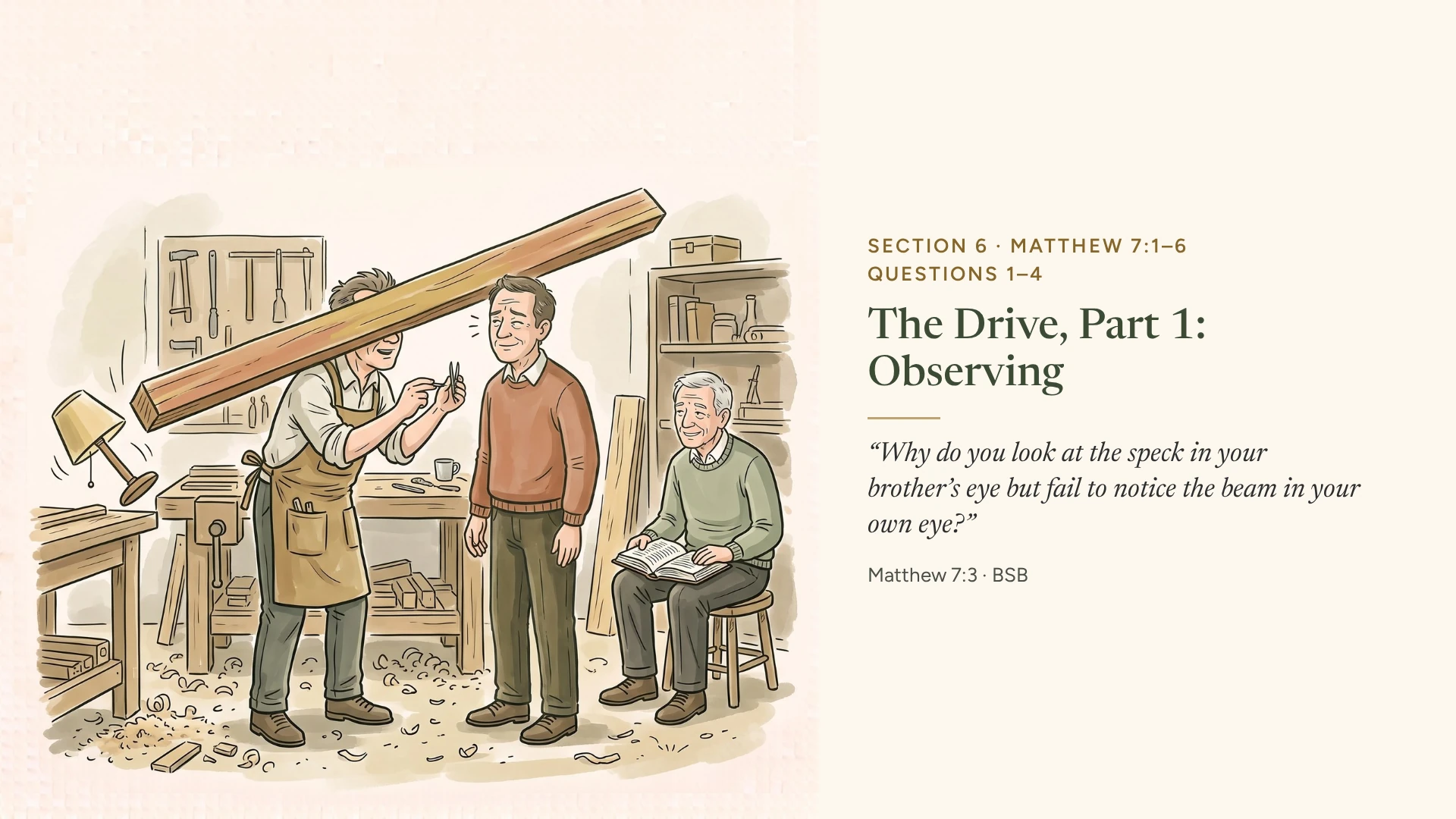
Observation slows us down long enough to see what's really there: humor, a repeated word, and a sermon full of both mercy and discernment. Before we decide what Do not judge means, we've already noticed that Jesus wants His disciples to see clearly.
The Drive, Part 2: Interpreting and Applying Matthew 7:1–6
The clues are on the table. Now we interpret, build the bridge, check it, and walk across.
5. What am I bringing to this text that I need to let go of? (Exegetical) Let me answer this one in the first person, the way the question is written. Maybe I bring my culture's version of the verse: don't judge me means no one may ever say that anything I do is wrong. Or maybe I bring the opposite. I enjoy spotting what's wrong with other people, and I call it discernment. The Reformer John Calvin knew that second one well: "there is hardly any person who is not tickled with the desire of inquiring into other people's faults." Whichever one I carry, I set it down. As lesson 3 put it, hold your convictions about the Bible firmly and your assumptions about this verse loosely.
6. What is the one thing this meant when it was first given, before later revelation illuminated it further? (One-Meaning) Here's the one meaning the clues point to. Jesus forbids the condemning, fault-finding spirit that sets itself up as judge over a brother while blind to its own sin. God alone is the Judge, and He will measure us by the measure we use. Jesus does not forbid discernment, and He does not forbid loving correction: the goal of verse 5 is a clear eye that can help.
Careful readers across the centuries have landed here. Calvin wrote that these words "do not contain an absolute prohibition from judging, but are intended to cure a disease." John Stott named the disease in a single word: censoriousness. "A censorious critic is a fault-finder who is negative and destructive towards other people and enjoys actively seeking out their failings." Stott summed up the command this way: "the command not to judge is not a requirement to be blind, but rather a plea to be generous."
Back around. Then verse 6 stops us. Right after Do not judge, Jesus speaks of dogs and swine. Isn't that judging? When a reading seems to clash with the passage itself, the road circles back to observation and context. And the clues are already there: verse 5 expects clear sight, and verse 16 expects disciples to recognize bad fruit. Verse 6 balances verses 1–5; it doesn't cancel them. Daniel Akin quotes D. A. Carson's wise observation about the balance: "five verses are reserved for judgmental people, and only one for undiscerning people. The ratio reflects an accurate assessment of where the greater danger lies."
What does verse 6 mean exactly? Here we hold our conclusion more humbly, because faithful readers differ. Keener admits, "Its meaning is unfortunately less clear than its authenticity." Most commentators read it as a call to discernment: holy, precious things, such as God's truth and the gospel, aren't to be pressed again and again on people who have shown they despise them. France puts it simply: "Holy and valuable things should be given only to those able to appreciate them." Stott adds a needed guardrail of his own: "This teaching of Jesus is for exceptional situations only; our normal Christian duty is to be patient and persevere with others, as God has patiently persevered with us." Some early Christians read "what is holy" (v. 6, BSB) as the Lord's Supper, kept from the unbaptized; Stott judges that "it is extremely doubtful whether Jesus had this question in mind at all." Others have read verse 6 as a call to guard your own spiritual life. Most of the commentators consulted for this lesson take the discernment reading, and it fits the flow from verses 1–5 to verses 15–20.
7. Where does this sit in the unfolding story? What had God revealed by then, and what did He reveal later? (Progressive) Long before the sermon, Moses charged Israel's judges to hear cases fairly, "for judgment belongs to God" (Deuteronomy 1:17, BSB). Even judges in Israel's courts judged under God, not in His place. Later, Jesus Himself taught His disciples how to correct a brother: "go and confront him privately" (Matthew 18:15, BSB). And after the cross and resurrection, the apostles carried this teaching into the churches. Paul asked the believers in Rome, "Why, then, do you judge your brother?" (Romans 14:10, BSB), and he taught the churches of Galatia the speck-and-beam lesson in his own words: "you who are spiritual should restore him with a spirit of gentleness. But watch yourself" (Galatians 6:1, BSB). The later light doesn't change Jesus' meaning. It shows that meaning lived out in the church.
8. What is the timeless, abiding principle that applies to us today? Here's one way to say it: God alone is the Judge. Those who have received His mercy examine themselves first, then help others humbly and gently, and use discernment without condemning. Try writing it in your own words. A good abiding principle is true for Jesus' first disciples and true for you.
9. Do clear passages elsewhere agree with my reading? (Harmony) Luke records the same teaching with two more clues:
36 Be merciful, just as your Father is merciful. 37 Do not judge, and you will not be judged. Do not condemn, and you will not be condemned. Forgive, and you will be forgiven.
Luke sets "Do not judge" between mercy and forgiveness, and right beside "Do not condemn" (Luke 6:37, BSB). That confirms the meaning we found. And elsewhere Jesus Himself commands a right kind of judging: "Stop judging by outward appearances, and start judging justly" (John 7:24, BSB). So the Bible doesn't ban all judgment; it bans the wrong kind.
Back around. Harmony checks the abiding principle too. If my principle had been never say anything is wrong, John 7:24 and Matthew 7:16 would send me back to the start. If it had been correct everyone you can, Luke 6:36–37 would. Our principle passes both checks.
10. How might we apply this abiding principle to our lives today? One meaning, many applications. Here are a few, from different lives:
- A parent is about to lecture a teenager about screen time. First, the beam: what does my own phone use look like? Then the conversation can be honest, and gentle.
- At work, a coworker's mistake shows up in the group chat, and the jokes start. Instead of piling on, go to the person privately, the way Jesus taught in Matthew 18:15.
- Online, before posting a verdict about someone you've never met, remember that only God sees the heart, and that the measure you use will be used on you.
- A friend mocks your faith every time you mention it. Verse 6 frees you from forcing the conversation. Keep loving, keep praying, and watch for an open door.
How is God inviting you to live out this abiding principle this week?
- What am I bringing to this text that I need to let go of?
- What is the one thing this meant when it was first given, before later revelation illuminated it further?
- Where does this sit in the unfolding story? What had God revealed by then, and what did He reveal later?
- What is the timeless, abiding principle that applies to us today?
- Do clear passages elsewhere agree with my reading?
- How might we apply this abiding principle to our lives today?
- How is God inviting you to live out this abiding principle this week?
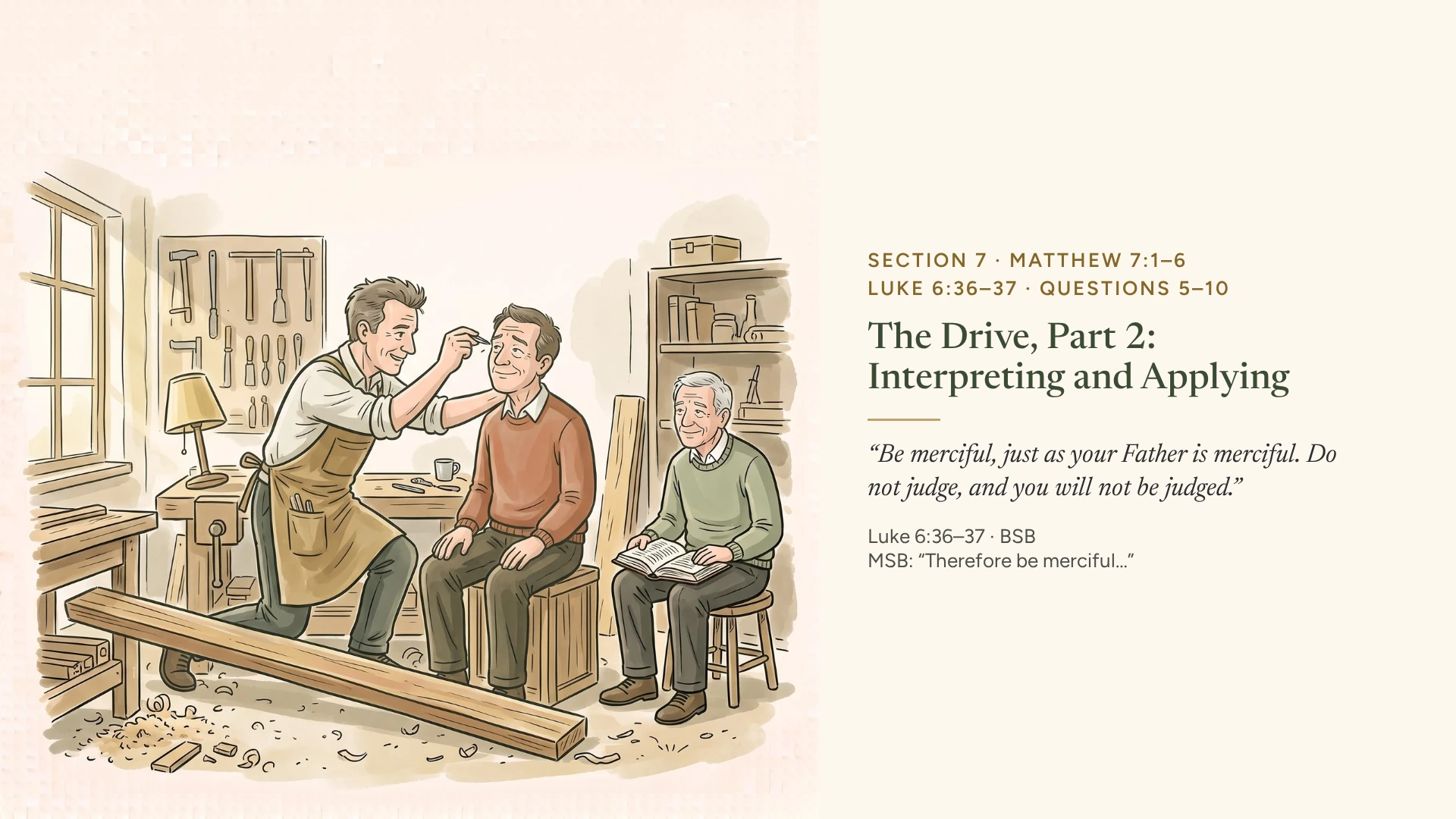
Do not judge doesn't mean never notice anything. It means stop playing God. Take the beam out of your own eye, then help your brother with a clear eye and a gentle hand. And notice what just happened: ten questions, in order, circling back three times, carried you from a misquoted verse to what Jesus actually said.
Humble Confidence
Remember your first week behind the wheel? Every turn took all your attention: mirrors, signal, brake, gas. A few years later you drive home and barely remember the turns. The skill hasn't gone away. It has become part of you.
The ten questions work the same way. At first they feel slow. With practice, they become the way you read. And they give you two gifts that seem to pull in opposite directions: confidence and humility.
Confidence. The textbook admits that the conclusions we reach by induction "are by nature probable and not absolute." That might sound shaky, but the authors go on: "we believe that you can reach firm interpretive conclusions, and that you can approach the text with confidence, expecting to be able to understand its meaning." In fact, "you'll be able to reach most interpretive conclusions with a high degree of certainty, and those findings that are more tentative tend to be the exception rather than the rule." The Bible was given to be understood.
Humility. The same paragraph adds that we remain "humble, knowing that induction by its very nature demands that we remain open to wherever the evidence may lead." You felt both in Matthew 7. You can be confident about verses 1–5. Verse 6 calls for a lighter grip. That's how it should feel. Sometimes Scripture sets two truths side by side, like "Do not judge" and "By their fruit you will recognize them" (Matthew 7:1, 16, BSB), and asks us to live both. The NIV Application Commentary calls this balance: learning to "take two seemingly opposite truths and live with them both at the same time, even though we may not be able to understand completely how they fit together."
And you're not just learning a method. The textbook's chapter ends with a line worth remembering: "we're not just developing a method; we're developing a person." Over time, reading this way grows habits in you: awareness of history and culture, a feel for the whole Bible, care with words and genres, and "an ability to apply the insights gained from the inductive study of Scripture to one's own life and to share them with others." The authors hope you'll hear God's "Well done, good and faithful servant" (Matthew 25:21, BSB) about the way you studied His Word.
Holmes had Dr. Watson at his side. You have someone far better: the Author Himself. On the evening He rose from the dead, Jesus found His disciples gathered in Jerusalem, "the Eleven and those with them" (Luke 24:33, BSB), and did for them what no detective can do for himself:
44 Jesus said to them, “These are the words I spoke to you while I was still with you: Everything must be fulfilled that is written about Me in the Law of Moses, the Prophets, and the Psalms.” 45 Then He opened their minds to understand the Scriptures.
Jesus sent those first disciples out as His witnesses (Luke 24:48), and through their witness the gospel has reached us. The same Lord still teaches His people by His Spirit through His Word. The apostle John wrote to believers being pulled toward false teaching, "His true and genuine anointing teaches you about all things" (1 John 2:27, BSB; MSB: "the same true and genuine anointing"). So we study carefully, and we pray as we study. The textbook's first chapter promised "to give you the tools you need for a lifetime of fruitful Bible study" and the ability "to approach the Scriptures with humble confidence." It also gave the reason we can have that confidence: "God is more intent on revealing himself to you than you are to get to know him."
Jesus made that promise in the passage you read in lesson 1: "Whoever has My commandments and keeps them is the one who loves Me. The one who loves Me will be loved by My Father, and I will love him and reveal Myself to him" (John 14:21, BSB). Notice who receives it: the one who loves Him, and that love shows in keeping His commands. The condition is real, but it's the condition of love, not a wage: His love comes first (John 15:9), and keeping His commands is how we remain in it (John 15:10). The detective work matters. But the One who wrote the Book wants to be found, and He reveals Himself to those who live what they read.
- What three parts of the Scriptures does Jesus name in verse 44?
- What does Jesus do in verse 45?
- These disciples had walked with Jesus for years. Why might they still need Him to open their minds to understand the Scriptures?
- What does this passage teach about who helps us understand God's Word?
- How is God inviting you to live out this abiding principle this week?
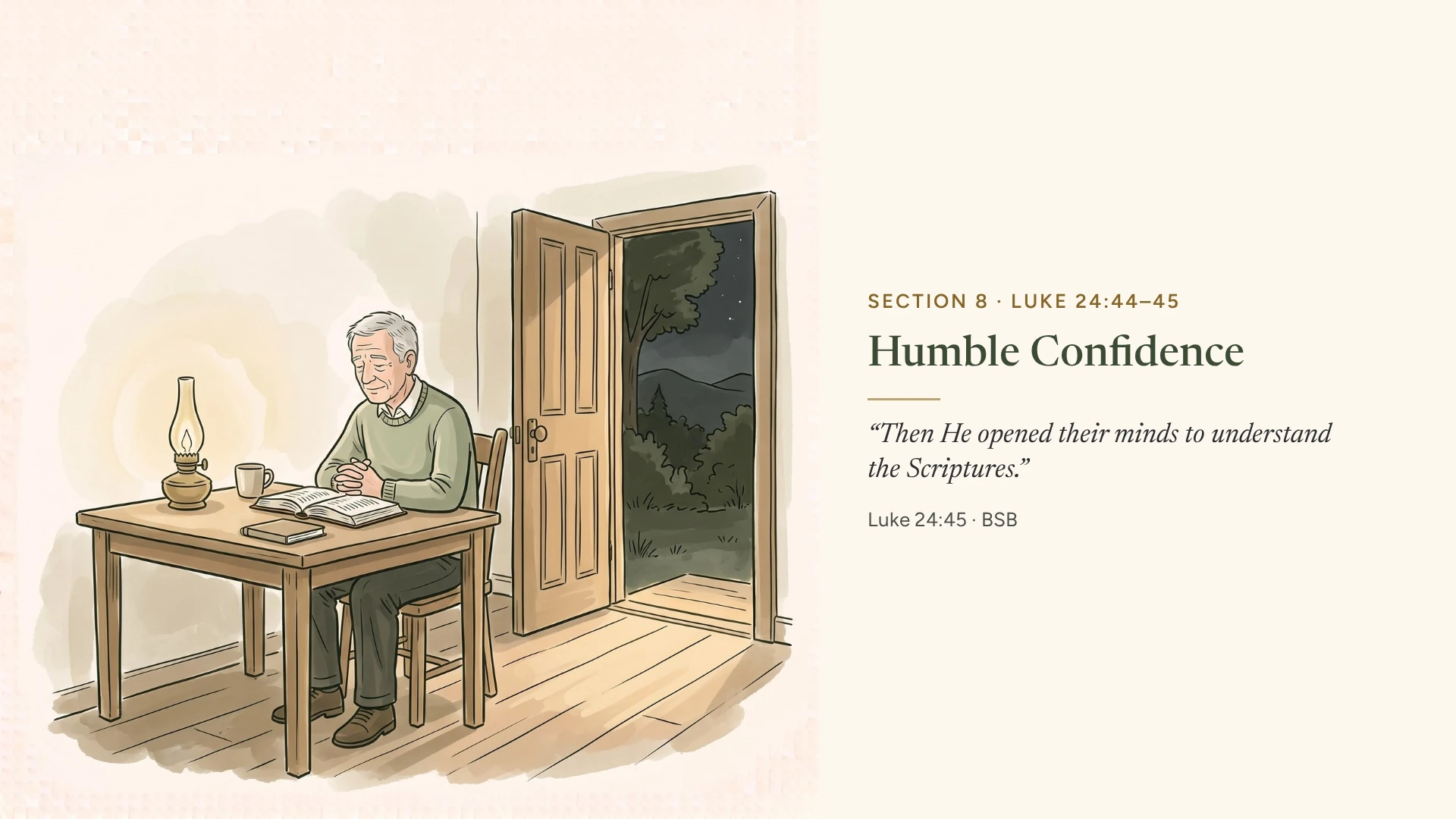
Read like Holmes: observe before you conclude. Walk the ten questions in order, and expect the road to circle back. Hold your conclusions with confidence where the evidence is clear and with humility where it isn't. And never study alone: ask the Author to open your mind.
Meditate and Obey. Study and Apply. Hear and Do.
This is how we abide in Christ. This is how we demonstrate our love for God.
Sources
- Fuhr, Richard Alan, Jr., and Andreas J. Köstenberger. Inductive Bible Study: Observation, Interpretation, and Application through the Lenses of History, Literature, and Theology. Nashville: B&H Academic, 2016. Ch. 1, 19; ch. 2, "Inductive Bible Study," 33–44.
- Akin, Daniel L. Exalting Jesus in the Sermon on the Mount. Christ-Centered Exposition Commentary. Nashville: Holman Bible Publishers, 2019, 120–127. Quotes D. A. Carson, The Sermon on the Mount, 104.
- Beetham, Christopher A., and Nancy L. Erickson, eds. The NIV Application Commentary on the Bible. One-volume ed. Grand Rapids: Zondervan Academic, 2024, 745–746.
- BibleProject. How to Read the Bible video series. Episode 4, "Ancient Jewish Meditation Literature." Tim Mackie and Jon Collins. bibleproject.com.
- Blomberg, Craig L. Matthew. New American Commentary 22. Nashville: Broadman & Holman, 1992, 127–129.
- Boxall, Ian. Matthew through the Centuries. Wiley Blackwell Bible Commentaries. Hoboken, NJ: Wiley Blackwell, 2019, 142–144.
- Calvin, John. Commentary on a Harmony of the Evangelists, Matthew, Mark, and Luke. Translated by William Pringle. Vol. 1. Edinburgh: Calvin Translation Society, 1845, 345–347.
- Doyle, Arthur Conan. "A Scandal in Bohemia." In The Adventures of Sherlock Holmes. Project Gutenberg eBook #1661.
- Doyle, Arthur Conan. A Study in Scarlet. Project Gutenberg eBook #244. Ch. 2, "The Science of Deduction."
- Earle, Ralph. "The Gospel according to St. Matthew." In Matthew–Acts, vol. 4, 39–40. Grand Rapids: Eerdmans, 1966.
- Evans, Craig A. The Bible Knowledge Background Commentary: Matthew–Luke. Colorado Springs: David C Cook, 2003, 134–136.
- France, R. T. "Matthew." In New Bible Commentary: 21st Century Edition, 4th ed., 913. Leicester: Inter-Varsity Press, 1994.
- Keener, Craig S. The Gospel of Matthew: A Socio-Rhetorical Commentary. Grand Rapids: Eerdmans, 2009, 239–244.
- Liddell, Henry George, Robert Scott, Henry Stuart Jones, and Roderick McKenzie. A Greek-English Lexicon. Oxford: Clarendon Press, 1996. S.v. κρίνω, 996.
- Louw, Johannes P., and Eugene A. Nida. Greek-English Lexicon of the New Testament: Based on Semantic Domains. 2nd ed. New York: United Bible Societies, 1996. §56.30.
- Stott, John. The Message of the Sermon on the Mount: Christian Counter-Culture. Rev. ed. Downers Grove, IL: IVP, 2020, 149–156.
Scripture quotations marked Berean Standard Bible (BSB) or Majority Standard Bible (MSB) are taken from texts that have been dedicated to the public domain. Free resources are available at BereanBible.com and MajorityBible.com.