The Literal Guardrail
Read each part of the Bible as the kind of writing it is: name the family and the subgenre, look for the real point behind every figure, and hear what its Author meant.
Published March 27, 2026 · Updated November 1, 2026
In this lesson · 8 sections
- Section 1Break a Leg: Reading the Bible as Literature
- Section 2The Two Cliffs
- Section 3The First Question, and Where We Are on the Map
- Section 4Case 1: A Story Inside a Story
- Section 5Case 2: Rain, Snow and Singing Trees
- Section 6Case 3: The Risen Christ Among the Lampstands
- Section 7The Central Case: Ephesians 1:3–14 Through the Ten Questions
- Section 8Every Kind, One Author
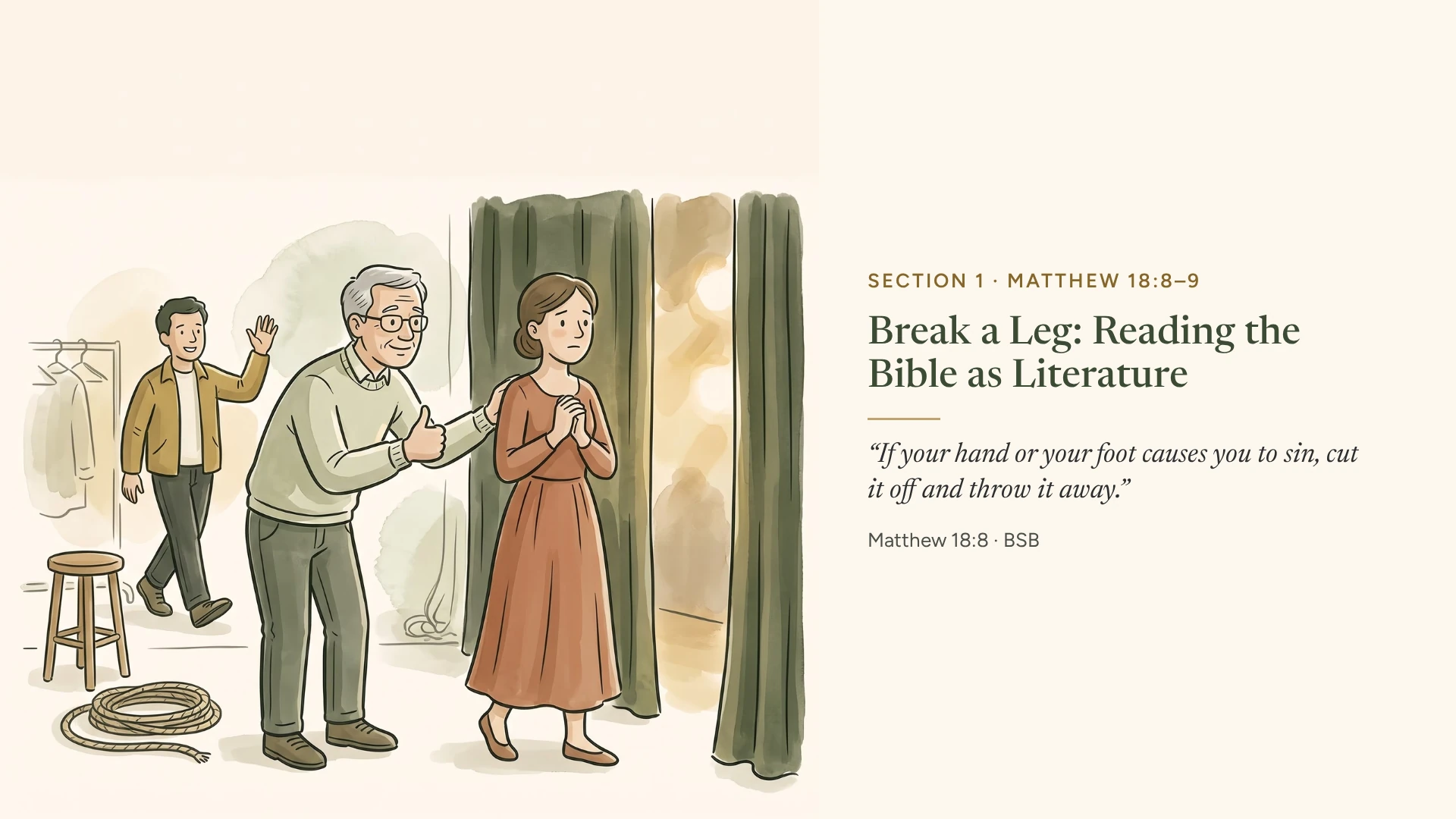
Break a Leg: Reading the Bible as Literature
Picture opening night at the community theater. Your friend is backstage in costume, hands shaking, a minute from walking out under the lights. You lean in and whisper, "Break a leg!" Her husband gives her a kiss on his way to his seat and adds, "Go knock 'em dead."
Nobody calls security. Nobody thinks you hope she falls off the stage, or that her husband wants the audience carried out. Taken word for word, both lines sound like threats. Heard the way they were meant, both say the same kind thing: good luck, you've got this, go do great.
You sorted that out in a split second, without stopping to think. You knew what kind of speech you were hearing. "Break a leg" and "knock 'em dead" are idioms, sayings whose meaning isn't the sum of their words, and everyone in that theater knows the rules for them.
You do this all day long. You read a grocery list one way and a birthday card another. A text from your best friend and a letter from the IRS both arrive in words, but you don't read them the same way. Nobody has to remind you. You notice what kind of writing it is, and you read it by its rules.
Some people say the Bible should be different: "You don't have to interpret the Bible; just read it and do what it says." Gordon Fee and Douglas Stuart, in How to Read the Bible for All Its Worth, take that seriously. They agree there's a lot of truth in it: the Bible isn't a puzzle locked away for experts, and the goal is what the author meant, not some clever new idea no one has ever seen. But they give two reasons every reader still interprets: the kind of readers we are, and the kind of book the Bible is.
That second reason is where this lesson lives. The Bible is one book made of many kinds of writing: stories, songs, laws, proverbs, letters and visions. Some report what happened. Some sing. Some paint pictures in words. Each one tells the truth in its own way, and each one asks to be read as the kind of writing it is. That's the Literal guardrail.
In lesson 3 we met R. C. Sproul's short definition: "To interpret the Bible literally is to interpret it as literature." The word "literal" grows from the Latin littera, a letter of the alphabet, and lesson 3 walked us into a bookstore where every aisle holds a different kind of book. Nobody reads the poetry aisle the way they read the history aisle.
Leland Ryken, in How to Read the Bible as Literature, passes along a line from C. S. Lewis that says it well: we should read "the different parts of it as the different sorts of literature they are." Fee and Stuart add a related point. To reach every kind of person, God used almost every kind of communication available: stories and family trees, laws and poems, proverbs and prophecies, riddles and parables, letters, sermons and visions.
So the Literal guardrail asks two what kind questions.
What kind of writing is this? Name the family first, then the subgenre. Abide uses four families: narrative (history, gospel, parable, genealogy), poetry (songs, wisdom, prophecy), prose discourse (law, sermons, letters) and apocalyptic (visions full of symbols, as in Daniel and Revelation). Proverbs is poetry, and its subgenre is wisdom. Romans is prose discourse, and its subgenre is a letter. A passage can also have its own kind inside a book, like a parable inside a Gospel, and that is what sets its reading rules.
What kind of speech is this? Every family uses figures of speech: pictures, comparisons, exaggerations, symbols. Roy Zuck makes a point worth remembering: figures of speech aren't the opposite of reading literally; they're part of it. He quotes Earl Radmacher on why: every figure carries a real point behind it. Our textbook, by Fuhr and Köstenberger, tells us to look for that point every time, which is why nobody hears "it's soupy outside" and pictures chicken noodles in the air. E. W. Bullinger pushed back on people who wave a verse away with "Oh, that's just figurative," as if a figure means less. He argued the opposite: a figure is there to add force, life, feeling and emphasis.
Here's a short way to keep this lesson and the next one straight: Literal asks what kind of words they are; Contextual's literary layer asks where the words are located. Lesson 6 takes up the "where": the book, the chapter, what comes before and after. The two work hand in hand: often the words around a phrase are what tell you it's a figure, and knowing the kind of writing tells you what those surrounding words are doing.
Here's what it looks like. One day Jesus' disciples came to Him with a question: "Who then is the greatest in the kingdom of heaven?" (Matthew 18:1, BSB). Jesus set a little child in front of them and talked about humility and about sin. Then He said this:
8 If your hand or your foot causes you to sin, cut it off and throw it away. It is better for you to enter life crippled or lame than to have two hands and two feet and be thrown into the eternal fire. 9 And if your eye causes you to sin, gouge it out and throw it away. It is better for you to enter life with one eye than to have two eyes and be thrown into the fire of hell.
Where the MSB (Majority Text) differs: verse 8, "lame or crippled" (BSB "crippled or lame").
Taken literally in the everyday sense, word for word, that's an order to maim yourself. But read literally in the Literal guardrail's sense, as literature, it's clearly hyperbole: a deliberate exaggeration that says more than is meant, to emphasize the point. Louis Barbieri explains in The Bible Knowledge Commentary that Jesus wasn't teaching anyone to harm their body. Cutting off a hand wouldn't touch the real source of sin, which is the heart (Matthew 15:18–19). Jesus was telling His disciples to make radical changes: get rid of whatever leads you into sin. The exaggeration doesn't soften the command. It sharpens it. Reading literally, as literature, means hearing it the way Jesus meant it, and that's the only way to interpret and apply it correctly.
The Two Cliffs
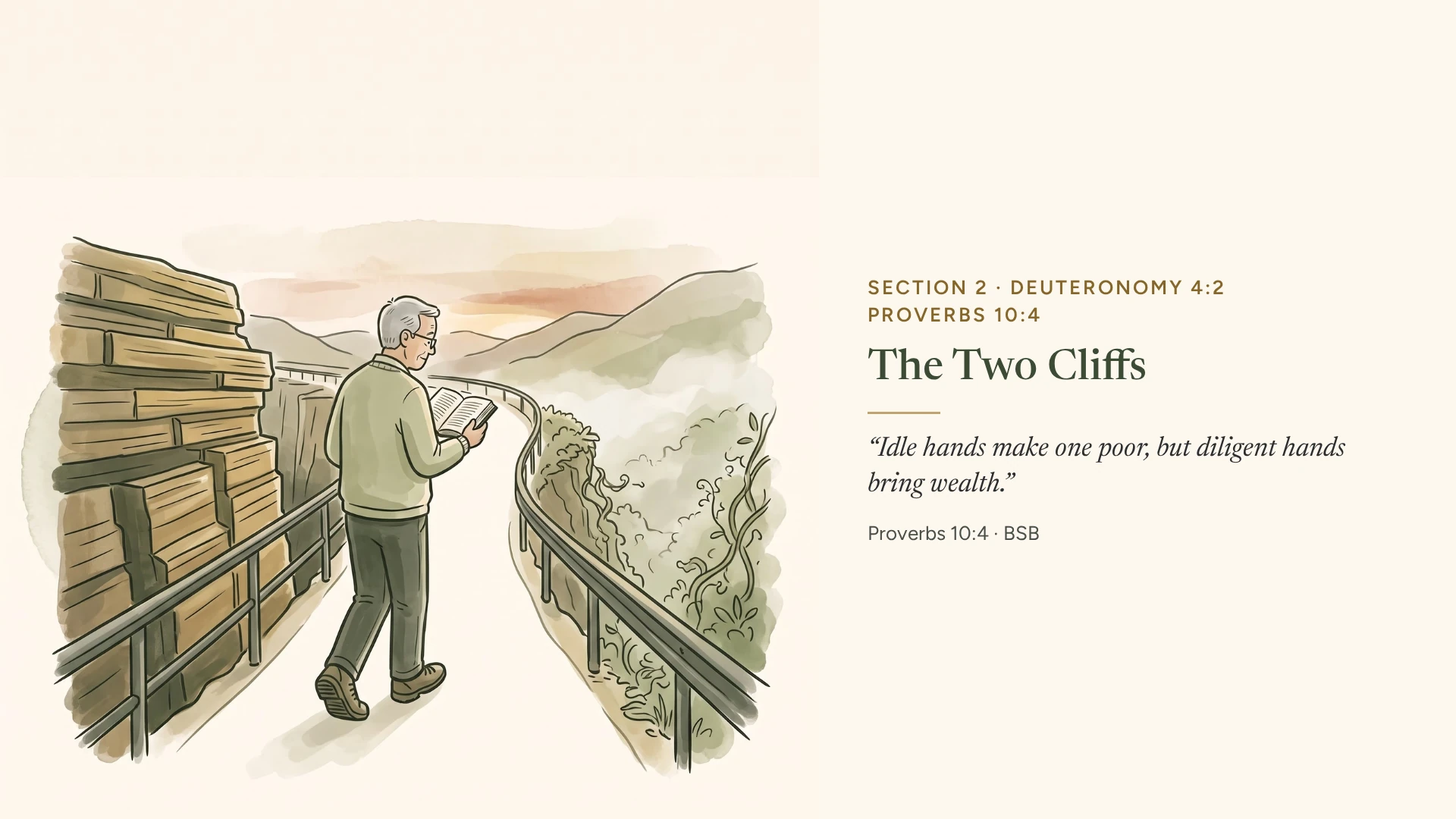
Lesson 3 pictured each guardrail as the steel rail on a mountain road at night, with a cliff on each side: adding to what God said, and taking away from it (Deuteronomy 4:2). The Literal guardrail has a cliff on each side too.
The wooden cliff reads every word flat, whatever kind of writing it is. It sounds careful, but it takes away from what God said, because it loses the point the writer was making. Proverbs are an easy place to slip. "Idle hands make one poor, but diligent hands bring wealth" (Proverbs 10:4, BSB). Read woodenly, that's a promise: work hard and you'll be rich, and if you're poor, you must be lazy. But a proverb is wisdom, and wisdom tells us how life usually goes. Roy Zuck sums it up this way: proverbs are "guidelines, not guarantees; precepts, not promises." He notes that a proverb states what is generally true, so life will show exceptions.
The hidden-meaning cliff treats ordinary words as a code. It adds to what God said, because the meaning comes from the reader instead of the writer. Bernard Ramm describes how it works: the reader brings in something foreign or hidden and calls it the text's deeper meaning.
The two cliffs are closer together than they look. Ramm tells how some readers, over the centuries, fixed so hard on single letters that they ended up treating the text as a code. He adds a warning for anyone today who likes to play with Bible numbers: look first at where that road has gone before. (There's more of that story in the note at the end of this lesson.)
The Literal guardrail keeps us on the road between: read each passage as the kind of writing it is, and look for the real point behind every figure.
The First Question, and Where We Are on the Map
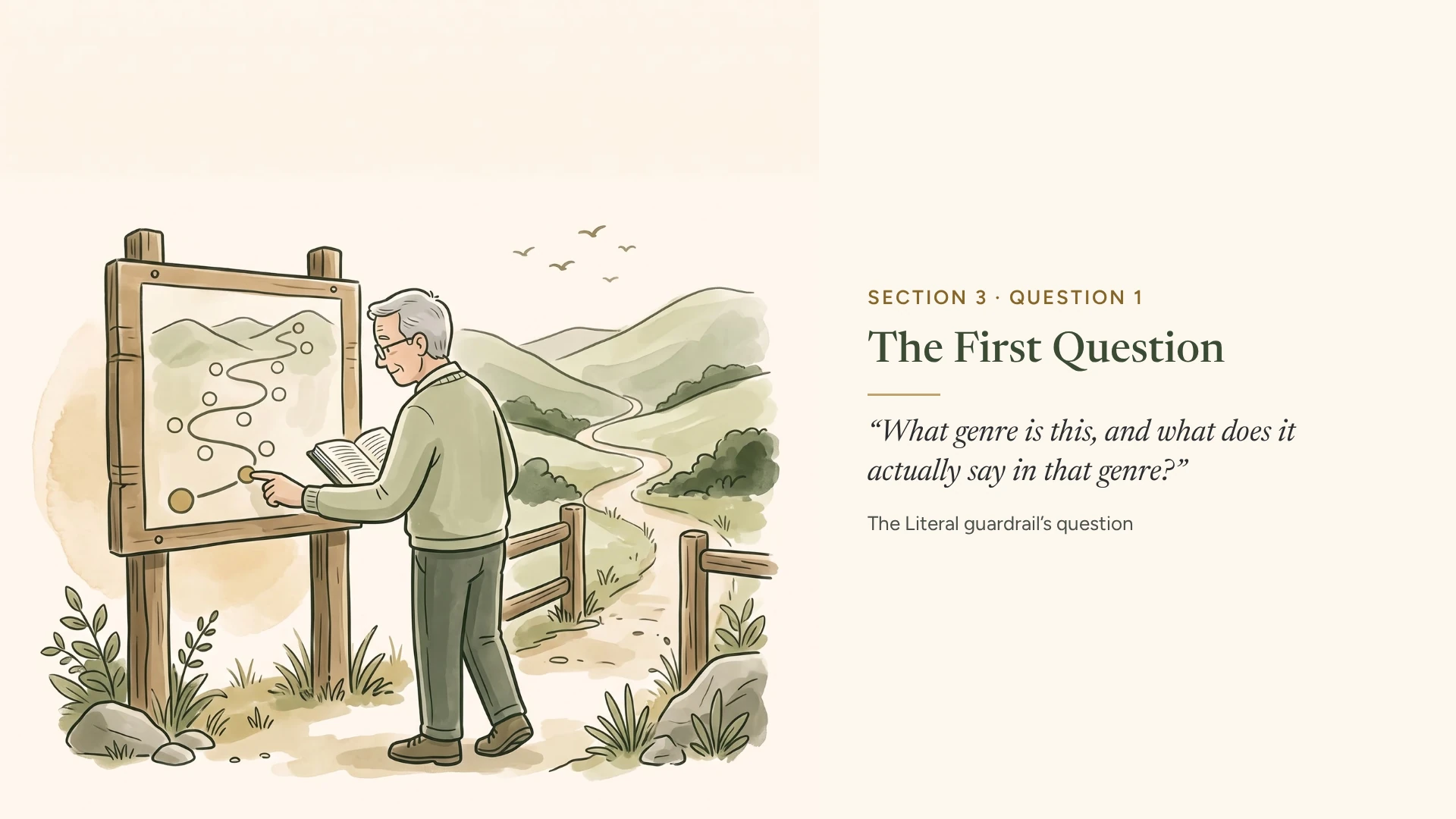
In lesson 4 you met the ten questions that carry a reader from observation all the way to application. The Literal guardrail owns the first one:
What genre is this, and what does it actually say in that genre?
Inductive Bible Study
A time-tested method for handling "the word of truth" accurately (2 Timothy 2:15, BSB)
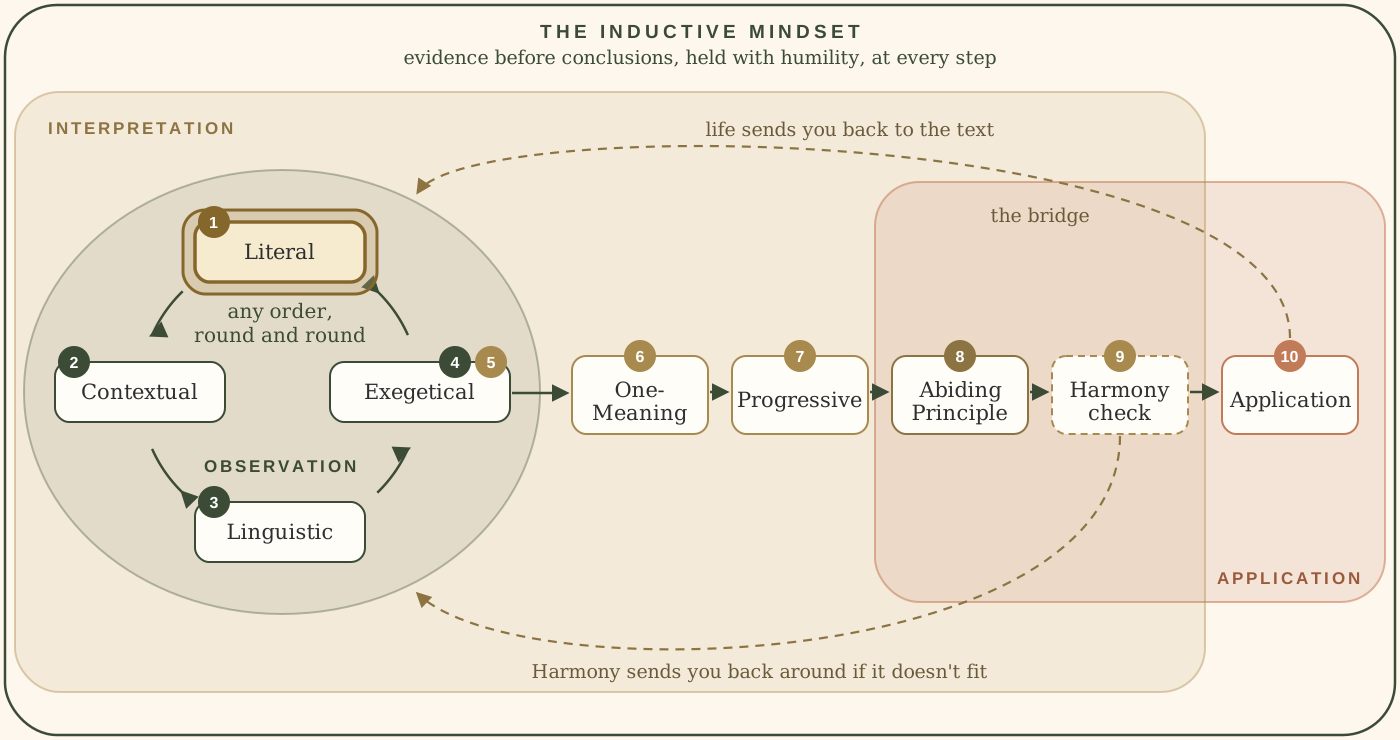
On the map, we're at question 1, the Literal guardrail, in the Observation circle.
It's a two-part question. The first part asks what kind of writing you're reading. The second part listens to what the passage says in that kind of writing. Here's one way to work through it:
- Name the family. Is it narrative, poetry, prose discourse or apocalyptic?
- Name the subgenre. For narrative: history, gospel, parable or genealogy. For poetry: song, wisdom or prophecy. For prose discourse: law, sermon or letter. For apocalyptic: vision.
- Look for figures of speech, and ask what real point each one makes.
How do you spot a figure? Most of the time you just do. Roy Zuck's example: when a sports announcer says the Falcons beat the Lions, nobody pictures birds of prey attacking big cats. For the times you're not sure, Zuck offers a few tests. Start by reading the words in their normal sense unless there's a good reason not to. A figure is probably at work when:
- The words describe something impossible, like the risen Jesus holding "seven stars" in His right hand (Revelation 1:16, BSB).
- The words would be absurd if taken word for word, like "all the trees of the field will clap their hands" (Isaiah 55:12, BSB).
- The words would require us to sin. That's how we knew in Section 1 that Jesus wasn't ordering anyone to cut off a hand.
- The text explains itself. Paul writes about believers who "have fallen asleep in Him" (1 Thessalonians 4:14, BSB), and two verses later calls them "the dead in Christ" (v. 16, BSB).
You'll see the first, second and fourth tests at work in the cases ahead.
Each case ends with a short line called Guardrails at work. The Literal guardrail leads in this lesson, but it never works alone, so that line lists the guardrails that help it. It looks like this: "Guardrails at work: Literal leads; Contextual and Harmony help."
Case 1: A Story Inside a Story
What genre is this, and what does it actually say in that genre?
Our first case comes from narrative, the history of Israel's kings. You may know what happened in 2 Samuel 11. King David saw Bathsheba, "the wife of Uriah the Hittite," and took her (2 Samuel 11:3, BSB). When she became pregnant, he sent a letter to his commander: "Put Uriah at the front of the fiercest battle" (2 Samuel 11:15, BSB). Uriah died, and David married her. The chapter ends with one sentence: "But the thing that David had done was evil in the sight of the LORD" (2 Samuel 11:27, BSB).
Then God sent the prophet Nathan:
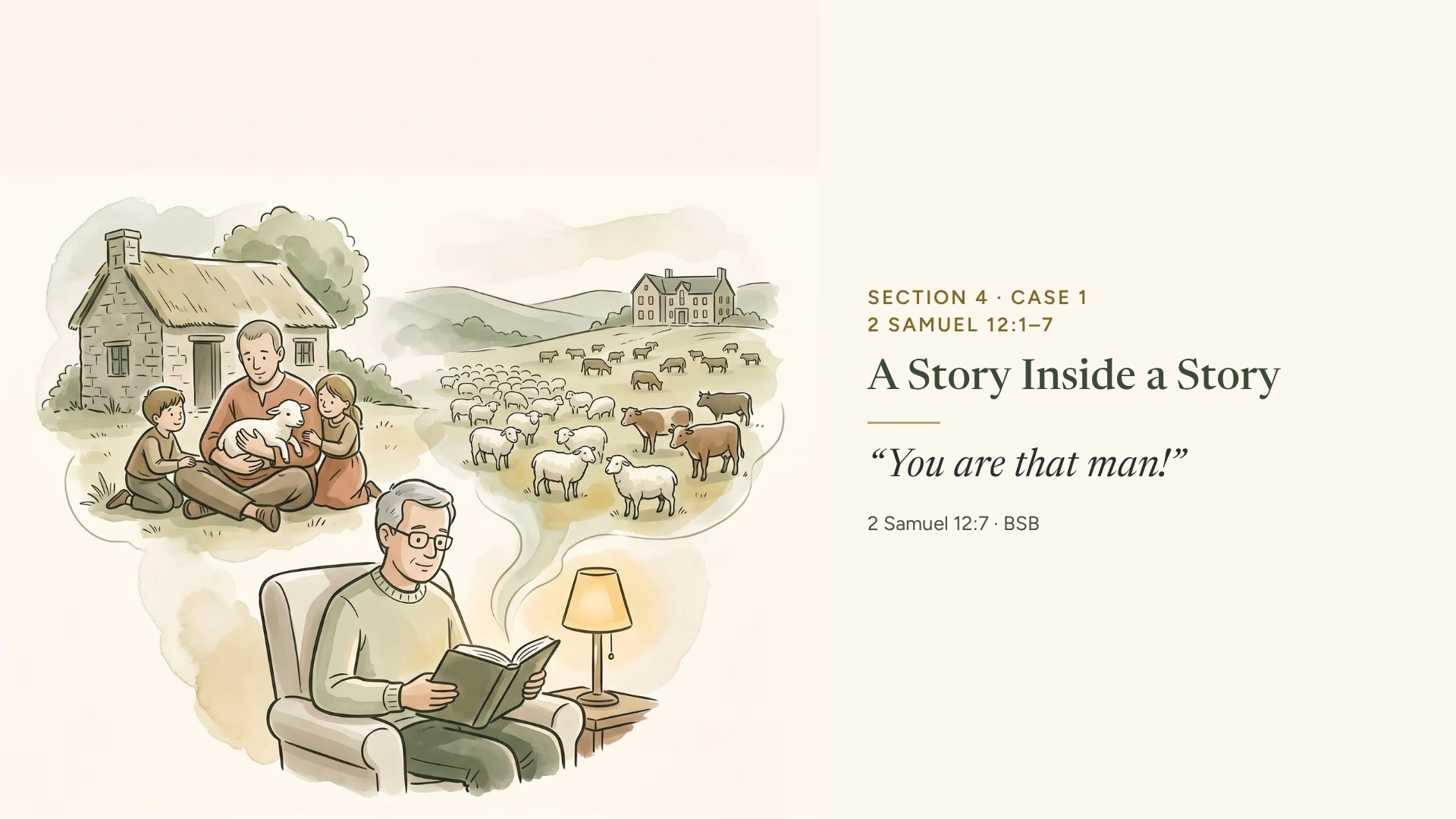
1 Then the LORD sent Nathan to David, and when he arrived, he said, “There were two men in a certain city, one rich and the other poor. 2 The rich man had a great number of sheep and cattle, 3 but the poor man had nothing except one small ewe lamb that he had bought. He raised it, and it grew up with him and his children. It shared his food and drank from his cup; it slept in his arms and was like a daughter to him. 4 Now a traveler came to the rich man, who refrained from taking one of his own sheep or cattle to prepare for the traveler who had come to him. Instead, he took the poor man’s lamb and prepared it for his guest.” 5 David burned with anger against the man and said to Nathan: “As surely as the LORD lives, the man who did this deserves to die! 6 Because he has done this thing and has shown no pity, he must pay for the lamb four times over.”
Ask question 1. What kind of writing is this? The book is narrative, and 2 Samuel tells real history. But inside the history, Nathan tells a different kind of story: a parable, a short made-up story with one point. The two levels matter. The rich man, the poor man and the lamb never existed. David, Uriah and Bathsheba did.
David missed the change in genre. The ESV Literary Study Bible puts it this way: Nathan told his story so that David thought he was ruling on a real case. So David did what a judge does. He passed sentence, and his anger rose against a man who didn't exist.
Then Nathan said, "You are that man!" (2 Samuel 12:7, BSB).
(Nathan doesn't stop there. In 2 Samuel 12:7–14 he delivers the rest of the LORD's message: all God had given David, what David had done, and the judgment to come. The sin David thought he had hidden is exposed: "You have acted in secret, but I will do this thing in broad daylight before all Israel" (v. 12, BSB). Then David confesses, "I have sinned against the LORD" (v. 13, BSB). He agreed with God about his sin, and about whom he had sinned against.)
The story was made up, and it told the truth. That's how a parable works. Bernard Ramm gives the first rule for reading one: find the one main truth it teaches. Or, as he says others put it, "Don’t make a parable walk on all fours." Nobody needs to ask who the traveler stands for. The point is the one Nathan made: a powerful man took what belonged to someone weaker, and showed no pity.
Notice what the parable did that a direct accusation might not have done. It got past David's defenses, and David judged himself before he knew it. We are often quickest to see sin in someone else's story.
Guardrails at work: Literal leads; Contextual helps. Contextual: David's sin in chapter 11 sets up the story, so we know what the lamb is about before David does.
Case 2: Rain, Snow and Singing Trees
What genre is this, and what does it actually say in that genre?
Our second case comes from poetry, and its subgenre is prophecy: the prophet Isaiah speaking God's words to His people Israel. Chapter 55 opens with an invitation: "Come, all you who are thirsty, come to the waters" (Isaiah 55:1, BSB). A few verses later it calls again: "Seek the LORD while He may be found; call on Him while He is near" (v. 6, BSB). The ESV Literary Study Bible points out how the chapter works: God invites, and then He gives promises that make saying yes the only fitting answer. Here is one of those promises, and the joy that follows it:
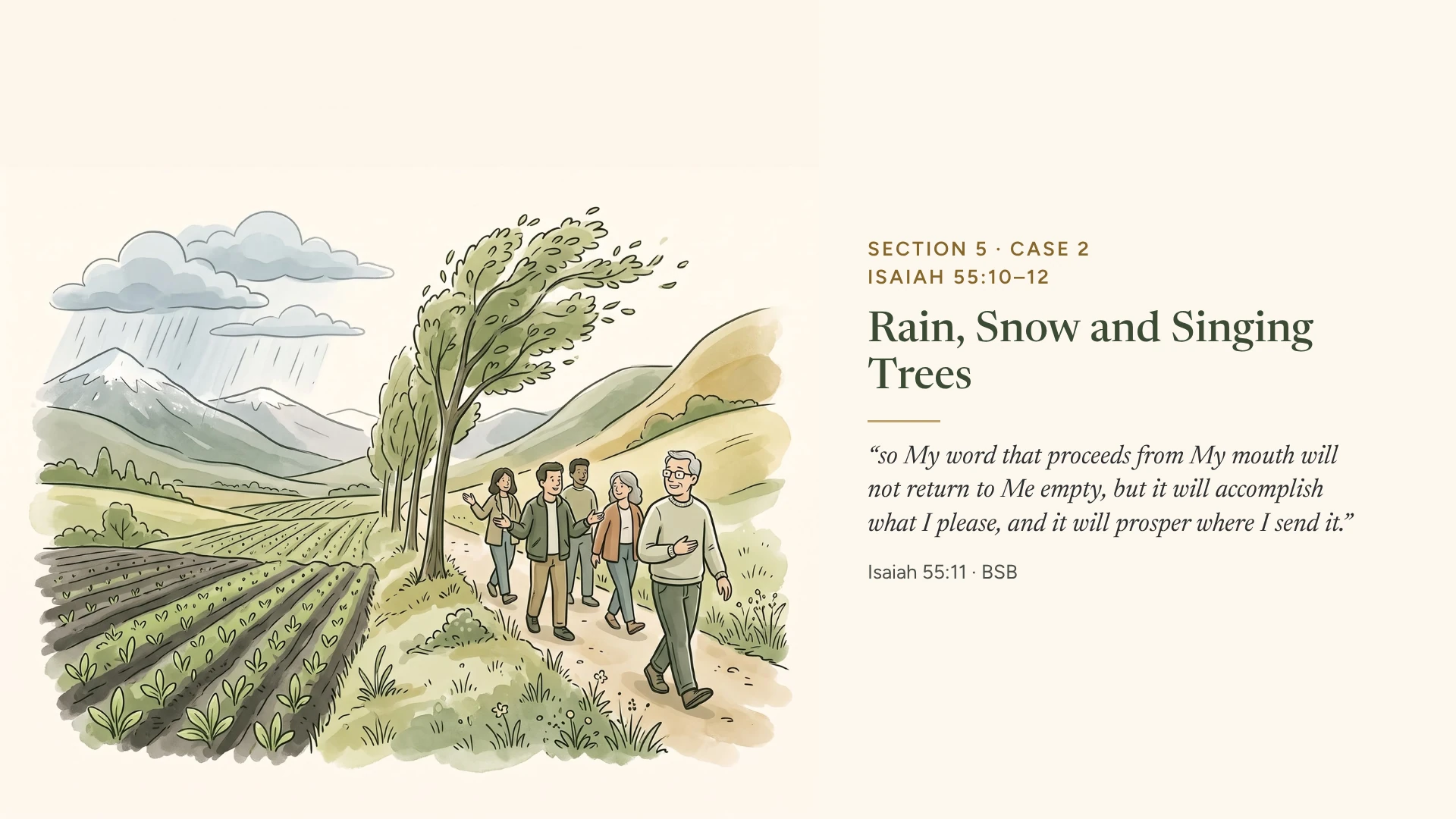
10 For just as rain and snow fall from heaven and do not return without watering the earth, making it bud and sprout, and providing seed to sow and food to eat, 11 so My word that proceeds from My mouth will not return to Me empty, but it will accomplish what I please, and it will prosper where I send it. 12 You will indeed go out with joy and be led forth in peace; the mountains and hills will burst into song before you, and all the trees of the field will clap their hands.
Ask question 1. The family is poetry, so expect pictures. Two kinds of speech show up here.
A simile. "Just as" rain and snow, "so My word" (vv. 10–11, BSB). A simile compares two things out loud, with like or as. Rain doesn't fall and then float back up unused. It soaks in, and things grow. John Martin, in The Bible Knowledge Commentary, notes that in that part of the world, dry, hard ground can seem to sprout overnight after the first rains. God says His word works the same way. It doesn't come back empty. It does what He sends it to do.
Personification. Mountains don't sing, and trees don't have hands. That's Zuck's "absurd" test from Section 3. Our textbook defines personification as giving human qualities to things that aren't human. Martin pictures the clapping as branches moving in the wind. The picture is joy: the hills and trees join in as God's people "go out with joy" (v. 12, BSB).
Now try the two cliffs. The wooden reading waits for trees to applaud and misses the joy. The hidden-meaning reading would turn the mountains and trees into a code, say, one for the nations and one for believers, with nothing in the passage to support it. The Literal guardrail hears a poem: real promises, told in pictures.
This passage also shows why Abide exists. God's word doesn't return to Him empty. It still does what He sends it to do, and Abide aims to put you where that word is at work: reading it, listening and responding. The ESV Literary Study Bible adds a warning, though: the sayings in this chapter are so familiar that many have long been taken out of their setting. Keep the promise attached to the invitation around it: God's word comes with a call to come, listen and seek.
Guardrails at work: Literal leads; Contextual and Harmony help. Contextual: the promise sits inside God's invitation (Isaiah 55:1, 6). Harmony: centuries later, the letter to the Hebrews says "the word of God is living and active" (Hebrews 4:12, BSB), and Paul tells Timothy that "all Scripture is God-breathed," given "so that the man of God may be complete, fully equipped for every good work" (2 Timothy 3:16–17, BSB). The same word is still at work.
Case 3: The Risen Christ Among the Lampstands
What genre is this, and what does it actually say in that genre?
Our third case comes from apocalyptic, the family of visions full of symbols. Revelation mixes kinds, too. The ESV Literary Study Bible points out that its first chapter even opens with a letter's greeting (Revelation 1:4–8). John writes "to the seven churches in the province of Asia" (v. 4, BSB). But the passage we're reading is a vision: John, on the island of Patmos (Revelation 1:9), turns to see who is speaking to him.
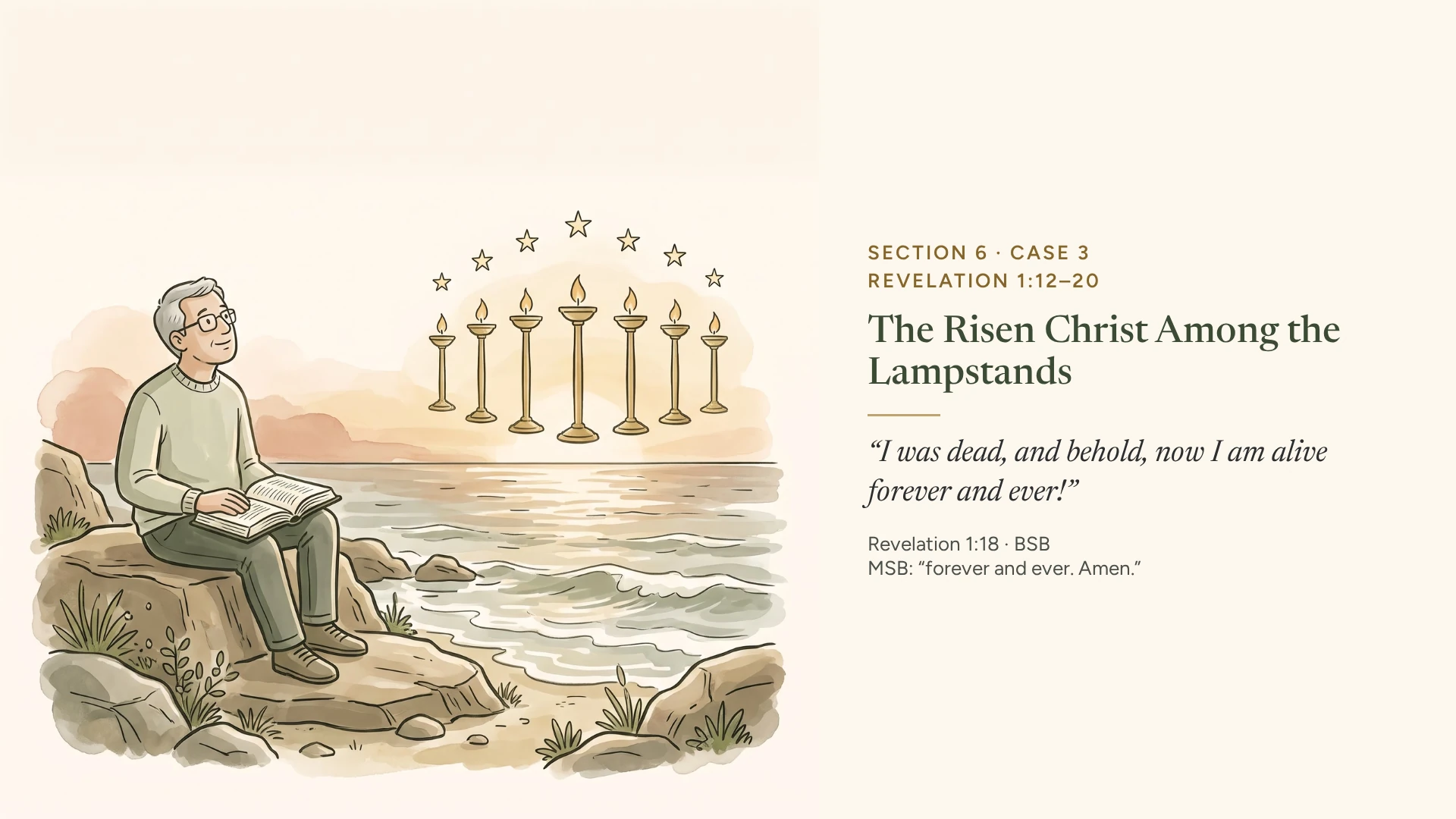
12 Then I turned to see the voice that was speaking with me. And having turned, I saw seven golden lampstands, 13 and among the lampstands was One like the Son of Man, dressed in a long robe, with a golden sash around His chest. 14 The hair of His head was white like wool, as white as snow, and His eyes were like a blazing fire. 15 His feet were like polished bronze refined in a furnace, and His voice was like the roar of many waters. 16 He held in His right hand seven stars, and a sharp double-edged sword came from His mouth. His face was like the sun shining at its brightest. 17 When I saw Him, I fell at His feet like a dead man. But He placed His right hand on me and said, “Do not be afraid. I am the First and the Last, 18 the Living One. I was dead, and behold, now I am alive forever and ever! And I hold the keys of Death and of Hades. 19 Therefore write down the things you have seen, the things that are, and the things that will happen after this. 20 This is the mystery of the seven stars you saw in My right hand and of the seven golden lampstands: The seven stars are the angels of the seven churches, and the seven lampstands are the seven churches.
Where the MSB (Majority Text) differs: verse 12, "And there I turned" (BSB "Then I turned"); verse 13, "among the seven lampstands" (BSB "among the lampstands"); verse 18, "forever and ever. Amen." (BSB "forever and ever!").
Ask question 1. This is a vision, so expect symbols, and Zuck's first test fires right away, the one for something impossible: no one can hold seven stars in one hand. Bernard Ramm puts it bluntly: in apocalyptic, reading every word woodenly is impossible. To be thoroughly literal, he says, we would have to insist that Jesus has an actual sword coming out of His mouth.
So how do we read the pictures? The ESV Literary Study Bible gives a wise rule: don't glue the details together into one strange portrait. Let each picture show something true about Christ. Eyes like blazing fire and feet like glowing bronze show that He is far above us. The sword from His mouth stands for His word and His judgment.
Then the text does something we've seen before: it explains itself. "The seven stars are the angels of the seven churches, and the seven lampstands are the seven churches" (v. 20, BSB). That's Zuck's fourth test: the text explains itself. John Walvoord, in The Bible Knowledge Commentary, takes the "angels" as angels or messengers of those churches; readers differ on exactly who they are. Ramm gives a rule that keeps us safe here: start with the symbols Scripture explains. And where the text doesn't explain a symbol and we can't find a sound clue, he says, it's wiser to be silent than to guess.
Notice what isn't a symbol. "I was dead, and behold, now I am alive forever and ever!" (v. 18, BSB). The pictures are symbols; the risen Jesus is real. John fell at His feet, and Jesus laid His right hand on him: "Do not be afraid" (v. 17, BSB).
This book also carries a promise for readers: "Blessed is the one who reads aloud the words of this prophecy, and blessed are those who hear and obey what is written in it" (Revelation 1:3, BSB). John was told to send what he saw "to the seven churches" (v. 11, BSB), where it would be read aloud. The blessing rests on reading, hearing and obeying, not on solving every symbol.
Guardrails at work: Literal leads; Contextual, Progressive and Harmony help. Contextual: verse 20 explains the stars and lampstands, and verse 3 shows how the book is meant to be received: read, heard and obeyed. Progressive: John borrows Daniel's words. "One like the Son of Man" (Daniel 7:13, BSB) comes from Daniel's vision, and Walvoord notes that the hair "white like wool" matches the Ancient of Days in Daniel 7:9. Harmony: other Scriptures confirm what the sword means. Isaiah's Servant says, "He made My mouth like a sharp sword" (Isaiah 49:2, BSB). Paul uses the same picture for the believer's armor: "the sword of the Spirit, which is the word of God" (Ephesians 6:17, BSB). The letter to the Hebrews, which we met in Isaiah's case, says God's word is "sharper than any double-edged sword" (Hebrews 4:12, BSB). And later in Revelation, Jesus warns a church that He will "wage war against them with the sword of My mouth" (Revelation 2:16, BSB). Word and judgment, just as the symbol showed.
The Central Case: Ephesians 1:3–14 Through the Ten Questions
The short cases showed the Literal guardrail in a moment each. Now let's take one passage all the way through the ten questions, the way lesson 4 did with Matthew 7. Question 1 gets the most room, since this is its lesson. The other nine move faster.
The passage is the opening of Paul's letter to the Ephesians, written "to the saints in Ephesus, the faithful in Christ Jesus" (Ephesians 1:1, BSB). After a short greeting, Paul breaks into this:
3 Blessed be the God and Father of our Lord Jesus Christ, who has blessed us in Christ with every spiritual blessing in the heavenly realms. 4 For He chose us in Him before the foundation of the world to be holy and blameless in His presence. In love 5 He predestined us for adoption as His sons through Jesus Christ, according to the good pleasure of His will, 6 to the praise of His glorious grace, which He has freely given us in the Beloved One. 7 In Him we have redemption through His blood, the forgiveness of our trespasses, according to the riches of His grace 8 that He lavished on us with all wisdom and understanding. 9 And He has made known to us the mystery of His will according to His good pleasure, which He purposed in Christ 10 as a plan for the fullness of time, to bring all things in heaven and on earth together in Christ. 11 In Him we were also chosen as God’s own, having been predestined according to the plan of Him who works out everything by the counsel of His will, 12 in order that we, who were the first to hope in Christ, would be for the praise of His glory. 13 And in Him, having heard and believed the word of truth—the gospel of your salvation—you were sealed with the promised Holy Spirit, 14 who is the pledge of our inheritance until the redemption of those who are God’s possession, to the praise of His glory.
Where the MSB (Majority Text) differs: verse 6, "by which He has bestowed favor upon us in the Beloved One" (BSB "which He has freely given us in the Beloved One"); verse 13, "And in Him you also—having heard the word of truth, the gospel of your salvation—believed and were sealed" (BSB "And in Him, having heard and believed the word of truth—the gospel of your salvation—you were sealed").
1. What genre is this, and what does it actually say in that genre? (Literal)
Kind of writing, at two levels. The family is prose discourse, and the subgenre is a letter. It opens the way letters often did: the writer's name, the readers, and a greeting, "Grace and peace to you" (v. 2, BSB). Craig Keener notes that letters in that world often went on to a prayer or a thanksgiving. A. T. Robertson points out that Paul usually gives thanks at this point. Here, as in 2 Corinthians 1:3, he blesses God instead.
That makes the passage's own kind a doxology, a burst of praise to God. The notes in the NIV Bible Speaks Today call it "a continuous cascade of praise." David Dockery explains that it's often called "the doxology" because it tells what God has done and offers Him worship. John Stott calls it a eulogy, since that's the word Paul uses for "Blessed," and he quotes Markus Barth: it is like the blessings spoken "in Jewish synagogues and homes."
You can see the kind of writing in its shape. In Greek, verses 3 through 14 are one long sentence; Stott pictures Paul pouring it out without stopping for breath. And a refrain keeps coming back: "to the praise of His glorious grace" (v. 6, BSB), "for the praise of His glory" (v. 12, BSB), "to the praise of His glory" (v. 14, BSB). Harold Hoehner, in The Bible Knowledge Commentary, shows how the refrain follows the work of each Person of God: the Father who chose (vv. 4–6), the Son who redeemed (vv. 7–12) and the Spirit who sealed (vv. 13–14).
So what does it say in that genre? Read as praise, it doesn't argue a case. It tells what God has done, so we'll be amazed and bless Him back. Keep that in mind; it matters at question 5.
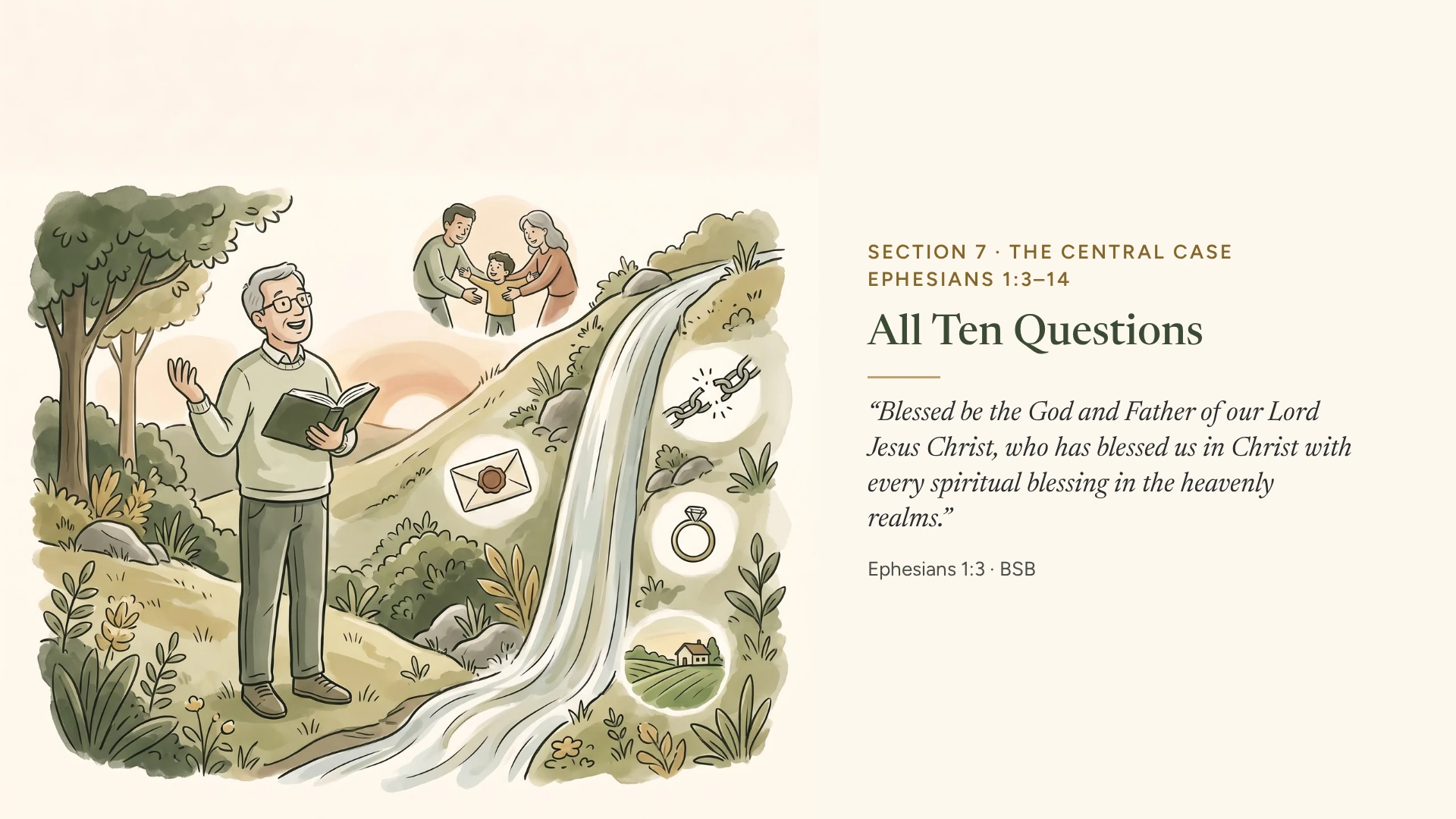
Kind of speech. Paul packs the praise with pictures, taken from family life, the slave market, official documents and business deals:
- Adoption (v. 5). Hoehner explains that an adopted son gets the same rights as a son born into the family.
- Redemption (v. 7). Stott notes that the word meant setting free by paying a price, and was used for freeing slaves. Then Paul explains his own picture: "the forgiveness of our trespasses" (v. 7, BSB). Ben Witherington points to exactly that: Paul's own explanation shows the word is a picture. That's Zuck's fourth test again: the text explains itself.
- Sealed (v. 13). A seal, Stott says, marks something as owned and as genuine.
- Pledge (v. 14). Stott explains that the word meant a first payment that guarantees the rest is coming. In modern Greek, he adds, the same word means an engagement ring.
- Inheritance and God's possession (vv. 11, 14). We'll come back to these at questions 6 and 7.
Every one of those pictures carries something real. We really are brought into God's family, really forgiven, really marked as His, and really promised the rest of what He has for us. The pictures don't make the blessings less real. As Bullinger said back in Section 1, they make them hit harder.
2. What surrounds it, what did the first readers know, and where does it sit in the whole story? (Contextual)
Here is where the Literal guardrail and the Contextual guardrail work hand in hand. Look at where the doxology sits. It comes right after the greeting (vv. 1–2), and right before Paul's prayer for his readers, which begins, "For this reason, ever since I heard about your faith in the Lord Jesus and your love for all the saints, I have not stopped giving thanks for you" (Ephesians 1:15–16, BSB). The Lexham Context Commentary puts the order this way: before Paul gives thanks and prays, he praises God. Talk Thru the Bible notes that this is the first of two prayers in the letter (1:15–23 and 3:14–21).
Now look further ahead. Chapter 3 ends with another burst of praise: "Now to Him who is able to do immeasurably more than all we ask or imagine, according to His power that is at work within us, to Him be the glory in the church and in Christ Jesus throughout all generations, forever and ever. Amen" (Ephesians 3:20–21, BSB). Stott calls that closing passage "the doxology." Notice, then: praise opens chapters 1 through 3, and praise closes them. And those three chapters, Talk Thru the Bible observes, give no commands at all. They tell what God has done. The commands come in chapters 4 through 6.
See how the two guardrails help each other? Knowing the kind (praise) helps us see why it stands where it does, at the head of three chapters about what God has done. And knowing where it stands helps confirm what kind it is. It sits in the spot where, as Keener notes, letters commonly included a prayer or a thanksgiving. Keener calls this one "one long praise to God." And a matching burst of praise answers it at the end of chapter 3. A passage at the doorway of three chapters of God's gifts, with praise at the other end, reads as worship, not as an argument. Literal asks what kind; Contextual's literary layer asks where. You need both answers.
3. Is there a word where the Hebrew or Greek adds nuance? (Linguistic)
We've already met one discovery from the Greek: verses 3–14 are one long sentence. The BSB breaks it into shorter sentences so we can follow it, which is a fair choice, but it hides how breathless the praise is. Another discovery is a phrase that keeps coming back: "in Christ" (v. 3, BSB), "in the Beloved One" (v. 6, BSB), "in Him" (v. 7, BSB). Witherington says this refrain must be kept in view all the way through the passage. Talk Thru the Bible counts the phrase or its equivalent about thirty-five times in the letter, more than in any other New Testament book. Every blessing in this passage comes in Christ.
Listen, too, for the second refrain we met at question 1: "to the praise of His glorious grace" (v. 6, BSB), and then "for the praise of His glory" (v. 12, BSB) and "to the praise of His glory" (v. 14, BSB). The two refrains run side by side. One tells us where every blessing comes from: in Christ. The other tells us what every blessing is for: the praise of His glory. Witherington sums up verse 12 this way: the purpose of redemption is God's glorious praise. God chose, adopted, redeemed and sealed us to the praise of His glorious grace. A passage that keeps circling back to praise is telling us what kind of writing it is. Lesson 7 takes up the Linguistic guardrail; for now, notice how much a few repeated words carry.
4. What is the Author saying in this passage to the original audience? (Exegetical)
Put it together for the first readers, the believers in Ephesus. Paul is saying: Praise God! In Christ, He has given you every spiritual blessing. He chose you to be holy, adopted you into His family, set you free and forgave you, let you in on His plan to bring all things together in Christ, and sealed you with His Spirit as a down payment on everything still to come, to the praise of His glorious grace.
There's one more thing the first readers would have noticed. Paul starts with "we, who were the first to hope in Christ" (v. 12, BSB), and then turns to "you": "having heard and believed the word of truth... you were sealed" (v. 13, BSB). Hoehner and Stott read "we" as Paul and his fellow Jewish believers, who believed first, and "you" as the Gentile believers in Ephesus. Look what happens in the very next words: the Spirit is "the pledge of our inheritance" (v. 14, BSB). We and you become our. Paul says it outright two chapters later: "the Gentiles are fellow heirs, fellow members of the body, and fellow partakers of the promise in Christ Jesus" (Ephesians 3:6, BSB). Gentile believers share the promise alongside Jewish believers; they "have been brought near through the blood of Christ" (Ephesians 2:13, BSB).
5. What am I bringing to this text that I need to let go of? (Exegetical: not reading a meaning in)
Take a moment here. Many of us arrive at verses 4, 5 and 11 with a debate already running. "He chose us in Him before the foundation of the world" (v. 4, BSB). "He predestined us for adoption as His sons through Jesus Christ" (v. 5, BSB). Faithful Christians have studied these words carefully and landed in different places, and some of us open Ephesians hoping to win the argument.
Now remember what kind of writing this is. It's praise. Paul isn't writing a position paper to settle a debate that later generations would have. He wants his readers amazed, and he wants them worshiping. Commentators from very different traditions agree on that much. One says Paul's aim is to get his hearers caught up in love, wonder and praise for what God has done for them. Another, from the other side of the old debate, says Paul uses this truth to stir up gratitude. A third sums up the passage as words that draw out adoration for the salvation we have in Christ.
The same verses hold God's choosing and our response together. God "chose us in Him" (v. 4, BSB), and the Ephesians "heard and believed the word of truth" (v. 13, BSB). The ESV Global Study Bible says that how God's sovereignty and human responsibility work together is a mystery no one fully understands. Paul doesn't solve that mystery here. He praises God inside it. And he says what the choosing is for: "to be holy and blameless in His presence" (v. 4, BSB). The first of those commentators adds that the praise isn't only meant to stir feeling; it prepares the readers to live out the instructions of chapters 4 through 6. So let go of the debate for a moment, and let the passage do what it was written to do: leave you amazed, worshiping and ready to live as God's holy people.
6. What is the one thing this meant when it was first given, before later revelation illuminated it further? (One-Meaning)
The one meaning: in Christ, God has given His people every spiritual blessing, to the praise of His glorious grace.
The word inheritance shows that one meaning can have two sides. In verse 11 the BSB says we were "chosen as God's own," and Marvin Vincent reads the Greek the same way: believers were made God's heritage. Other translations read the same words the other way, that believers obtained an inheritance, as the notes in the Reformation Heritage KJV Study Bible explain. Then in verse 14 the Spirit is "the pledge of our inheritance" (BSB). And a few verses later Paul prays that we would know "the riches of His glorious inheritance in the saints" (Ephesians 1:18, BSB). Is the inheritance God's, or ours? Both, and that isn't two meanings. It's one relationship seen from two sides: God's people belong to Him as His treasure, and He gives His people all He has promised. Chief of all He has promised is an eternal, loving, intimate relationship with Him: "Now this is eternal life, that they may know You, the only true God, and Jesus Christ, whom You have sent" (John 17:3, BSB). The Holy Spirit is both the seal and the pledge of that relationship, giving us a foretaste now of His glorious presence (Ephesians 1:13–14).
7. Where does this sit in the unfolding story? What had God revealed by then, and what did He reveal later? (Progressive)
Paul's pictures come from Israel's story. The ESV Global Study Bible notes that the great Old Testament example of redemption was the exodus, when God set Israel free from slavery in Egypt. Keener adds the next step: after God redeemed Israel, He led them into their inheritance in the Promised Land. And "God's possession" (Ephesians 1:14, BSB) recalls what God told Israel at Sinai: "you will be My treasured possession out of all the nations" (Exodus 19:5, BSB). By Paul's day, God had revealed more: "the mystery of His will" is now "made known to us" (Ephesians 1:9, BSB), and Gentiles who believe now share the inheritance with Israel's believers as "fellow heirs" (Ephesians 3:6, BSB). And the story isn't finished. The Spirit is a pledge "until the redemption of those who are God's possession" (v. 14, BSB). The best is still ahead.
8. What is the timeless, abiding principle that applies to us today? (Abiding principle)
Everything God has given us in Christ is meant to lead us to praise Him, and to live as people who belong to Him and bear His name. When the priests blessed Israel, God said, "So they shall put My name on the Israelites, and I will bless them" (Numbers 6:27, BSB). And at the end of the story, John says of God's servants, "His name will be on their foreheads" (Revelation 22:4, BSB).
9. Do clear passages elsewhere agree with my reading? (Harmony)
Yes. Paul opens 2 Corinthians the same way: "Blessed be the God and Father of our Lord Jesus Christ" (2 Corinthians 1:3, BSB). So does Peter: "Blessed be the God and Father of our Lord Jesus Christ! By His great mercy He has given us new birth into a living hope" (1 Peter 1:3, BSB). Dockery points to both as similar doxologies. Adoption and inheritance go together in Romans: "if we are children, then we are heirs: heirs of God and co-heirs with Christ" (Romans 8:17, BSB). And the seal and the pledge appear together in another letter: God "placed His seal on us, and put His Spirit in our hearts as a pledge of what is to come" (2 Corinthians 1:22, BSB). Scripture tells the same story with the same pictures.
10. How might we apply this abiding principle to our lives today? How is God inviting you to live out this abiding principle this week?
Read Ephesians 1:3–14 aloud this week, slowly, as a prayer. After each blessing, stop and thank God for it by name: chosen, adopted, redeemed, forgiven, sealed, promised. When you come to "chose" and "predestined," don't argue. Worship. Then ask Him where you can live this week as someone who belongs to Him.
Every Kind, One Author
Back at the theater, nobody needed a lesson to hear "break a leg" as good luck. You knew what kind of speech it was, so you heard what was meant. That's the gift of the Literal guardrail. It lets each part of the Bible speak in its own voice.
Think back over the cases. Nathan's story was made up, and it told the truth so sharply that a king judged himself. Isaiah's rain, snow and singing trees were pictures, and the promise inside them is real: God's word does what He sends it to do. John's vision was full of symbols, and they showed us a real, risen Christ. And Paul's long sentence, read as praise, leaves us worshiping instead of arguing. In every case, naming the kind of writing didn't weaken what God said. It let us hear it the way He meant it.
We don't do this reading alone. On the night before the cross, Jesus promised the Eleven, "But the Advocate, the Holy Spirit, whom the Father will send in My name, will teach you all things and will remind you of everything I have told you" (John 14:26, BSB). Through those first disciples we received the Scriptures, and the same Spirit now helps every believer understand them. Paul wrote, "We have not received the spirit of the world, but the Spirit who is from God, that we may understand what God has freely given us" (1 Corinthians 2:12, BSB). What God has freely given us: that's exactly what Ephesians 1 praises Him for.
So ask question 1 every time you open your Bible: What genre is this, and what does it actually say in that genre? Then let the answer take you where Paul's doxology took him: to praise.
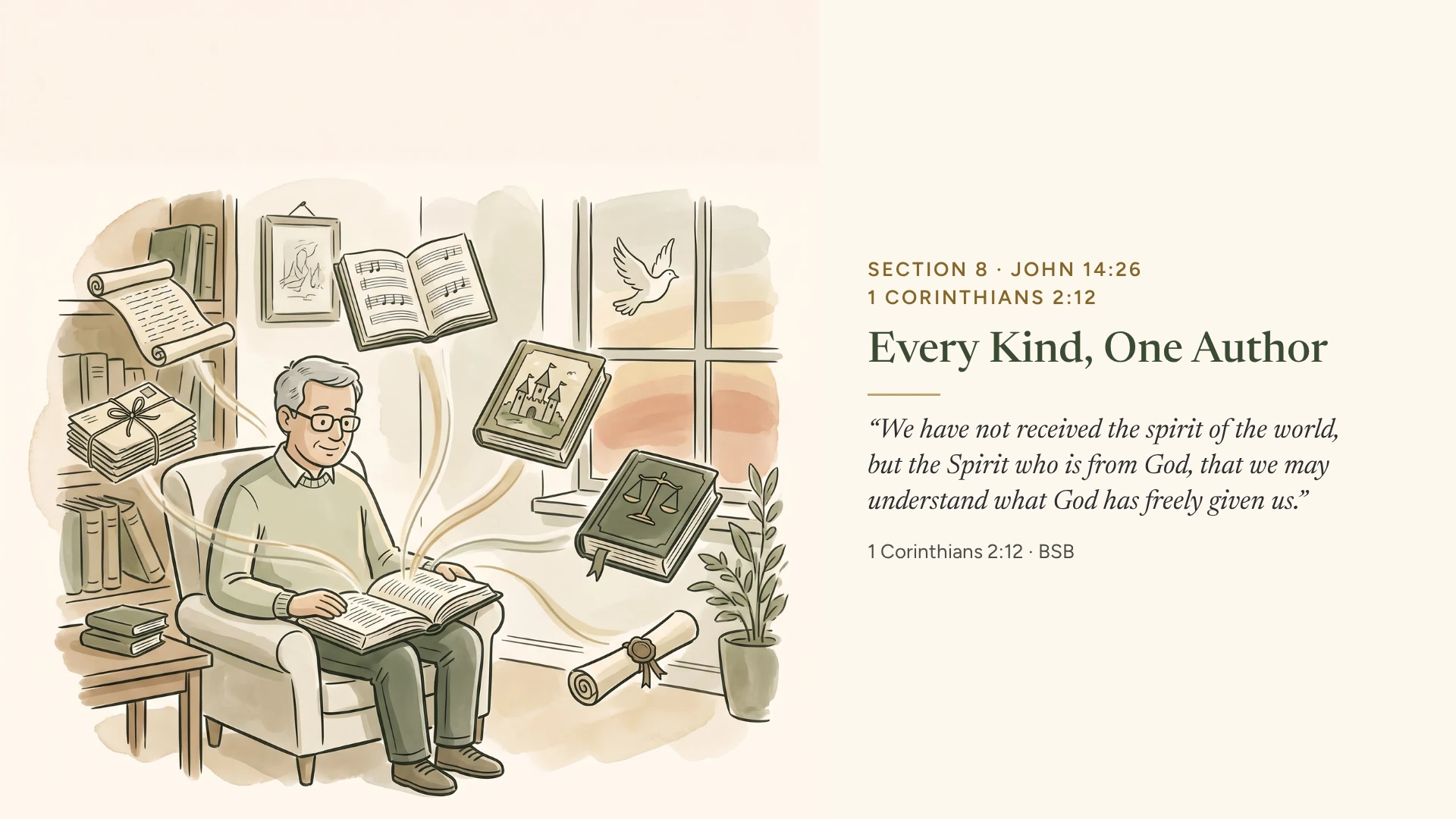
Read the Bible as the kinds of writing God gave it in. Name the family, then the subgenre, and look for the real point behind every figure. Literal asks what kind; Contextual asks where. Stay off the wooden cliff and the hidden-meaning cliff, and let each passage say what its Author meant.
Meditate and Obey. Study and Apply. Hear and Do.
This is how we abide in Christ. This is how we demonstrate our love for God.
Notes
Note on Section 2: when the two cliffs meet. Ramm tells how some ancient rabbis fixed on the tiniest details of the text, until every letter seemed to carry a meaning of its own. Centuries later, a mystical school called the Cabbalists pushed this further: Ramm describes how they made each letter stand for another word and gave words number values, linking verses in ways he calls arbitrary and odd. In that school, he says, letter-by-letter reading and code reading joined hands. Ramm is fair to the rabbis, too. He credits them with sound rules we still use, like reading a word in its sentence and a sentence in its context, and he notes that later Jewish scholars, such as the Karaites, led the way back to careful reading. Back to Section 2
Sources
- Fuhr, Richard Alan, Jr., and Andreas J. Köstenberger. Inductive Bible Study: Observation, Interpretation, and Application through the Lenses of History, Literature, and Theology. Nashville: B&H Academic, 2016. Ch. 2, "#1. The Literal Principle," 22–24; ch. 6, Table 6.2, 143–146.
- Barbieri, Louis A., Jr. "Matthew." In The Bible Knowledge Commentary: New Testament, edited by John F. Walvoord and Roy B. Zuck, 61–62. Wheaton, IL: Victor Books, 1985.
- Beeke, Joel R., Michael P. V. Barrett, and Gerald M. Bilkes, eds. The Reformation Heritage KJV Study Bible. Grand Rapids: Reformation Heritage Books, 2014, 1703–1704.
- Bullinger, E. W. Figures of Speech Used in the Bible. London: Eyre & Spottiswoode, 1898. Introduction, v–xiii.
- Calvin, John. Commentaries on the Epistles of Paul to the Galatians and Ephesians. Translated by William Pringle. Bellingham, WA: Logos Bible Software, 2010, 196–211.
- Carasik, Michael, ed. and trans. Deuteronomy: Introduction and Commentary. Philadelphia: Jewish Publication Society, 2015, 48–49.
- Crossway Bibles. ESV Literary Study Bible. Wheaton, IL: Crossway, 2019, 453, 1137, 1949.
- Deere, Jack S. "Deuteronomy." In The Bible Knowledge Commentary: Old Testament, edited by John F. Walvoord and Roy B. Zuck, 274–275. Wheaton, IL: Victor Books, 1985.
- Dockery, David S. "Ephesians." In Holman Illustrated Bible Commentary, edited by E. Ray Clendenen and Jeremy Royal Howard, 1278–1280. Nashville: B&H, 2015.
- Fee, Gordon D., and Douglas Stuart. How to Read the Bible for All Its Worth. 4th ed. Grand Rapids: Zondervan, 2014, 21–27.
- Hoehner, Harold W. "Ephesians." In The Bible Knowledge Commentary: New Testament, edited by John F. Walvoord and Roy B. Zuck, 616–619. Wheaton, IL: Victor Books, 1985.
- Keener, Craig S. The IVP Bible Background Commentary: New Testament. 2nd ed. Downers Grove, IL: IVP Academic, 2014, 543–544.
- Mangum, Douglas, ed. Lexham Context Commentary: New Testament. Bellingham, WA: Lexham Press, 2020. On Ephesians 1:3–14.
- Martin, John A. "Isaiah." In The Bible Knowledge Commentary: Old Testament, edited by John F. Walvoord and Roy B. Zuck, 1111. Wheaton, IL: Victor Books, 1985.
- Merrill, Eugene H. Deuteronomy. New American Commentary 4. Nashville: Broadman & Holman, 1994, 166–168.
- NIV Bible Speaks Today: Notes. London: IVP, 2020, 1608.
- Packer, J. I., Wayne Grudem, and Ajith Fernando, eds. ESV Global Study Bible. Wheaton, IL: Crossway, 2012, 1661–1662.
- Ramm, Bernard. Protestant Biblical Interpretation: A Textbook of Hermeneutics. 3rd rev. ed. Grand Rapids: Baker, 1970, 45–48, 221–227, 232–238, 244–269, 279–287.
- Robertson, A. T. Word Pictures in the New Testament. Nashville: Broadman Press, 1933. On Ephesians 1:3–14.
- Ryken, Leland. How to Read the Bible as Literature … and Get More Out of It. Grand Rapids: Zondervan, 2016, 11–17. Quotes C. S. Lewis.
- Sproul, R. C. Knowing Scripture. Downers Grove, IL: InterVarsity Press, 2009, 53–60.
- Stott, John R. W. God's New Society: The Message of Ephesians. Downers Grove, IL: InterVarsity Press, 1979, 31–50, 139–141. Quotes Markus Barth.
- Vincent, Marvin R. Word Studies in the New Testament. Vol. 3. New York: Charles Scribner's Sons, 1887, 363–369.
- Walvoord, John F. "Revelation." In The Bible Knowledge Commentary: New Testament, edited by John F. Walvoord and Roy B. Zuck, 930–931. Wheaton, IL: Victor Books, 1985.
- Wilkinson, Bruce, and Kenneth Boa. Talk Thru the Bible. Nashville: Thomas Nelson, 1983, 400–405.
- Witherington, Ben, III. The Letters to Philemon, the Colossians, and the Ephesians: A Socio-Rhetorical Commentary on the Captivity Epistles. Grand Rapids: Eerdmans, 2007, 227–237.
- Zuck, Roy B. Basic Bible Interpretation: A Practical Guide to Discovering Biblical Truth. Colorado Springs: David C. Cook, 1991, 129–132, 144–159.
Scripture quotations marked Berean Standard Bible (BSB) or Majority Standard Bible (MSB) are taken from texts that have been dedicated to the public domain. Free resources are available at BereanBible.com and MajorityBible.com.