The Exegetical Guardrail
How drawing the meaning out of Scripture, rather than reading our own assumptions into it, keeps us close to what God actually said.
Published March 29, 2026 · Updated October 3, 2026
In this lesson · 8 sections
- Section 1The Heart of Abiding: An Invitation to the Word
- Section 2The Exegetical Guardrail: Drawing Out vs. Reading In
- Section 3Practicing the Guardrail: The Pre-Understanding Audit
- Section 4Practice Case 1: The Greater Works
- Section 5Practice Case 2: Plans for a Future and a Hope
- Section 6Practice Case 3: All Things Through Christ
- Section 7Walking with the Teacher: How the Guardrails Work Together
- Section 8Final Invitation: The Joy of Hearing Him Clearly
The Heart of Abiding: An Invitation to the Word
You have probably seen it on a bumper sticker, a coffee mug, or painted above a locker room doorway: "I can do all things through Christ who strengthens me." It is one of the most quoted verses in the Bible. But here is a question worth sitting with: does that verse mean what most people say it means?
If you have ever quoted a verse confidently, only to later discover that the surrounding passage tells a very different story, you know the feeling. It is not guilt. It is the honest recognition that somewhere along the way, you inherited an interpretation that was never rooted in what the Author actually said. And if you are willing to sit with that, you are already practicing the guardrail we are about to study.
This Abide Discovery Session introduces the Exegetical Guardrail, the practice of drawing meaning out of the text rather than reading our own assumptions into it. Our path through this course is shaped by three action pairs: Meditate & Obey, Study & Apply, and Hear & Do. Every one of them depends on hearing what God actually said before we set out to do it.
And the Word is designed for exactly this kind of engagement. It is not a collection of fortune-cookie phrases to be pulled at random. It is a living communication from a precise Author who intends for it to dwell richly in us:
16 Let the word of Christ dwell in you richly, with all wisdom teaching and admonishing one another with psalms and hymns and spiritual songs, singing with gratefulness in your hearts to God.
Notice what Paul calls for: not a passing acquaintance with the Word, but a rich, wisdom-filled indwelling. The word "richly" implies depth, not surface skimming. And the phrase "with all wisdom" tells us the manner: the Word is meant to teach us with the wisdom it already contains, not with the assumptions we bring to it. That kind of depth is only available when we draw out what God placed in the text.
But this depth does not come without practice. It is a skill the faithful reader develops over time:
13 For everyone who partakes only of milk is not accustomed to the word of righteousness, for he is an infant. 14 But solid food is for the mature, who because of practice have their senses trained to discern both good and evil.
The word "practice" is the key. Discernment is not a gift that arrives overnight. It is trained. The Exegetical Guardrail is one of the primary tools for that training. It teaches us to set aside what we assume the text says and to discover what it actually says, so that our obedience is built on bedrock rather than borrowed impressions.
Engage the Text: Colossians 3:16 and Hebrews 5:13–14
- In Colossians 3:16, what does Paul say the word of Christ should do in us? What two words describe the manner in which it should dwell?
- In Hebrews 5:13, what metaphor does the author use for someone who is unskilled in the word of righteousness? What does he call that person?
- In Hebrews 5:14, what produces the maturity the author describes? What specific ability does that maturity create?
- Colossians 3:16 says the Word should dwell in us "richly, with all wisdom." If someone reads a verse superficially, applying it based on a quick impression rather than careful study, would you describe that as "richly" or "thinly"? How does the Exegetical Guardrail move us from thin reading to rich reading?
- Hebrews 5:14 says mature readers have their senses "trained to discern." The Exegetical Guardrail trains us to discern between what a passage actually says and what we might want it to say. Why is that particular discernment essential for spiritual maturity?
- Both passages assume the reader must do something active: let the Word dwell richly, practice discernment. How does the Exegetical Guardrail provide a practical, repeatable way to do both?
- When you sit down to read your Bible, would you describe your current approach as letting the Word dwell "richly" or as skimming the surface? What is one habit that could deepen your engagement?
- Hebrews 5:14 says maturity comes through practice. What is one area of your Bible reading where you know you have been relying on inherited impressions rather than doing the work of drawing the meaning out yourself?
- This week, choose one passage you think you know well. Read it slowly, in its surrounding context, and ask: "Is this what the Author actually said, or is this what I have always assumed it said?" Write down what you discover.
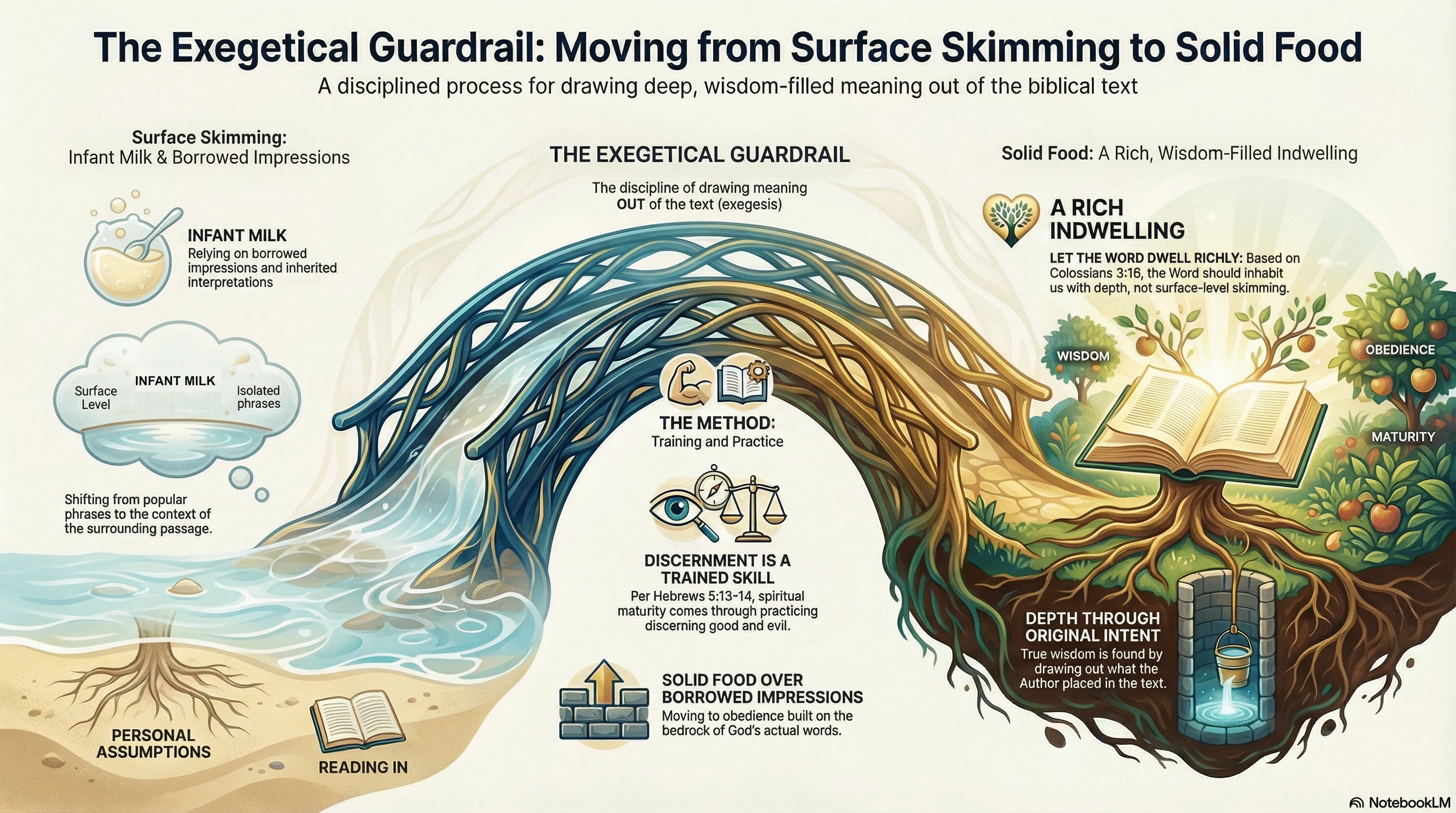
The Word of God is designed to dwell in us richly, not thinly. But richness requires the trained skill of drawing out what the Author placed in the text. The Exegetical Guardrail is the tool that trains that skill, moving us from borrowed impressions to the solid food of what God actually said.
The Exegetical Guardrail: Drawing Out vs. Reading In
What is the Author saying in this passage to the original audience?
The Exegetical Guardrail is built around one essential distinction: the difference between drawing meaning out of the text and reading meaning into it.
The technical terms are exegesis and eisegesis. Do not let those words intimidate you. The principle is straightforward:
| Principle | Action | Definition |
|---|---|---|
| Exegesis | Drawing Out | Finding the meaning that is already in the text; letting the Bible speak for itself. |
| Eisegesis | Reading In | Forcing our own ideas, desires, or assumptions onto the biblical text. |
To practice exegesis faithfully, we need to be honest about two things we carry into every reading:
- Pre-understanding: These are the biases and cultural assumptions we possess before we open a single page. For example, you might approach the Bible with the silent assumption that "God's primary goal is my personal happiness." The Exegetical Guardrail asks us to approach the Word with humility, willing to release any notion that does not match what the text actually says.
- Presuppositions: These are foundational convictions we hold with confidence. An example is the belief that "The Bible is the final, inspired authority on what is good and true." These are not biases to surrender; they are anchors to hold.
The difference is crucial: humility about pre-understanding, confidence in presuppositions. With both in their proper place, we are positioned to let the Word speak.
Peter points to the source of Scripture's meaning:
20 Know this first of all, that no prophecy of Scripture comes by one's own interpretation. 21 For no prophecy was ever made by an act of human will, but men moved by the Holy Spirit spoke from God.
Notice what Peter is saying. Scripture did not originate in the minds of its human authors. It came from God, carried by men who were moved by the Holy Spirit. The meaning belongs to the One who sent it. Our task is not to create an interpretation; it is to receive the one that is already there.
This guardrail does not restrict us. It releases us. When we stop working to make the Bible say what we want, we begin to hear what He is actually saying. And what He is saying is always better than anything we could have projected onto the page.
Engage the Text: 2 Peter 1:20–21
- Peter prefaces this truth with "know this first of all." Why might this principle be foundational before any other rule of interpretation is applied?
- In verse 20, what does Peter say prophecy of Scripture does not come from? What is the implication for who holds the meaning of a passage?
- In verse 21, what two things does Peter say prophecy was not made by? What phrase describes how the human authors operated?
- If no prophecy comes by "one's own interpretation," what is the proper posture of the reader before the text: creator of meaning, or receiver of meaning? How does the Exegetical Guardrail put us in the receiver's posture?
- Pre-understanding often does not announce itself as bias. It simply feels like common sense. How might a reader's "own interpretation" enter a passage without them realizing it? What habit or practice does the Exegetical Guardrail establish to interrupt that?
- Peter says the human authors were "moved by the Holy Spirit." What does that tell us about who is the ultimate Author of Scripture, and how does that shape how we approach the text?
- Have you ever approached a passage with a conclusion already in mind, looking for confirmation rather than discovery? What would it look like to begin your reading time with the posture of "I am here to receive, not to confirm"?
- What is one assumption you carry about God, life, or yourself that you would want to test against what the Scripture actually says?
- This week, before you read a passage, try writing down what you expect it to say. Then read it carefully and see whether the text confirms or corrects that expectation. What does the result reveal?
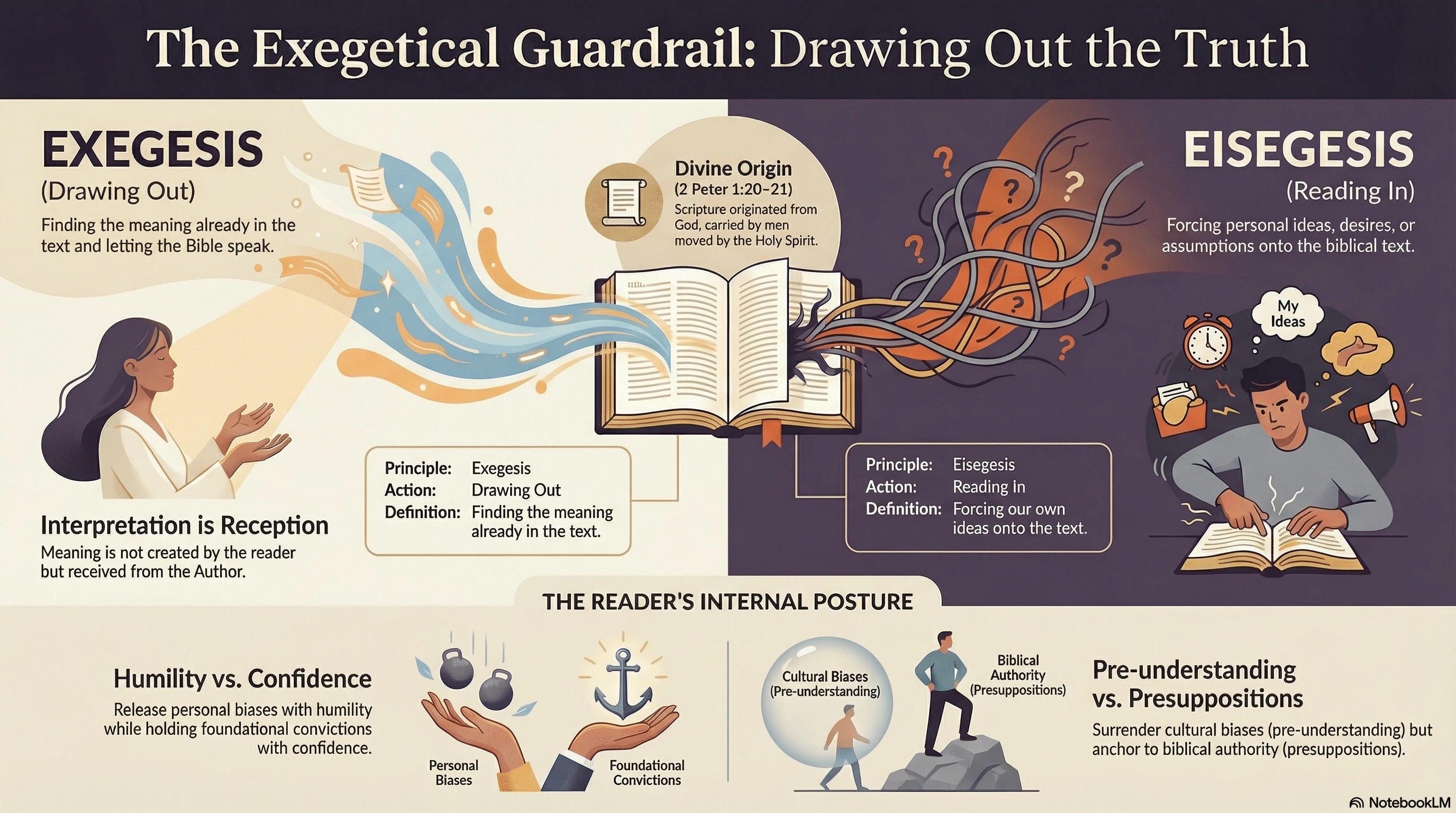
Meaning is not ours to create. It belongs to the Author who breathed it out. The Exegetical Guardrail is the practice of approaching Scripture as a receiver rather than a generator, setting pre-understanding aside with humility while holding presuppositions with confidence.
Practicing the Guardrail: The Pre-Understanding Audit
Every reader comes to Scripture from somewhere. We carry years of habits, sermons, traditions, church culture, and personal experience into every reading. Most of the time, we are not even aware of how much that shapes what we "see" in a passage.
The Exegetical Guardrail gives us a practical way to address this honestly. Before building any interpretation, it asks two questions:
Question 1: What do I believe before I start reading?
This is the pre-understanding audit. Every reader has assumptions. The question is whether we are honest about them. A person who grew up hearing Jeremiah 29:11 used as a promise of personal prosperity will approach that verse very differently from someone reading it in context for the first time. The guardrail does not ask us to pretend we have no history. It asks us to hold that history loosely.
Question 2: What convictions am I right to hold with confidence?
These are our presuppositions: the settled truths that do not shift with our feelings or cultural moment. The Bible is God's Word. It is true. It has one intended meaning per passage. These are not biases to release. They are the foundation on which proper exegesis is built.
Seeing the Audit in Action
Here is what the pre-understanding audit looks like in practice. Take a verse most readers encounter early in their faith:
11 'For I know the plans that I have for you,' declares Yahweh, 'plans for peace and not for calamity, to give you a future and a hope.
Before reading a word of the surrounding chapter, the faithful reader pauses and asks both questions honestly.
Question 1: What do I believe before I start reading?
"I have heard this verse hundreds of times. I have seen it on greeting cards and hospital walls. My pre-understanding tells me this is a personal promise, that God has a good and comfortable future planned specifically for me. I am holding that loosely, because I have not yet let the text speak."
Question 2: What convictions am I right to hold with confidence?
"I am confident that the Bible is God's Word, that it has one intended meaning per passage, and that meaning belongs to the Author who breathed it out. These I do not release."
With the audit complete, the reader opens the surrounding text. What they discover there, who the audience actually was, what circumstances they were in, what God was actually promising, is covered in the practice case ahead. But notice what the audit did first: it separated the assumption (personal comfort) from the anchor (God's Word is trustworthy) before a single line of interpretation was attempted.
That separation is the whole work of the audit. It does not require expertise. It requires honesty.
With both questions answered honestly, the work of drawing out begins. Exegesis asks: What did the author intend to say, to this audience, in this moment? Eisegesis asks a different question: What would I like this to say to me, right now? These are not the same question, and they do not produce the same result.
4 Delight yourself in Yahweh; And He will give you the desires of your heart.
Here is what drawing out produces, rather than reading in. Consider Psalm 37:4, which we studied in our lesson on the Contextual Guardrail: "Delight yourself in Yahweh; And He will give you the desires of your heart" (Psalm 37:4, LSB).
Through eisegetical lenses, this reads like a blank check: delight in God and He will give you whatever you want. But the Exegetical Guardrail reveals the real treasure. When you genuinely delight in Yahweh, something profound happens, He becomes the desire of your heart. The heart that is actively delighting in Him is already crying out for more of Him, deeper intimacy, closer relationship, greater nearness.
In a beautiful act of covenant faithfulness, He promises to give you the desire of your heart, which is Himself. He gives you more of what you are already longing for: more of His presence, more of His love, more of the relationship your delight has awakened in you. As that intimacy deepens, He also begins to shape new desires within you: desires for what He cares about, longings you could not have manufactured on your own, until your heart and His beat the same rhythm. The desires of your heart are not your pre-existing wish list; they are the desires He has grown in you through the delight. The guardrail draws that meaning out rather than allowing us to read our wish list into it.
The good news is that exegesis always produces something better than eisegesis can offer. The truth God placed in the text is more stable, more satisfying, and more transformative than anything we could read into it. When the guardrail holds, the Word is free to do what only it can do.
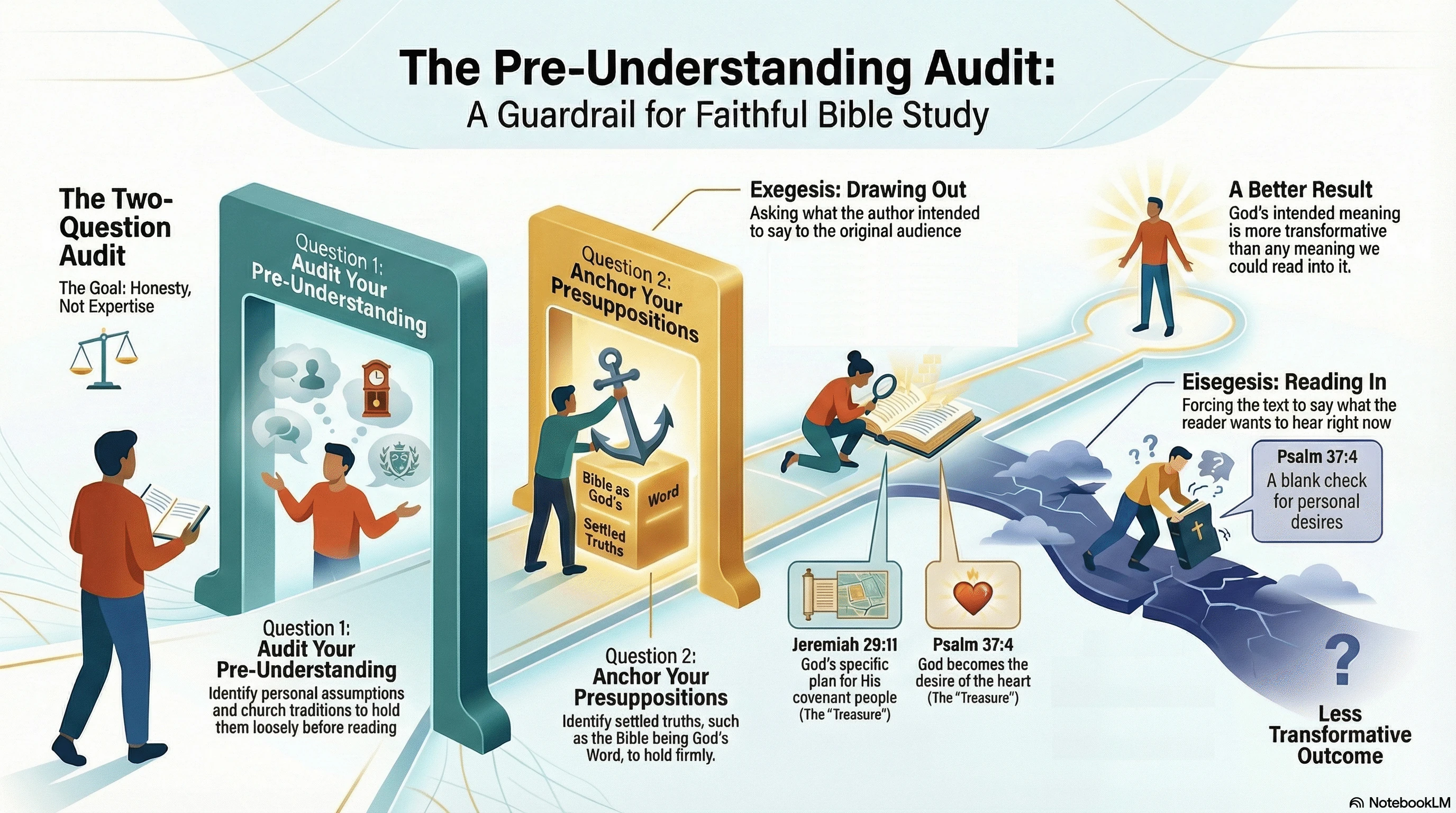
The Exegetical Guardrail is not about eliminating personal application. It is about getting the meaning right first, so that every application we build is standing on the solid ground of what God actually said.
Practice Case 1: The Greater Works
Here is a verse that is frequently used to encourage believers to pursue more powerful miracles than Jesus performed during His earthly ministry. It shows up in certain circles as a bold promise that individual Christians will raise the dead, heal the sick, and do signs greater than the Son of God Himself. But is that what Jesus is actually saying?
12 "Truly, truly, I say to you, he who believes in Me, the works that I do, he will do also; and greater works than these he will do; because I go to the Father."
A common eisegesis of this verse assumes "greater works" means more spectacular individual miracles: raising more dead people, healing more diseases, commanding greater signs. This reading feeds a pre-understanding shaped by a desire for power and spectacle. But it has bypassed the key phrase in the verse: "because I go to the Father."
That phrase is not decoration. It is the interpretive hinge. To find out what Jesus means, we have to practice exegesis, which means drawing the meaning out of the text. And we cannot do proper exegesis here without the Contextual Guardrail, which tells us to read the surrounding verses.
First, notice what Jesus says right before this: "because I go to the Father." He is talking about His departure from the earth and His return to heaven. Second, consider Jesus' earthly ministry. It was limited to a specific time and a specific place. He ministered for about three years, primarily in the region of Israel.
Now think about what happened after Jesus ascended to heaven and the Holy Spirit came (John 14:16–17). The disciples, empowered by the Spirit, took the Gospel message not just to one region, but to the entire world. The number of people who came to believe in Him grew exponentially, and the message reached places Jesus never physically visited.
So when Jesus says "greater works than these he will do," He is not talking about more spectacular individual miracles. He is talking about the scope and reach of the Gospel of Jesus Christ. The "greater works" are the works of the global church, which would spread the Gospel to countless people and across the entire world, a work far greater in scale than Jesus' three-year ministry in Israel.
We also need the Literal Guardrail here. We are reading a Gospel, which is historical narrative. Jesus is speaking to His disciples in a specific moment, not making an abstract theological declaration. And notice how the guardrails always work together. We could not do proper exegesis without the Contextual Guardrail (reading the surrounding verses) and the Literal Guardrail (understanding the genre of what we are reading).
Engage the Text: John 14:12
- What specific condition does Jesus attach to the promise in this verse? Who does He say will do these works?
- What reason does Jesus give for why these "greater works" will happen? What event does the phrase "because I go to the Father" point to?
- Jesus' earthly ministry lasted approximately three years and was centered in Israel. What does the history of the early church reveal about the geographic and numerical scope of what followed His departure?
- The common eisegesis reads "greater works" as more impressive individual miracles. What pre-understanding might lead a reader to that conclusion? What does the text itself indicate "greater" refers to?
- The phrase "because I go to the Father" is the interpretive key to the entire verse. What happens to the meaning if a reader isolates verse 12 from its surrounding context and does not let that phrase shape the interpretation?
- How does understanding this verse exegetically produce a more awe-inspiring result than the eisegetical reading? What does the exegetical reading reveal about the scope of what God has accomplished through the Spirit-empowered church?
- Have you heard this verse used to encourage a pursuit of signs and wonders? How does the exegetical reading change what you would be encouraged to pursue?
- The "greater works" include you: every person who has come to faith through the Spirit-empowered proclamation of the Gospel is part of this promise. How does this reframe your understanding of your role in the church?
- What would it look like to spend more time this week marveling at the scope of what the Gospel has accomplished across the world, rather than looking for spectacular individual experiences to validate your faith?
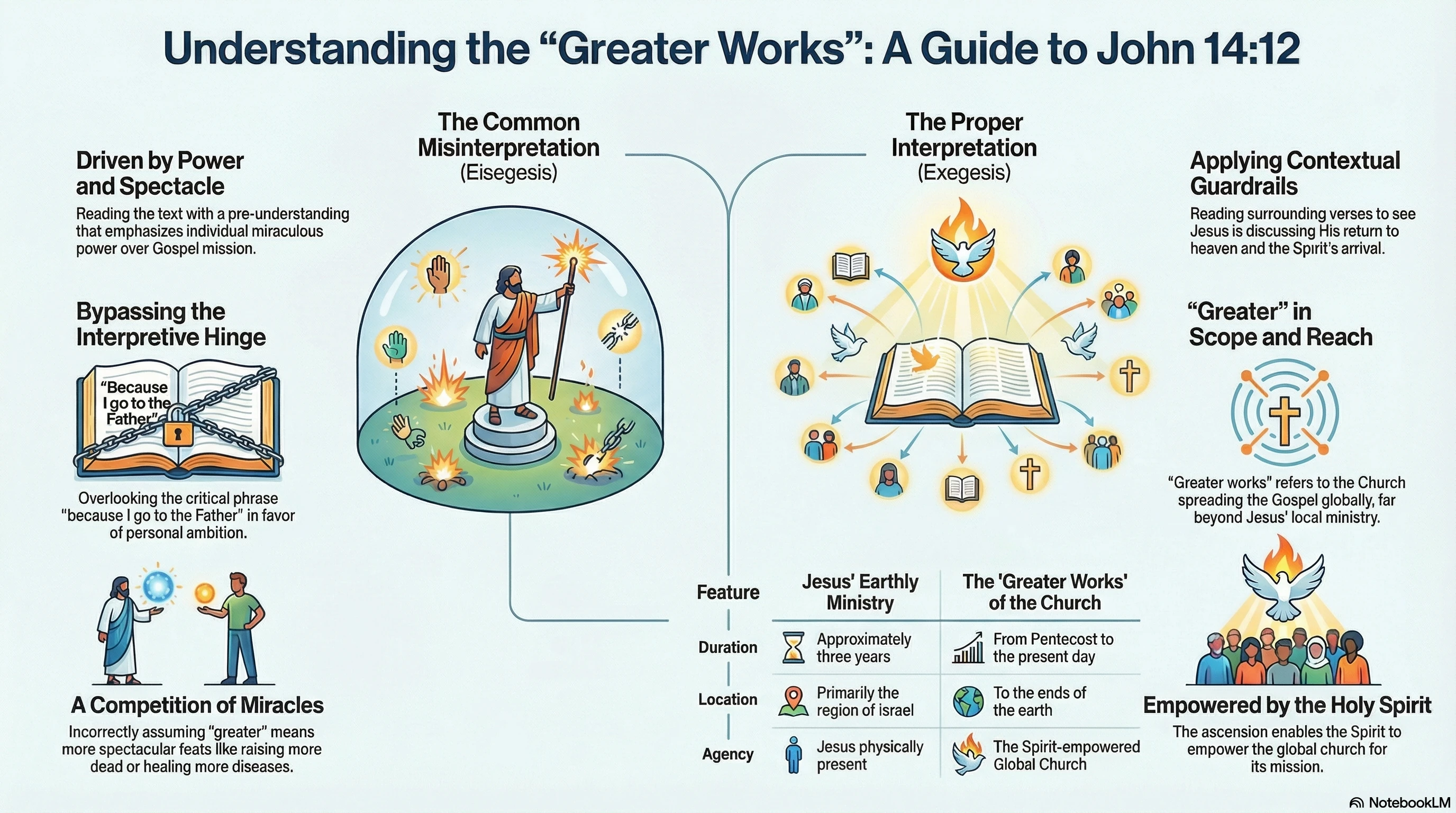
Exegesis does not diminish the promise of John 14:12. It magnifies it. The "greater works" are not a personal miracle competition. They are the Spirit-empowered global mission of the church, and every believer who has shared the Gospel is already participating in them.
Practice Case 2: Plans for a Future and a Hope
Few verses have been used more broadly as a personal promise than this one. It appears on graduation cards, hospital walls, and inspirational social media posts. But when you read it in its full context, you discover a far more specific, and far more powerful, statement than those uses suggest.
11 'For I know the plans that I have for you,' declares Yahweh, 'plans for peace and not for calamity, to give you a future and a hope.
A common eisegesis applies this as a personal promise that God has a comfortable and prosperous life planned for each individual believer. When things get hard, the verse becomes a reassurance that the situation will improve quickly.
But the Exegetical Guardrail asks: Who is God actually speaking to, and what was their situation?
The answer is in the surrounding chapters. God is speaking to the nation of Israel, who had just been taken into Babylonian exile. They were in a terrible situation: living as captives, facing immense suffering, ripped from their homes and everything they knew. In the preceding verses, God even tells them to build houses, plant gardens, and have families in Babylon, because they would be there for a long time, seventy years, to be exact.
So when God says, "I know the plans that I have for you... plans for peace and not for calamity, to give you a future and a hope," He is not promising them a quick escape from hardship. He is giving them a promise of a certain future: ultimate restoration and a return to their land after a long period of suffering. The promise was to the people as a whole, for a future that was decades away.
This example shows us how easy it is to read our own desires for personal ease into a passage. The Exegetical Guardrail forces us to look at the historical, communal, and literary context to understand the author's true intent. Notice how the Contextual Guardrail (who is being addressed? what is the historical setting?) and the One-Meaning Guardrail (one intended meaning for this audience, not a blank check for every individual) work hand-in-hand with exegesis here. The guardrails always work together.
But does this mean the verse has nothing to say to us today? Not at all. Good exegesis does not diminish a passage; it deepens it. When we protect the meaning, the application actually becomes richer and more firmly grounded in the whole counsel of God. The exegetical reading reveals a God who is faithful in the fire, not just after it. It shows us a God who can be trusted across decades of suffering, who keeps promises on a timeline that is larger than our comfort. That is a God we can anchor our lives to.
There is a world of difference between saying "God promised He will give me a comfortable life" and saying "The God who sustained His people through seventy years of exile is the same God who holds my future."
Engage the Text: Jeremiah 29:11
- Who is speaking in Jeremiah 29:11, and who is the audience based on the surrounding chapter? What situation is the audience in when they receive this word?
- What does God instruct the people to do in the preceding verses of Jeremiah 29 (build houses, plant gardens, raise families)? What does that instruction reveal about how long they would be in Babylon?
- The promise is "a future and a hope." Based on the context, what kind of future is being promised, and over what timeframe?
- The common eisegesis makes this a personal promise of individual comfort and prosperity. What pre-understanding leads someone to that reading? What does the historical and communal context reveal instead?
- The Exegetical Guardrail forces us to ask "Who is God speaking to?" before we ask "What does this mean to me?" How does answering the first question actually enrich the second question rather than eliminate it?
- The exegetical reading shows a God who is faithful through suffering, not just after it. How is that truth more durable and trustworthy than a promise of personal ease?
- Have you leaned on Jeremiah 29:11 as a personal promise during a hard season? How does understanding its original context change what you draw from it: does it take something away, or does it offer something better?
- The Israelites were told to settle in for seventy years. What would it look like to trust God's faithfulness across a longer timeline than you are currently comfortable with?
- Who in your life is in a season of suffering right now? How might the exegetical truth of this passage, a God who is faithful in exile, be more comforting than the popular misreading?
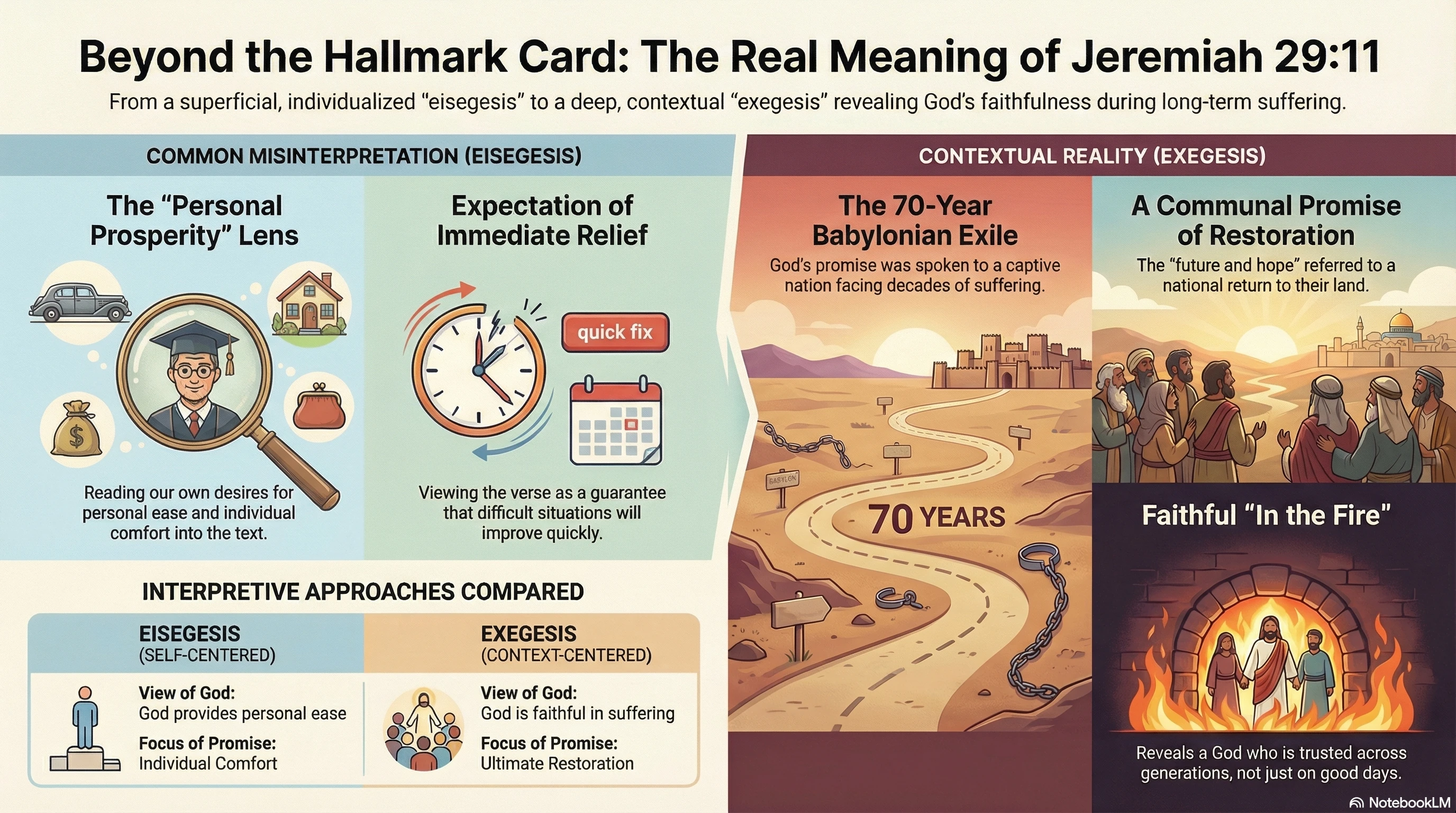
Jeremiah 29:11 is not a personalized promise of a comfortable life. It is a communal promise of ultimate restoration to a people in the middle of a long trial. The exegetical reading gives us a God who is greater, not smaller: one who is faithful through seventy years of exile, not just on the good days.
Practice Case 3: All Things Through Christ
Before reading the passage, run the audit.
Question 1: What do I believe before I start?
Pause and answer honestly. Most readers carry something like: "This verse is about God empowering me to succeed at hard things. I have heard it in locker rooms, on motivational accounts, and in sermons about overcoming obstacles. That is my pre-understanding." Write it down if it helps. Hold it loosely.
Question 2: What convictions am I right to hold with confidence?
"This letter was written by a real person, to a real church, in a real situation. The Author had one meaning in mind. I am not here to confirm what I think it says."
Now read it:
13 I can do all things through Him who strengthens me.
With the audit done and the pre-understanding named, look at the surrounding text...
11 Not that I speak from want, for I have learned to be content in whatever circumstances I am. 12 I know how to get along with humble means, and I also know how to live in abundance; in any and all things I have learned the secret of being filled and going hungry, both of having abundance and suffering need.
Paul is writing from prison. He is not celebrating a victory or achieving a personal goal. He is describing the secret of contentment in every circumstance, whether he has plenty or has nothing. The "all things" he can do through Christ is not any goal he desires. It is enduring every circumstance he faces: abundance and need, fullness and hunger. Christ's strength is sufficient for everything, especially the worst.
The Literal Guardrail is also at work here. This is a letter, an epistle written by a specific author to a specific church. We read it as personal correspondence, not as a motivational poster. Letters carry context, tone, and situation. When we strip verse 13 from its context and turn it into a slogan, we lose all three.
And the One-Meaning Guardrail reminds us that Paul's one intended meaning is contentment through Christ's strength, not unlimited personal empowerment. There may be many applications of that truth, but the meaning is singular.
The exegetical reading does not shrink the verse. It liberates it. Instead of a verse about trying harder to succeed, it becomes a word for the person who is at the end of their own strength: Christ's power is sufficient in weakness, not in striving. That is not a smaller promise. It is a far greater one.
Engage the Text: Philippians 4:11–13
- What is Paul's situation when he writes Philippians? What does verse 11 say he has "learned"?
- List the contrasts Paul describes in verse 12: humble means and abundance, being filled and going hungry, having abundance and suffering need. What do these pairs tell us about the scope of "all things" in verse 13?
- The word "learned" in verses 11 and 12 suggests this did not come naturally. What does that imply about how contentment is developed?
- The common eisegesis reads "all things" as any personal goal. The Exegetical Guardrail asks: what does Paul's context in verses 11–12 indicate "all things" actually refers to? How does that change the meaning?
- Pre-understanding shaped by sports culture, motivational speakers, and church pep talks all push this verse toward achievement language. How do we practice exegesis when our cultural pre-understanding is strong and widely shared?
- The exegetical reading reveals a verse about endurance in suffering, not success in striving. How does that reading serve a person in genuine pain better than the eisegetical reading?
- Have you used or heard Philippians 4:13 as motivation for a personal goal or achievement? Based on its context, what is a more faithful application of this verse?
- Contentment in every circumstance is described as something Paul "learned." What would it mean for you to be in the process of learning contentment, rather than expecting strength for unlimited achievement?
- Where are you currently trying to succeed through your own striving? How might this verse, properly understood, offer you something better: the sufficiency of Christ's strength in your weakness?
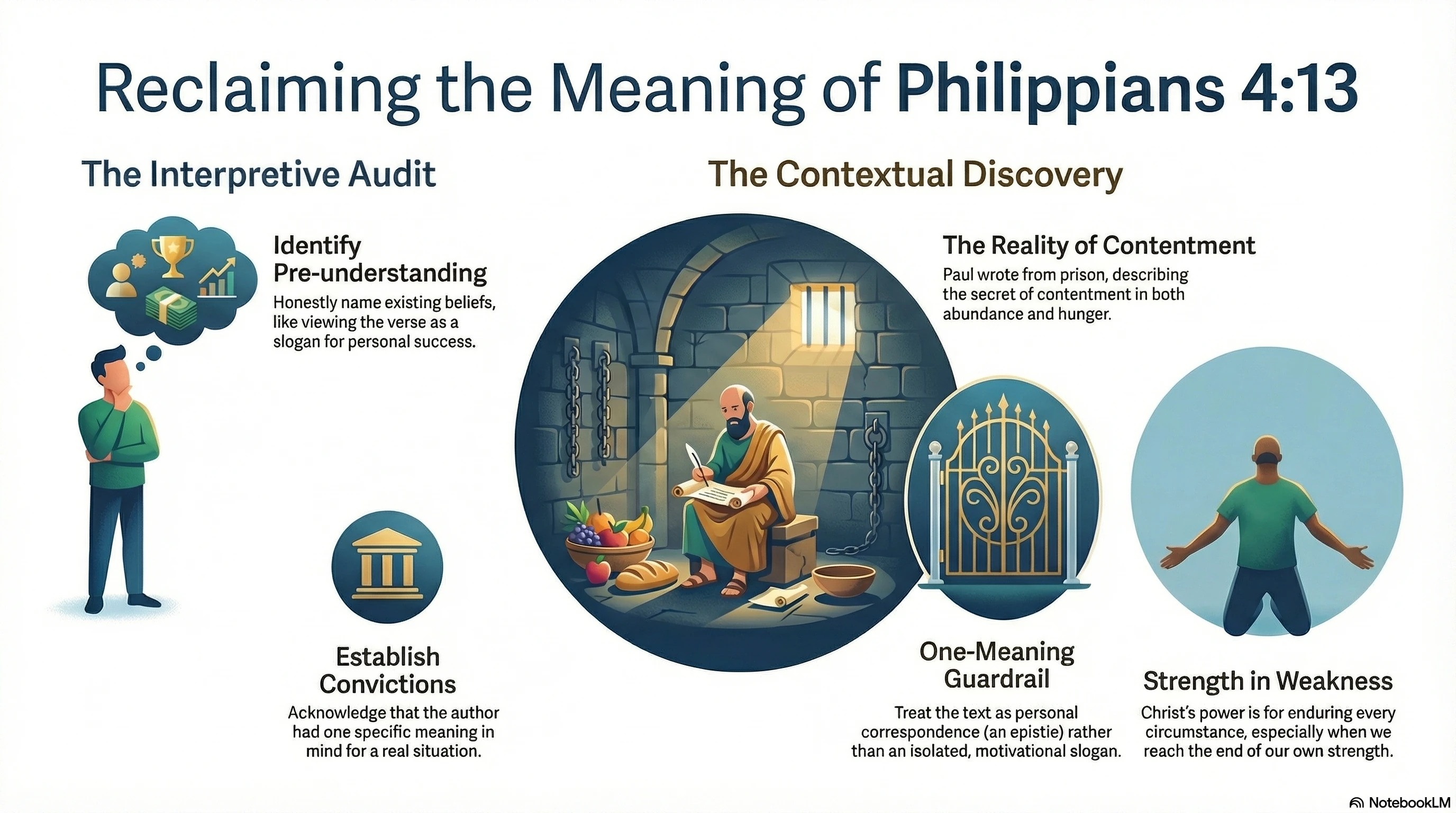
Philippians 4:13 is not a promise that God will empower your ambition. It is a declaration that Christ's strength is sufficient for every circumstance, especially the hardest ones. That is not a smaller promise. It is a far greater one.
Walking with the Teacher: How the Guardrails Work Together
The Exegetical Guardrail does not stand alone. No guardrail does. In every practice case we have studied in this lesson, we needed more than one guardrail to arrive at the faithful reading. We needed the Contextual Guardrail to read the surrounding verses. We needed the Literal Guardrail to recognize the genre. We needed the One-Meaning Guardrail to remember that applications can be many, but meaning is one.
And beneath all of the guardrails is the same conviction: the Holy Spirit who inspired the text is the same Spirit who illuminates it for faithful readers. He is not a passive presence. He is an active guide:
25 "These things I have spoken to you while abiding with you. 26 "But the Advocate, the Holy Spirit, whom the Father will send in My name, He will teach you all things, and bring to your remembrance all that I said to you."
The Spirit's role is not to give us new meanings for old passages. His role is to illumine the meaning that was already placed there by the Author: to help us receive what was already given. That is exactly what the Exegetical Guardrail asks us to do. When we approach Scripture with humility about our pre-understanding and confidence in God's authority, we position ourselves to receive the Spirit's teaching.
Engage the Text: John 14:25–26
- Jesus says the Holy Spirit "will teach you all things" and "bring to your remembrance all that I said to you." What is the Spirit's relationship to the words Jesus has already spoken? Is the Spirit adding new content, or helping the disciples receive what was already given?
- Jesus describes the Spirit as the Advocate sent "in My name." What does that phrase imply about the Spirit's alignment with Jesus' purposes and the integrity of Jesus' words?
- Notice Jesus says these things while "abiding with you." What does this verse suggest about the connection between Jesus' abiding presence and our understanding of His Word?
- The Spirit's role is to bring to remembrance what Jesus said, not to generate new meanings. How does this confirm that the Exegetical Guardrail is not a human invention but a posture aligned with how God Himself intended His Word to be received?
- Every passage we examined in this section (Matthew 18:20, 2 Chronicles 7:14, Revelation 3:20, Proverbs 22:6, Psalm 46:10) required more than one guardrail to interpret faithfully. What does that tell us about how the guardrail system is designed to work: as isolated rules, or as an interconnected community of protection?
- The Exegetical Guardrail works most effectively when we approach the text with the same humility Jesus asked of His disciples: dependent on the Spirit's illumination, not our own cleverness. What does humble, Spirit-dependent reading look like in your personal Bible study?
- Which of the five passages covered in this section surprised you most? What pre-understanding had been shaping how you read it?
- The Exegetical Guardrail protects you from building your life on a misreading. Which guardrail do you most need to strengthen alongside it: Contextual, Literal, One-Meaning, Progressive, Harmony, or Linguistic?
- What would it look like this week to approach one Bible passage with the explicit prayer: "Holy Spirit, teach me what You have already placed in this text, and protect me from what I have been adding to it"?
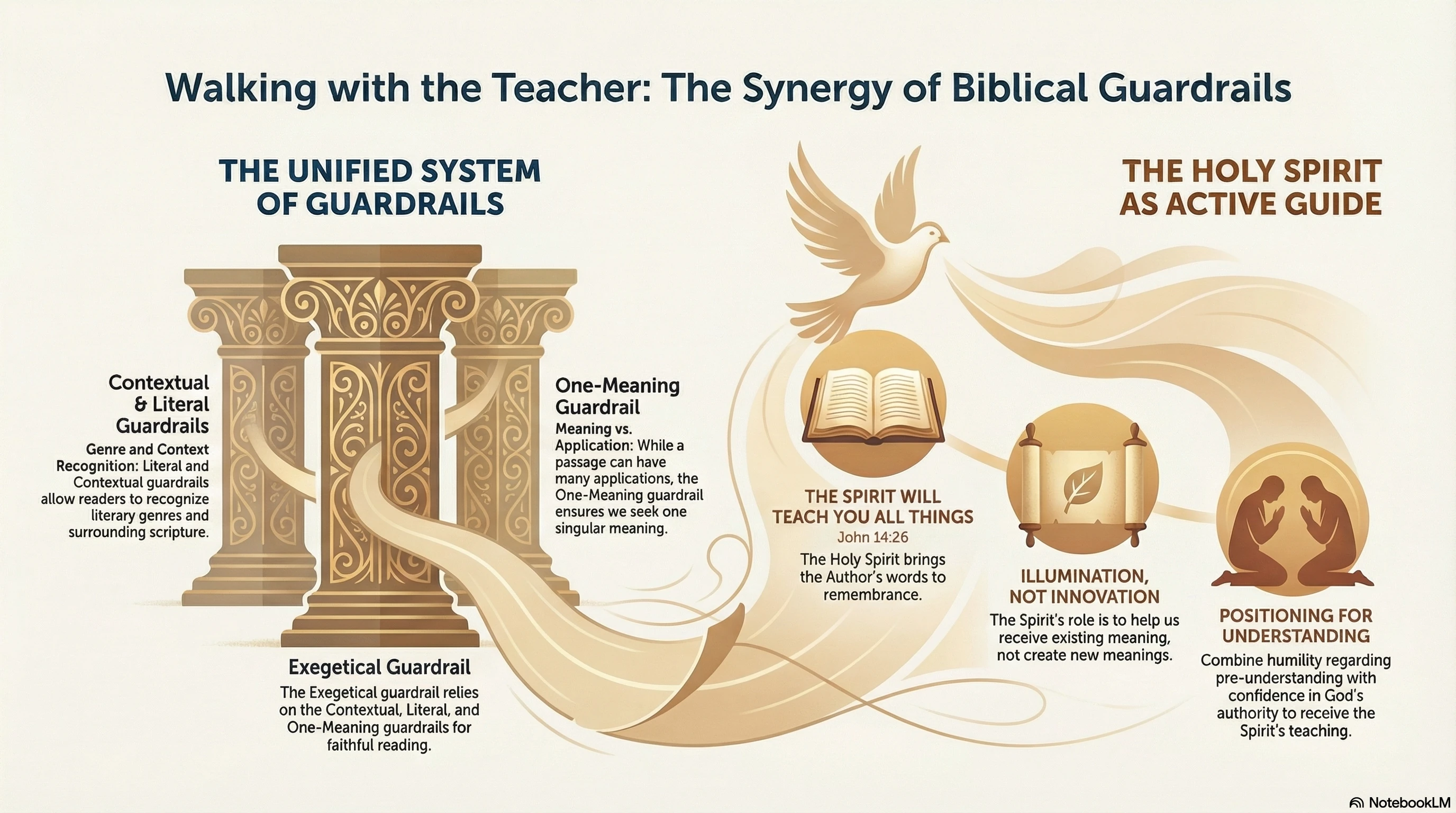
Here is how that partnership plays out across several passages that are frequently misread without it.
Practice Case 4: Where Two or Three Are Gathered (Matthew 18:20)
15 "Now if your brother sins, go and show him his fault, between you and him alone; if he listens to you, you have won your brother. 16 "But if he does not listen to you, take one or two more with you, so that by the mouth of two or three witnesses every fact may be confirmed. 17 "And if he refuses to listen to them, tell it to the church; and if he refuses to listen even to the church, let him be to you as the Gentile and the tax collector. 18 "Truly I say to you, whatever you bind on earth shall have been bound in heaven; and whatever you loose on earth shall have been loosed in heaven. 19 "Again I say to you, that if two of you agree on earth about anything that they may ask, it shall be done for them by My Father who is in heaven. 20 "For where two or three have gathered together in My name, I am there in their midst."
Common eisegesis applies this to any small prayer meeting or worship gathering, as if Jesus is validating small attendance. But the Contextual Guardrail shows that verses 15 through 19 are about church discipline: the process of confronting a brother or sister who is in sin. Jesus describes a three-step process: go privately, then take witnesses, then bring it before the church. The "two or three" gathered in His name are the witnesses in a discipline process, and Jesus is affirming His authority behind the disciplinary decisions of the church. Not attendance. Authority.
Without the Contextual Guardrail, our pre-understanding, shaped by years of hearing this verse in prayer meetings, takes over. The Exegetical Guardrail demands that we let the text speak for itself, and when we do, we discover something far richer: Jesus is present with His authority when His people are doing the hard, faithful work of holding one another accountable.
Engage the Text: Matthew 18:20
- What is the subject of Matthew 18:15–19, the verses immediately preceding verse 20? What three-step process does Jesus describe in those verses?
- Who are the "two or three" gathered in Jesus' name, based on the context of verses 15–19? What role do they play in the process Jesus is describing?
- What does Jesus say He provides when two or three are gathered in His name? Is He making a statement about attendance, or about something else?
- The common eisegesis reads this verse as a promise of Jesus' presence in any small gathering. What pre-understanding, shaped by years of hearing this verse in prayer meetings, leads a reader to that conclusion? What does the Contextual Guardrail reveal instead?
- The Exegetical Guardrail asks: what did the author intend to say, to this audience, in this moment? How does reading verse 20 in isolation from verses 15–19 change the meaning, and why is that isolation itself an act of eisegesis?
- The exegetical reading reveals that Jesus is affirming His authority behind the church's disciplinary decisions, not validating small attendance. How does that reading actually place a higher and more serious claim on the church than the popular misreading does?
- Have you heard Matthew 18:20 used to comfort a small gathering or prayer group? How does understanding its context change what the verse is actually promising?
- The exegetical reading connects Jesus' presence to the hard, faithful work of accountability. What does it mean for your church community that Jesus stands behind that process with His authority?
- Is there a situation in your life or church where Matthew 18:20, properly understood, speaks more directly than you previously recognized? What would it look like to take that seriously?
Practice Case 5: If My People Who Are Called by My Name (2 Chronicles 7:12–14)
12 Then Yahweh appeared to Solomon at night and said to him, "I have heard your prayer and have chosen this place for Myself as a house of sacrifice. 13 "If I shut up the heavens so that there is no rain, or if I command the grasshopper to devour the land, or if I send pestilence among My people, 14 and My people who are called by My name humble themselves and pray and seek My face and turn from their evil ways, then I will listen from heaven, I will forgive their sin, and I will heal their land.
A common eisegesis applies this directly to modern nations as a formula for national revival, as if God is promising that any nation that prays hard enough will be "healed." But the Contextual Guardrail asks: who is God speaking to, and when? Look at verse 12: "Then Yahweh appeared to Solomon at night." God is speaking specifically to Solomon about the nation of Israel in the context of the newly dedicated Temple. The "land" is the Promised Land, and the covenant terms are specific to Israel's unique relationship with Yahweh under the Davidic covenant.
The Progressive Guardrail is also important here: this promise was given at a specific stage of God's unfolding plan, during the Old Covenant era. We cannot simply lift covenant promises made to Old Covenant Israel and drop them onto a modern secular nation as though the same covenantal terms apply directly. And the Harmony Guardrail confirms this: nowhere in the New Testament does God promise to "heal the land" of any nation in response to prayer.
But here is where the Exegetical Guardrail keeps us from stopping too soon. Many teachers of exegesis will correctly explain that 2 Chronicles 7:14 is not a direct covenant promise to modern nations, and then leave it there, as if the passage has nothing to say to us today. That is incomplete.
The One-Meaning Guardrail tells us the meaning is fixed: God speaking to Solomon about Israel under the Davidic covenant. But what does this passage reveal about God's character? He is the God who honors repentance. He is sovereign over all nations. And He responds to humility. That is an abiding principle, confirmed by Nineveh: a thoroughly pagan city with no covenant relationship with God whatsoever. Yet when the people of Nineveh repented at the preaching of Jonah, God relented. He responded to their repentance because that is who He is. It is His character, revealed throughout all of Scripture.
So is it appropriate for believers in every nation to humble themselves and pray, to weep and repent, and to ask for God's blessing? Absolutely. Not because 2 Chronicles 7:14 is a covenant promise to them, but because the God who spoke those words to Solomon is the same God who rules over all peoples, and it is His nature to respond to humility and repentance. There is a world of difference between saying "God promised He will heal our nation if we pray" and saying "The God who honors repentance calls all peoples everywhere to humble themselves before Him." Good exegesis does not diminish this passage. It deepens it.
Engage the Text: 2 Chronicles 7:12–14
- Who is God speaking to in verse 12, and what is the occasion? What does the phrase "this place" refer to, and why does that context matter for identifying the audience?
- The conditions in verse 14 are specific: humble themselves, pray, seek My face, turn from their evil ways. Who are "My people who are called by My name" in the original context? What covenant relationship defines that phrase?
- What does God promise in response in verse 14? What is "the land" He says He will heal, and what is its significance to the original audience?
- The common eisegesis applies this passage as a formula for national revival in any modern nation. Which guardrails are needed to correct that reading, and what does each one specifically reveal about why that application misreads the text?
- This passage is a case where stopping at "this doesn't apply directly to modern nations" is itself an incomplete use of the Exegetical Guardrail. What does the passage reveal about God's character that does carry across covenants, and how is that different from claiming the covenant promise directly?
- The story of Nineveh confirms that God responds to repentance even outside a covenant relationship. How does that cross-reference, drawn from the Harmony Guardrail, actually strengthen rather than weaken what a believer today can draw from this passage?
- Have you heard 2 Chronicles 7:14 invoked as a promise for your nation? How does the exegetical reading change what you would actually be calling your nation to, and why is that call more honest and more durable?
- There is a world of difference between "God promised to heal our land" and "the God who honors repentance calls all peoples to humble themselves before Him." Which of those statements can you stand on with full integrity? What does that shift require of you in how you pray for your nation?
- This passage shows that good exegesis does not take something away — it deepens it. Where else in your Bible reading have you been settling for a flattened application when the exegetical reading would have given you something richer and more firmly grounded?
Practice Case 6: Stand at the Door and Knock (Revelation 3:14–20)
14 "And to the angel of the church in Laodicea write: This is what the Amen, the faithful and true Witness, the Beginning of the creation of God, says: 15 'I know your deeds, that you are neither cold nor hot. I wish that you were cold or hot. 16 'So because you are lukewarm, and neither hot nor cold, I will spit you out of My mouth. 17 'Because you say, "I am rich, and have become wealthy, and have need of nothing," and you do not know that you are wretched and pitiable and poor and blind and naked. 18 I advise you to buy from Me gold refined by fire so that you may become rich, and white garments so that you may clothe yourself, and that the shame of your nakedness will not be manifested; and eye salve to anoint your eyes so that you may see. 19 'Those whom I love, I reprove and discipline. Therefore be zealous and repent. 20 'Behold, I stand at the door and knock. If anyone hears My voice and opens the door, I will come in to him and will dine with him, and he with Me.
For generations, this verse has been used as an evangelistic invitation to unbelievers: Jesus standing at the door of an unregenerate heart, gently knocking and waiting to be invited in for salvation. You may have seen the famous painting of Jesus standing outside a door with no handle on the outside. But who is Jesus actually speaking to? The Contextual Guardrail makes it clear. Look at verse 14: "And to the angel of the church in Laodicea write..." Jesus is addressing a church, believers who have become lukewarm. In verse 16, He says, "Because you are lukewarm, and neither hot nor cold, I will spit you out of My mouth." And in verse 19: "Those whom I love, I reprove and discipline. Therefore be zealous and repent."
This is not an evangelistic invitation to unbelievers. It is a call to repentance and renewed fellowship for people who are already inside the church but have grown complacent and self-sufficient. This is a striking example of how pre-understanding, shaped by popular evangelistic tradition, can completely override what the text actually says. The Exegetical Guardrail insists we draw the meaning out of the text, and when we do, the message is actually more convicting: Jesus is knocking on the door of a church that has shut Him out. The Literal Guardrail also helps here: Revelation is a letter to specific churches, not a general evangelistic tract.
Engage the Text: Revelation 3:14–20
- Look at verse 14. Who is Jesus addressing in this passage? What does the word "church" tell us about the spiritual status of the audience before Jesus even begins His rebuke?
- In verses 15–17, what specific condition does Jesus identify in this community? What does the phrase "I am rich, and have become wealthy, and have need of nothing" reveal about the spiritual posture that produced their lukewarmness?
- In verse 19, Jesus says "Those whom I love, I reprove and discipline." What does this statement tell us about the relationship between Jesus and the people He is addressing? Is this the language of evangelism or the language of covenant correction?
- The common eisegesis reads verse 20 as an evangelistic invitation to unbelievers. What pre-understanding, shaped by generations of evangelistic tradition and the famous painting of Jesus at the door, leads a reader to that conclusion? What does the Contextual Guardrail reveal when we read verse 20 inside its full passage?
- The Literal Guardrail identifies Revelation as a letter written to specific churches. How does recognizing the genre and the specific audience change how verse 20 must be read, and what happens to the meaning when we strip it from that context?
- The exegetical reading reveals something more convicting than the popular reading: Jesus is not knocking on the door of an unbeliever's heart but on the door of a church that has shut Him out. Why is that reading actually more urgent and more applicable to a believer than the eisegetical one?
- Have you heard Revelation 3:20 used primarily as an evangelistic verse? How does understanding its context change what it is calling you to, as someone already inside the church?
- The Laodicean church was not cold toward God, they were lukewarm: comfortable, self-sufficient, and unaware of their own spiritual poverty. Where in your own life might that description be more accurate than you are comfortable admitting?
- Jesus says He stands at the door and knocks. In its exegetical context, that knock is an invitation to repentance and renewed fellowship, not initial salvation. What would it look like this week to open that door, to invite Him back into the areas of your life where comfort and self-sufficiency have quietly crowded Him out?
Practice Case 7: Train Up a Child (Proverbs 22:6)
6 Train up a child according to his way, Even when he is old he will not depart from it.
A common eisegesis reads this as an absolute, unconditional guarantee from God: if you raise your children in a godly home, they will always turn out to be faithful believers. And when a child goes astray, the parent carries crushing guilt: "What did I do wrong? God promised this would work." This is where the Literal Guardrail is absolutely essential. What genre are we reading? This is Wisdom Literature. Specifically, a proverb.
Proverbs express general principles about how life typically works under God's design. They are not unconditional divine guarantees. To read a proverb as a promise is to misunderstand the very type of literature we are engaging with. The Harmony Guardrail confirms this: the rest of Scripture shows us godly parents whose children went astray. Samuel's sons turned corrupt (1 Samuel 8:1–5). The proverb teaches a general truth: faithful training tends to produce faithful children. That is the one meaning. It is wisdom, not a contractual promise. See how the Exegetical Guardrail, working alongside the Literal and Harmony Guardrails, actually frees parents from false guilt? Drawing the meaning out, rather than forcing a guarantee onto the text, leads to a healthier and more truthful understanding.
Engage the Text: Proverbs 22:6
- What genre is Proverbs? What is the defining characteristic of a proverb as a literary form, and how does that differ from a covenant promise or a direct divine guarantee?
- The verse says "train up a child according to his way." What does this phrase suggest about the nature of the instruction being described? Is it a formula, or a principle of faithful, intentional formation?
- The second line says "even when he is old he will not depart from it." Based on the genre, is this a statement of what typically happens under God's design, or an unconditional promise of what always happens regardless of the child's choices?
- The common eisegesis reads this proverb as an unconditional guarantee. What pre-understanding, perhaps a desire for certainty about outcomes we cannot control, leads a reader to that conclusion? What does the Literal Guardrail reveal when we correctly identify the genre?
- The Harmony Guardrail points us to Samuel, a faithful man whose sons turned corrupt. How does that cross-reference confirm the exegetical reading and protect us from forcing a guarantee onto a wisdom statement?
- The Exegetical Guardrail, working alongside the Literal and Harmony Guardrails, actually produces a more pastorally honest result than the eisegetical reading. How does drawing the meaning out, rather than reading a promise in, free parents from false guilt while still honoring the real wisdom the proverb contains?
- Have you or someone you love carried guilt over a prodigal child, believing God's promise had failed or that faithful parenting guaranteed a certain outcome? How does the exegetical reading of this proverb speak to that burden?
- Wisdom literature teaches us how life generally works under God's design, not how it always works in every individual case. How does that understanding change the way you read and apply other proverbs in your daily life?
- The proverb still contains real and weighty wisdom: faithful, intentional formation matters deeply. What is one practical way you can invest in the faithful training of a child in your life — your own, or one God has placed near you — without treating the outcome as something you can guarantee?
Practice Case 8: Cease Striving and Know (Psalm 46:10)
1 God is our refuge and strength, A very present help in trouble. 2 Therefore we will not fear, though the earth should change And though the mountains shake into the heart of the sea; 3 Though its waters roar and foam, Though the mountains quake at its lofty pride. Selah. 4 There is a river whose streams make glad the city of God, The holy dwelling places of the Most High. 5 God is in the midst of her, she will not be shaken; God will help her when morning dawns. 6 The nations roar, the kingdoms shake; He gives His voice, the earth melts. 7 Yahweh of hosts is with us; The God of Jacob is our stronghold. Selah. 8 Come, behold the works of Yahweh, Who has appointed desolations in the earth. 9 He makes wars to cease to the end of the earth; He breaks the bow and cuts up the spear; He burns the chariots with fire. 10 "Cease striving and know that I am God; I will be exalted among the nations, I will be exalted in the earth." 11 Yahweh of hosts is with us; The God of Jacob is our stronghold. Selah.
This verse appears on coffee mugs, wall art, and meditation apps as an invitation to personal quiet time and relaxation: "Be still. Slow down. Relax in God's presence." But the Contextual Guardrail directs us to read the entire psalm. What is Psalm 46 about? Look at verse 6: "The nations roar, the kingdoms shake; He gives His voice, the earth melts." And verse 9: "He makes wars to cease to the end of the earth; He breaks the bow and cuts up the spear; He burns the chariots with fire." This psalm is about God's sovereign power over warring nations. The command "Cease striving" is not a whisper to a weary soul in a quiet room. It is a thundering declaration to the nations: Stop fighting and recognize that I am God.
Notice the second half of the verse, which the devotional reading almost always drops: "I will be exalted among the nations, I will be exalted in the earth." This is cosmic-scale sovereignty, not personal relaxation. The Literal Guardrail reminds us we are reading Hebrew poetry, and the parallelism in this psalm consistently pairs God's power with the trembling of the earth and the defeat of nations. The Linguistic Guardrail adds depth here as well: the Hebrew word translated "cease striving" is raphah, which carries the sense of "let go," "release your grip," "stop your fighting." It is a command to surrender, not an invitation to nap. Once again, the Exegetical Guardrail protects us from reducing a declaration of God's supreme authority over all the earth into a personal self-care slogan. Drawing the meaning out reveals something far more awe-inspiring than what our pre-understanding had put in.
Engage the Text: Psalm 46:10
- Read Psalm 46 as a whole. What is the psalm about? List the specific images in verses 2–3, 6, and 9 that establish the scale and subject matter of the psalm before you reach verse 10.
- Verse 10 contains two parts. The first is the command "Cease striving and know that I am God." The second is "I will be exalted among the nations, I will be exalted in the earth." Who is the audience for this command based on the surrounding context, and what does the second half of the verse tell us about the scope of what God is declaring?
- The Hebrew word translated "cease striving" is raphah, carrying the sense of "let go," "release your grip," or "stop your fighting." Based on the context of warring nations and cosmic upheaval in the psalm, what kind of striving is being commanded to stop?
- The common eisegesis reads this verse as a personal invitation to quiet time and relaxation. What pre-understanding, shaped by devotional culture, wall art, and meditation apps, produces that reading? What do the Contextual and Literal Guardrails reveal when we read verse 10 inside the full psalm?
- The devotional reading almost always drops the second half of verse 10: "I will be exalted among the nations, I will be exalted in the earth." What happens to the meaning of the verse when that half is omitted? Why is that omission itself an act of eisegesis?
- The Linguistic Guardrail adds precision here: raphah is a command to surrender, not an invitation to rest. How does that distinction change what the verse is actually demanding of its audience, and why is a command to surrender to God's sovereignty more weighty than an invitation to personal stillness?
- Have you used or heard Psalm 46:10 as a call to personal quiet and relaxation? How does the exegetical reading change what you are actually being summoned to when you encounter this verse?
- The psalm declares that God is exalted among the nations and over all the earth. What area of your life are you still gripping, still striving to control, where the thundering command of raphah — release your grip — speaks more directly than a gentle nudge to slow down?
- The exegetical reading does not make this verse less personal. It makes the personal application more honest: you are not being invited to a spa. You are being called to surrender to the sovereign God who melts the earth with His voice. How does that reframing change the posture you bring to your time with Him?
The Exegetical Guardrail is strongest when the other guardrails are present. And all of them are given life by the Holy Spirit, who teaches us what the Author placed in the text, not what we hoped to find there.
Final Invitation: The Joy of Hearing Him Clearly
Here is the quiet miracle at the center of exegetical reading: when you stop trying to make the Bible say what you want, you finally begin to hear what God is actually saying. And what He is saying is always better.
God deeply desires to be known by you. He wants to reveal Himself to you more than you want to know Him. That is not a platitude. It is grounded in the nature of His Word. The same Word that was carried by men "moved by the Holy Spirit" (2 Peter 1:21, LSB) is alive and active today, doing its work in anyone willing to receive it with honesty:
10 "For as the rain and the snow come down from heaven, And do not return there without watering the earth And making it bear and sprout, And giving seed to the sower and bread to the eater, 11 So will My word be which goes forth from My mouth; It will not return to Me empty, Without accomplishing what pleases Me, And without succeeding in the matter for which I sent it.
God's Word will accomplish what He sent it to do. Not what we hoped it would say. Not what our pre-understanding projected onto it. What He sent it to do. The Exegetical Guardrail positions us to receive that Word on its own terms, so that its accomplishing work lands where it was aimed.
And there is a blessing for the one who does:
25 But one who looks intently at the perfect law, the law of freedom, and abides by it, not having become a forgetful hearer but a doer of the work, this man will be blessed in what he does.
The doer of the Word looks intently. Not glancing. Not browsing. Looking with the kind of careful, honest attention that the Exegetical Guardrail trains us to bring. And this person is blessed "in what he does," not eventually, but in the doing itself. That is what faithful exegesis opens up: the joy of acting on what God actually said.
28 But He said, "On the contrary, blessed are those who hear the word of God and keep it."
Engage the Text: Isaiah 55:10–11, James 1:25, and Luke 11:28
- In Isaiah 55:10–11, what illustration does God use to describe how His Word works? What two outcomes does He guarantee for His Word?
- In James 1:25, what does the person who is blessed do with "the perfect law, the law of freedom"? What three things does he not become?
- In Luke 11:28, what two actions does Jesus link to blessedness? How does the phrase "on the contrary" reframe what came before?
- These three passages span three different genres: prophecy, epistle, and gospel. What does each one say individually about the relationship between hearing God's Word and acting on it? What unified theme emerges when you hold all three together?
- James says the blessed person looks "intently" rather than glancing. The Exegetical Guardrail is a tool for looking intently. How does the guardrail enable the kind of focused, sustained attention James is describing?
- Isaiah says God's Word "will not return to Me empty." If we have been reading our own meaning into the text, have we been receiving the Word God sent, or something else? How does faithful exegesis ensure we are standing under the Word that actually accomplishes His purposes?
- James describes a "forgetful hearer," someone who encounters the Word but does not let it change them. Is there a truth from this lesson that you have already encountered? What would it mean to move from hearing to doing?
- Isaiah says the Word accomplishes what God pleases, not what we please. Is there a passage you have been reading through eisegetical lenses, finding in it what you wanted rather than what God sent? What would it look like to release that reading and receive what God actually said?
- The ultimate goal of the Exegetical Guardrail is not information but blessing: the deep joy of a life built on what God actually said. What is one step you could take today toward that kind of life?
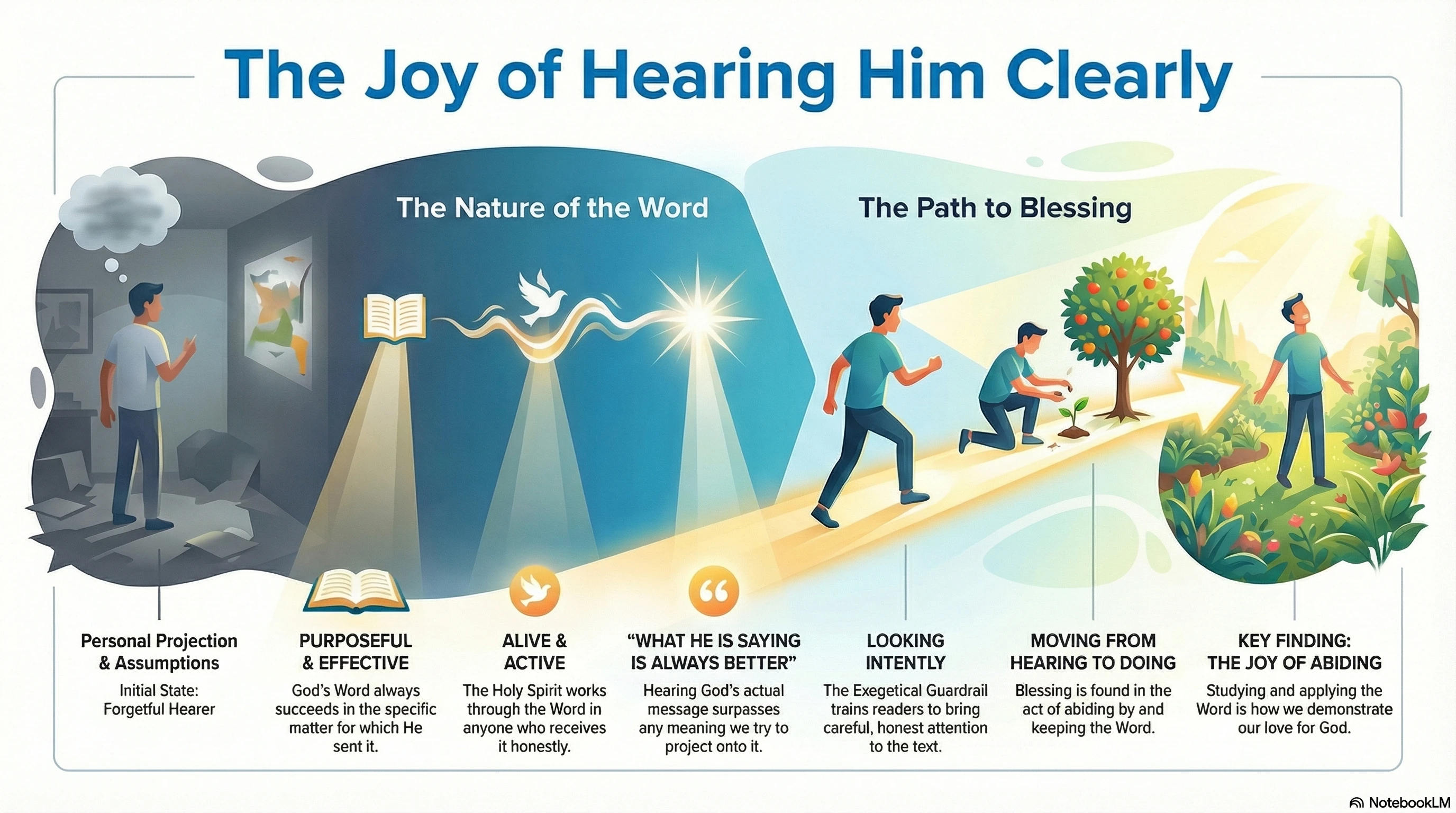
May you find the courage to read honestly. May you find the humility to release what you assumed and receive what He actually said. May every encounter with His Word draw you deeper into the joy of knowing the One who is the Way, the Truth, and the Life.
Meditate and Obey. Study and Apply. Hear and Do.
This is how we abide in Christ. This is how we demonstrate our love for God.
Scripture quotations marked Berean Standard Bible (BSB) or Majority Standard Bible (MSB) are taken from texts that have been dedicated to the public domain. Free resources are available at BereanBible.com and MajorityBible.com.
Scripture quotations taken from the (LSB®) Legacy Standard Bible®, Copyright © 2021 by The Lockman Foundation. Used by permission. All rights reserved. Managed in partnership with Three Sixteen Publishing Inc. LSBible.org and 316publishing.com.