The Guardrails of Biblical Interpretation · Lesson Plan
Seven principles that protect how we read God's Word, keeping us on the road between two cliffs: adding to what God said and taking away from it.
Published March 27, 2026 · Updated October 6, 2026
Leader Prep Sheet
Lesson Goal: Help your class meet the seven guardrails of Bible reading, see that they already use most of them with letters from people they love, and leave with seven questions they can ask of any passage.
Big Idea: Reading the Bible well is like driving a mountain road at night. There is a cliff on each side: adding to what God said, or taking away from it. The seven guardrails keep us on the road. Each one has a question to ask, a cliff on either side, and one example. Behind every human writer stands one divine Author, so the guardrails work together, and the goal of reading carefully is obeying faithfully.
Main Outcomes:
- Students can name the two cliffs (adding and subtracting) and the seven guardrails in the order a reader uses them.
- Students can ask each guardrail's question of a passage.
- Students leave with the seven questions on paper and one step of obedience for this week.
How this packet works:
- Thirteen slides. Use the teaching deck (the Slides link on this page): the cover, one illustrated slide for each of the ten sections, the table of the seven questions, and the close. Each guardrail's slide shows its key verse and the question to ask; it stays on the screen while you teach that guardrail.
- The handout carries the detail. The two cliffs, the three layers of context and the shepherd trail, the good eye, preunderstanding and presuppositions, the One-Meaning exceptions, the food thread, Paul and James, and the table of the seven questions are on the student handout. The script tells you when to point to it.
- You will not cover the whole article, and that is fine. This lesson introduces all seven guardrails; lessons 5 through 11 each take one deeper. Students can read the full lesson page on their own; tell them where to find it.
- Two lengths. The script is written for 45 minutes. For 30 minutes, skip the paragraphs marked (45-minute only) and follow the 30-minute flow. With seven guardrails, keep each one moving: name it, ask its question, give its example.
- Read Scripture from the Bible. When the script says to have someone read a passage aloud, ask a volunteer ahead of time. All quotations in this packet are from the Berean Standard Bible (BSB).
Materials Needed:
- Bibles (any translation; the slides quote the BSB)
- The teaching slides and a screen
- One student handout per person
- This packet, printed
Teacher Emphasis:
- Keep the tone hopeful. The guardrails don't take away our freedom on the road; they keep us on it.
- Each passage was spoken first to someone else: Israel east of the Jordan, Israel at worship, David, Jesus' hearers on the mountain, Timothy in Ephesus, an expert in the law. Say who first, then what carries over to us.
- Name no preacher, church or movement as an example of a cliff. The lesson describes the cliffs; it doesn't point at people.
- Aim for a response, not information. One step obeyed beats ten facts learned.
Scripture List
- Deuteronomy 4:1–2: You must not add to or subtract from what I command you.
- Psalm 19:14: O LORD, my Rock and my Redeemer.
- Psalm 23: The LORD is my shepherd.
- Matthew 6:22–23: The eye is the lamp of the body.
- 1 Timothy 6:6–10: The love of money is the root of all kinds of evil.
- Luke 10:36–37: Go and do likewise.
- Mark 7:18–19: Nothing that enters a man from the outside can defile him.
- Romans 3:28 and James 2:24: Justified by faith; justified by deeds.
- Deuteronomy 5:32–33: Not to the right or to the left.
Timed Teaching Flow · 30 Minutes
| Time | Slide | Section | Script Cue | Notes |
|---|---|---|---|---|
| 0:00–1:00 | 1 | Welcome | "Picture a two-lane road climbing a mountain at night." | Brief welcome; open in prayer |
| 1:00–4:00 | 2 | 1 · Deuteronomy 4:1–2 | "You must not add to or subtract from what I command you" (Deuteronomy 4:2, BSB) | The two cliffs; handout |
| 4:00–6:00 | 3 | 2 · Letters | "You already read this way." | The grandmother's letters |
| 6:00–8:30 | 4 | 3 · Literal | "O LORD, my Rock and my Redeemer" (Psalm 19:14, BSB) | Read by genre |
| 8:30–11:30 | 5 | 4 · Contextual | "The LORD is my shepherd; I shall not want" (Psalm 23:1, BSB) | Three layers; handout |
| 11:30–14:00 | 6 | 5 · Linguistic | "The eye is the lamp of the body" (Matthew 6:22, BSB) | The good eye; handout |
| 14:00–16:30 | 7 | 6 · Exegetical | "For the love of money is the root of all kinds of evil" (1 Timothy 6:10, BSB) | Draw it out; handout |
| 16:30–19:00 | 8 | 7 · One-Meaning | "Go and do likewise" (Luke 10:37, BSB) | One meaning, many applications |
| 19:00–21:30 | 9 | 8 · Progressive | "Do not call anything impure that God has made clean" (Acts 10:15, BSB) | The food thread; handout |
| 21:30–24:00 | 10 | 9 · Harmony | "Let Scripture explain Scripture." | Paul and James; handout |
| 24:00–25:30 | 11 | 10 · Deuteronomy 5:32–33 | "Not to the right or to the left." | The road |
| 25:30–28:00 | 12 | The Seven Questions | "Seven guardrails, seven questions." | Handout table |
| 28:00–30:00 | 13 | The Close | "How is God inviting you to live out this abiding principle this week?" | This week's step; pray |
Timed Teaching Flow · 45 Minutes
| Time | Slide | Section | Script Cue | Notes |
|---|---|---|---|---|
| 0:00–2:00 | 1 | Welcome | "Picture a two-lane road climbing a mountain at night." | Welcome; open in prayer |
| 2:00–6:00 | 2 | 1 · Deuteronomy 4:1–2 | "Every road like this has two edges." | Read 4:1–2 aloud; hermeneutics once; the two cliffs |
| 6:00–9:00 | 3 | 2 · Letters | "You already read this way." | The shoebox of letters, all seven at work |
| 9:00–13:00 | 4 | 3 · Literal | "Reading the Bible literally means reading it as literature." | Read Psalm 19:14; the bookstore; Proverbs 22:6 |
| 13:00–18:00 | 5 | 4 · Contextual | "Let's read it where it lives." | Read Psalm 23 aloud; three layers; the shepherd trail |
| 18:00–22:00 | 6 | 5 · Linguistic | "Jesus wasn't speaking English." | Read Matthew 6:22–23; the good eye; compare translations |
| 22:00–26:00 | 7 | 6 · Exegetical | "Read what it says before deciding what it means." | Read 1 Timothy 6:6–10 aloud; the money saying |
| 26:00–30:00 | 8 | 7 · One-Meaning | "One meaning doesn't mean a shallow meaning." | The Good Samaritan; Origen; the holy kiss |
| 30:00–34:00 | 9 | 8 · Progressive | "The menu changed. The call to be holy never did." | The food thread; Mark 7:18–19 |
| 34:00–38:00 | 10 | 9 · Harmony | "They're guarding the same road from opposite sides." | Read Romans 3:28 and James 2:24; the loop |
| 38:00–40:00 | 11 | 10 · Deuteronomy 5:32–33 | "We read carefully so we can obey faithfully." | Read 5:32–33 aloud |
| 40:00–42:00 | 12 | The Seven Questions | "Seven guardrails, seven questions." | The reader's order; lesson 4 pointer |
| 42:00–45:00 | 13 | The Close | "How is God inviting you to live out this abiding principle this week?" | This week's step; the three pairs; pray |
Full Lecture Script
Welcome
Say this verbatim:
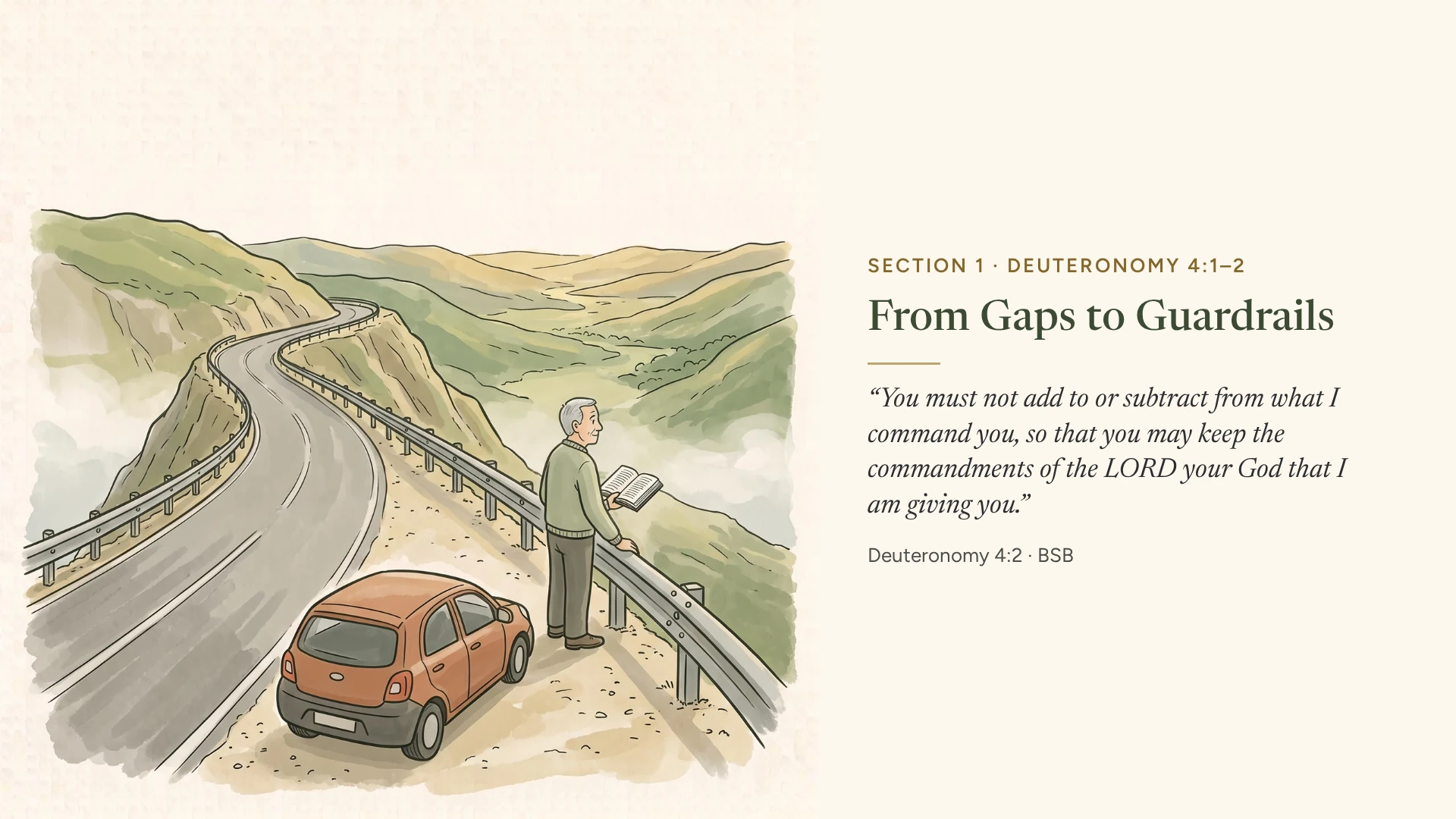
"Picture a two-lane road climbing a mountain at night. Fog has rolled in, your headlights reach maybe twenty feet, and on both sides the ground drops away into the dark. You can't see the cliffs, but you know they are there. What you can see is the guardrail: a ribbon of steel with little reflectors catching your lights, curve after curve."
"Nobody resents that guardrail or pulls over to complain that it limits their freedom. It is the reason you can keep driving, and the reason you can relax and enjoy the view when the fog lifts. Today we meet seven guardrails for reading God's Word."
"Let's pray. Father, thank You for speaking to us in Your Word. Keep us on the road today, humble and eager to hear what You said. In Jesus' name, amen."
Section 1 · Deuteronomy 4:1–2 · From Gaps to Guardrails
Say this verbatim:
"In lesson 1 we saw why we read the Bible at all: to know God, to abide in Christ, and to hear and do His Word. In lesson 2 we saw why reading it well takes effort: there are gaps of history, language and theology between the Bible's world and ours. This lesson gives you the guardrails for the road across those gaps."
(45-minute only)
"Scholars have a name for this subject: hermeneutics. You'll hear it in Bible classes and on podcasts, so it's worth knowing once. The textbook behind Abide, Fuhr and Köstenberger's Inductive Bible Study, defines it simply as 'the science and art of Bible interpretation.' In Abide we call its principles guardrails, and from here on that's the word we'll use."
"Every road like this has two edges. Off one side, we add to the Bible: we read into a verse what its author never put there, until it says whatever we wanted it to say. Off the other side, we subtract: we skip what we don't understand or don't like, or explain away what the text clearly says. Scripture names both dangers. As Israel camped east of the Jordan, ready to enter the land, Moses gave this charge."
Ask a volunteer to read Deuteronomy 4:1–2 aloud:
Hear now, O Israel, the statutes and ordinances I am teaching you to follow, so that you may live and may enter and take possession of the land that the LORD, the God of your fathers, is giving you. You must not add to or subtract from what I command you, so that you may keep the commandments of the LORD your God that I am giving you. (Deuteronomy 4:1–2, BSB)
Then say:
"Moses wasn't teaching Israel a way of reading. He was telling them to keep God's commands exactly as given, 'so that you may live' (Deuteronomy 4:1, BSB). God's words were given for life. Every time we open the Bible, we face the same two dangers: adding our own ideas to God's Word, or quietly leaving parts of it out. Look at the two cliffs on your handout. Every guardrail today keeps us away from one of them."
Section 2 · You Already Read This Way
Say this verbatim:
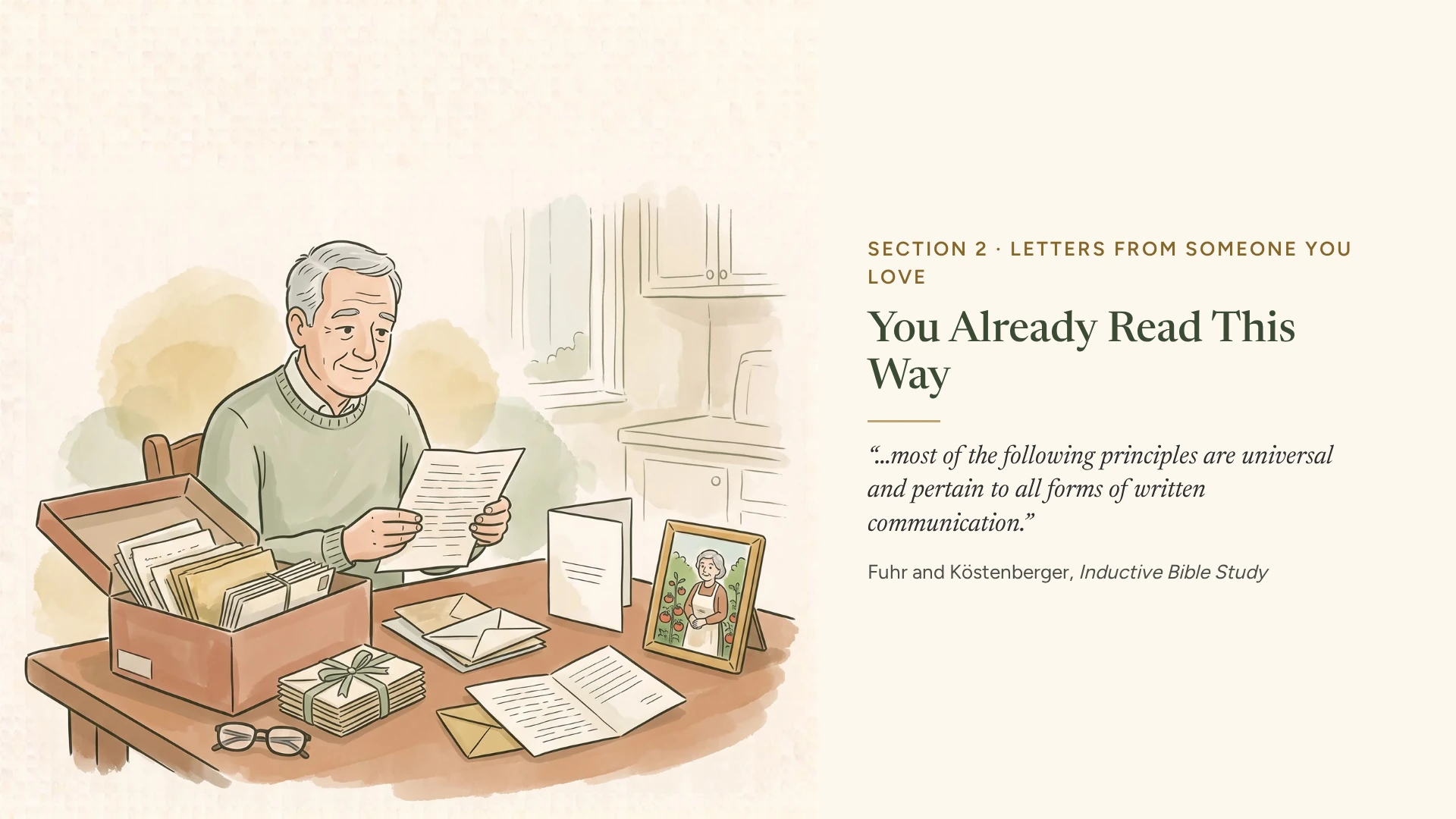
"Don't worry about memorizing seven guardrails today. You already use most of them. Imagine a shoebox in your closet, full of letters from your grandmother, written over forty years. The oldest ones are in Spanish, her first language; the newer ones are in English."
"You read a birthday card differently from the letter about selling the farm. When she wrote, 'I'm drowning in tomatoes this summer,' you didn't worry she was in danger; you pictured her kitchen counter. You read each letter knowing when she wrote it. When a translation sounded odd, you went back to her Spanish. You let her say what she said. You took one sentence to mean one thing. You let a later letter explain an earlier one. And when one letter sounded unlike her, you read it in light of the whole box, because you know her."
"Without knowing it, you just used all seven guardrails. The textbook notes that 'most of the following principles are universal and pertain to all forms of written communication.' The Bible has one difference that changes everything: behind every human writer stands one divine Author."
Section 3 · Psalm 19:14 · The Literal Guardrail
Say this verbatim:
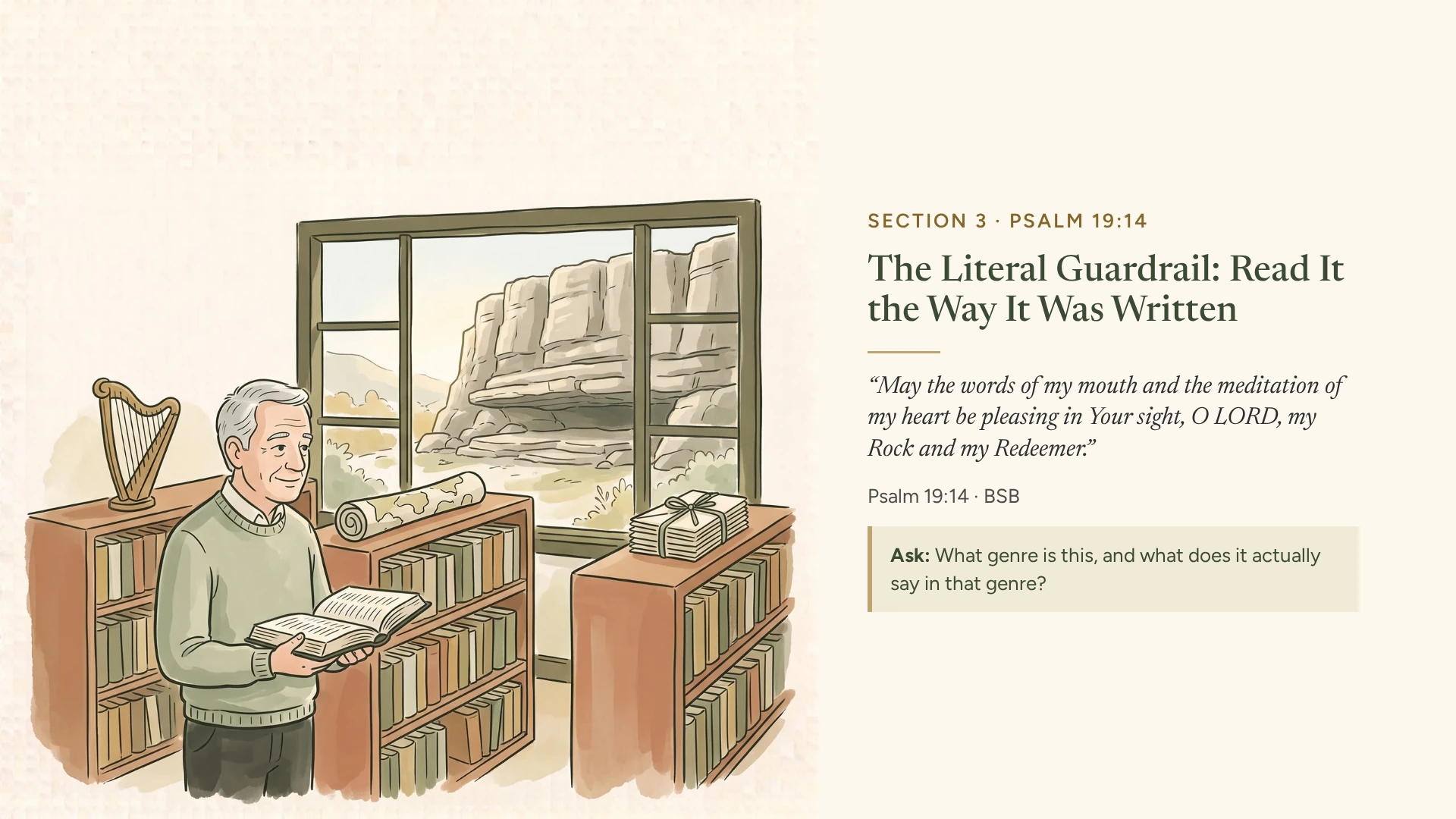
"The first guardrail rescues a word. In everyday talk, 'literally' has come to mean 'really, truly, no exaggeration.' That has never been what it means in Bible study. Reading the Bible literally means reading each passage according to the kind of literature it is. A story is read as a story. A poem is read as a poem. A letter is read as a letter. R. C. Sproul puts it in one line: 'To interpret the Bible literally is to interpret it as literature.'"
(45-minute only)
"You already know this from any bookstore. BibleProject's Tim Mackie says, 'Think of it like walking into a bookstore where every aisle has a different kind of literature.' Nobody reads the poetry aisle the way they read the history aisle."
"The question to ask: 'What genre is this, and what does it actually say in that genre?' The cliffs: the wooden reading, every word pressed flat whatever the genre; and the hidden-meaning reading, ordinary words treated as a code. David wrote Psalm 19 for Israel's worship, and it closes with a prayer: 'May the words of my mouth and the meditation of my heart be pleasing in Your sight, O LORD, my Rock and my Redeemer' (Psalm 19:14, BSB)."
"Is God a rock? This is poetry, and poetry tells us how to hear it. David isn't describing what God is made of; he's saying what God is like: solid and safe, a refuge. The same guardrail helps with a proverb like Proverbs 22:6. A proverb tells how life usually works under God; it isn't a contract. That's good news for every parent who did their best."
Section 4 · Psalm 23 · The Contextual Guardrail
Say this verbatim:
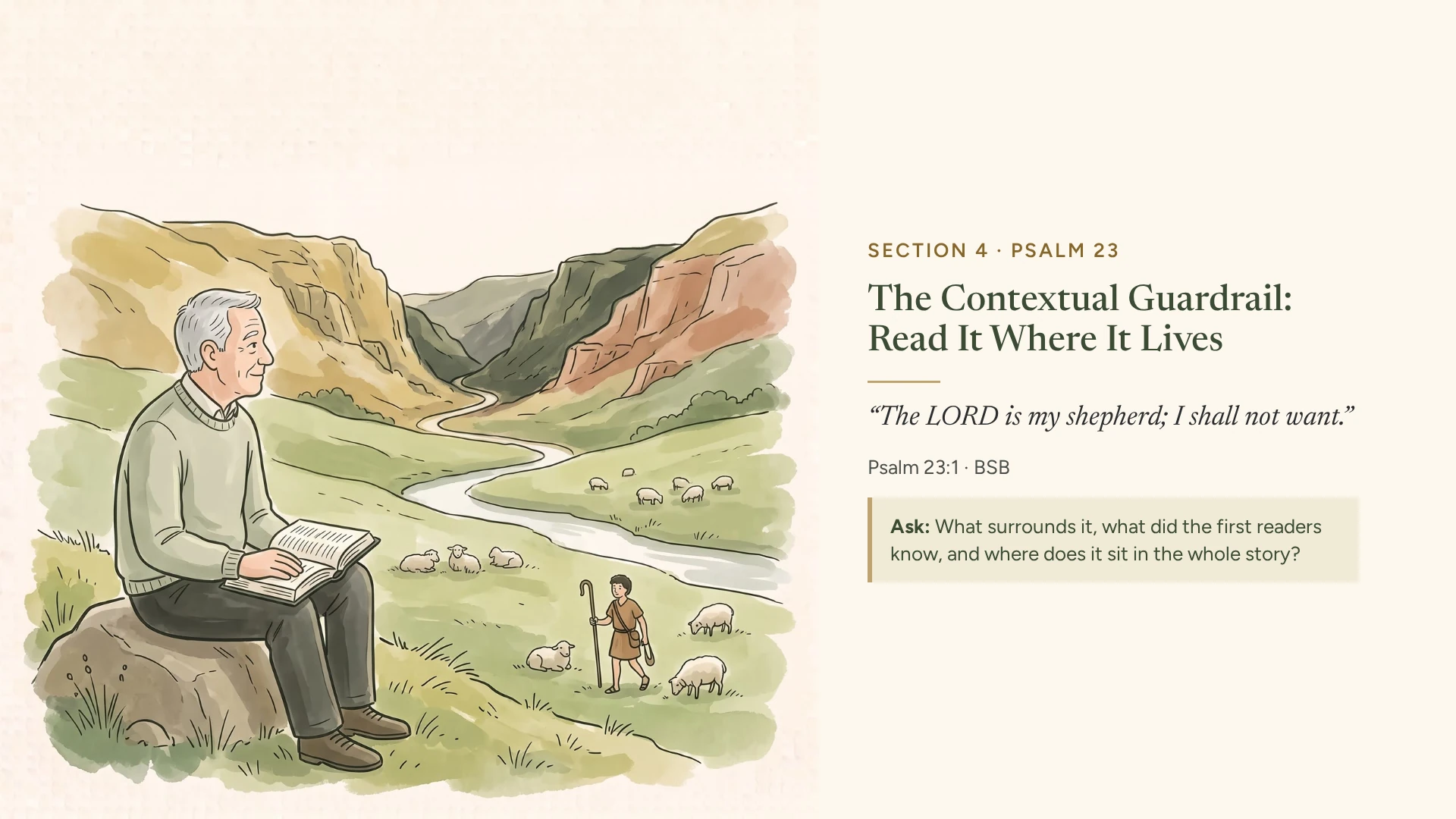
"Have you ever overheard one side of a phone call? You might get some of it. You might also get it badly wrong. The textbook calls context 'perhaps the most important principle to remember.' The question to ask: 'What surrounds it, what did the first readers know, and where does it sit in the whole story?' That's three layers, and they're on your handout."
(45-minute only) Ask a volunteer to read Psalm 23 aloud:
The LORD is my shepherd; I shall not want. He makes me lie down in green pastures; He leads me beside quiet waters. He restores my soul; He guides me in the paths of righteousness for the sake of His name. Even though I walk through the valley of the shadow of death, I will fear no evil, for You are with me; Your rod and Your staff, they comfort me. You prepare a table before me in the presence of my enemies. You anoint my head with oil; my cup overflows. Surely goodness and mercy will follow me all the days of my life, and I will dwell in the house of the LORD forever. (Psalm 23:1–6, BSB)
Then say:
"The historical layer: before he was king, David was the boy 'tending the sheep' (1 Samuel 16:11, BSB). He knew what a good shepherd does because he had done it, at the risk of his own life. The literary layer: read the whole psalm. At the darkest point, the valley of the shadow of death, David turns from talking about the LORD to talking to Him: 'for You are with me' (Psalm 23:4, BSB). The closer the danger, the closer the Shepherd."
"The theological-canonical layer: the shepherd picture runs through the prophets, and in Ezekiel 34 God promises to shepherd His people Himself. Centuries later, Jesus said, 'I am the good shepherd. The good shepherd lays down His life for the sheep' (John 10:11, BSB). Here the guardrail does careful work. David wasn't writing about Jesus; David meant the LORD, the God of Israel. But read in the whole story, we see that very Shepherd come near in Jesus. Later light doesn't erase David's meaning; it shows how far that meaning reaches."
(45-minute only)
"The cliffs: the lonely verse, cut loose until it can carry whatever we load onto it; and skipping layers, jumping straight to what a passage means for us without hearing what it meant to its first readers. This week, read Ezekiel 34:11–24 and John 10:1–21 alongside Psalm 23. The whole shepherd trail is on your handout."
Section 5 · Matthew 6:22–23 · The Linguistic Guardrail
Say this verbatim:
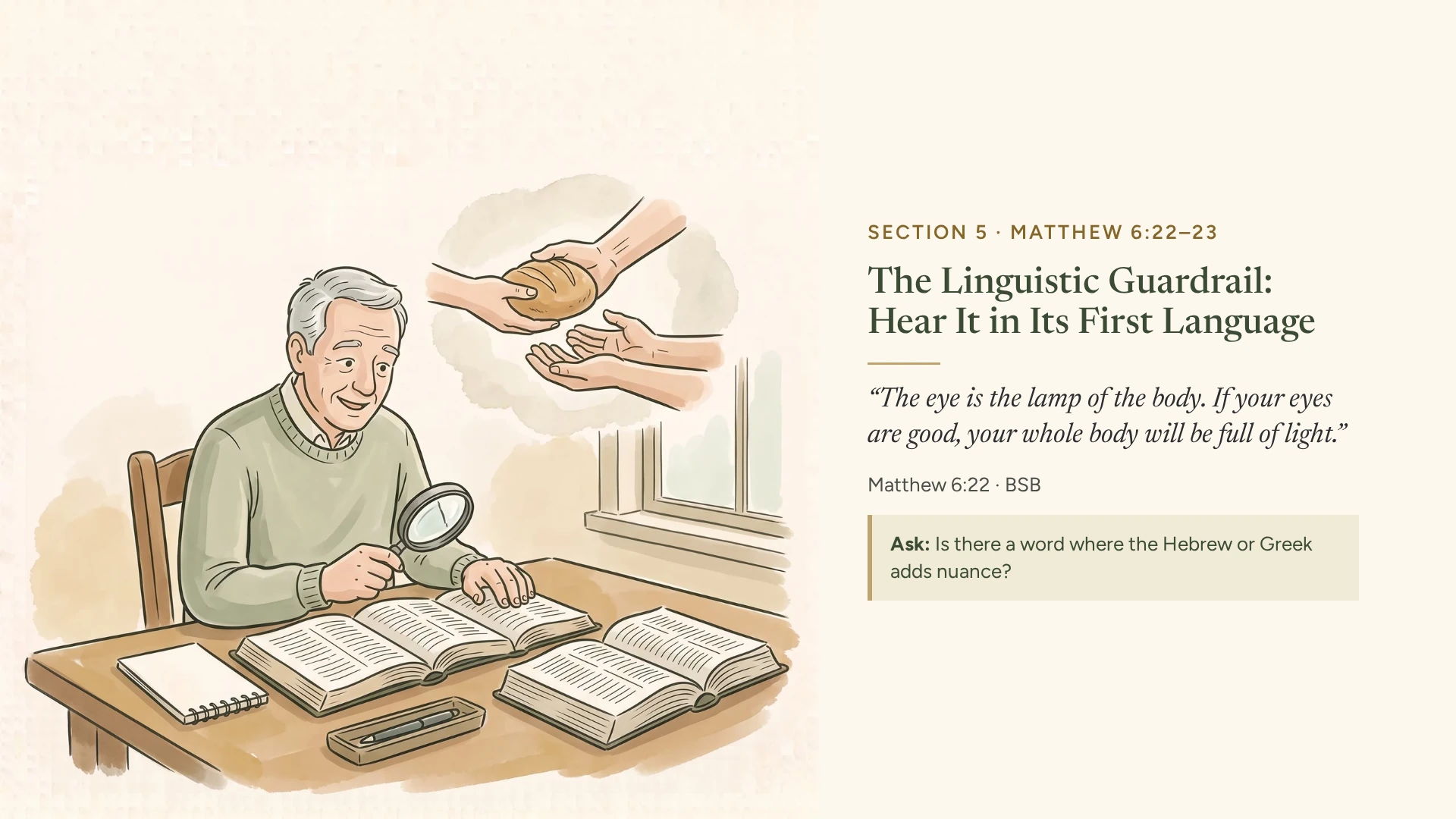
"Remember the grandmother's Spanish letters? Suppose one says a big job was 'eaten bread.' That's word for word; the meaning is 'it's a piece of cake.' Every language has sayings like that. The Bible was written in Hebrew and Greek, and this guardrail asks: 'Is there a word where the Hebrew or Greek adds nuance?'"
Ask a volunteer to read Matthew 6:22–23 aloud:
The eye is the lamp of the body. If your eyes are good, your whole body will be full of light. But if your eyes are bad, your whole body will be full of darkness. If then the light within you is darkness, how great is that darkness! (Matthew 6:22–23, BSB)
Then say:
"In English, 'good eyes' means you see well. But start with what surrounds it. Just before, Jesus says, 'Do not store up for yourselves treasures on earth' (Matthew 6:19, BSB). Just after, 'You cannot serve both God and money' (Matthew 6:24, BSB). Money on both sides. In the Hebrew Scriptures, the eye was a way to talk about generosity. So Jesus seems to be saying that a generous eye fills your life with light, and a stingy, grasping eye fills it with darkness. Not every reader takes it this way, but with treasure before it and money after it, the generosity reading has strong support."
(45-minute only)
"The cliffs: treating the English as if it were the original, so an ancient saying gets read like a modern sentence; and the word-study show-off, pouring every dictionary meaning into one verse. The textbook warns, 'Context always takes precedence over lexical definitions.' Your handout shows how different translations handle this saying. When translations differ, that's where to dig."
Section 6 · 1 Timothy 6:6–10 · The Exegetical Guardrail
Say this verbatim:
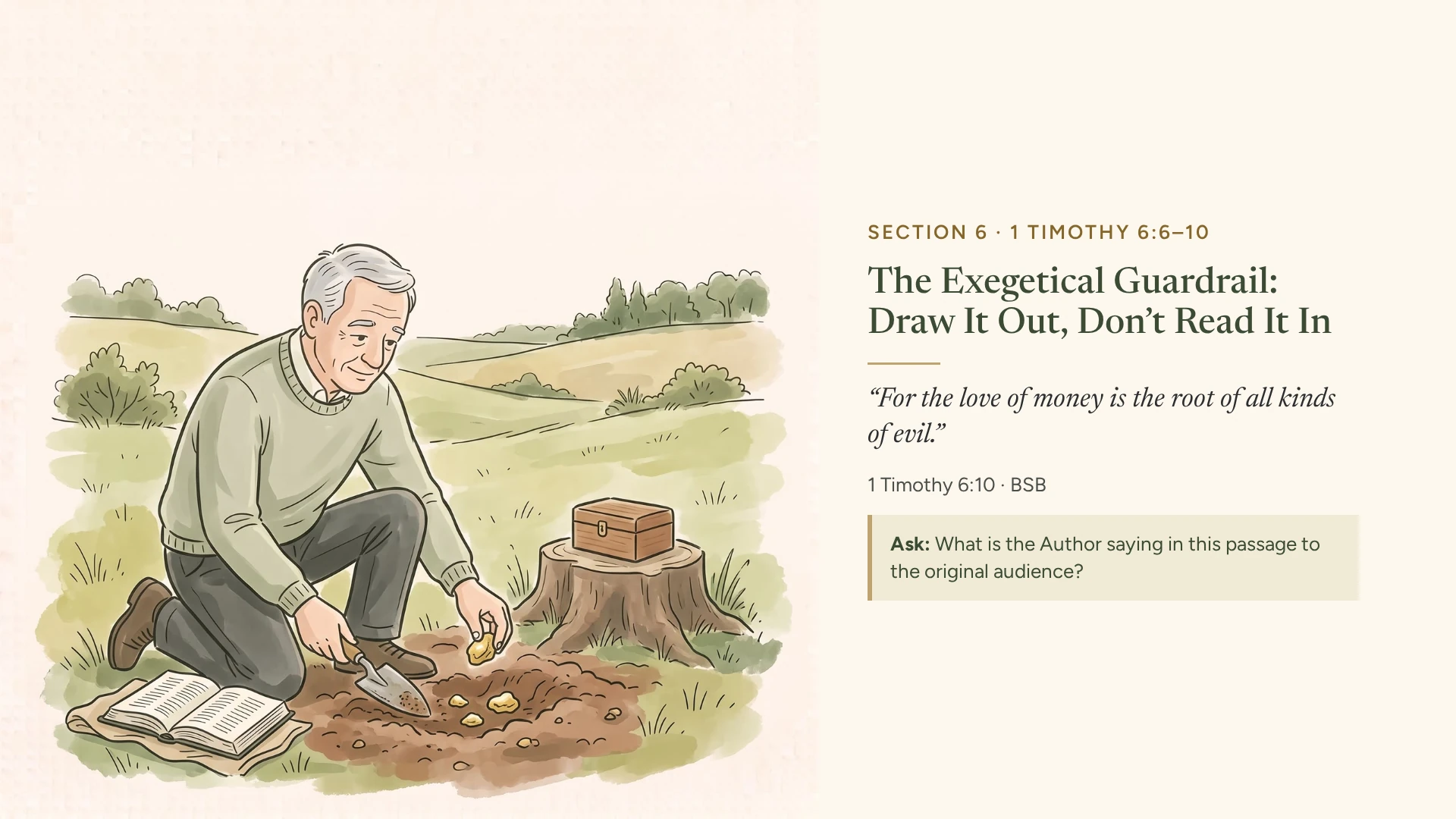
"You text a friend about Saturday, and the reply comes back: 'ok.' If you've been worried they're upset with you, it sounds cold. If your day has gone well, it sounds friendly. The word didn't change; what you brought to it did. This guardrail says 'the meaning of any biblical text must be drawn from the text rather than be ascribed to the text.' Drawing the meaning out is exegesis; reading a meaning in is eisegesis. It's the difference between digging for the gold God placed in the field and bringing our own jewelry to bury there. The question: 'What is the Author saying in this passage to the original audience?'"
(45-minute only) Ask a volunteer to read 1 Timothy 6:6–10 aloud:
Of course, godliness with contentment is great gain. For we brought nothing into the world, so we cannot carry anything out of it. But if we have food and clothing, we will be content with these. Those who want to be rich, however, fall into temptation and become ensnared by many foolish and harmful desires that plunge them into ruin and destruction. For the love of money is the root of all kinds of evil. By craving it, some have wandered away from the faith and pierced themselves with many sorrows. (1 Timothy 6:6–10, BSB)
Then say:
"You've probably heard someone say, 'Money is the root of all evil.' Here's what Paul wrote: 'For the love of money is the root of all kinds of evil' (1 Timothy 6:10, BSB). The saying leaves out three words, and they change everything. The trap is for 'those who want to be rich' (1 Timothy 6:9, BSB): the wanting, not the having. Paul wrote to Timothy in Ephesus, where false teachers 'regard godliness as a means of gain' (1 Timothy 6:5, BSB). Paul turns their word around: 'godliness with contentment is great gain' (1 Timothy 6:6, BSB)."
(45-minute only)
"We can't empty our heads before we read. Look at your handout: hold your preunderstanding loosely, the sayings and assumptions you bring, and let the text correct it. Hold your presuppositions firmly: the Bible is God's Word, true in everything it says, never leading us astray, with the final word over what we believe and how we live."
Section 7 · Luke 10:36–37 · The One-Meaning Guardrail
Say this verbatim:
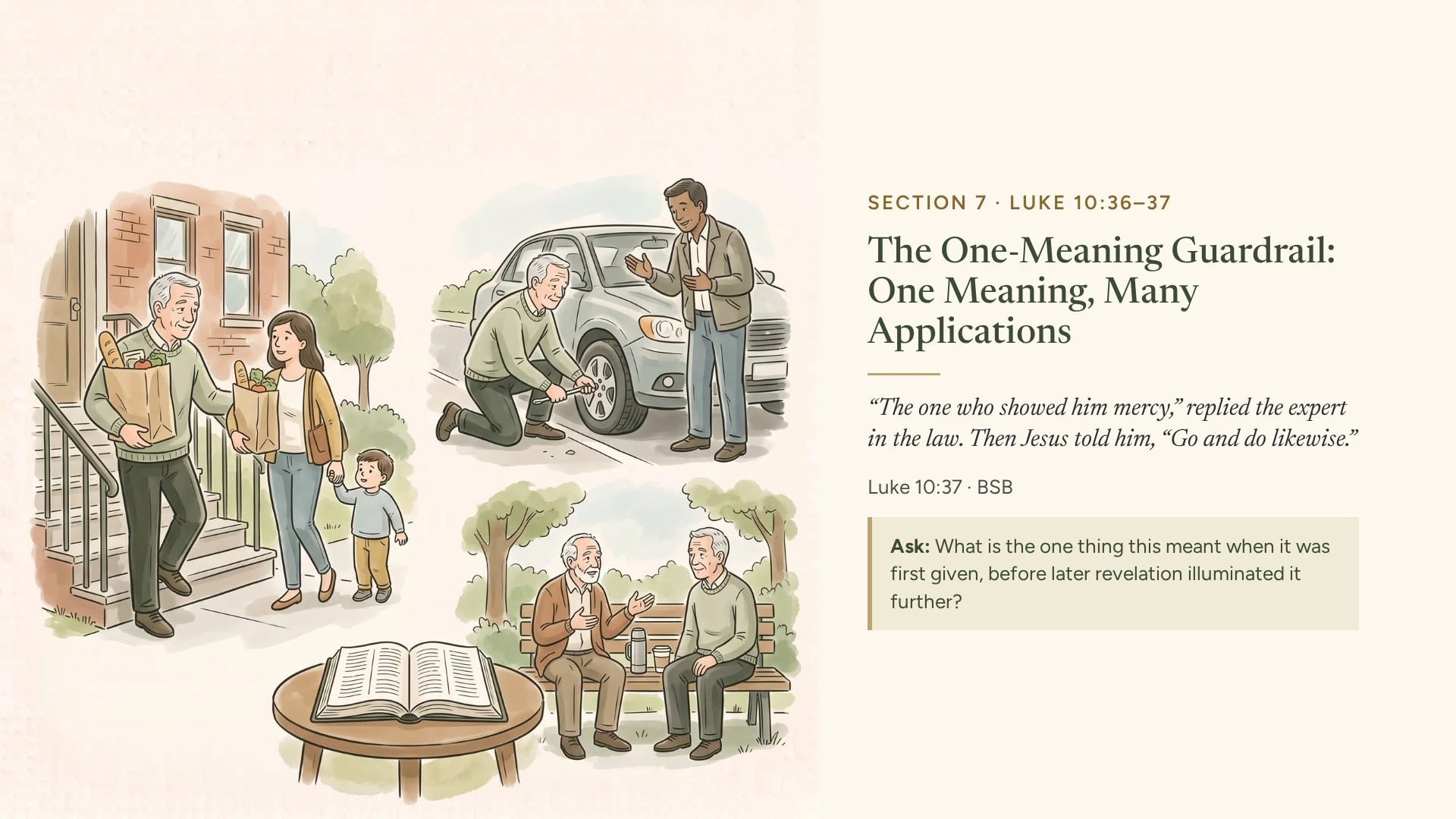
"Mom leaves a note on the fridge: 'Take care of your brother while I'm at work.' Carrying it out could look like a dozen things. But if you told Mom the note also meant you could borrow her car, she wouldn't be impressed. The first four guardrails help us hear the Author's voice; this one brings it all together, like a detective lining up the clues. R. C. Sproul: 'Though a text may have a multitude of applications, it has only one correct meaning.' The question: 'What is the one thing this meant when it was first given, before later revelation illuminated it further?'"
"You met the Good Samaritan in lesson 2. An expert in the law asked Jesus, 'And who is my neighbor?' (Luke 10:29, BSB). Jesus ended the story this way: '“The one who showed him mercy,” replied the expert in the law. Then Jesus told him, “Go and do likewise.”' (Luke 10:37, BSB). Jesus gives the meaning Himself: don't ask who qualifies; be a neighbor to anyone who needs mercy."
(45-minute only)
"For more than a thousand years, many readers found much more in the story. Origen turned it into an allegory: the man was Adam, the inn was the church, the two coins were the Father and the Son. Many of those ideas are true about the gospel, but they aren't what Jesus was teaching here, and they pull our eyes off 'Go and do likewise' (Luke 10:37, BSB). That's the adding cliff. The subtracting cliff is skipping a passage because its setting differs from ours, like 'Greet one another with a holy kiss' (1 Corinthians 16:20, BSB). Its meaning still stands: warm, pure family affection among believers."
"One meaning doesn't mean a shallow meaning. 'Go and do likewise' (Luke 10:37, BSB) will reach into your home, your work, your street, and the people you'd rather walk past, for the rest of your life."
Section 8 · Mark 7:18–19 · The Progressive Guardrail
Say this verbatim:
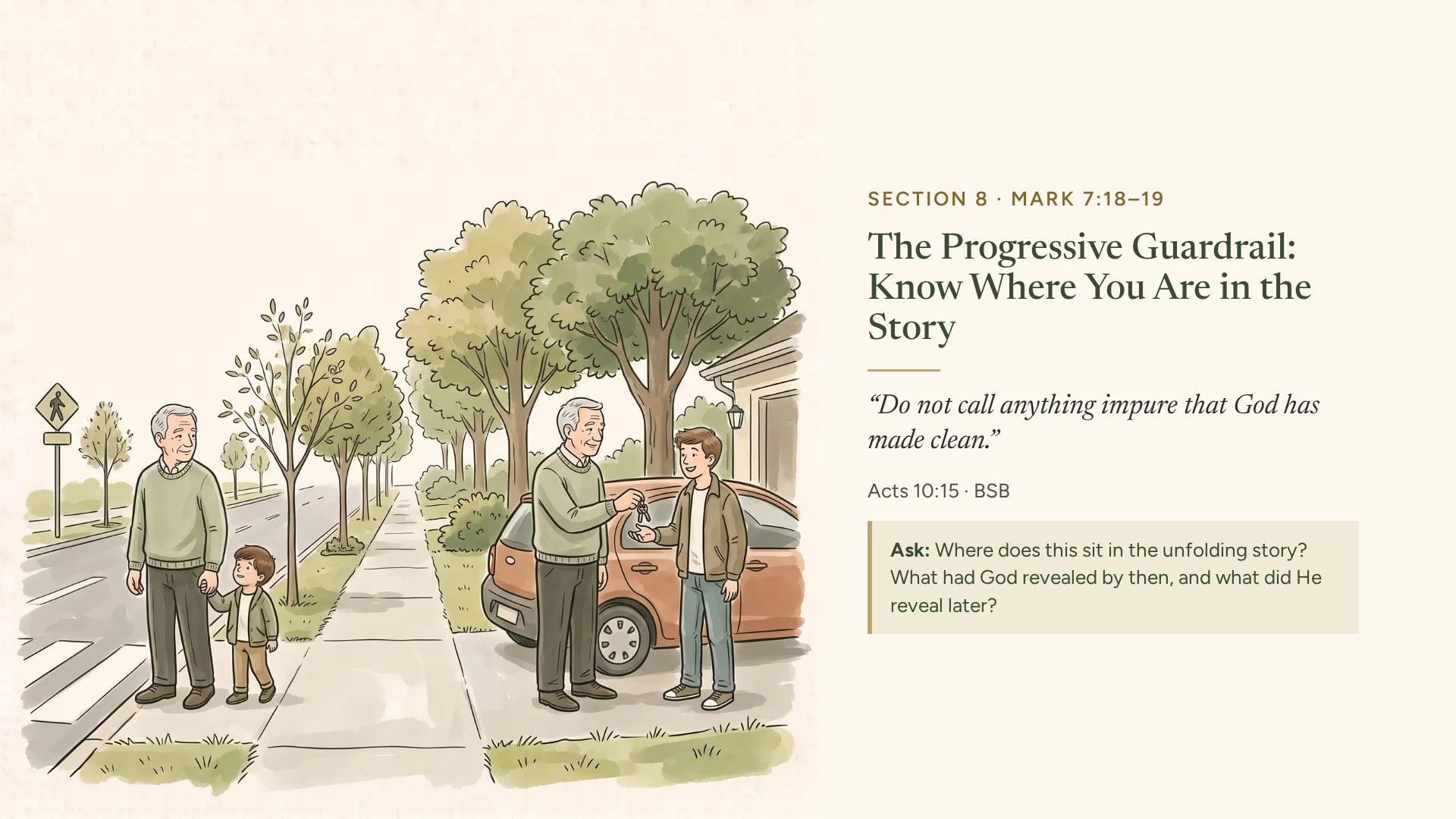
"When you were five, the rule was 'Hold my hand when we cross the street.' At sixteen, your dad hands you the car keys. The rule changed, but your dad didn't contradict himself. You grew. The textbook says 'God didn't reveal his Word to humanity all at once.' The question: 'Where does this sit in the unfolding story? What had God revealed by then, and what did He reveal later?'"
"Follow the food thread on your handout. At creation, plants for food. After the flood, 'Everything that lives and moves will be food for you' (Genesis 9:3, BSB). At Sinai, food laws for Israel, with the reason: 'be holy, because I am holy' (Leviticus 11:45, BSB). Then Jesus said, 'Nothing that enters a man from the outside can defile him' (Mark 7:18, BSB), and Mark adds, 'Thus all foods are clean' (Mark 7:19, BSB). In a vision, Peter heard, 'Do not call anything impure that God has made clean' (Acts 10:15, BSB), and the next day the gospel went to a Gentile's house."
(45-minute only)
"Does Mark 7 contradict Leviticus 11? No. Leviticus 11 meant what it said to Israel. Jesus said of the Law and the Prophets, 'I have not come to abolish them, but to fulfill them' (Matthew 5:17, BSB). Later revelation may complete, clarify, or replace an earlier instruction, but it never contradicts it. The cliffs: freezing the story on an earlier page, or tearing out the earlier pages, when 'everything that was written in the past was written for our instruction' (Romans 15:4, BSB)."
"And notice what carries forward. Peter writes to the church, 'Be holy, because I am holy' (1 Peter 1:16, BSB). The menu changed. The call to be God's set-apart people never did."
Section 9 · Romans 3:28 and James 2:24 · The Harmony Guardrail
Say this verbatim:
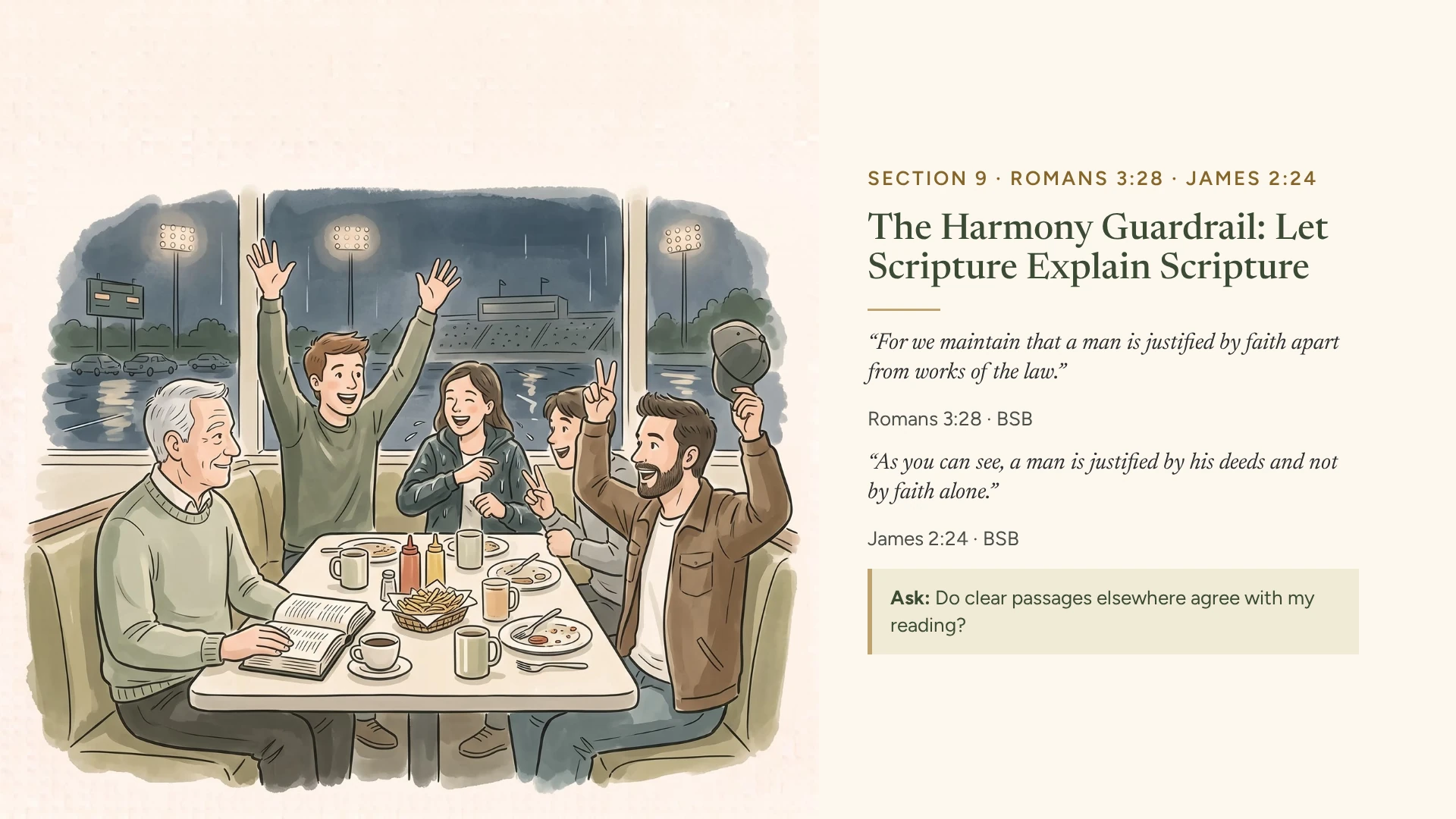
"Four friends tell you about the same football game: one describes the touchdown, one the rain, one the coach, one the final score. Their stories don't match word for word, but nobody thinks they went to different games. If one said the home team lost while the others said it won, you'd start asking questions. This guardrail rests on the one Author: the textbook says 'ultimately God is its single author.' The question: 'Do clear passages elsewhere agree with my reading?'"
"Read these two verses side by side. Paul: 'For we maintain that a man is justified by faith apart from works of the law' (Romans 3:28, BSB). James: 'As you can see, a man is justified by his deeds and not by faith alone' (James 2:24, BSB). At first glance, they seem to say opposite things."
(45-minute only)
"Read each where it lives. Paul is answering how anyone, Jew or Gentile, can be made right with God. James asks about someone who 'claims to have faith, but has no deeds' (James 2:14, BSB). Both quote the same verse about Abraham: Paul points to the moment Abraham believed; James to what his faith did when he offered Isaac. And Paul holds both together: 'For it is by grace you have been saved through faith, and this not from yourselves; it is the gift of God, not by works, so that no one can boast' (Ephesians 2:8–9, BSB). Christians have discussed this for centuries, and lesson 11 looks closer."
"Paul fights against works as the way to earn God's favor. James fights against a faith that never changes anything. They're guarding the same road from opposite sides. And if your reading of a passage clashes with clear passages elsewhere, don't force it. Go back around and check the earlier guardrails."
Section 10 · Deuteronomy 5:32–33 · Seven Rails, One Road
Say this verbatim:
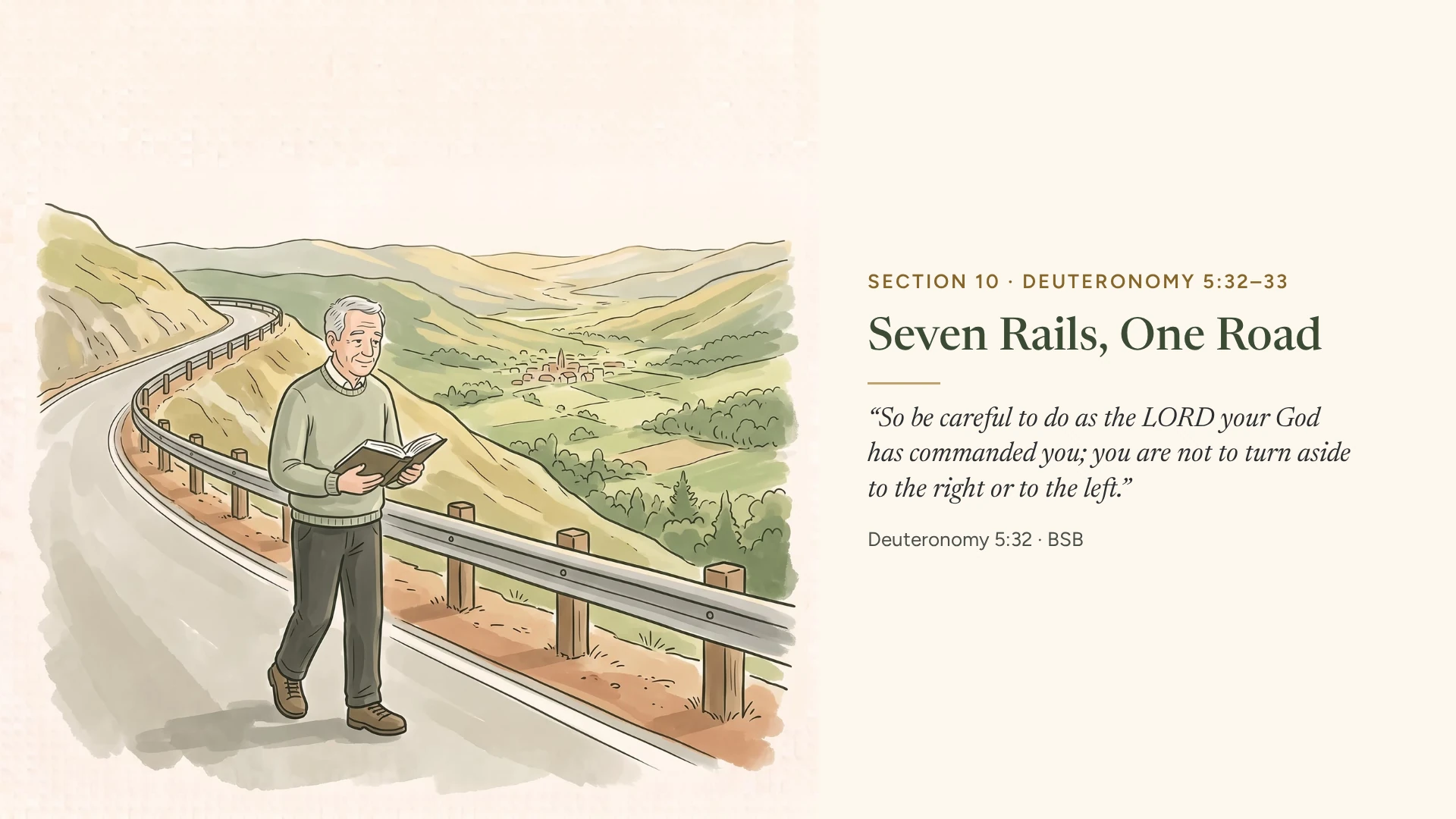
"We began with Moses warning Israel not to add to God's words or take away from them. A little later in the same speech, he described the road."
(45-minute only) Ask a volunteer to read Deuteronomy 5:32–33 aloud:
So be careful to do as the LORD your God has commanded you; you are not to turn aside to the right or to the left. You must walk in all the ways that the LORD your God has commanded you, so that you may live and prosper and prolong your days in the land that you will possess. (Deuteronomy 5:32–33, BSB)
Then say:
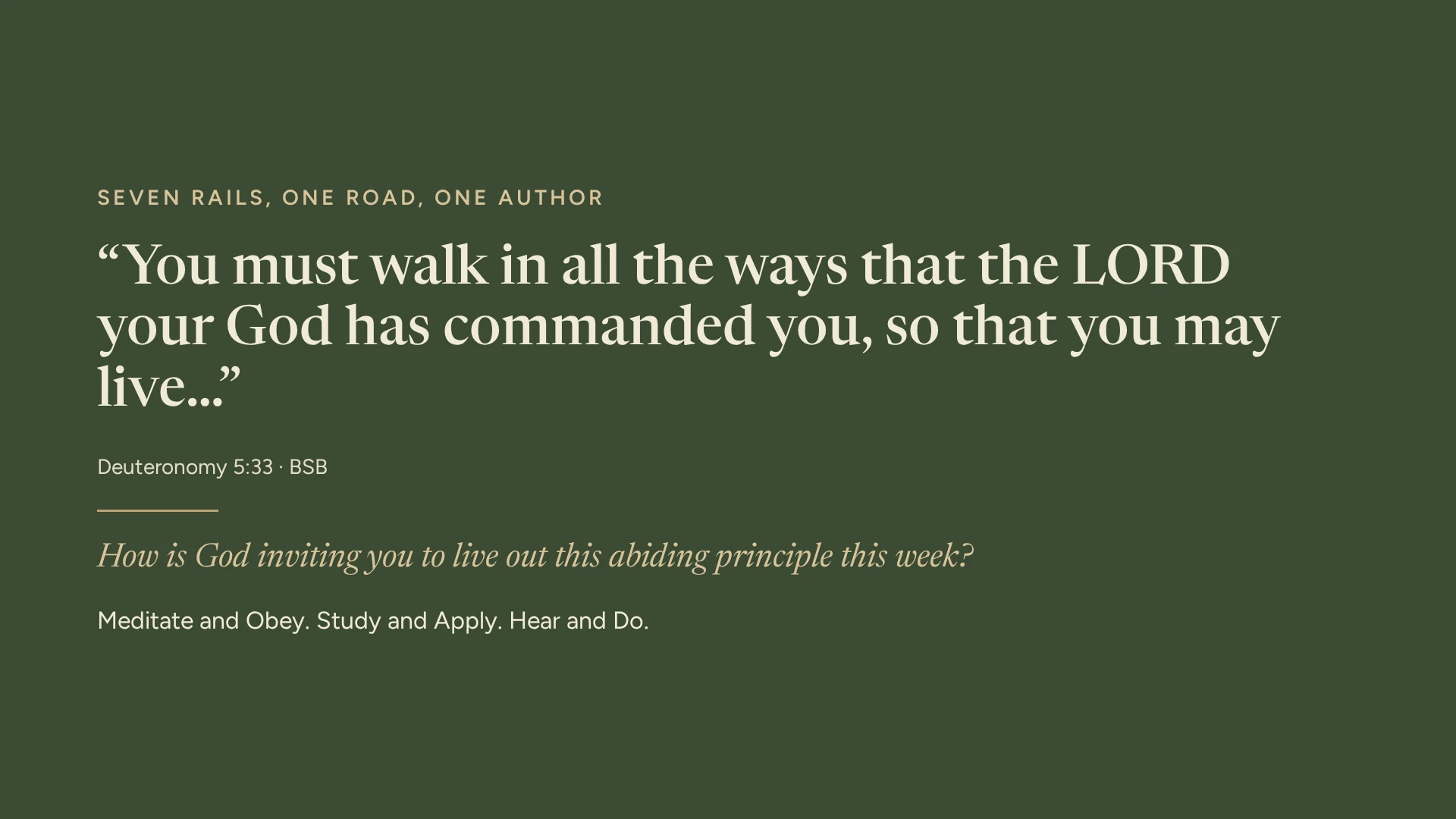
"Not to the right or to the left: those are the two cliffs. But the point of staying on the road isn't the road itself. It's walking with God, 'so that you may live' (Deuteronomy 5:33, BSB). We read carefully so we can obey faithfully."
The Seven Questions
Say this verbatim:
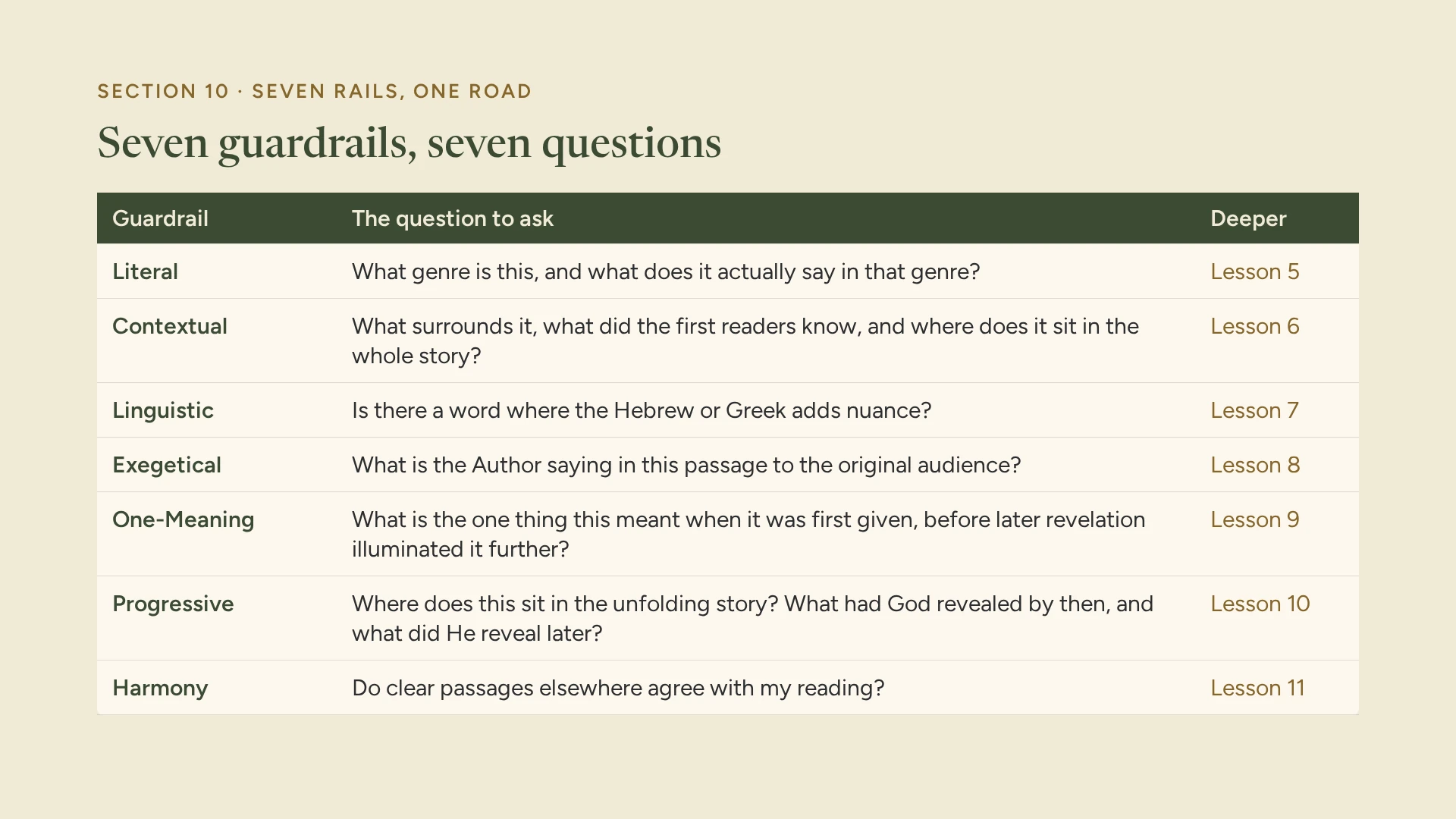
"Here are all seven, with their questions. Let's read them down the table together."
"If you read the textbook, you'll notice it lists the guardrails in a different order. The textbook introduces them the way a teacher would. Abide puts them in the order a reader uses them: observe carefully first, then interpret. The first four help us see what's on the page and hear the Author's voice. One-Meaning brings what we've found together. Progressive and Harmony widen the view to the whole Bible."
(45-minute only)
"The guardrails also work together, and sometimes a later one sends you back to an earlier one. Lesson 4 shows how to use them in order, how the process circles back, and the two questions that come after them: the abiding principle, and how to live it out."
The Close
Say this verbatim:
"The guardrails don't slow you down. They keep you on the road, so you can hear what God said and do it. And you don't walk this road alone. Jesus promised that the Holy Spirit 'will teach you all things and will remind you of everything I have told you' (John 14:26, BSB)."
"So here is the question that ends every guardrail in the lesson: How is God inviting you to live out this abiding principle this week?"
(Pause.)
"On your handout, write one step you will take this week. Maybe it's asking the seven questions of one passage. Maybe it's reading Ezekiel 34 and John 10 beside Psalm 23. Just one."
"Let's say them together: Meditate and Obey. Study and Apply. Hear and Do. This is how we abide in Christ. This is how we demonstrate our love for God."
"Let's pray. Father, thank You for Your Word, given for life. Keep us on the road: humble enough to let You correct us, and eager to obey. By Your Spirit, teach us all things. In Jesus' name, amen."
Discussion Prompts
Use these after the teaching or in small groups. Choose two or three based on the time you have.
- Which cliff are you more likely to drift toward: adding to what God said, or taking away from it? Why?
- Think of a verse you've often heard quoted. Which guardrail would help you read it more carefully?
- Of the seven questions, which one do you tend to skip? Which one do you want to practice first?
- David wrote "The LORD is my shepherd" (Psalm 23:1, BSB) about the God of Israel, and Jesus later said, "I am the good shepherd" (John 10:11, BSB). How does reading them together deepen both without changing what David meant?
- Paul says we are "justified by faith apart from works of the law" (Romans 3:28, BSB), and James says faith without deeds is dead (James 2:17). How do both truths show up in your own life?
Optional Homework
Assign one or both before the next session:
Reading Assignment: Read the full lesson page on your own; it covers more than we had time for today. Then read Ezekiel 34:11–24 and John 10:1–21 alongside Psalm 23, and note how each passage fills in the others.
Application Assignment: Choose one short passage (Psalm 1 or Philippians 4:4–9 work well) and ask the seven questions from the handout. Write one sentence for each, then one step of obedience the passage invites.
Scripture quotations marked Berean Standard Bible (BSB) or Majority Standard Bible (MSB) are taken from texts that have been dedicated to the public domain. Free resources are available at BereanBible.com and MajorityBible.com.