Thinking Like Sherlock Holmes · Lesson Plan
Read the Bible like a good detective: gather the evidence before reaching a verdict, and let ten questions walk you from what the text says, through what it meant, to how God is inviting you to live it.
Published October 6, 2026 · Updated October 6, 2026
Leader Prep Sheet
Lesson Goal: Help your class read the Bible like a good detective: gather the evidence before reaching a verdict, walk the road of Observation, Interpretation and Application, and leave with ten questions they have already practiced on one well-known passage.
Big Idea: The bad detective decides who is guilty and bends every clue to fit. Sherlock Holmes gathers the clues and lets them lead. Those are two ways to read the Bible. Abide's ten questions walk the guardrails in order, from what a passage says, to what it meant, to the abiding principle, to how God is inviting us to live it. The road circles back as it climbs, and the Author Himself helps us understand.
Main Outcomes:
- Students can tell the difference between the deductive posture (deciding first) and the inductive one (evidence first), without taking sides on any debate.
- Students can name the three stretches of road (Observation, Interpretation, Application) and the abiding principle that bridges into application.
- Students have walked all ten questions through Matthew 7:1–6, and leave with one step of obedience for this week.
How this packet works:
- Twelve slides. Use the teaching deck (the Slides link on this page): the cover, one illustrated slide for each of the eight sections, the Inductive Bible Study diagram and the table of the ten questions (right after Section 4), and the close.
- The handout carries the detail. The deduction and induction table, the three stretches of road, the ten questions with their stages and guardrails, the three places the road circles back, and a worksheet for Matthew 7:1–6 are on the student handout. The script tells you when to point to it.
- The heart of the class is the drive. Sections 6 and 7 walk the ten questions through Matthew 7:1–6. If you run short of time, shorten the earlier sections, not the drive. Students can read the full lesson page on their own.
- Two lengths. The script is written for 45 minutes. For 30 minutes, skip the paragraphs marked (45-minute only) and follow the 30-minute flow.
- Read Scripture from the Bible. When the script says to have someone read a passage aloud, ask a volunteer ahead of time. All quotations in this packet are from the Berean Standard Bible (BSB).
Materials Needed:
- Bibles (any translation; the slides quote the BSB)
- The teaching slides and a screen
- One student handout per person
- This packet, printed
Teacher Emphasis:
- Keep the weight on the posture, not the topic. Section 1 mentions debates such as predestination and eternal security only as examples of coming to the Bible to prove or disprove a view. Don't take a side, and don't let the class turn it into a debate. Faithful Christians have landed in different places on these questions.
- Model humility. The textbook's own authors confess they have sometimes read their views into the text. So have we all.
- Each passage was spoken first to someone else: Israel's young people learning wisdom, a son learning from his father, Jesus' disciples on the mountain, the Eleven in Jerusalem. Say who first, then what carries over to us.
- Matthew 7:1 touches real hurts: people judged harshly by Christians, and people who use the verse to silence any correction. Speak gently. Aim for a response, not a verdict on anyone in the room.
Scripture List
- Proverbs 18:13–17: He who answers a matter before he hears it.
- Proverbs 2:1–5: Seek it like silver and search it out like hidden treasure.
- Matthew 7:1–6: Do not judge, or you will be judged.
- Luke 6:36–37: Be merciful, just as your Father is merciful.
- John 7:24: Stop judging by outward appearances, and start judging justly.
- Luke 24:44–45: Then He opened their minds to understand the Scriptures.
- John 14:21: Whoever has My commandments and keeps them is the one who loves Me.
- John 15:9–10: Remain in My love.
Timed Teaching Flow · 30 Minutes
| Time | Slide | Section | Script Cue | Notes |
|---|---|---|---|---|
| 0:00–1:00 | 1 | Welcome | "Every detective show has one." | Brief welcome; open in prayer |
| 1:00–4:00 | 2 | 1 · Two detectives | "He who answers a matter before he hears it—this is folly and disgrace to him" (Proverbs 18:13, BSB) | Holmes; deduction vs. induction; handout |
| 4:00–6:00 | 3 | 2 · Why it matters | "if you seek it like silver and search it out like hidden treasure" (Proverbs 2:4, BSB) | Three reasons and a fourth |
| 6:00–8:30 | 4 | 3 · Three stretches | "What does it say? What did it mean? How do we live it?" | O-I-A; the abiding principle; handout |
| 8:30–10:00 | 5 | 4 · Ten questions | "Pilots still run a checklist." | The checklist |
| 10:00–11:00 | 6 | Inductive Bible Study | "This is inductive Bible study." | Trace the diagram |
| 11:00–12:00 | 7 | The Ten Questions | "Let's read all ten down the table." | Handout table |
| 12:00–14:00 | 8 | 5 · The road circles back | "Going back isn't failure. It's how the road climbs." | Three loops; handout |
| 14:00–20:00 | 9 | 6 · Matthew 7:1–6, questions 1–4 | "Do not judge, or you will be judged" (Matthew 7:1, BSB) | Read 7:1–6; worksheet |
| 20:00–26:00 | 10 | 7 · Matthew 7:1–6, questions 5–10 | "Stop judging by outward appearances, and start judging justly" (John 7:24, BSB) | Meaning, principle, harmony, application |
| 26:00–28:00 | 11 | 8 · Humble confidence | "Then He opened their minds to understand the Scriptures" (Luke 24:45, BSB) | Confidence and humility |
| 28:00–30:00 | 12 | The Close | "How is God inviting you to live out this abiding principle this week?" | This week's step; pray |
Timed Teaching Flow · 45 Minutes
| Time | Slide | Section | Script Cue | Notes |
|---|---|---|---|---|
| 0:00–2:00 | 1 | Welcome | "Every detective show has one." | Welcome; open in prayer |
| 2:00–7:00 | 2 | 1 · Two detectives | "You see, but you do not observe." | Holmes; read Proverbs 18:13–17; the posture, not the topic |
| 7:00–10:00 | 3 | 2 · Why it matters | "We finish His sentences for Him." | Read Proverbs 2:1–5 aloud; three reasons and a fourth |
| 10:00–14:00 | 4 | 3 · Three stretches | "Holmes solves every case in three moves." | O-I-A; the abiding principle; handout |
| 14:00–16:00 | 5 | 4 · Ten questions | "Pilots still run a checklist." | The checklist |
| 16:00–18:00 | 6 | Inductive Bible Study | "This is inductive Bible study." | Trace the circle, the road and the loops |
| 18:00–20:00 | 7 | The Ten Questions | "Let's read all ten down the table." | Read down the table together; why this order |
| 20:00–23:00 | 8 | 5 · The road circles back | "Going back isn't failure. It's how the road climbs." | Three loops; lesson 3's good eye |
| 23:00–31:00 | 9 | 6 · Matthew 7:1–6, questions 1–4 | "Do not judge, or you will be judged" (Matthew 7:1, BSB) | Read 7:1–6 aloud; genre, context, krinō, the first loop |
| 31:00–39:00 | 10 | 7 · Matthew 7:1–6, questions 5–10 | "Be merciful, just as your Father is merciful" (Luke 6:36, BSB) | The one meaning; verse 6; harmony; four lives |
| 39:00–42:00 | 11 | 8 · Humble confidence | "Then He opened their minds to understand the Scriptures" (Luke 24:45, BSB) | Read Luke 24:44–45 aloud |
| 42:00–45:00 | 12 | The Close | "How is God inviting you to live out this abiding principle this week?" | This week's step; the three pairs; pray |
Full Lecture Script
Welcome
Say this verbatim:
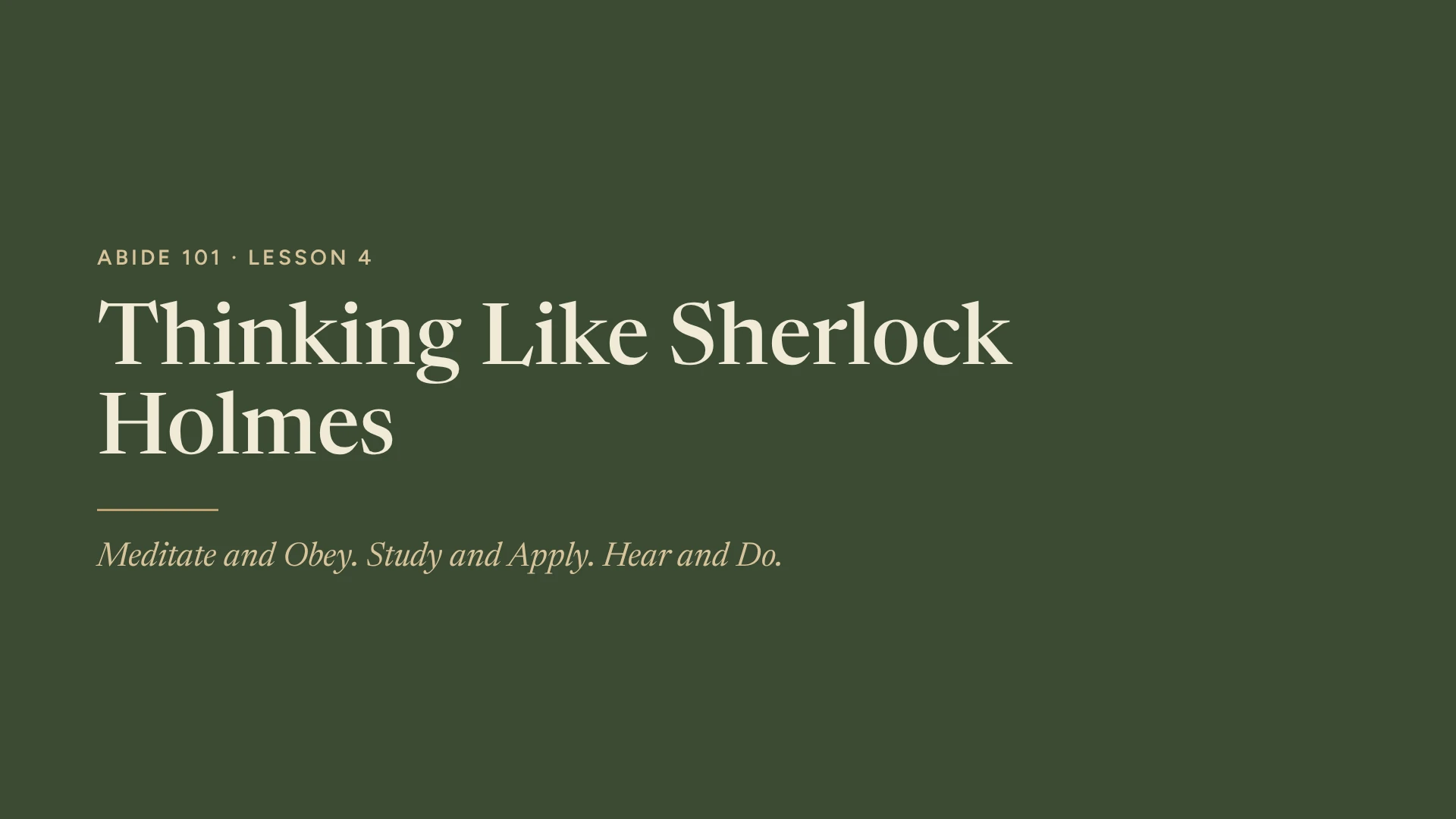
"Every detective show has one. The bad detective walks into the room, takes one look at the butler, and decides on the spot: he did it. From then on, every clue gets bent to fit. Mud on the butler's shoes? Proof. A witness who saw him across town? She must be confused. The case closes fast, and the wrong man goes to prison."
"Today we learn to read the Bible like a better detective. Let's pray. Father, thank You for speaking to us in Your Word. Give us humble hearts and open eyes, and teach us to listen before we decide. In Jesus' name, amen."
Section 1 · Proverbs 18:13–17 · The Bad Detective and Sherlock Holmes
Say this verbatim:
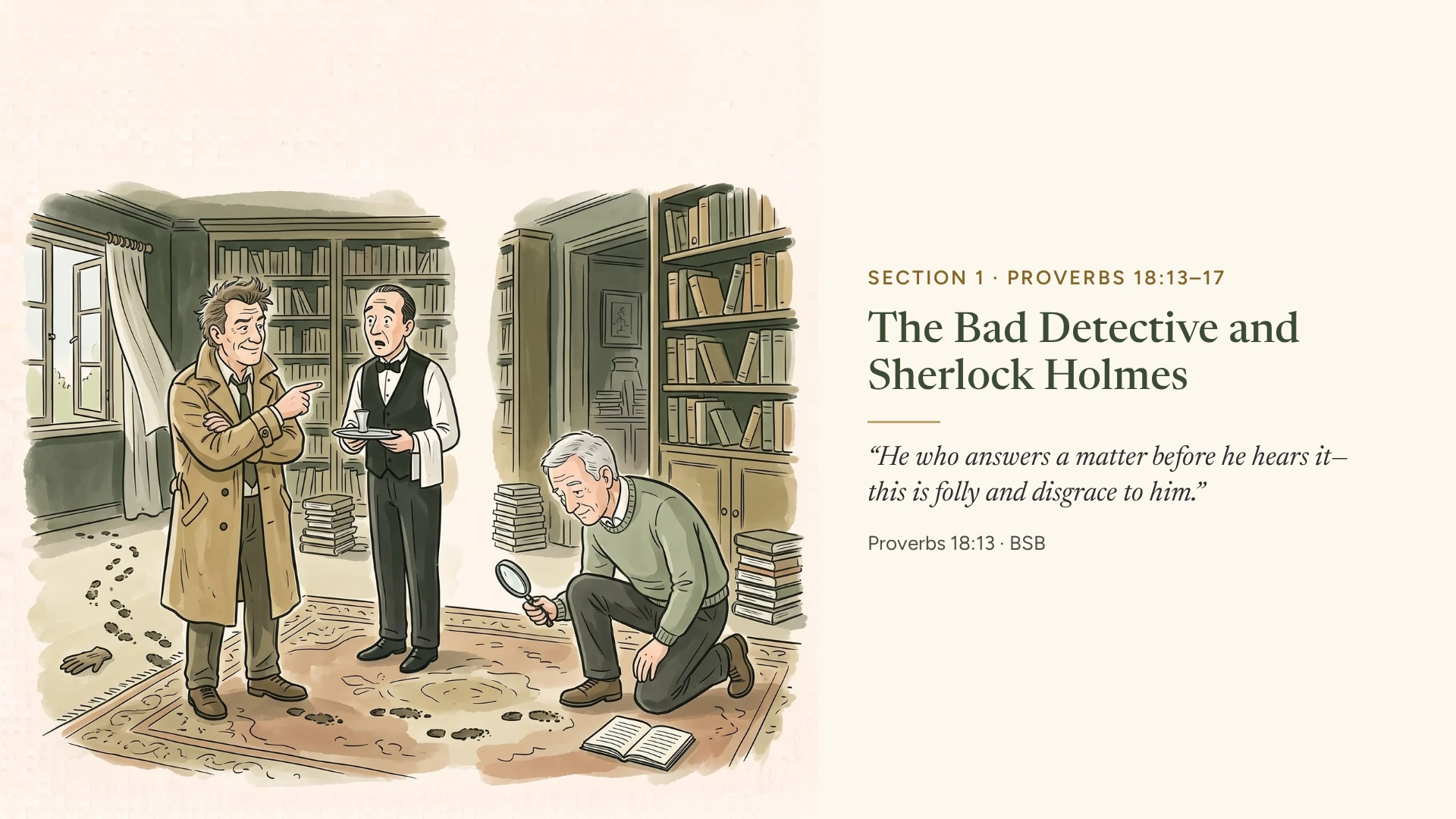
"Then there's Sherlock Holmes. In one story, Holmes teases Dr. Watson, who has climbed the stairs to their rooms hundreds of times but can't say how many steps there are. Holmes tells him, 'You see, but you do not observe.' Holmes knows: there are seventeen. And handed a mysterious note, he refuses to guess: 'It is a capital mistake to theorise before one has data.' Holmes lets the clues lead him. The bad detective drags the clues to the answer he already picked."
"Those two detectives are two ways to read the Bible. The textbook behind Abide calls them deduction and induction. Look at the table on your handout. Deduction starts with the answer and looks for support. Induction starts with the clues and builds toward the answer. With a deductive approach, the textbook says, 'you begin with certain assumptions or beliefs and allow the Bible only room to support those assumptions or beliefs.'"
(45-minute only)
"You've probably seen the deductive posture, or caught yourself in it. Someone opens the Bible to prove predestination, or to disprove it. Someone sets out to show that a true believer can never lose salvation, or that one can. Someone needs a verse for their side of a cultural debate. Faithful Christians have studied these questions carefully and landed in different places, and we won't settle any of them today. The question is the posture, not the topic: did I come to find out what the Bible says, or to find support for what I already decided?"
"Before we point at anyone, notice that the textbook's own authors point at themselves. They confess there have been times they 'imposed our own understanding upon the text before discovering its meaning.' Every reader plays the bad detective sometimes. Induction begins with humility."
(45-minute only) Ask a volunteer to read Proverbs 18:13–17 aloud:
He who answers a matter before he hears it—this is folly and disgrace to him. The spirit of a man can endure his sickness, but who can survive a broken spirit? The heart of the discerning acquires knowledge, and the ear of the wise seeks it out. A man’s gift opens doors for him, and brings him before great men. The first to state his case seems right until another comes and cross-examines him. (Proverbs 18:13–17, BSB)
Then say:
"Solomon gathered these proverbs for Israel's young people. He's talking about listening to people: hearing someone out before you answer, letting both sides speak before you settle a dispute. 'He who answers a matter before he hears it—this is folly and disgrace to him' (Proverbs 18:13, BSB). That's wisdom for every conversation. And it fits the way we read. If it's folly to answer a person before we hear him out, it's folly to decide what God is saying before we've heard Him out."
Section 2 · Proverbs 2:1–5 · Why the Inductive Mindset Matters
Say this verbatim:
"Think of the last time someone finished your sentence for you and got it wrong. You walked away feeling unheard. When we read the Bible deductively, we do that to God. We finish His sentences for Him. The inductive mindset is how you listen to someone you respect."
"It matters for three reasons. It honors what the Bible is: an ancient book from God deserves to be heard on its own terms. It keeps us from bending the Bible: we want our beliefs shaped by the Bible, not the other way around. Doctrine comes last, built up from the texts. And it grows discernment, like the Bereans in lesson 1, who checked even Paul against the Scriptures. Weigh every voice against Scripture, including this one."
"And a fourth reason, to encourage you: you can start now. The textbook says the method fits anyone, 'whether reading a devotion at the breakfast table or preparing next week's sermon at the office.' You don't need a degree. You need curiosity."
(45-minute only) Ask a volunteer to read Proverbs 2:1–5 aloud:
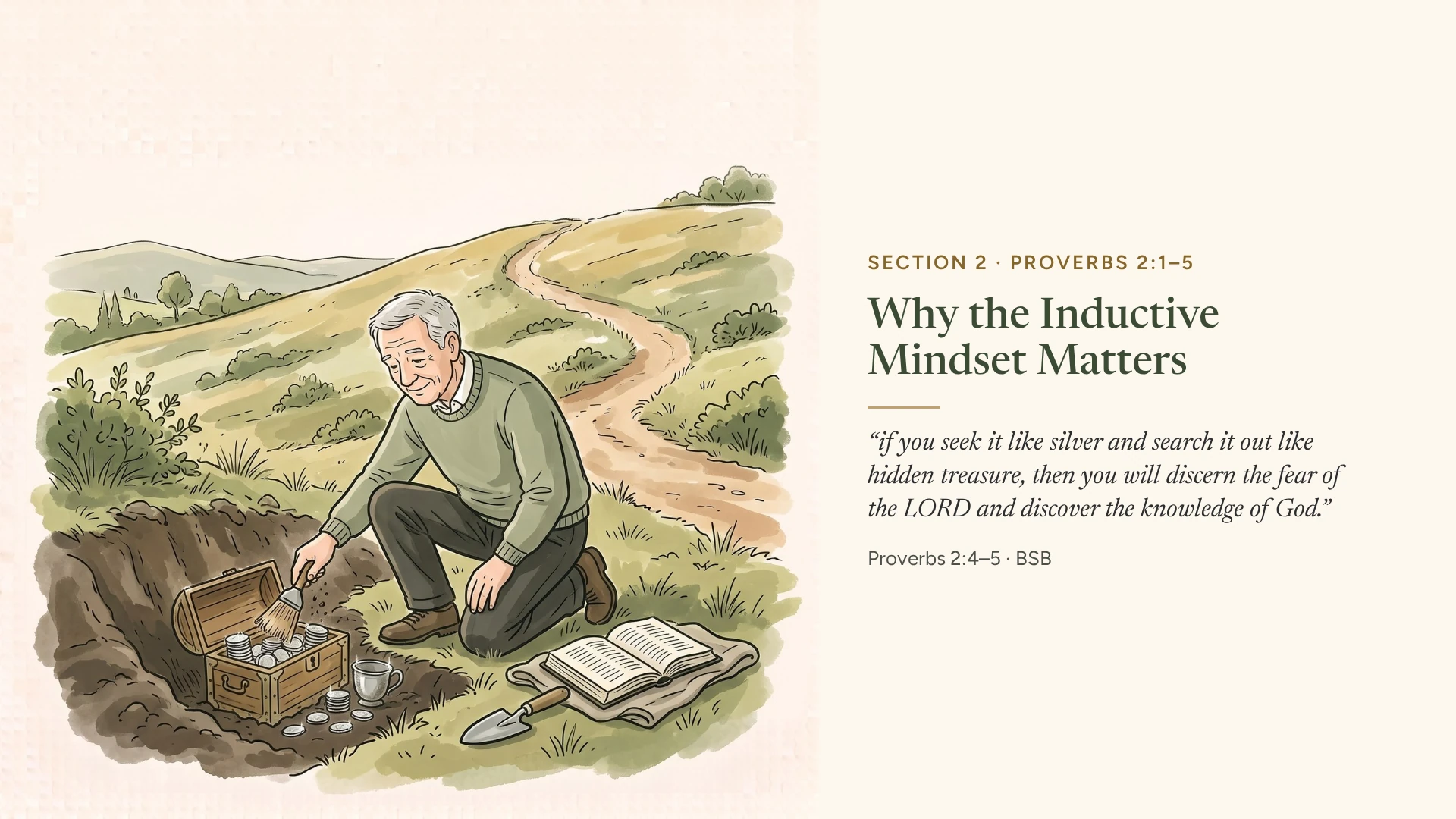
My son, if you accept my words and hide my commandments within you, if you incline your ear to wisdom and direct your heart to understanding, if you truly call out to insight and lift your voice to understanding, if you seek it like silver and search it out like hidden treasure, then you will discern the fear of the LORD and discover the knowledge of God. (Proverbs 2:1–5, BSB)
Then say:
"A father is teaching his son. He piles up verbs: accept, hide, incline, call out, seek, search. Then he names the prize: 'then you will discern the fear of the LORD and discover the knowledge of God' (Proverbs 2:5, BSB). That's the inductive spirit: a holy curiosity that keeps digging, because the treasure is knowing God."
Section 3 · Three Stretches of Road: Observation, Interpretation, Application
Say this verbatim:
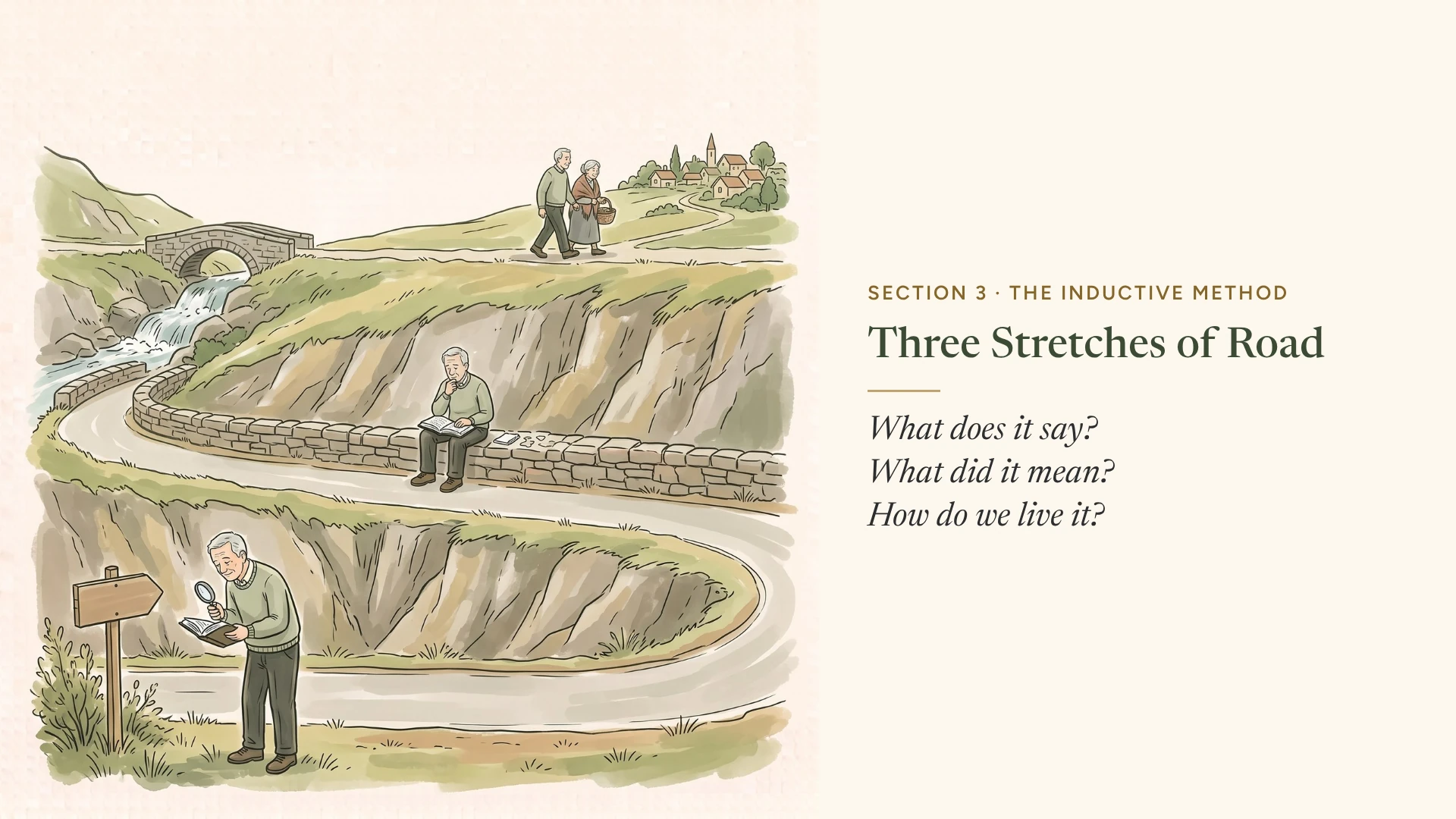
"Holmes solves every case in three moves. He observes the scene. He puts the clues together. Then he acts. Bible study has the same three moves: Observation, Interpretation, Application. The textbook calls it 'strikingly simple,' and scholars use the same steps for their most careful work."
"Observation asks: what does it say? You read slowly and notice who is speaking, what repeats, what surprises you. Interpretation asks: what did it mean to the people who first received it? That waits for observation. Application asks: how do we live it? And it has to stand on an accurate interpretation. The textbook asks, 'how often does the tail wag the dog and we start with application?'"
(45-minute only)
"Between interpretation and application there's a bridge. Abide calls it the abiding principle: the timeless truth in a passage that holds for God's people in every age. You've been walking this road since lesson 1. The labels in our Engage the Text questions, Observation, Interpretation, Abiding Principle and Application, are these stretches of road. Now the road has a name."
Section 4 · Ten Questions for the Road
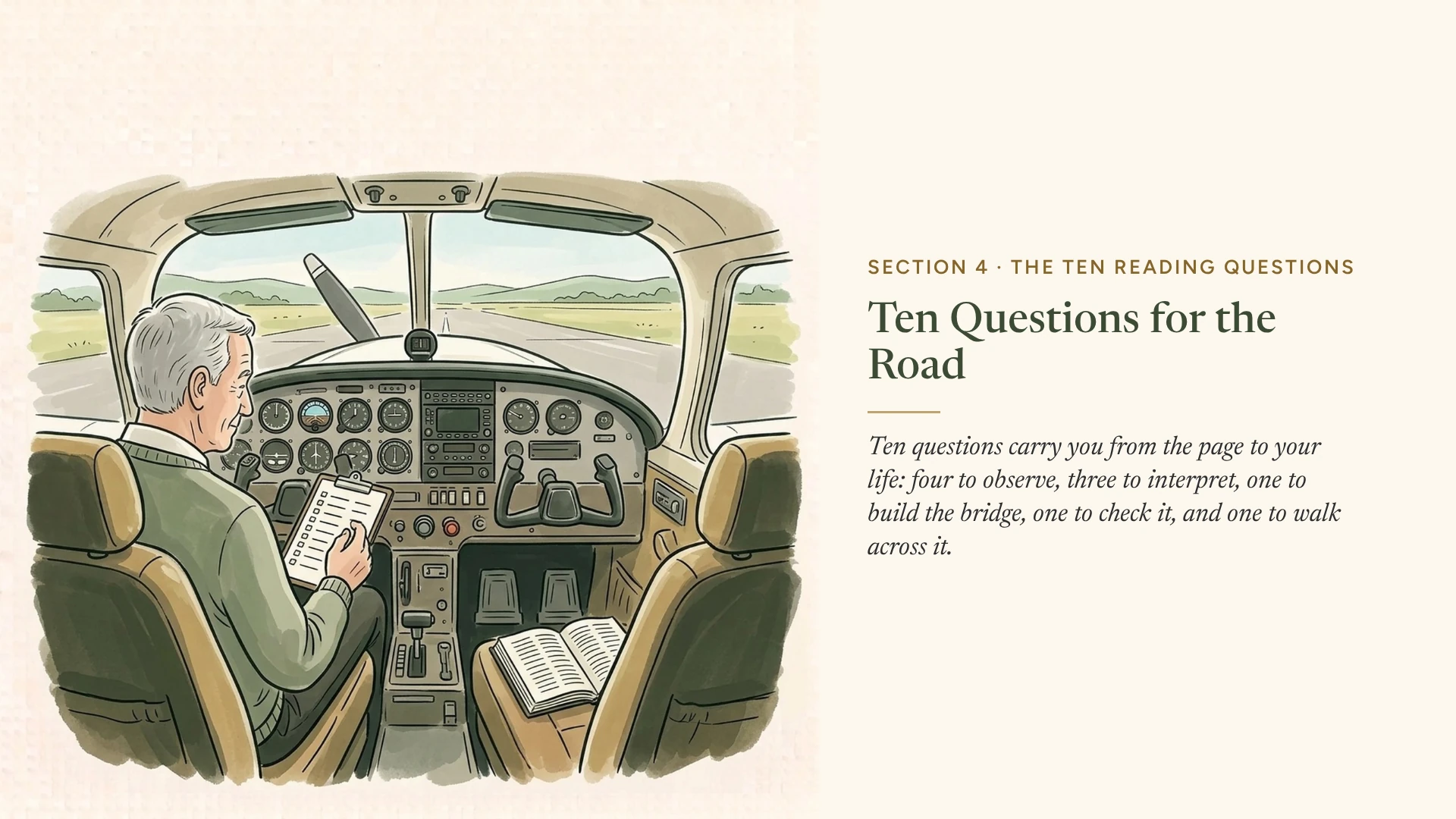
Say this verbatim:
"Airline pilots with thousands of hours still run a checklist before every takeoff. They haven't forgotten how to fly. The checklist catches what experience skips on a busy morning. Abide has a checklist for the road too: ten questions. Lesson 3 gave you seven, one for each guardrail. Today adds three: a second question for the Exegetical guardrail, a question for the abiding principle, and the application question we've been asking since lesson 1."
Say this verbatim:
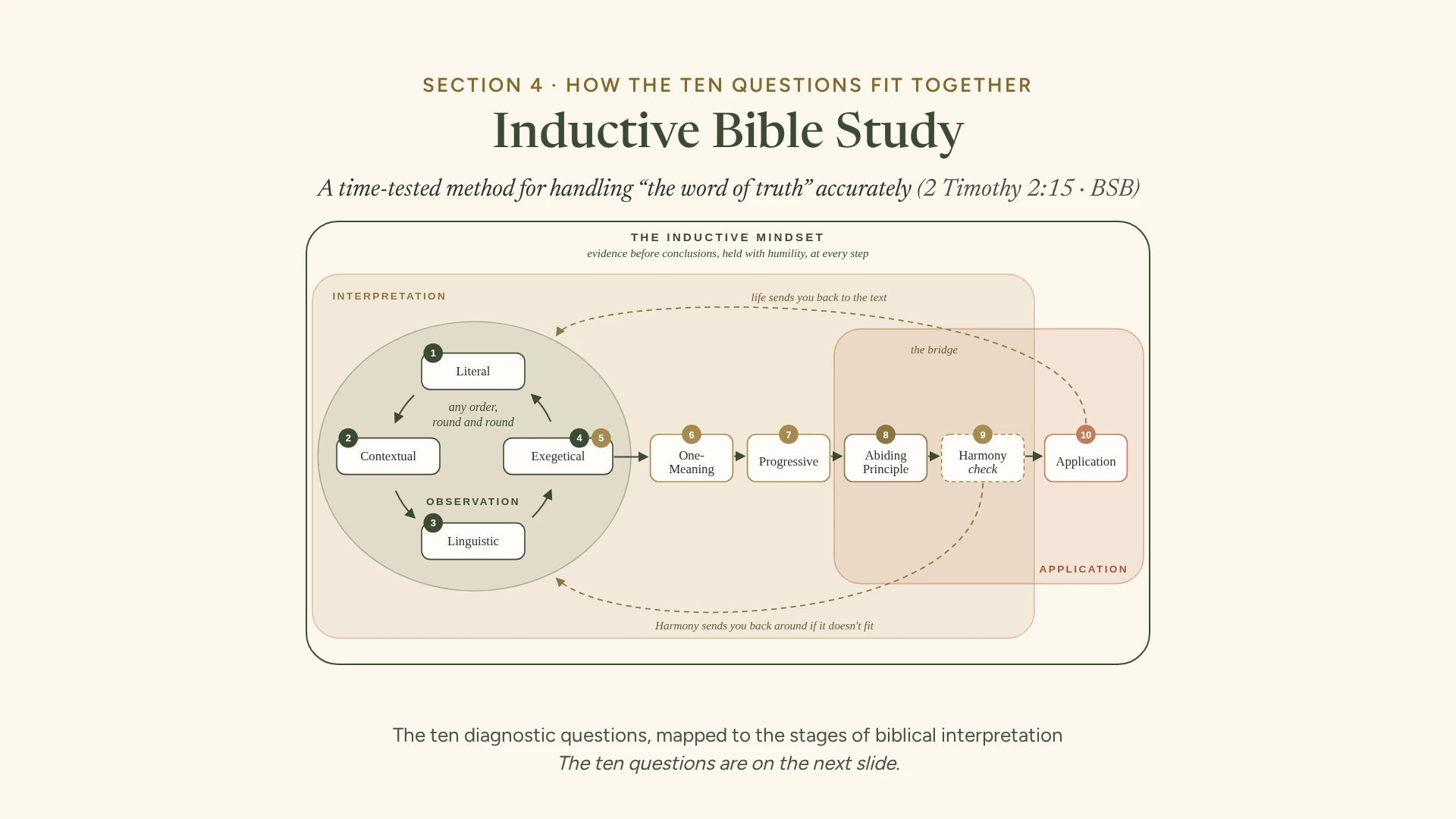
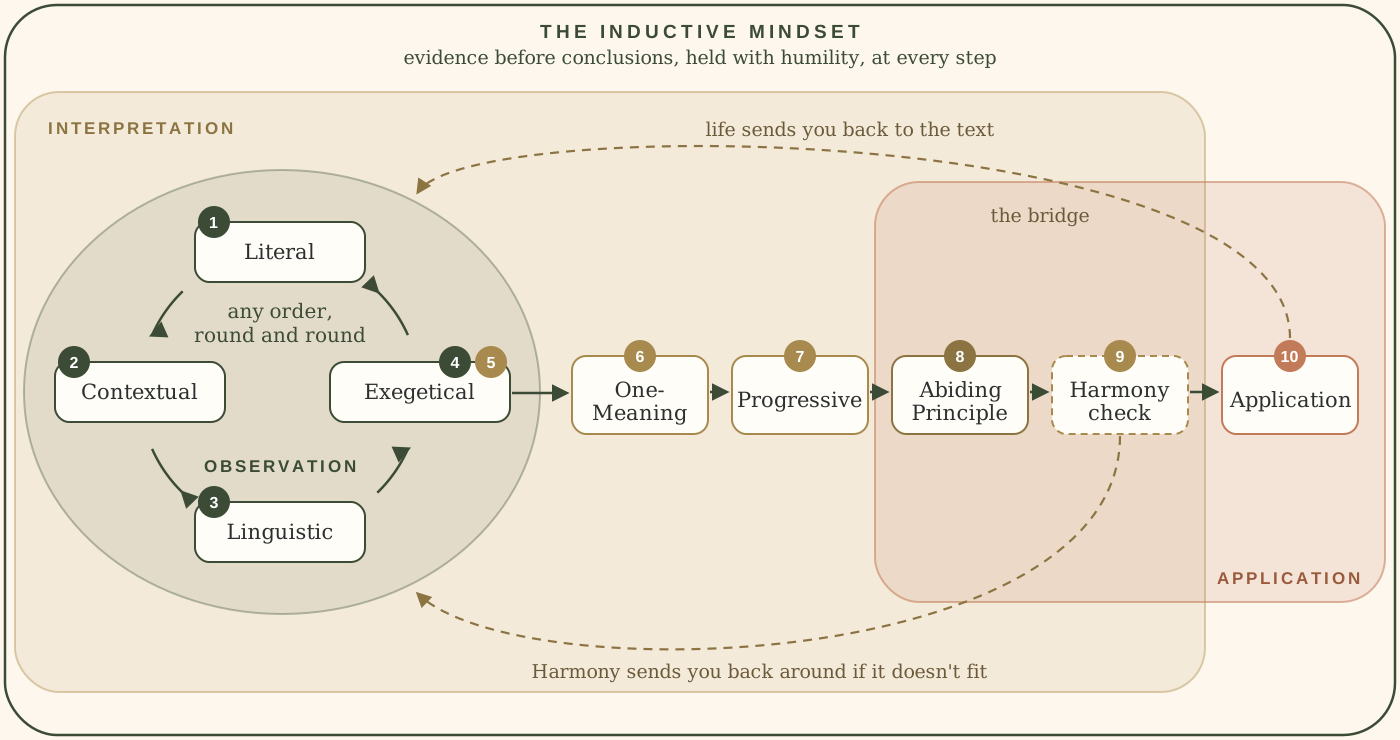
"This is inductive Bible study: here's the whole road in one picture. The first four questions go round and round, in any order, until the meaning comes clear. Then the road runs on: one meaning, the unfolding story, the abiding principle, the Harmony check, and application. And see the dashed lines? Harmony, or life itself, can send you back around."
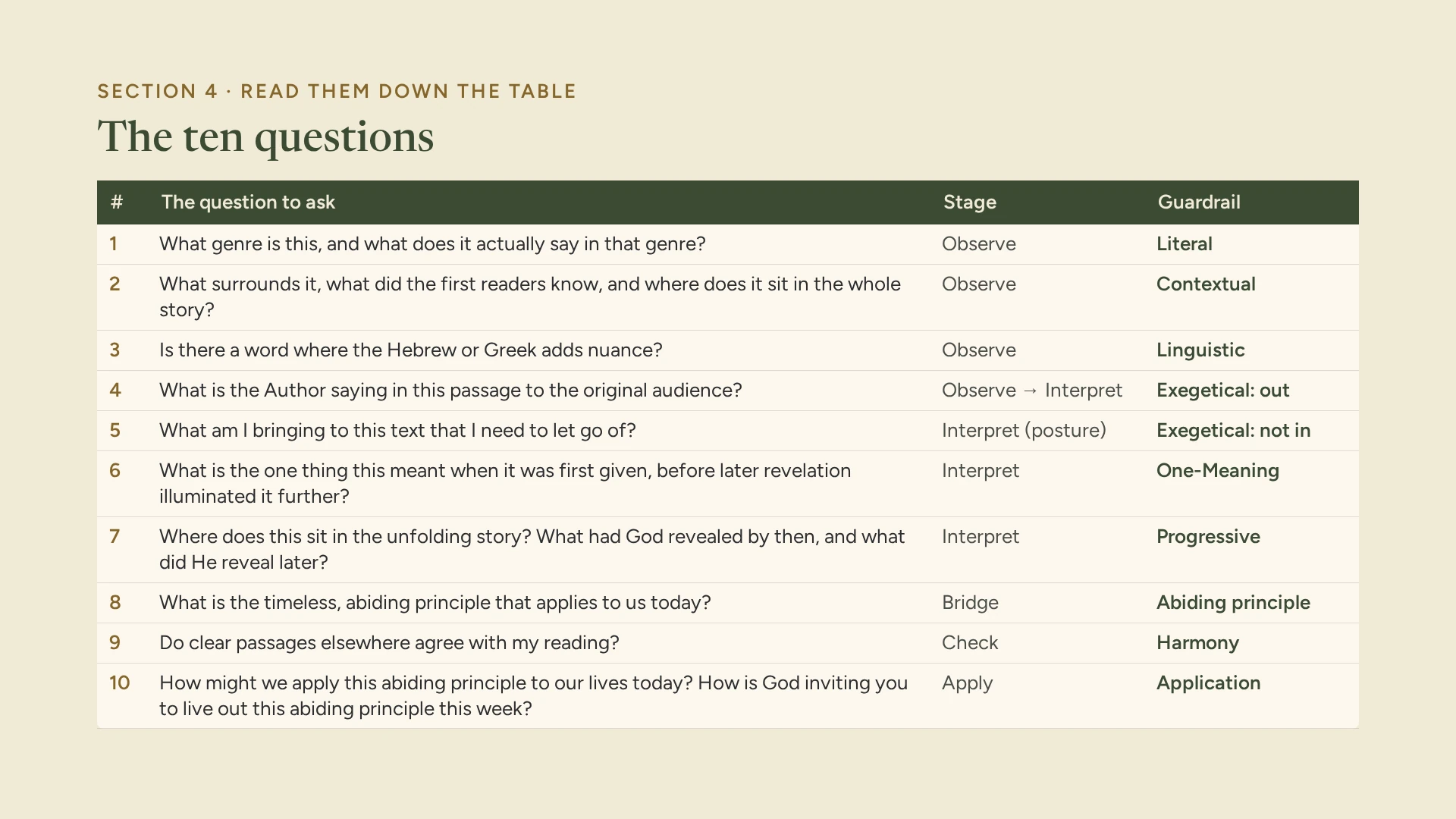
Say this verbatim:
"Let's read all ten down the table on your handout together."
"Look at the handout. Questions 1 to 4 observe. Questions 5 to 7 interpret. Question 8 builds the bridge. Question 9 checks it. Question 10 walks across."
(45-minute only)
"The order is on purpose. Question 5 is written with 'I': 'What am I bringing to this text that I need to let go of?' It isn't an accusation; it's a mirror. Question 6 names the first meaning before question 7 brings in what God revealed later: name the acorn before you admire the oak. And Harmony comes after the abiding principle, because the principle is where readers drift most. Remember the proverb about raising children that gets turned into a guarantee? Harmony checks the principle before anyone acts on it."
The diagram (slide 6) and the table (slide 7), as they appear on the slides and the handout:
Inductive Bible Study
A time-tested method for handling "the word of truth" accurately (2 Timothy 2:15, BSB)
| # | The question to ask | Stage | Guardrail |
|---|---|---|---|
| 1 | What genre is this, and what does it actually say in that genre? | Observation | Literal |
| 2 | What surrounds it, what did the first readers know, and where does it sit in the whole story? | Observation | Contextual |
| 3 | Is there a word where the Hebrew or Greek adds nuance? | Observation | Linguistic |
| 4 | What is the Author saying in this passage to the original audience? | Observation, turning into Interpretation | Exegetical: drawing the meaning out |
| 5 | What am I bringing to this text that I need to let go of? | Interpretation: a posture check | Exegetical: not reading a meaning in |
| 6 | What is the one thing this meant when it was first given, before later revelation illuminated it further? | Interpretation | One-Meaning |
| 7 | Where does this sit in the unfolding story? What had God revealed by then, and what did He reveal later? | Interpretation | Progressive |
| 8 | What is the timeless, abiding principle that applies to us today? | The bridge to Application | Abiding principle |
| 9 | Do clear passages elsewhere agree with my reading? | A check on the meaning and the principle | Harmony |
| 10 | How might we apply this abiding principle to our lives today? How is God inviting you to live out this abiding principle this week? | Application | Application |
Section 5 · The Road Circles Back
Say this verbatim:
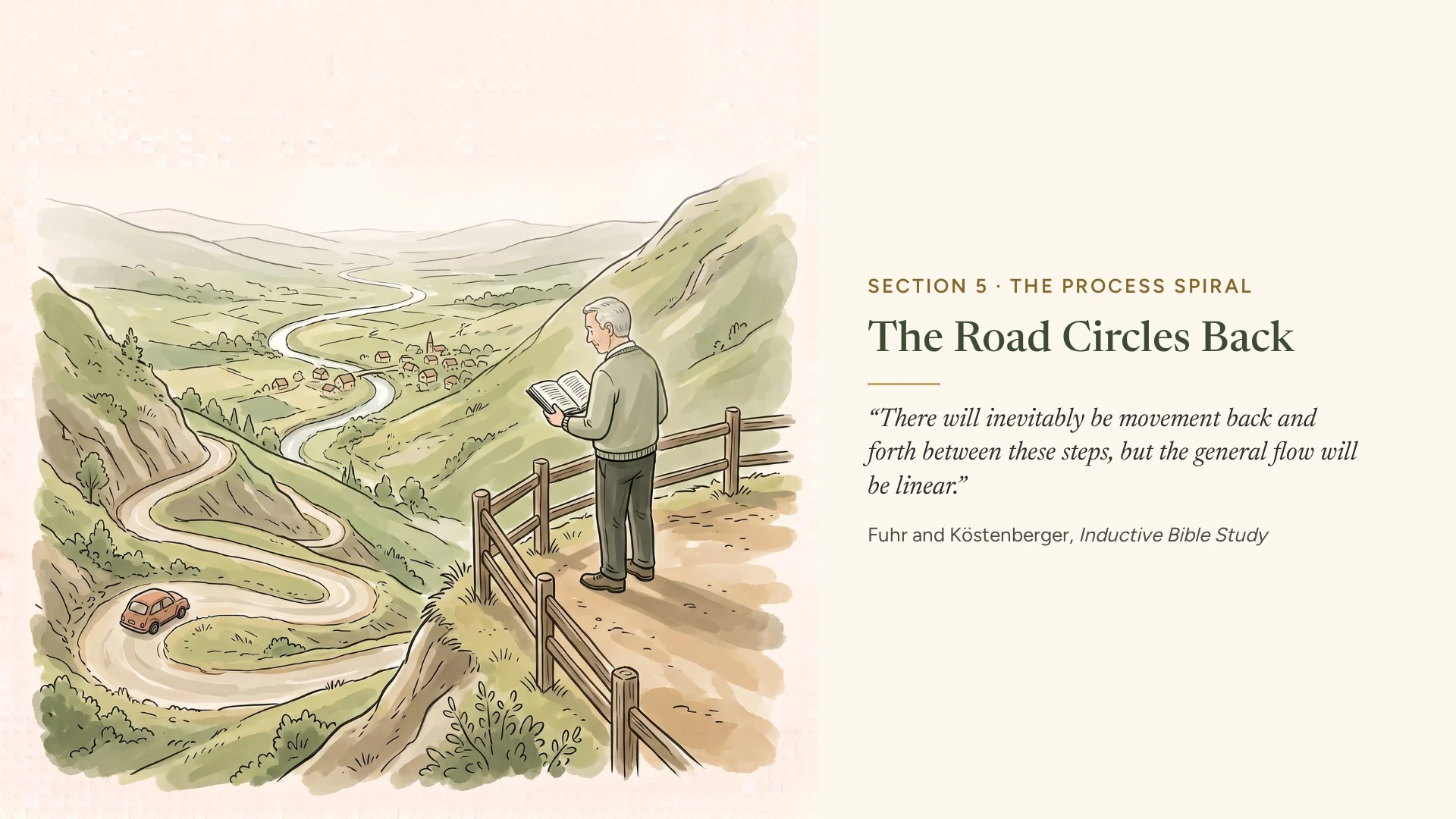
"Some mountain roads switch back and forth. You pass above the same valley again and again, but you haven't gone backward. You're higher, and you see more each time. Bible study works the same way. The questions run in order, but the road circles back. The textbook says, 'There will inevitably be movement back and forth between these steps, but the general flow will be linear.'"
"There are three common loops on your handout. A word sends you back to the context. Harmony sends you back to the start. And life sends you back to the text. Going back isn't failure. It's how the road climbs."
(45-minute only)
"BibleProject's Tim Mackie says, 'you're actually not expected to notice all of this by yourself or all at once.' The Bible invites 'a lifetime of reading and re-reading.' That's why a passage you've known for twenty years can still surprise you."
Section 6 · Matthew 7:1–6 · The Drive, Part 1 (Questions 1–4)
Say this verbatim:
"Now let's take the drive. One verse that almost everyone knows, even people who never read the Bible, is Matthew 7:1. It gets used two opposite ways: to shut down any moral conversation at all, or ignored by people who stay quick to criticize. Let's walk the ten questions through it and see what Jesus actually said."
Ask a volunteer to read Matthew 7:1–6 aloud:
“Do not judge, or you will be judged. For with the same judgment you pronounce, you will be judged, and with the measure you use, it will be measured to you. Why do you look at the speck in your brother’s eye but fail to notice the beam in your own eye? How can you say to your brother, ‘Let me take the speck out of your eye,’ while there is still a beam in your own eye? You hypocrite! First take the beam out of your own eye, and then you will see clearly to remove the speck from your brother’s eye. Do not give dogs what is holy; do not throw your pearls before swine. If you do, they may trample them under their feet, and then turn and tear you to pieces. (Matthew 7:1–6, BSB)
Then say:
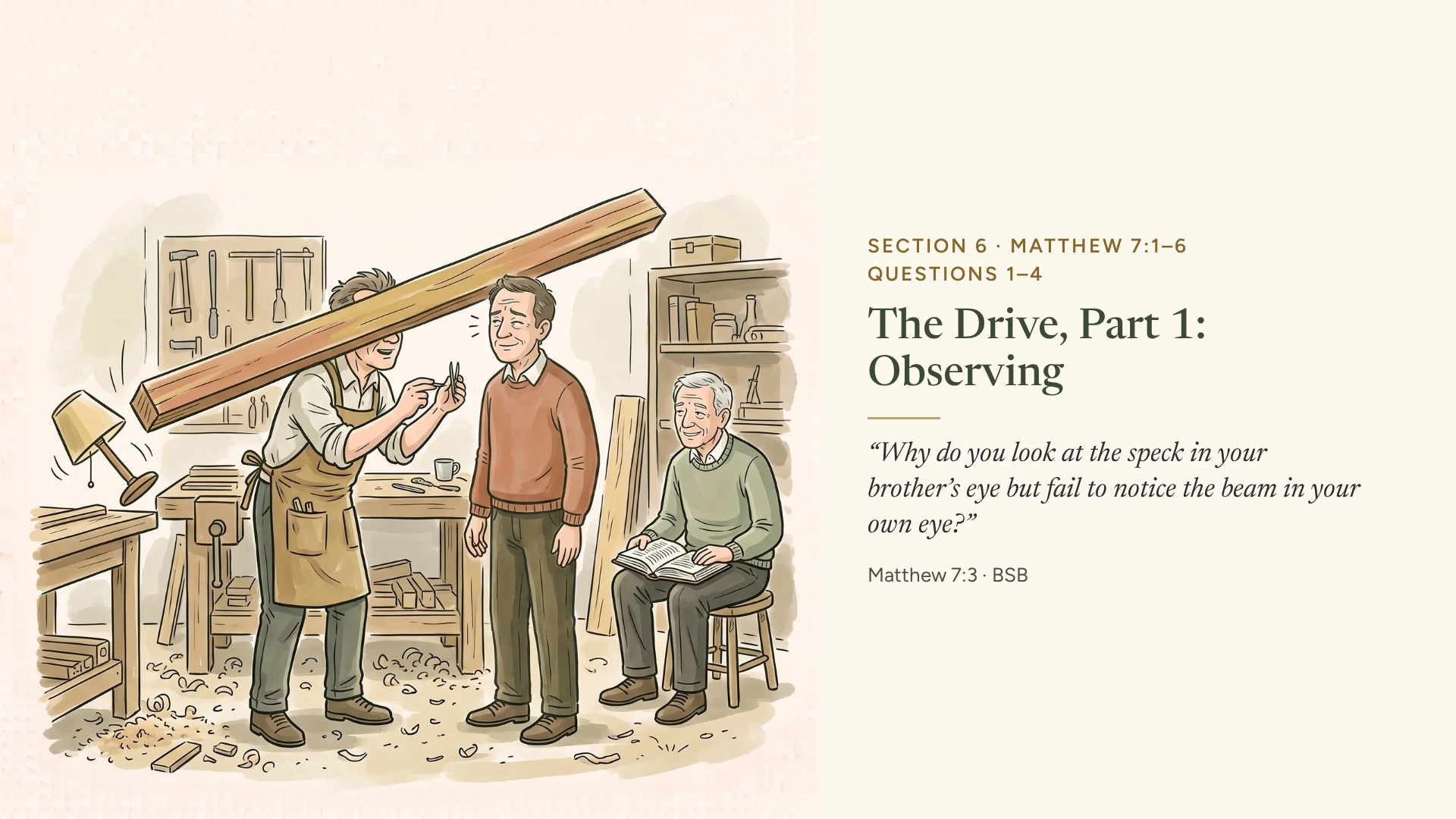
"Question 1: what genre is this? It's a sermon, Jesus teaching His disciples on the mountain, and the picture is meant to be funny. The speck is a bit of sawdust; the beam is the kind of timber that holds up a roof. Picture a man with a roof beam sticking out of his eye, offering to do eye surgery on his friend. Jesus uses humor and exaggeration so the point sticks."
"Question 2: what surrounds it? The sermon opens with 'Blessed are the merciful, for they will be shown mercy' (Matthew 5:7, BSB). It warns three times about hypocrites. And a few verses later, Jesus says of false prophets, 'By their fruit you will recognize them' (Matthew 7:16, BSB). Hold on to that clue. Recognizing a false prophet takes evaluation."
(45-minute only)
"What did the first hearers know? They knew the marketplace, where a merchant measured out grain or oil; the saying about the measure was a familiar proverb. And they knew dogs and pigs. These weren't pets. The dogs were wild scavengers, and the Law called the pig 'unclean for you' (Leviticus 11:7, BSB)."
"Question 3: is there a word where the Greek adds nuance? The word for judge, krinō, has a range, from telling things apart to passing sentence. The dictionary can't choose, so the road circles back to question 2, the context. And the context answers: verse 5 tells you how to help your brother, and verse 16 expects discernment. So Jesus can't mean 'never evaluate anything.' The word leans toward the judge's verdict: condemning. That's our first loop."
"Question 4: what is the Author saying to the original audience? Something like this: Don't set yourself up as the judge who condemns your brother while you ignore your own bigger sin, because God will measure you by the measure you use. Deal with your own sin first. Then, seeing clearly, help your brother."
Section 7 · Matthew 7:1–6 · The Drive, Part 2 (Questions 5–10)
Say this verbatim:
"Question 5 is in the first person: 'What am I bringing to this text that I need to let go of?' Maybe I bring my culture's version: don't judge me means no one may ever say I'm wrong. Or maybe I bring the opposite: I enjoy spotting other people's faults, and I call it discernment. Whichever one I carry, I set it down."
"Question 6: what is the one meaning? Jesus forbids the condemning, fault-finding spirit that sets itself up as judge over a brother while blind to its own sin. He does not forbid discernment, and He does not forbid loving correction. John Stott put it this way: 'the command not to judge is not a requirement to be blind, but rather a plea to be generous.'"
(45-minute only)
"Then verse 6 stops us. Right after 'Do not judge' (Matthew 7:1, BSB), Jesus speaks of dogs and swine. Isn't that judging? That's our second loop, back to the context: verse 5 already expects clear sight, and verse 16 expects discernment. Verse 6 balances verses 1 to 5; it doesn't cancel them. Most commentators read it as discernment: don't keep pressing what is holy on people who have shown they despise it. Faithful readers differ on the details, so we hold this part more humbly. And notice the balance: five verses warn the judgmental, and one warns the undiscerning."
"Question 7: where does this sit in the unfolding story? Long before, Moses told Israel's judges, 'judgment belongs to God' (Deuteronomy 1:17, BSB). Later, Paul taught the churches the same lesson: 'restore him with a spirit of gentleness. But watch yourself' (Galatians 6:1, BSB)."
"Question 8: the abiding principle. Here's one way to say it: God alone is the Judge. Those who have received His mercy examine themselves first, then help others humbly and gently, and use discernment without condemning."
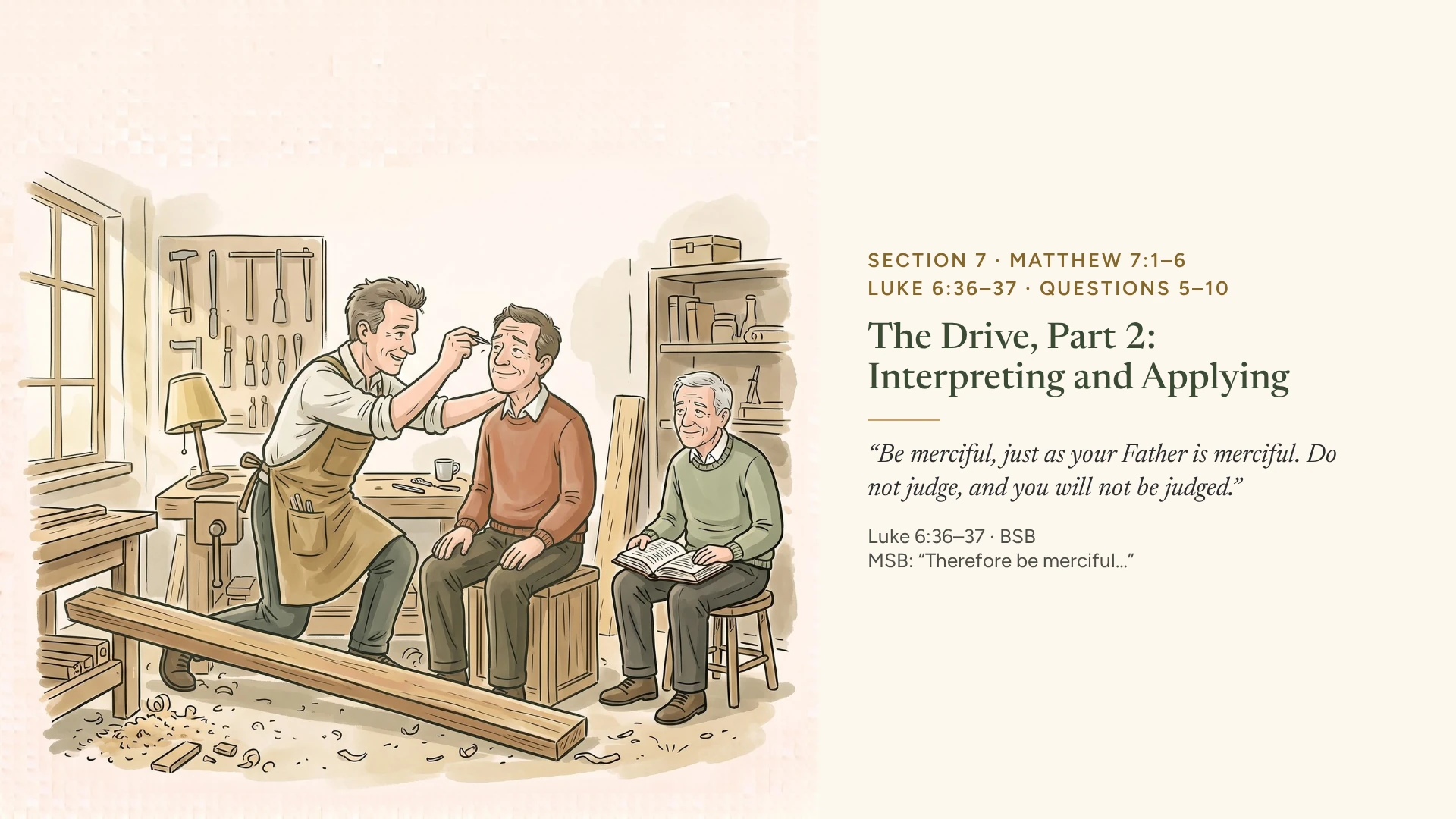
"Question 9: do clear passages agree? Luke records the same teaching: 'Be merciful, just as your Father is merciful. Do not judge, and you will not be judged. Do not condemn, and you will not be condemned' (Luke 6:36–37, BSB). And Jesus Himself says, 'Stop judging by outward appearances, and start judging justly' (John 7:24, BSB). So the Bible doesn't ban all judgment; it bans the wrong kind. That's the third loop: if our principle had been 'never say anything is wrong' or 'correct everyone you can,' these passages would send us back."
"Question 10: how might we apply it? A parent about to lecture a teenager about screen time first checks their own phone. A coworker's mistake shows up in the group chat, and instead of piling on, we go to the person privately. Online, before posting a verdict about someone we've never met, we remember that only God sees the heart. And with a friend who mocks our faith, verse 6 frees us from forcing the conversation. We keep loving, keep praying, and watch for an open door."
Section 8 · Luke 24:44–45 · Humble Confidence
Say this verbatim:
"The ten questions give you two gifts that seem to pull in opposite directions: confidence and humility. The textbook says 'you can approach the text with confidence, expecting to be able to understand its meaning.' Most of what you study, you can understand with real certainty. And a few things, like the details of Matthew 7:6, call for a lighter grip. The textbook adds that 'we're not just developing a method; we're developing a person.'"
(45-minute only) Ask a volunteer to read Luke 24:44–45 aloud:
Jesus said to them, “These are the words I spoke to you while I was still with you: Everything must be fulfilled that is written about Me in the Law of Moses, the Prophets, and the Psalms.” Then He opened their minds to understand the Scriptures. (Luke 24:44–45, BSB)
Then say:
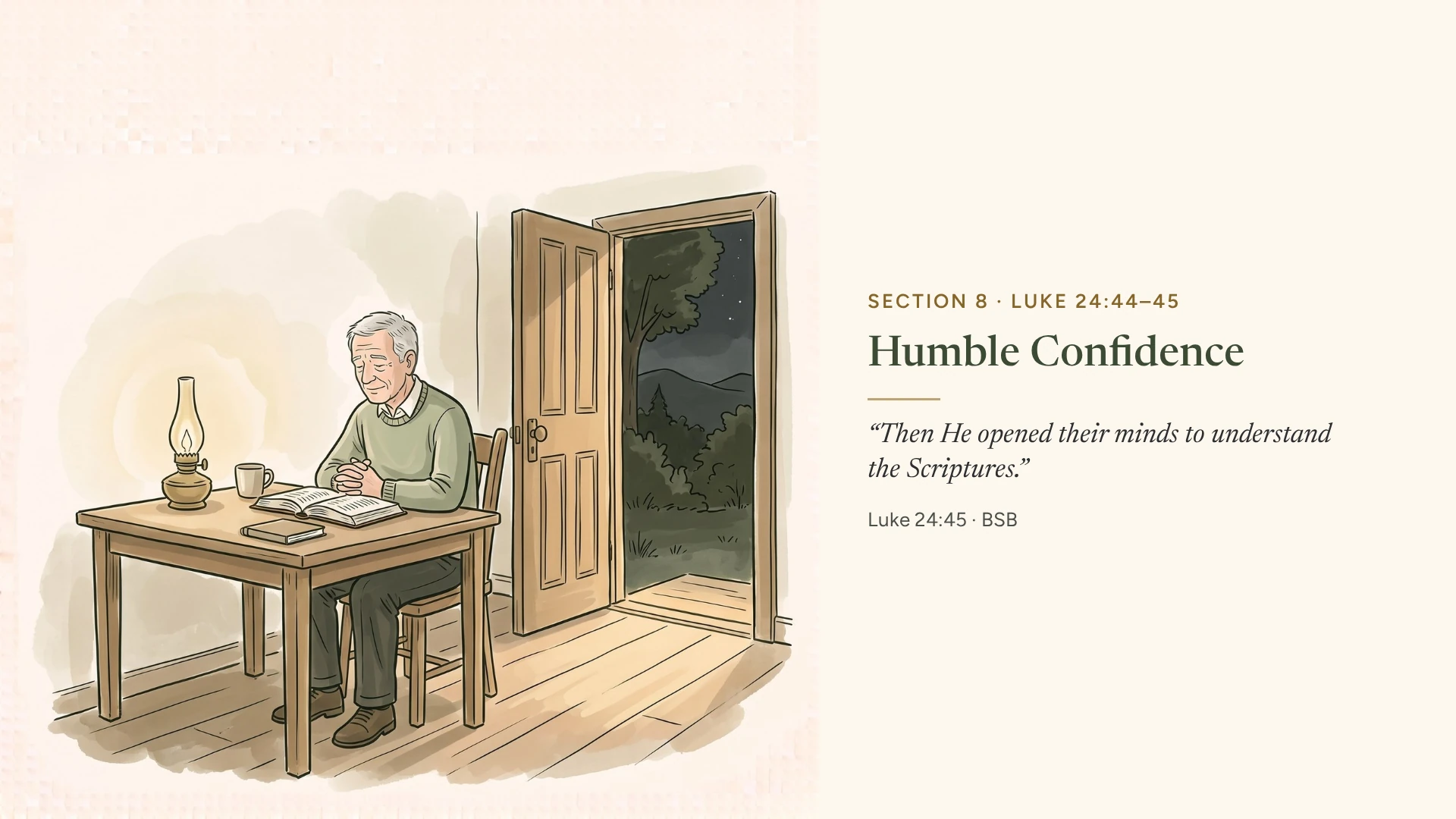
"Holmes had Dr. Watson. You have someone far better: the Author Himself. On the evening He rose from the dead, Jesus found His disciples in Jerusalem, and 'He opened their minds to understand the Scriptures' (Luke 24:45, BSB). The same Lord still teaches His people by His Spirit through His Word. So we study carefully, and we pray as we study."
The Close
Say this verbatim:
"Read like Holmes: observe before you conclude. Walk the ten questions in order, and expect the road to circle back. Hold your conclusions with confidence where the evidence is clear and with humility where it isn't. And never study alone: ask the Author to open your mind."
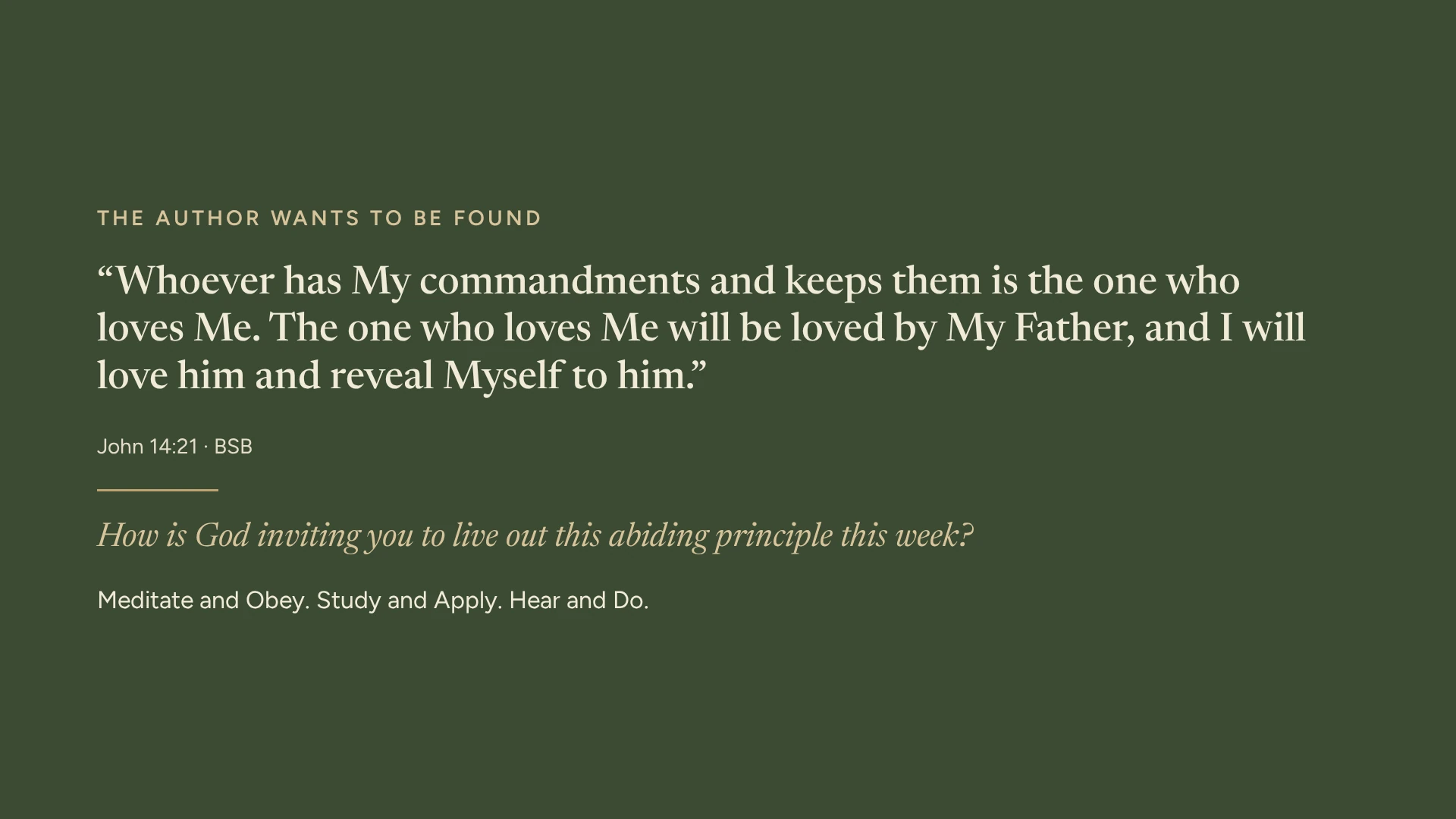
"So here is the question we ask at the end of every passage: How is God inviting you to live out this abiding principle this week?"
(Pause.)
"On your handout, write one step you will take this week. Maybe it's taking the beam out of your own eye before a hard conversation. Maybe it's walking the ten questions through one short passage. Just one."
"Let's say them together: Meditate and Obey. Study and Apply. Hear and Do. This is how we abide in Christ. This is how we demonstrate our love for God."
"Let's pray. Father, thank You that You want to be known. Open our minds to understand the Scriptures. Make us slow to condemn and quick to show mercy, and teach us to see clearly. In Jesus' name, amen."
Discussion Prompts
Use these after the teaching or in small groups. Choose two or three based on the time you have.
- When have you come to the Bible already knowing what you wanted it to say? What helped you listen instead?
- Which of the ten questions feels most natural to you? Which one do you tend to skip?
- Have you heard Matthew 7:1 used to shut down a conversation? How does the whole passage, verses 1–6, change the way you hear it?
- "First take the beam out of your own eye" (Matthew 7:5, BSB). What does it look like to examine yourself before you correct someone you love?
- Where have you seen the road circle back in your own study, when a later question sent you back to look at a passage again?
Optional Homework
Assign one or both before the next session:
Reading Assignment: Read the full lesson page on your own; it covers more than we had time for today. Then read the whole Sermon on the Mount, Matthew 5–7, in one sitting, and notice every time Jesus talks about the eye.
Application Assignment: Choose one short passage (Luke 6:36–38 or Philippians 2:1–5 work well) and walk the ten questions from the handout. Write one sentence for each, mark any place the road circled back, and write one step of obedience the passage invites.
Scripture quotations marked Berean Standard Bible (BSB) or Majority Standard Bible (MSB) are taken from texts that have been dedicated to the public domain. Free resources are available at BereanBible.com and MajorityBible.com.