Why So Many Translations? · Lesson Plan
The many English translations are not a reason to doubt your Bible. Faithful scholars toiled over them, their differences come from four illuminating reasons, and a few translations side by side help you see God's Word more clearly.
Published October 17, 2026 · Updated October 17, 2026
Leader Prep Sheet
Lesson Goal: Help your class trust their Bibles more, not less, by understanding why English translations differ, who makes them, and how to use a few of them side by side.
Big Idea: Most of us read God's Word in translation, and the differences between Bibles can raise a quiet worry. This lesson turns the worry into confidence. Faithful scholars toiled over our translations, their differences come from four illuminating reasons, and a few translations side by side help us see more of what God has said.
Main Outcomes:
- Students can name the four reasons translations differ: the approach, the interpretation, the manuscripts, and the English.
- Students can explain why differences between good translations are a reason for confidence, not doubt.
- Students leave with a translation toolbox: a Bible they love, plus three or four from different parts of the Translation Map.
How this packet works:
- Sixteen slides. Use the teaching deck (the Slides link on this page): the cover, one illustrated slide for each of the eight sections, five detail slides (the four reasons, the translation spectrum, the good-eye table, the Translation Map and "Ask why"), the close, and a Scripture credits slide to leave on screen at the end.
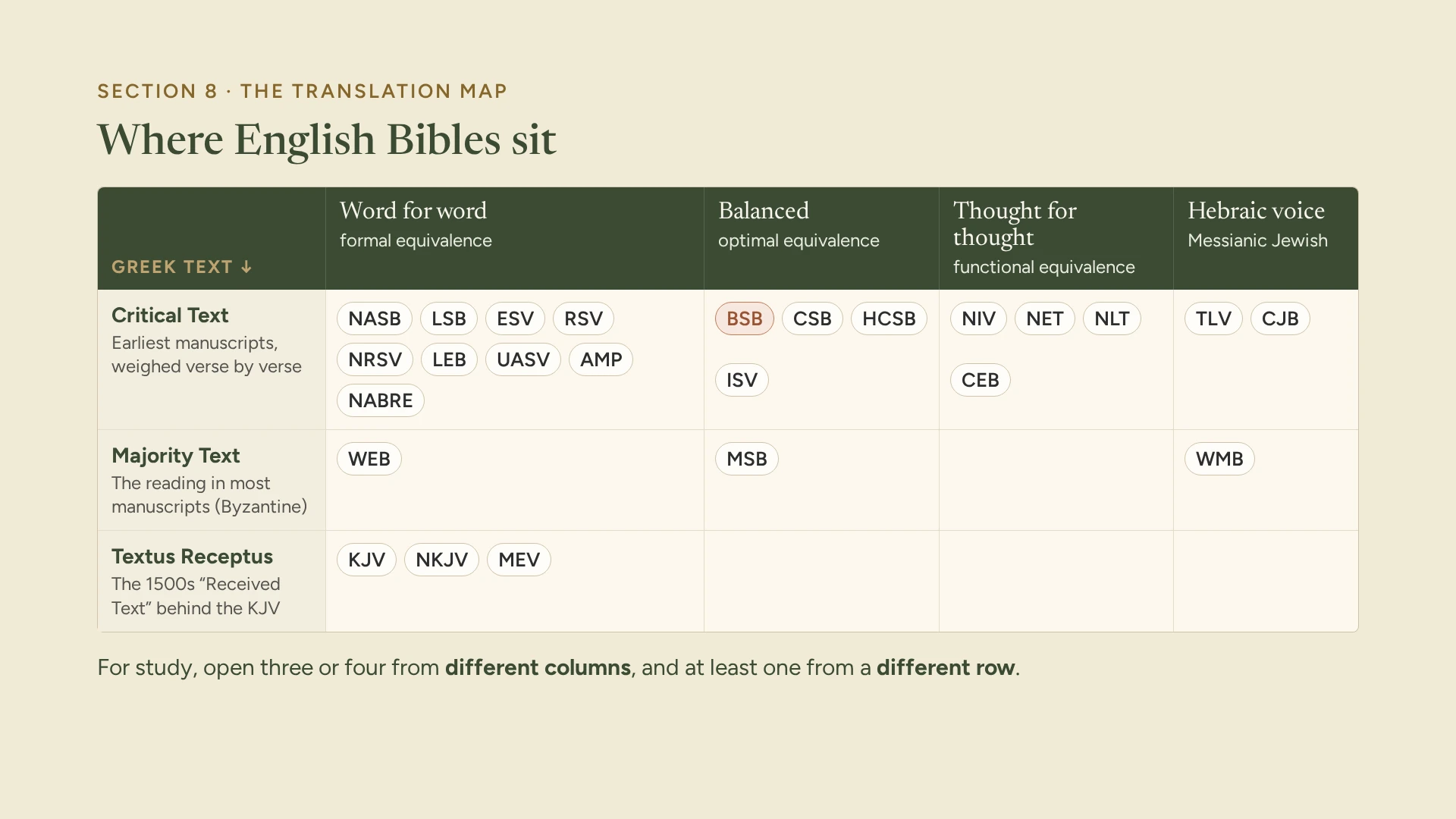
- The handout carries the detail. The comparison tables (Luke 9:44 and Amos 4:6, Psalm 8:5, Colossians 1:14, the KJV and today's English) and the two toolbox sets are on the student handout. The Translation Map is on the Translation Toolbox sheet, free at bensonacademy.com. The script tells you when to point to them.
- You won't cover everything. Students can read the full lesson page on their own.
- Two lengths. The script is written for 45 minutes. For 30 minutes, skip only the parts marked (45-minute only), such as a volunteer reading a passage aloud, and keep everything marked Both lengths. Follow the 30-minute flow.
- Read Scripture from the Bible. When the script says to have someone read a passage aloud, ask a volunteer ahead of time. Scripture in this packet is from the Berean Standard Bible (BSB) unless another translation is named, as it is when the lesson compares translations.
Materials Needed:
- Bibles, in as many different translations as the class owns (the variety helps today)
- The teaching slides and a screen
- One student handout per person, and the Translation Toolbox sheet if you have it
- This packet, printed
Teacher Emphasis:
- Honor every Bible in the room. Some people love the King James Version; some love a modern translation. Don't rank them or start a debate about which is best. The lesson's point is that faithful translations differ for sound reasons, and each one has something to show us.
- Speak to the worry gently. Some students have heard that modern Bibles "removed" words, or that translations can't be trusted. Lead with the reasons for confidence the lesson gives at every step.
- Keep the weight on trust and practice, not on technical terms. Words like formal equivalence and Textus Receptus are labels; the point is what they mean for a reader.
- Each passage was spoken first to someone else: an official on the road to Gaza, Israel at the Water Gate, Jesus' disciples, Peter's readers living as exiles, the crowd at Pentecost. Say who first, then what carries over to us.
Scripture List
- Acts 8:26–35: The official reading Isaiah asks for someone to guide him.
- Ezra 7:10: Ezra had set his heart to study the Law of the LORD, to practice it, and to teach.
- Nehemiah 8:8: Explaining it and giving insight, so that the people could understand.
- Luke 9:43–45: Let these words sink into your ears.
- Amos 4:6: Cleanness of teeth and lack of bread.
- Psalm 8:3–6: A little lower than the angels.
- Colossians 1:13–14 and Ephesians 1:7: In Him we have redemption.
- 1 Peter 2:11–12: Conduct yourselves with such honor among the Gentiles.
- Acts 2:5–11: We hear them declaring the wonders of God in our own tongues.
- John 14:21: I will love him and reveal Myself to him.
Timed Teaching Flow · 30 Minutes
| Time | Slide | Section | Script Cue | Notes |
|---|---|---|---|---|
| 0:00–1:00 | 1 | Welcome | "The words don't match." | Brief welcome; open in prayer |
| 1:00–3:30 | 2 | 1 · Which Bible can I trust? | "How can I," he said, "unless someone guides me?" (Acts 8:31, BSB) | Translators are guides |
| 3:30–6:00 | 3 | 2 · The people behind your Bible | "explaining it and giving insight, so that the people could understand what was being read" (Nehemiah 8:8, BSB) | Committees; nothing new |
| 6:00–7:00 | 4 | 3 · Four reasons | "Usually neither did." | Name the four |
| 7:00–8:30 | 5 | Four reasons (cards) | "A big difference is a clue." | Red flags |
| 8:30–11:00 | 6 | 4 · Word for word or thought for thought | "Let these words sink into your ears" (Luke 9:44, BSB) | Idioms; handout table |
| 11:00–12:30 | 7 | The translation spectrum | "Picture a line." | Where translations sit |
| 12:30–15:00 | 8 | The good eye | "Watch what happens to the eye." | Read across the table |
| 15:00–17:30 | 9 | 5 · The same words, read two ways | "You made him a little lower than the angels" (Psalm 8:5, BSB) | Elohim; handout table |
| 17:30–21:00 | 10 | 6 · Different manuscripts | "In Him we have redemption through His blood" (Ephesians 1:7, BSB) | Colossians 1:14; handout table |
| 21:00–23:00 | 11 | 7 · English keeps changing | "Having your conversation honest among the Gentiles" (1 Peter 2:12, KJV) | Words drift; handout table |
| 23:00–24:30 | 12 | 8 · Your translation toolbox | "we hear them declaring the wonders of God in our own tongues!" (Acts 2:11, BSB) | Tools, not competitors |
| 24:30–26:30 | 13 | The Translation Map | "Across the top, the spectrum. Down the side, the Greek text." | Translation Toolbox sheet |
| 26:30–28:00 | 14 | Ask why | "When translations differ, ask why." | This week's passage |
| 28:00–30:00 | 15 | The Close | "How is God inviting you to live out this abiding principle this week?" | This week's step; pray |
Timed Teaching Flow · 45 Minutes
| Time | Slide | Section | Script Cue | Notes |
|---|---|---|---|---|
| 0:00–2:00 | 1 | Welcome | "The words don't match." | Welcome; open in prayer |
| 2:00–6:00 | 2 | 1 · Which Bible can I trust? | "How can I," he said, "unless someone guides me?" (Acts 8:31, BSB) | Read Acts 8:30–31 and 35 aloud |
| 6:00–10:00 | 3 | 2 · The people behind your Bible | "For Ezra had set his heart to study the Law of the LORD, to practice it, and to teach" (Ezra 7:10, BSB) | Read Ezra 7:10 and Nehemiah 8:8 aloud |
| 10:00–11:00 | 4 | 3 · Four reasons | "Usually neither did." | Name the four |
| 11:00–13:00 | 5 | Four reasons (cards) | "A big difference is a clue." | Red flags |
| 13:00–17:00 | 6 | 4 · Word for word or thought for thought | "Let these words sink into your ears" (Luke 9:44, BSB) | Read Luke 9:43–45 aloud; Amos 4:6 |
| 17:00–19:00 | 7 | The translation spectrum | "Picture a line." | Paraphrases |
| 19:00–23:00 | 8 | The good eye | "Watch what happens to the eye." | Read across the table together |
| 23:00–27:00 | 9 | 5 · The same words, read two ways | "You made him a little lower than the angels" (Psalm 8:5, BSB) | Read Psalm 8:3–6 aloud; Hebrews 2:9 |
| 27:00–32:00 | 10 | 6 · Different manuscripts | "In Him we have redemption through His blood" (Ephesians 1:7, BSB) | Three Greek texts; Colossians 1:14; brackets |
| 32:00–35:00 | 11 | 7 · English keeps changing | "Having your conversation honest among the Gentiles" (1 Peter 2:12, KJV) | 2 Corinthians 8:1; the KJV preface |
| 35:00–38:00 | 12 | 8 · Your translation toolbox | "we hear them declaring the wonders of God in our own tongues!" (Acts 2:11, BSB) | Read Acts 2:5–11 aloud |
| 38:00–40:30 | 13 | The Translation Map | "Across the top, the spectrum. Down the side, the Greek text." | Translation Toolbox sheet |
| 40:30–42:30 | 14 | Ask why | "When translations differ, ask why." | The two sets; this week's passage |
| 42:30–45:00 | 15 | The Close | "How is God inviting you to live out this abiding principle this week?" | This week's step; the three pairs; pray |
Full Lecture Script
Welcome
Say this verbatim:
"Picture this. The pastor reads the morning's verse, and you follow along in the Bible on your lap. Then you notice: the words don't match. Same chapter, same verse, different words. The person beside you is reading a third version on a phone. Which one is right? Can I trust any of them?"
"Look around the room. How many different Bibles do we have here today? That's not a problem. By the end of this class, I hope you'll see it as a gift. Let's pray. Father, thank You for giving us Your Word, and for the people who carried it into our language. Open our eyes to see more of what You have said. In Jesus' name, amen."
Section 1 · Acts 8:26–35 · Which Bible Can I Trust?
Say this verbatim:
"For some 300 years the King James Version was the Bible of the English-speaking world. Today, as our textbook puts it, 'today's Bible reader is faced with dozens of translations.' So let's start with a man who had the Scriptures in his hands and still needed help."
(45-minute only) Ask a volunteer to read Acts 8:30–31 and 35 aloud:
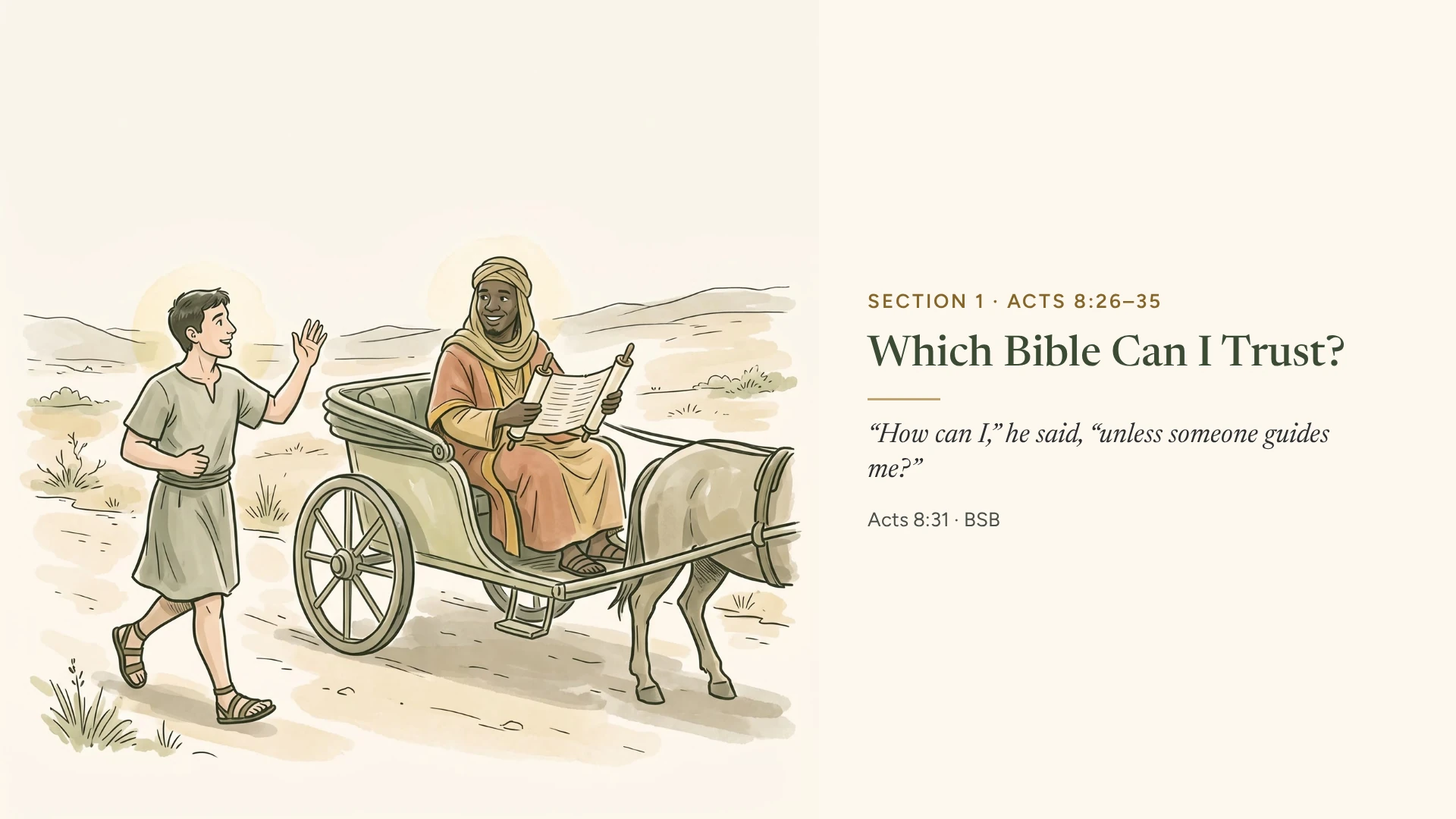
So Philip ran up and heard the man reading Isaiah the prophet. “Do you understand what you are reading?” Philip asked. “How can I,” he said, “unless someone guides me?” And he invited Philip to come up and sit with him. (Acts 8:30–31, BSB)
Then Philip began with this very Scripture and told him the good news about Jesus. (Acts 8:35, BSB)
Both lengths: say this verbatim:
"This was a court official of the queen of the Ethiopians, on his way home from worshiping in Jerusalem. He could read every word of Isaiah. What he needed was someone to guide him into what the words meant, and God sent one. Philip didn't replace Isaiah. He 'began with this very Scripture' (Acts 8:35, BSB) and opened it up."
"If you read the Bible in English, you already have guides sitting beside you in the chariot. Unless you read Hebrew and Greek, someone carried every word on your page across into English. Those people are translators. Different translations aren't a reason to doubt. They're more guides beside you."
Section 2 · Ezra 7:10 · Nehemiah 8:8 · The People Behind Your Bible
Say this verbatim:
"Reading God's Word in translation isn't a modern compromise. Our textbook says, 'even Jesus and the apostles utilized the Greek Septuagint in their reading of the Old Testament.' That's an ancient Greek translation of the Hebrew Old Testament. And the Gospel writers translated too. Mark keeps Jesus' own Aramaic words, 'Talitha koum!' and then gives their meaning: 'Little girl, I say to you, get up!' (Mark 5:41, BSB)."
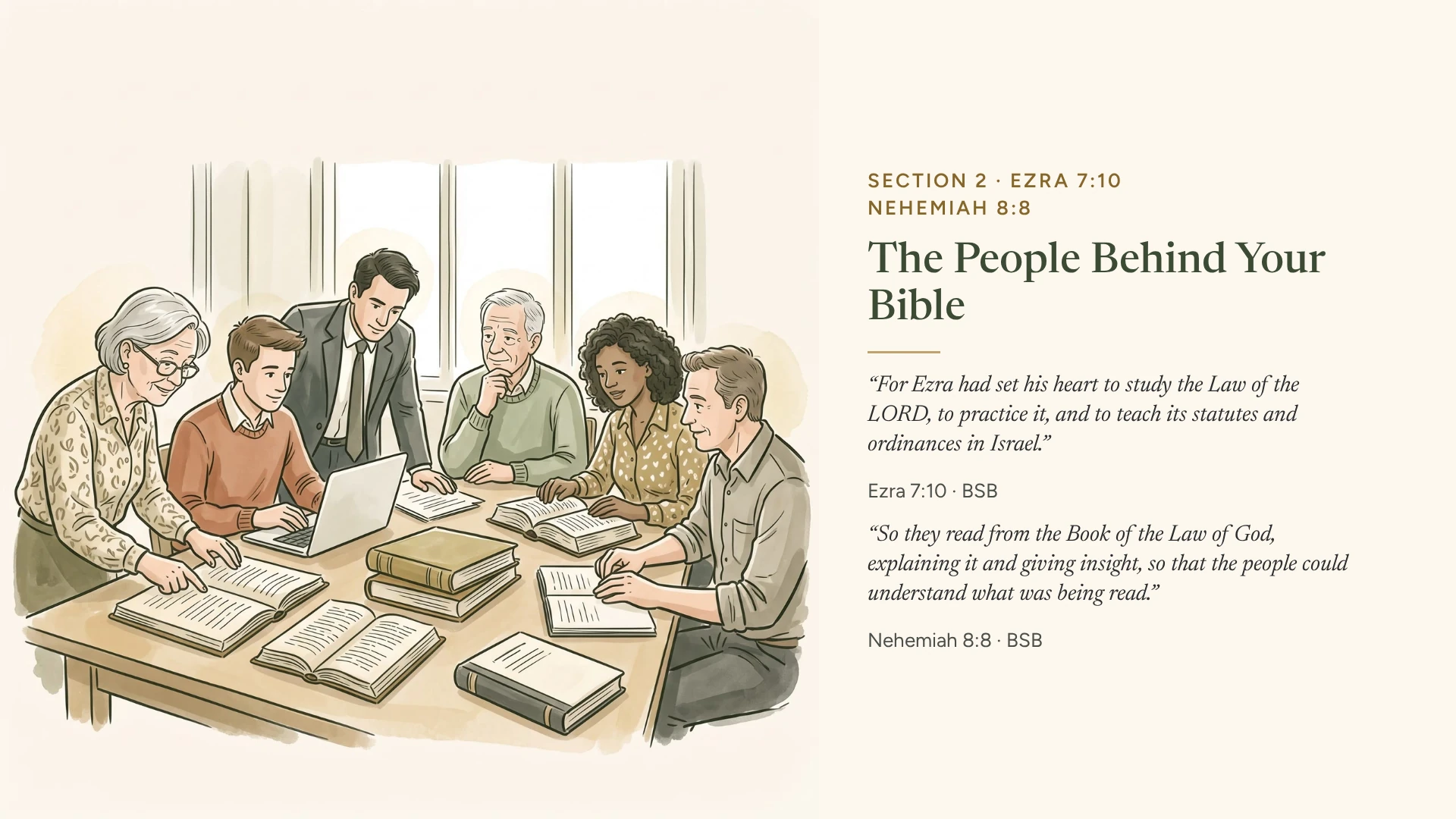
"So who translates the Bible you hold? Usually a team. Most translations come from 'years of painstaking committee-based research and debate,' by experts in the original languages, in comparing the old copies, in translation, and in English. Committees usually include scholars from different churches, and that gives 'a hedge of protection from theological prejudice.' When good translations differ, it isn't malice or mistakes. As the textbook says, 'differences occur due to legitimate points of view that come into play in the process of translation.'"
(45-minute only) Ask a volunteer to read Ezra 7:10 and Nehemiah 8:8 aloud:
For Ezra had set his heart to study the Law of the LORD, to practice it, and to teach its statutes and ordinances in Israel. (Ezra 7:10, BSB)
So they read from the Book of the Law of God, explaining it and giving insight, so that the people could understand what was being read. (Nehemiah 8:8, BSB)
Both lengths: say this verbatim:
"After the exile, Israel gathered at the Water Gate, and Ezra read them the Law from daybreak until noon. Beside the reading, the Levites helped the people understand. That scene was Israel's. But the heart behind it runs through every faithful translator and teacher since: study the Word, live it, and help God's people understand it. Notice Ezra's order: study, then practice, then teach. That's Study and Apply."
Section 3 · Four Reasons Translations Differ
Say this verbatim:
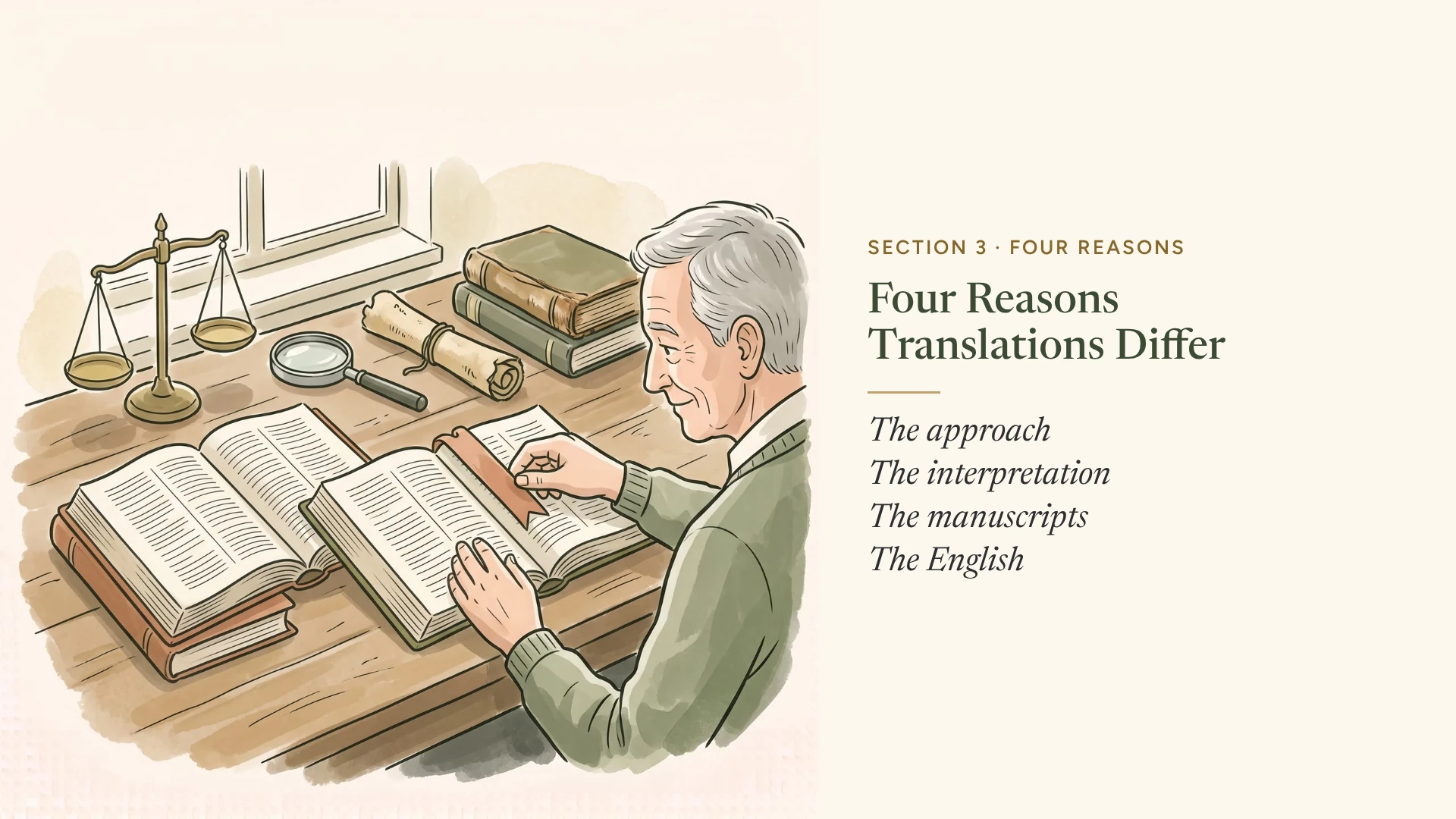
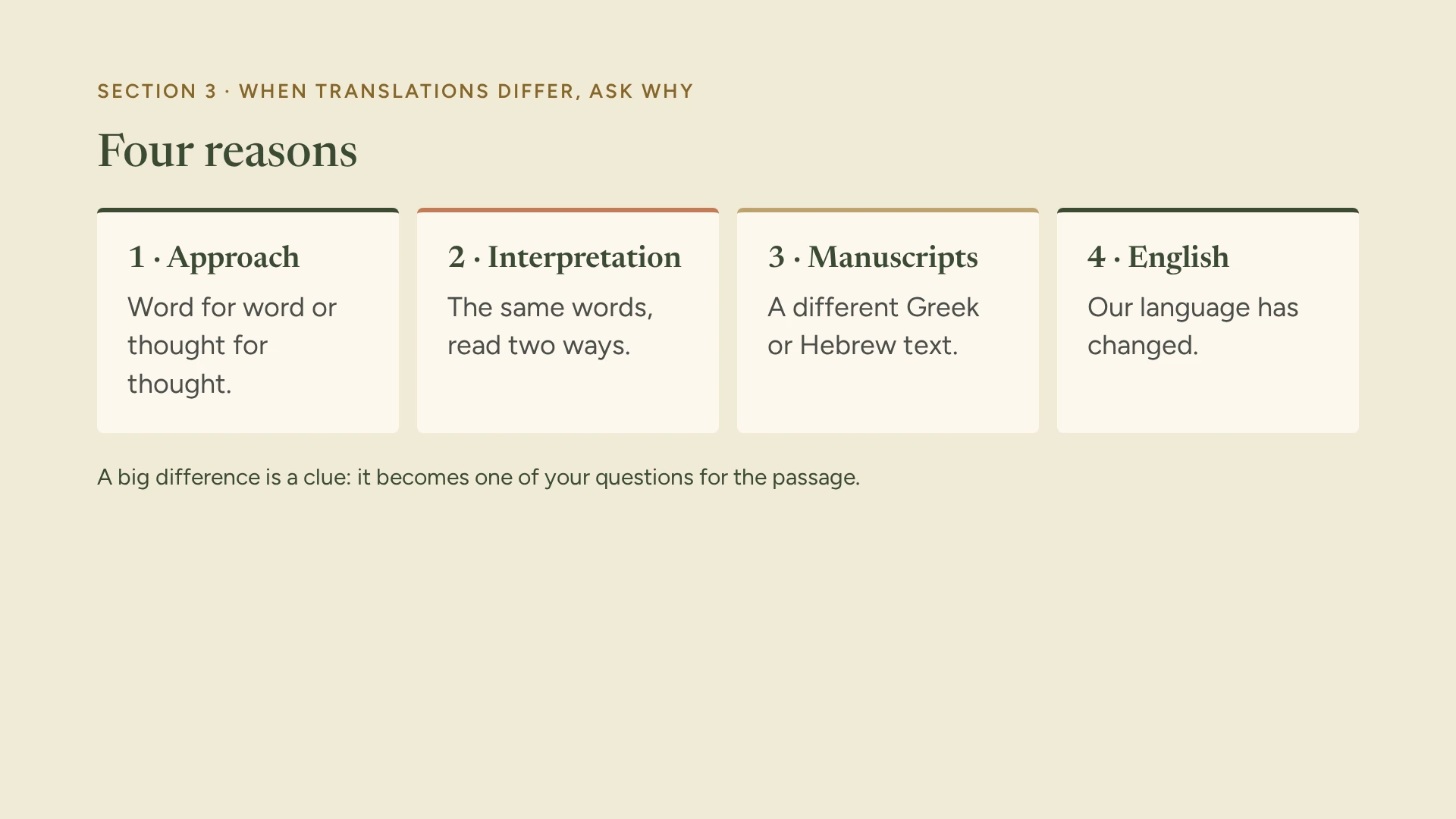
"When two good translations read differently, it's tempting to assume one of them got it wrong. Usually neither did. Our textbook says, 'There's almost always a good reason why translations may differ on any particular passage.' Once you know the reasons, a difference stops being a worry and starts being a clue. The textbook gives four."
Say this verbatim:
"One, the approach: some translations stay close to the original words, and others carry over the thought in natural English. Two, the interpretation: sometimes a word could mean more than one thing, and the translators have to choose. Three, the manuscripts: the original pages are gone, and where the copies differ, translators choose which reading to follow. Four, the English: our language keeps changing."
"Many differences are matters of style. But a big difference is like a red flag on the road, 'indicating difficult exegetical or textual issues that warrant further investigation.' A red flag isn't bad news. It's the text telling you to slow down, because there's something worth seeing."
Section 4 · Luke 9:43–45 · Amos 4:6 · Word for Word or Thought for Thought
Say this verbatim:
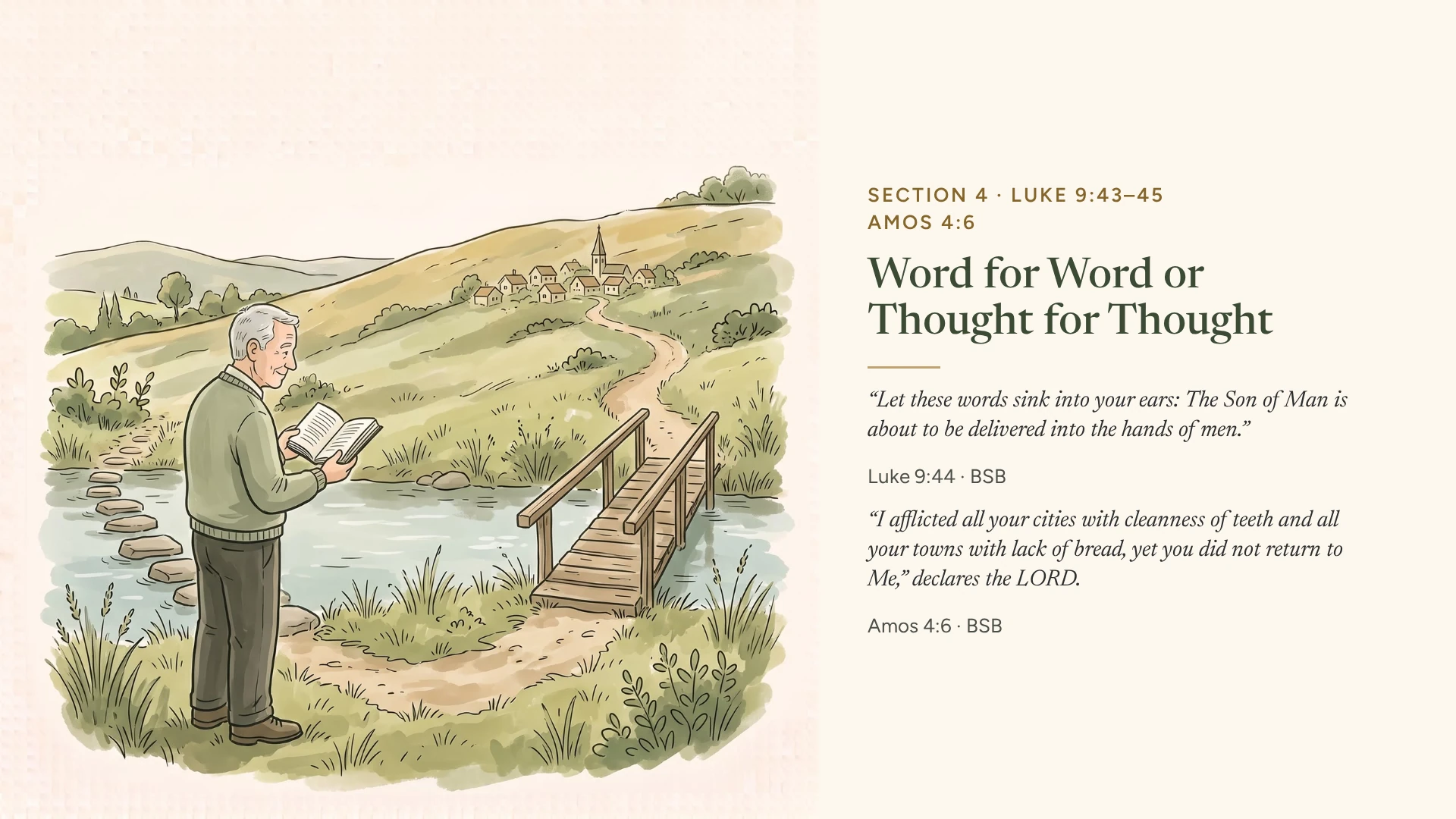
"No two languages line up word for word. So every translation has to decide how closely to follow the original wording. Some stay as close to the words as English allows. Others carry over the meaning in natural English. The textbook gives a warning worth remembering: 'literal' doesn't necessarily mean 'accurate.' By literal it means word for word, which is different from the Literal guardrail you learned in Abide 101. Both kinds of translation can be faithful."
(45-minute only) Ask a volunteer to read Luke 9:43–45 aloud:
And they were all astonished at the greatness of God. While everyone was marveling at all that Jesus was doing, He said to His disciples, “Let these words sink into your ears: The Son of Man is about to be delivered into the hands of men.” But they did not understand this statement. It was veiled from them so that they could not comprehend it, and they were afraid to ask Him about it. (Luke 9:43–45, BSB)
Both lengths: say this verbatim:
"'Let these words sink into your ears' (Luke 9:44, BSB) keeps the picture in the Greek. The NIV gives the meaning instead: 'Listen carefully to what I am about to tell you' (Luke 9:44, NIV). The Old Testament has idioms too. Amos speaks of 'cleanness of teeth' (Amos 4:6, BSB), and the rest of the verse explains it: 'all your towns with lack of bread' (Amos 4:6, BSB). Teeth stay clean when there's nothing to eat. Look at the table on your handout: the word-for-word Bible keeps the picture, and the thought-for-thought Bible hands you the meaning."
Say this verbatim:
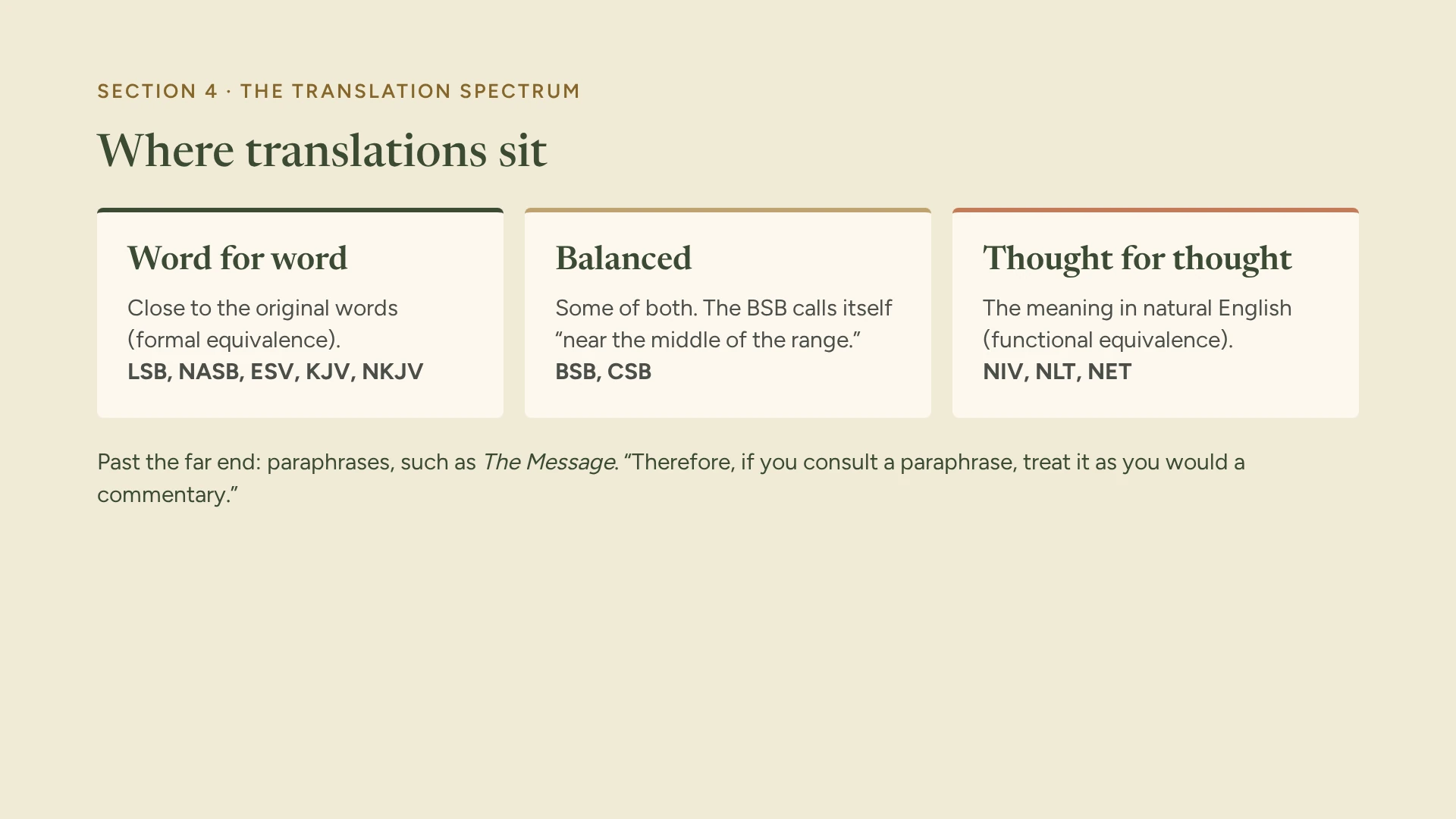
"Picture a line, called the translation spectrum. At one end, word for word. At the other, thought for thought. In between, balanced translations that do some of both. The BSB, which our course quotes, calls itself 'near the middle of the range.' Where does your Bible sit?"
(45-minute only) Say:
"Past the far end of the spectrum are paraphrases, like The Message, which retell the Bible freely in modern speech. They can be refreshing, but the textbook's advice is wise: 'Therefore, if you consult a paraphrase, treat it as you would a commentary.'"
Say this verbatim:
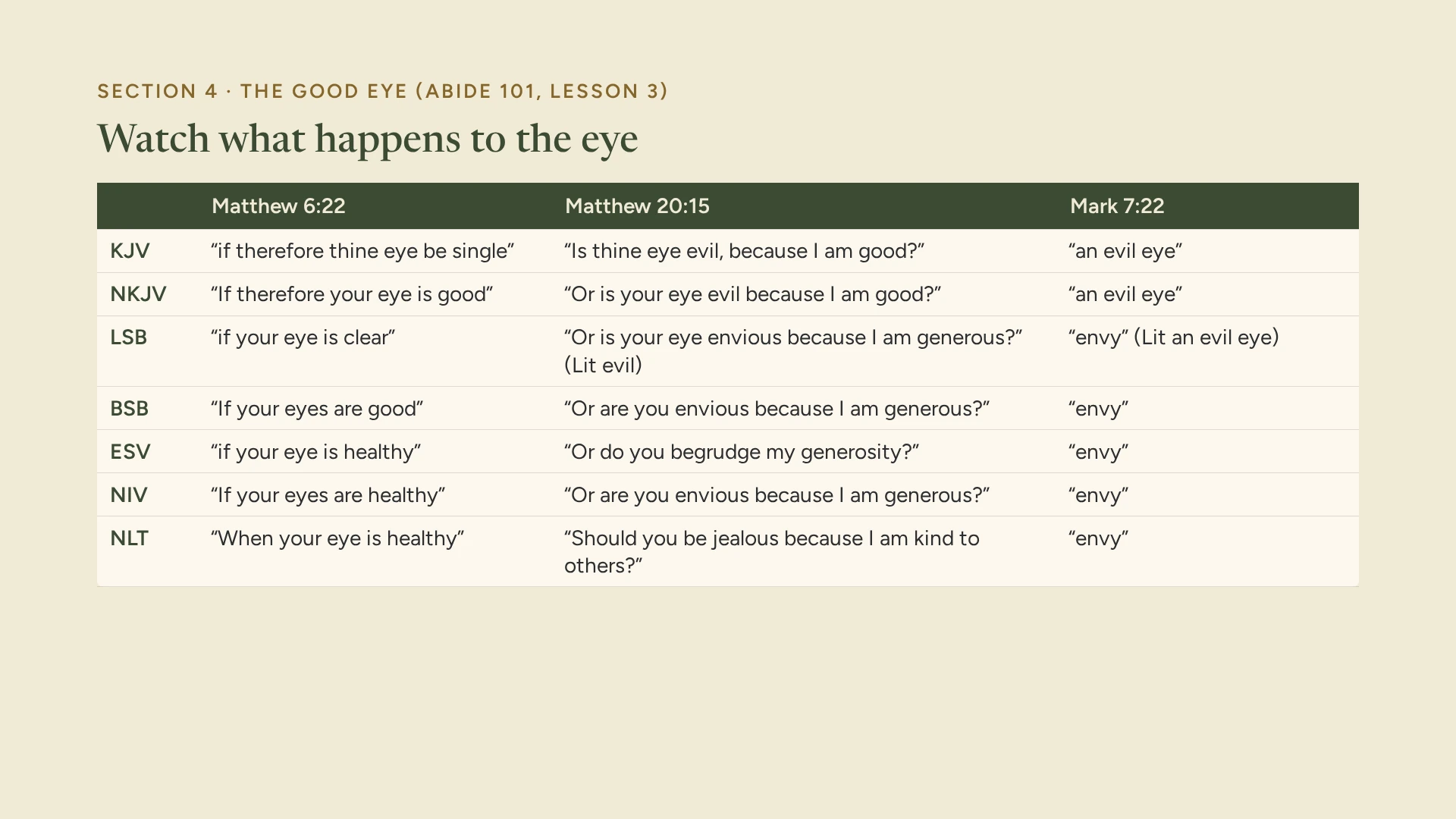
"Remember the good eye from Abide 101? In the Hebrew way of speaking, a good eye meant generosity, and a bad or evil eye meant stinginess or envy. Jesus uses that idiom in two passages of Matthew, and it shows up again in Mark. Watch what happens to the eye."
"The KJV and NKJV keep the eye every time, so you can watch the same picture come back in all three verses. That's one of many reasons to love these translations. The LSB keeps the eye in both Matthew passages and puts the literal words in its footnotes. The BSB keeps the picture in Matthew 6 but gives the meaning in Matthew 20 and Mark 7. With the BSB alone, you'd never see that the three verses share one idiom. The ESV, NIV and NLT give the meaning in Matthew 20 and Mark 7, but in Matthew 6 they turn the eye into eyesight."
"Each of these is a faithful translation, and none of them shows you everything. Read a translation that keeps the words beside one that gives the meaning, check the footnotes, and you'll see the picture and its meaning together."
Section 5 · Psalm 8:3–6 · The Same Words, Read Two Ways
(45-minute only) Ask a volunteer to read Psalm 8:3–6 aloud:
When I behold Your heavens, the work of Your fingers, the moon and the stars, which You have set in place—what is man that You are mindful of him, or the son of man that You care for him? You made him a little lower than the angels; You crowned him with glory and honor. You made him ruler of the works of Your hands; You have placed everything under his feet: (Psalm 8:3–6, BSB)
Both lengths: say this verbatim:
"Sometimes a word in the original could mean more than one thing. The BSB says God made man 'a little lower than the angels' (Psalm 8:5, BSB). On your handout you'll see the ESV says heavenly beings, and the NLT says God. The reason is one Hebrew word, elohim. It's one of the most common words for God, but it can also refer to other heavenly beings, and here the context could point either way."
"The translators couldn't leave the Hebrew word on the page, so they chose, and many give the other option in a footnote. The textbook says, 'Clearly, any of the three translation choices could work, and a good argument can be made lexically and contextually for any of them.' And the New Testament helps: Hebrews applies this psalm to Jesus, 'who was made a little lower than the angels' (Hebrews 2:9, BSB). Scripture helps explain Scripture."
Section 6 · Colossians 1:13–14 · Ephesians 1:7 · Different Manuscripts, and Why We Can Trust Them
Say this verbatim:
"Before anyone can translate the Bible, they have to know what the Hebrew and Greek say. 'Many English Bible readers don't realize that transmission precedes translation, and the two are quite distinct.' The pages the apostles first wrote are gone. What we have are copies, thousands of them, made by hand. Sometimes the copies differ in small ways."
"Should that worry you? The textbook's answer is reassuring: 'But don't be dismayed; variants are usually exegetically insignificant, and no area of Christian doctrine rests upon a textual variant.' So many copies are a gift, because they can be checked against one another."
(45-minute only) Say:
"English Bibles follow one of three main Greek texts. Most modern translations use a critical text, which weighs all the manuscripts verse by verse. The KJV and NKJV follow the Textus Receptus, the printed Greek text of the 1500s; the name means 'Received Text.' And a few, like the Majority Standard Bible, follow the Majority Text, the reading found in most of the surviving manuscripts."
Both lengths: say this verbatim:
"Look at Colossians 1:14 on your handout. The KJV and NKJV say 'through His blood,' and most modern translations don't. Some people have called modern Bibles 'bloodless.' The real story is less dramatic. The phrase, the textbook explains, 'is found in only a few late New Testament manuscripts yet is represented in the Textus Receptus.' Paul wrote almost the same sentence in Ephesians, and there the phrase is secure: 'In Him we have redemption through His blood' (Ephesians 1:7, BSB). The blood of Christ never left your Bible."
Section 7 · 1 Peter 2:11–12 · English Keeps Changing
Say this verbatim:
"The last reason has nothing to do with Hebrew or Greek. It's about English. A translation made in 1611 used the English of 1611. The KJV reads, 'Having your conversation honest among the Gentiles' (1 Peter 2:12, KJV). Today, 'conversation' means talking. But the Greek word behind it 'does not infer verbal communication, but rather the broader elements of human conduct and behavior.' Peter meant their way of life."
(45-minute only) Say:
"Some changes are funnier. The KJV opens 2 Corinthians 8 with 'Moreover, brethren, we do you to wit of the grace of God bestowed on the churches of Macedonia' (2 Corinthians 8:1, KJV). The BSB clears it up: 'Now, brothers, we want you to know about the grace that God has given the churches of Macedonia' (2 Corinthians 8:1, BSB)."
Both lengths: say this verbatim:
"None of this is a knock on the King James Version. It has fed English-speaking Christians for four centuries. And its own translators encouraged comparing. In their preface to the 1611 Bible they wrote, 'Therefore, as S. Augustine saith, that variety of Translations is profitable for the finding out of the sense of the Scriptures.'"
Section 8 · Acts 2:5–11 · What's in Your Translation Toolbox?
(45-minute only) Ask a volunteer to read Acts 2:5–11 aloud:
Now there were dwelling in Jerusalem God-fearing Jews from every nation under heaven. And when this sound rang out, a crowd came together in bewilderment, because each one heard them speaking his own language. Astounded and amazed, they asked, “Are not all these who are speaking Galileans? How is it then that each of us hears them in his own native language? Parthians, Medes, and Elamites; residents of Mesopotamia, Judea and Cappadocia, Pontus and Asia, Phrygia and Pamphylia, Egypt and the parts of Libya near Cyrene; visitors from Rome, both Jews and converts to Judaism; Cretans and Arabs—we hear them declaring the wonders of God in our own tongues!” (Acts 2:5–11, BSB)
Both lengths: say this verbatim:
"Think of translations not as competitors but as tools. A carpenter doesn't own one tool and use it for every job. At Pentecost, God didn't make the crowd learn one language before they could hear Him. By His Spirit, each one heard 'in his own native language' (Acts 2:8, BSB). Every faithful translation carries on that work. The many translations on the shelf are evidence of how much God wants to be understood."
Say this verbatim:
"Here's the lesson on one page: the Translation Map. Across the top, the spectrum: word for word, balanced, thought for thought, and the Hebraic voice of the Messianic Jewish translations. Down the side, the Greek text: the critical text, the Majority Text, and the Textus Receptus. Find your Bible on the map. The BSB, which we quote, sits near the middle."
"Now here's how to use it. Keep a Bible you love. For study, open three or four from different columns, one close to the words and one that carries the flow of thought, and at least one from a different row, so you notice when the Greek text itself differs. The same map is on your Translation Toolbox sheet, so you can take it home."
Say this verbatim:
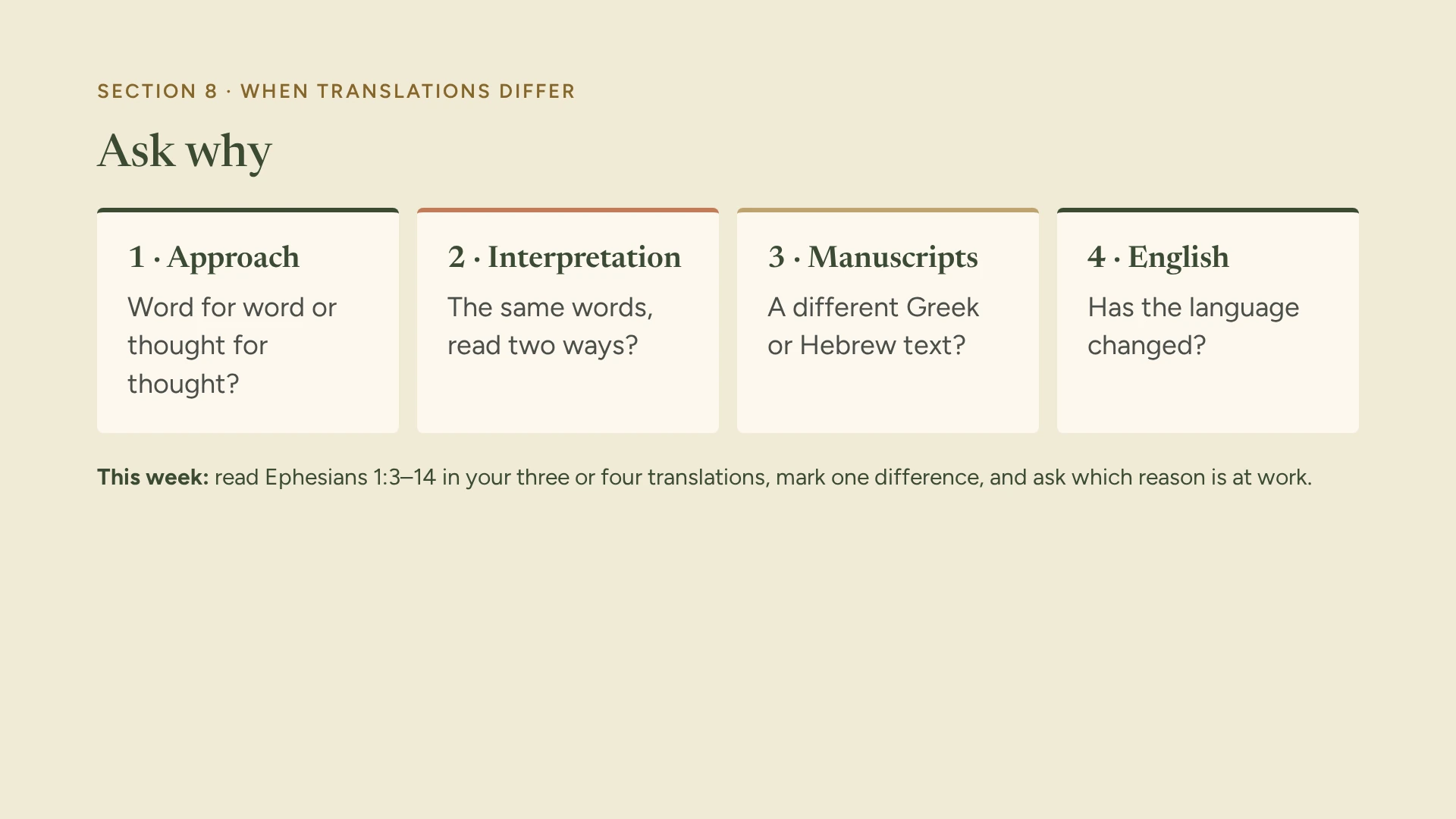
"When translations differ, ask why. Is it the approach, word for word or thought for thought? Is it the interpretation, the same words read two ways? Is it the manuscripts, a different Greek or Hebrew text? Or has the English changed? A small difference you can enjoy and move on. A big difference becomes one of your questions for the passage."
(45-minute only) Say:
"Your handout shows two sets to start with: a Scholar's Set and a Devotional and Discipleship Set. You don't need all of them. Pick three or four, from different parts of the map."
The Close
Say this verbatim:
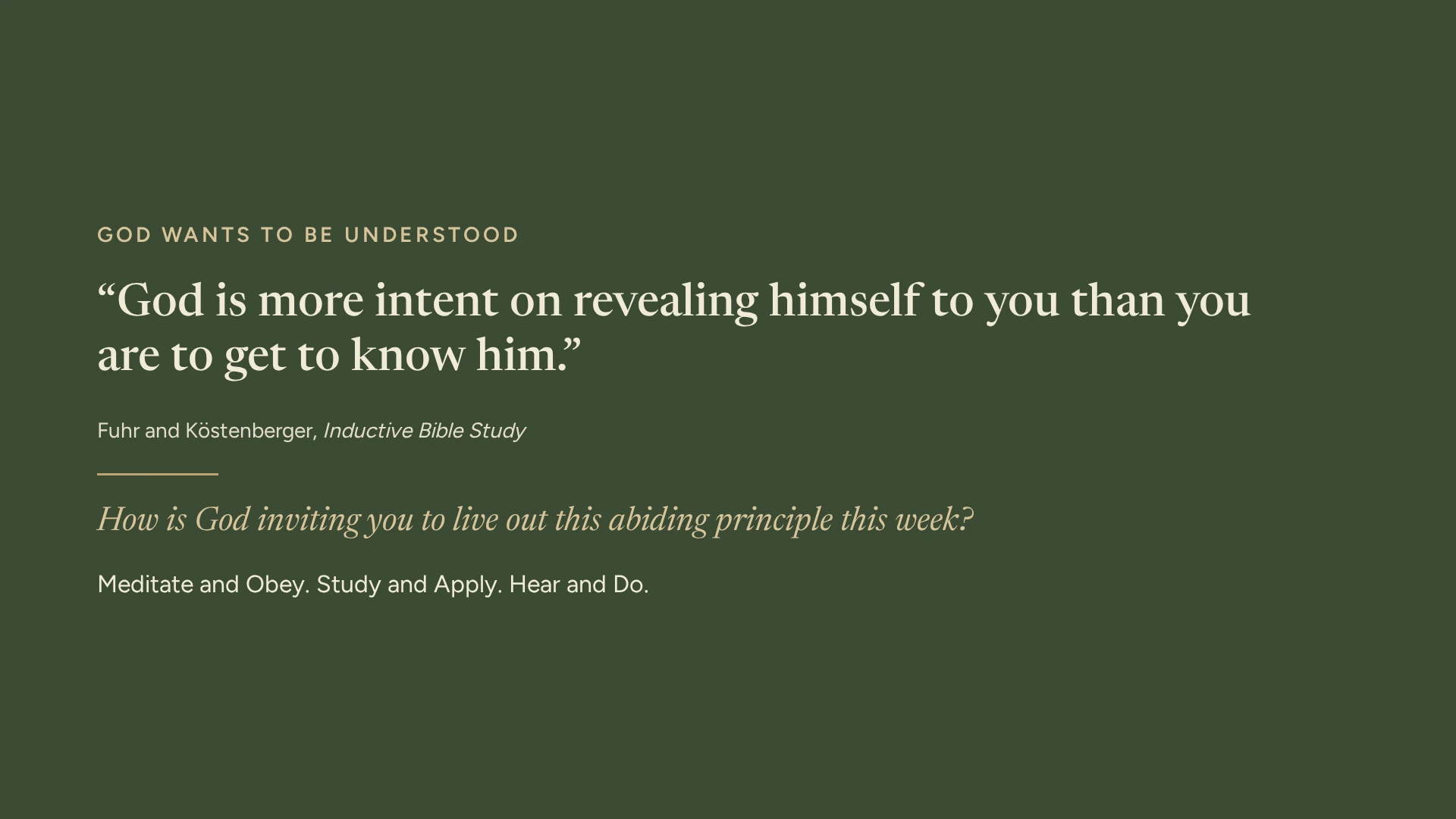
"Our textbook says it this way: 'God is more intent on revealing himself to you than you are to get to know him.' Jesus promised the one who loves Him and keeps His commandments, 'I will love him and reveal Myself to him' (John 14:21, BSB). So open your Bible, open two or three more beside it, and ask the Author to guide you."
"So here is the question we ask at the end of every lesson: How is God inviting you to live out this abiding principle this week?"
(Pause.)
"On your handout, write one step. Here's one I'd suggest: choose your three or four translations, read Ephesians 1:3–14 in all of them, mark one place where they differ, and ask which of the four reasons is at work."
"Let's say them together: Meditate and Obey. Study and Apply. Hear and Do. This is how we abide in Christ. This is how we demonstrate our love for God."
"Let's pray. Father, thank You that You want to be understood, and that You have given us Your Word in our own language. Thank You for the people who carried it to us. Guide us as we read, and make us doers of what we hear. In Jesus' name, amen."
Discussion Prompts
Use these after the teaching or in small groups. Choose two or three based on the time you have.
- Have you ever felt uneasy when two Bibles read differently? What helps you now?
- Which Bible do you read most, and why? Where does it sit on the Translation Map?
- Which of the four reasons was new to you?
- In the good-eye table, what did you notice when you read across the rows?
- Peter's readers lived as "foreigners and exiles" (1 Peter 2:11, BSB) among neighbors who slandered them. What does honorable conduct look like where you live and work this week?
Optional Homework
Assign one or both before the next session:
Reading Assignment: Read the full lesson page on your own; it covers more than we had time for today. Then read the preface of the Bible you use most, and note where it sits on the spectrum and which Greek text it follows.
Application Assignment: Choose your three or four translations from different parts of the Translation Map. Read Ephesians 1:3–14 in all of them, mark one place where they differ, and write which of the four reasons is at work.
Scripture quotations marked Berean Standard Bible (BSB) or Majority Standard Bible (MSB) are taken from texts that have been dedicated to the public domain. Free resources are available at BereanBible.com and MajorityBible.com.
Scripture quotations marked KJV are from the King James Version, public domain in the United States.
Scripture quotations marked NIV are taken from The Holy Bible, New International Version® NIV® Copyright © 1973, 1978, 1984, 2011 by Biblica, Inc.® Used by Permission of Biblica, Inc.® All rights reserved worldwide.