The Guardrails of Biblical Interpretation
Seven principles that protect how we read God's Word, keeping us on the road to sound interpretation and off the cliff of misuse.
The Workman's Invitation
Have you ever opened your Bible, read a passage, and walked away unsure whether you understood it correctly? Or perhaps you have heard someone teach a verse in a way that seemed off, but you could not quite put your finger on why? You are not alone. Most of us were handed a Bible and told to read it, but no one taught us how.
God had something different in mind. He did not just give us His Word and leave us to figure it out on our own. He gave us a standard, a calling, and the tools to meet it:
15 Be diligent to present yourself approved to God as a workman who does not need to be ashamed, accurately handling the word of truth.
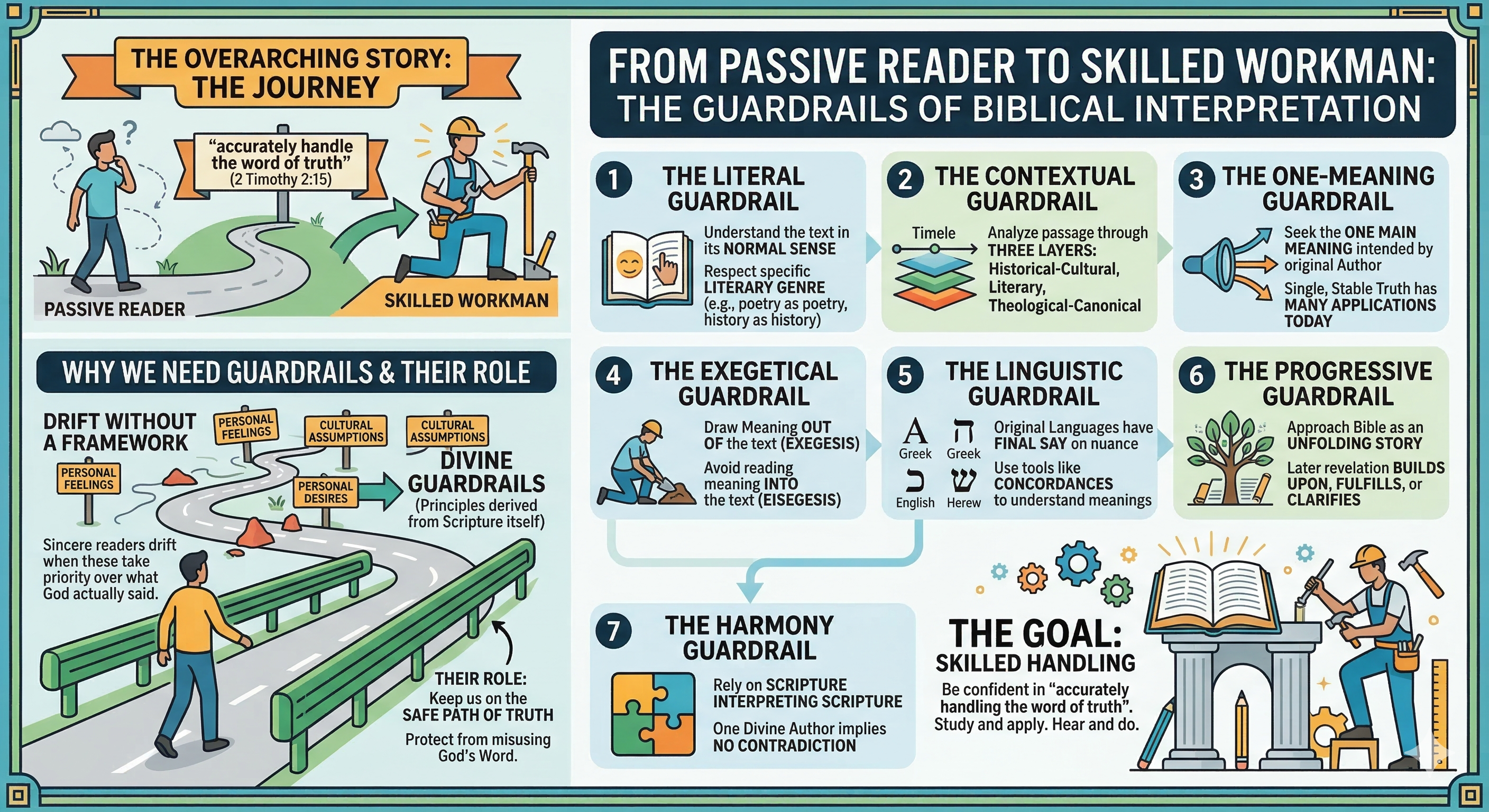
Engage the Text: 2 Timothy 2:15
- What is the primary command Paul gives in this verse?
- What two descriptions define the person who meets that standard?
- What specific phrase describes the workman's goal with God's Word?
- The phrase "accurately handling" literally means "to cut a straight line." Which of the seven guardrails do you think are most essential for keeping that line straight — and why?
- Paul warns against "needing to be ashamed." What kinds of mishandling might produce shame? Can you match one or two of those failures to a guardrail that would have prevented them?
- This verse calls Bible engagement a craft, not just a habit. What does the workman metaphor suggest about the role of practice, humility, and skill in your study life?
- Do you currently feel more like a "workman" or a "passive reader" when you open your Bible? What is the first shift you could make?
- What area of your spiritual life do you most want to feel "approved" in — not before others, but before God?
- What would it look like to be "diligent" in your handling of the Word this week?
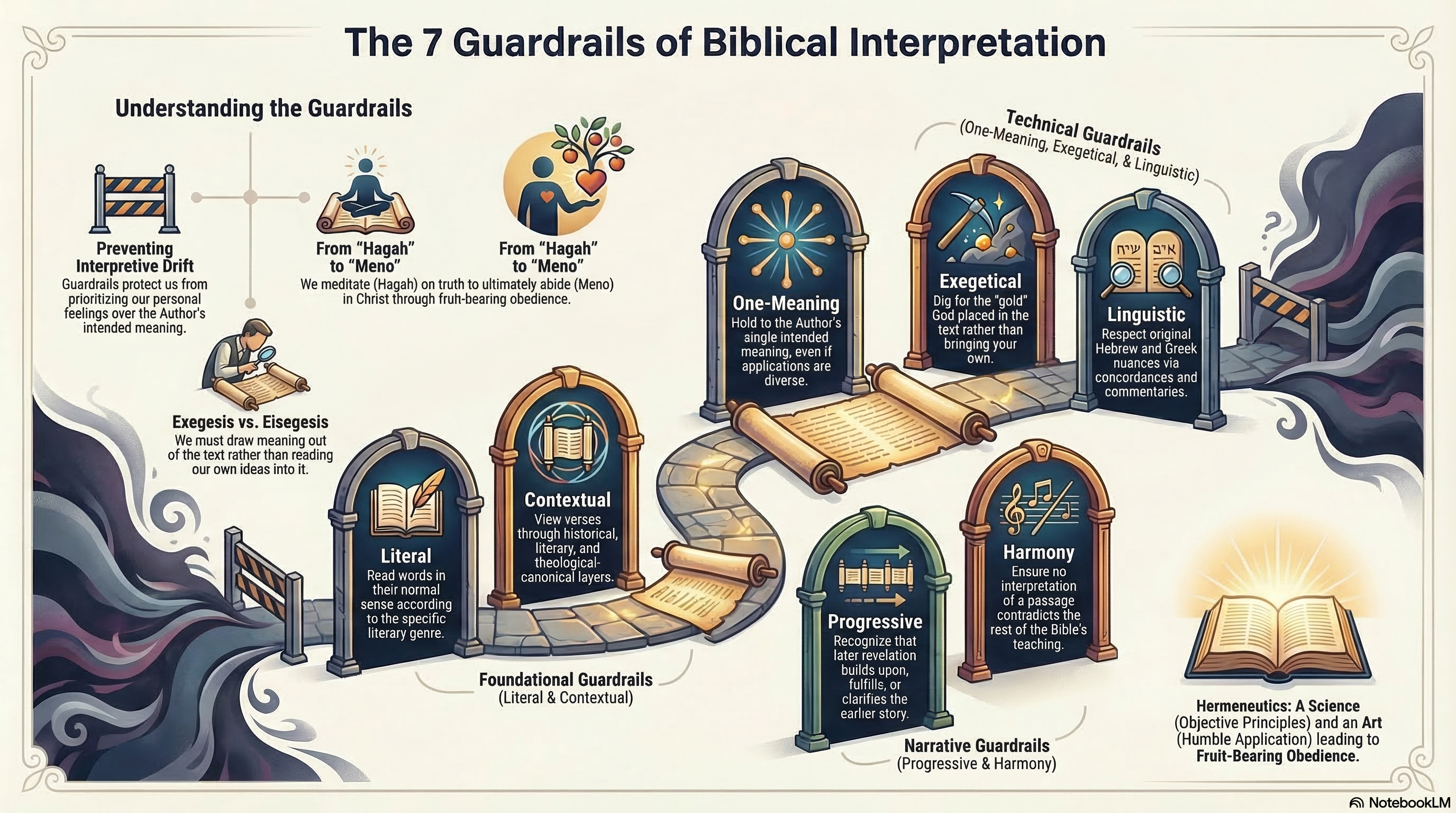
A skilled craftsman does not resent his tools. He values them because they are what make precision possible. Without them, he is guessing. With them, he can build something that lasts. The same is true for us. We are invited to a life where we Meditate & Obey, Study & Apply, and Hear & Do. This is not a burden. It is an invitation into the deep joy of knowing God through His Word.
The Hebrew word for meditate is Hagah, translated as "meditate," but literally meaning "to mutter" or "to muse." Unlike Eastern meditation, which seeks to empty the mind, biblical Hagah fills the mind with truth, turning it over again and again until it moves from the head down into the heart. The Psalmist knew this joy well:
1 How blessed are those whose way is blameless, Who walk in the law of Yahweh. 2 How blessed are those who observe His testimonies, They seek Him with all their heart.
Just as a highway uses guardrails to keep travelers safe from the surrounding terrain, God has given us specific guardrails designed to keep our feet on the path of truth and our hearts in the posture of a disciple.
The shift from passive reader to skilled workman begins with one honest question: Am I reading the Bible, or am I letting the Bible read me? The guardrails ahead are not restrictions. They are the tools that make precision — and the joy that comes with it — possible.
Why We Need Guardrails
Without a framework, even the most sincere reader will eventually drift. Drift happens when we, without realizing it, prioritize our personal feelings, cultural assumptions, or what we want the text to say over what it actually says. The result is not Bible study; it is a conversation with ourselves.
Scripture addresses this directly. The apostle Peter, reflecting on the prophetic Word of God, reminds us:
20 Know this first of all, that no prophecy of Scripture comes by one's own interpretation.
Scripture does not bend to our private readings. It has a meaning placed there by its Author, and our calling is to receive that meaning faithfully, not to create it. These guardrails are the principles that protect us in that effort, helping us distinguish between what God is saying and what we are projecting.
Biblical interpretation is sometimes called Hermeneutics, understood as both a science and an art. It is a science because it rests on consistent, objective principles. It is an art because applying those principles well takes practice and humility. In this course, we use Inductive Bible Study as the proven method for working through them.
At the foundation of all this is the nature of the Word itself. We handle the Bible with unique care because it is Theopneustos, literally "God-breathed":
16 All Scripture is God-breathed and profitable for teaching, for reproof, for correction, for training in righteousness,
Because this Word comes from the breath of the Creator, how we listen matters. These guardrails are how we listen well.
Engage the Text: 2 Peter 1:20 and 2 Timothy 3:16
- In 2 Peter 1:20, what does Peter say prophecy of Scripture does not come from?
- In 2 Timothy 3:16, what word describes the origin of Scripture? What four purposes follow?
- In what order does Paul list the four purposes? Note whether they move from diagnosis to restoration.
- Peter says no prophecy comes by "one's own interpretation." Which guardrail does this verse most directly support? How does the verse itself illustrate why that guardrail exists?
- If Scripture is Theopneustos — breathed out by God — what does that tell us about whether we bring meaning to the text or receive meaning from it? Which guardrail does that distinction describe?
- Consider: a text this authoritative deserves to be handled with care. How does the God-breathed nature of Scripture make the case for having guardrails in the first place?
- Have you ever approached a passage with a conclusion already in mind? What guardrail could protect you from doing that?
- Of the four profitable purposes (teaching, reproof, correction, training), which do you most need the Word to do in your life right now?
- How does knowing that Scripture comes from God's own breath change the posture you bring to your next study session?
The guardrails are not our invention. They flow from the nature of the Word itself — a God-breathed communication with a real, singular Author. Because the meaning is His, our job is to receive it faithfully, not to project our own.
The Literal Guardrail
Respecting God's voice begins with a commitment to take His Word at face value. The Literal Guardrail teaches us to understand the words of the text in their normal, plain sense, honoring the intent of both the human author and the Holy Spirit who inspired him.
Reading the Bible "literally" does not mean reading every passage as if it were a newspaper article. It means reading each passage according to its literary genre. A story is read as a story. A poem is read as a poem. A letter is read as a letter. When we ignore genre, we risk missing the message entirely.
Consider Psalm 19:14, where God is called "my rock and my Redeemer":
14 Let the words of my mouth and the meditation of my heart Be acceptable in Your sight, O Yahweh, my rock and my Redeemer.
We understand intuitively that God is not a literal stone. The genre signals that this is poetry, reaching for a metaphor, conveying that He is the unmoving source of strength and salvation. The Literal Guardrail keeps us from flattening that beauty into something wooden, or from floating it into something vague.
The Literal Guardrail also protects us from over-spiritualizing texts that were meant to be concrete. Take Proverbs 22:6, the familiar verse about training children:
6 Train up a child according to his way, Even when he is old he will not depart from it.
Applying the Literal Guardrail, alongside an awareness of genre, helps us read this as a wisdom principle about the formative power of early instruction, not as a mathematical guarantee of a specific outcome in every case. By respecting what the Author actually said, in the kind of literature He chose to say it, we stay close to His meaning.
Engage the Text: Psalm 19:14 and Proverbs 22:6
- In Psalm 19:14, what two words does the Psalmist use to describe God in the closing line?
- What is the Psalmist asking God to do with the words of his mouth and the meditation of his heart?
- In Proverbs 22:6, what action is commanded, and what outcome is described?
- What genre is Psalm 19? What clues in the text signal that "rock" is a metaphor rather than a geological statement? What does the metaphor actually communicate about God's character that a literal reading would miss entirely?
- Proverbs is a specific genre — wisdom literature. How is a proverb different from a legal statute or a direct promise? How does understanding the genre protect you from applying Proverbs 22:6 as a guarantee and then losing your faith when a grown child walks away?
- If you stripped the Literal Guardrail away and read both passages hyper-literally, ignoring genre, what false conclusions might you reach? Now apply it correctly — what does each verse actually say?
- Is there a passage you have treated as a promise when it may have been wisdom literature, poetry, or prophecy? How would the Literal Guardrail change your reading?
- The Psalmist calls God "my rock." Where in your life right now do you need God to be that unmoving source of strength?
- What is one area of your life where you need wisdom from a principle rather than a guarantee of a specific outcome?
The Literal Guardrail does not flatten the Bible. It honors the creativity and intentionality of its Author. God chose to speak through poetry, wisdom, history, letter, and prophecy — and reading each well, in its own genre, is the doorway to hearing Him accurately.
The Contextual Guardrail
A verse read in isolation is a verse vulnerable to misuse. The Contextual Guardrail is our commitment to read every passage as a member of a larger family. We approach the text through three vital layers:
- Historical-Cultural Context: The world of the Bible, understanding the original audience, their daily life, and their history.
- Literary Context: Reading a verse within its surrounding paragraphs, keeping the full section in view, and respecting its specific genre.
- Theological-Canonical Context: Seeing how a passage fits into the larger story of Scripture, with Christ at the center.
Consider the 23rd Psalm. When we understand what the life of a shepherd in ancient Israel actually looked like, the danger, the sacrifice, the relentless proximity to the flock, the opening declaration "Yahweh is my shepherd" becomes something far richer than a comfort card sentiment. It becomes a bold claim of total dependence on a Protector who gives everything for His sheep.
A Psalm of David. 1 Yahweh is my shepherd, I shall not want. 2 He makes me lie down in green pastures; He leads me beside quiet waters. 3 He restores my soul; He guides me in the paths of righteousness For His name's sake. 4 Even though I walk through the valley of the shadow of death, I fear no evil, for You are with me; Your rod and Your staff, they comfort me. 5 You prepare a table before me in the presence of my enemies; You have anointed my head with oil; My cup overflows. 6 Surely goodness and lovingkindness will pursue me all the days of my life, And I will dwell in the house of Yahweh forever.
Context does not diminish the Word. It reveals how much more is there than we first saw.
Engage the Text: Psalm 23
- List all the images David uses to describe Yahweh's provision and protection across the six verses.
- What does the Psalmist say will "pursue" him in verse 6, and for how long?
- What two tools does the shepherd carry in verse 4? What does the Psalmist say about them?
- Historical-Cultural Layer: A shepherd in ancient Israel faced predators, thieves, treacherous terrain, and extreme weather to protect his flock, and was with the sheep constantly. How does this historical reality change the emotional weight of "I shall not want" (v. 1)? What changes when you read it knowing what kind of shepherd David was?
- Literary Layer: Read verses 1–3 and then verses 4–6. How does the psalm shift in tone and setting? What does that movement from pasture to threat to table tell you about the structure — and the intended encouragement — of the poem?
- Theological-Canonical Layer: In John 10:11, Jesus declares, "I am the good shepherd; the good shepherd lays down His life for the sheep." How does this New Testament passage change what you see in Psalm 23? Who is the Shepherd standing behind David's words?
- Have you ever read Psalm 23 as a comfort card rather than a declaration of costly, total dependence on a Shepherd who is willing to die for you? What changes when you understand the shepherd's role in its historical context?
- Which verse in Psalm 23 speaks most directly to something you are walking through right now?
- How could you practice walking through the three contextual layers this week with another passage you are studying?
Context is not a detour from the text. It is the path into the heart of it. The Contextual Guardrail does not make Bible study more complicated; it makes it more alive.
The One-Meaning Guardrail
In a culture that treats personal interpretation as a right, the One-Meaning Guardrail provides necessary stability. It holds that a Bible passage has one main, correct meaning, specifically the meaning intended by the original author under the inspiration of the Holy Spirit.
This guardrail honors the authority of the Spirit. When we insist that the text can mean "whatever it means to me," we quietly replace the Author with ourselves. The Spirit inspired this Word with purpose and precision. Our calling is to receive that meaning faithfully.
It is helpful to hold two things together clearly:
- Single Meaning: What the text actually said and meant to its original audience.
- Many Applications: How that stable, unchanging truth lives itself out across different lives, cultures, and circumstances today. In Abide we call these timeless truths abiding principles.
The meaning does not change. The applications are wonderfully diverse. By seeking the one meaning, we build our lives on what God actually said, not on what we wished He had said.
The One-Meaning Guardrail is not a restriction on your application; it is protection for your foundation. When God's Word means one thing clearly, it can be trusted absolutely. A text with a thousand meanings has no real authority over anyone.
The Exegetical Guardrail
There is a word that describes the goal of good Bible study: Exegesis, drawing meaning out of the text. Its opposite is Eisegesis, reading meaning into the text. The Exegetical Guardrail is our commitment to dig for the gold God placed in the field, rather than bringing our own jewelry to bury there.
To do this well, we must manage what we bring to the text. We carry two kinds of things with us when we open the Bible:
Our pre-understanding includes our personal biases, cultural assumptions, and preconceived notions. These are things we must hold loosely, willing to let the Word correct them.
Our presuppositions include our foundational convictions: that the Bible is God's inspired Word, and that it is our final authority. These we hold firmly.
The discipline is knowing which is which, and having the humility to let go of the first when it conflicts with what the text actually says.
When we are willing to be changed by the text rather than changing the text to fit us, we become exactly the kind of disciples Paul calls us to be:
1 Therefore I exhort you, brothers, by the mercies of God, to present your bodies as a sacrifice, living, holy, and pleasing to God, which is your spiritual service of worship. 2 And do not be conformed to this world, but be transformed by the renewing of your mind, so that you may approve what the will of God is, that which is good and pleasing and perfect.
If our preferences clash with what the text says, the Exegetical Guardrail calls us to change, not the Bible.
Engage the Text: Romans 12:1–2
- What command does Paul give in verse 1, and what is the stated basis for it?
- In verse 2, what two things does Paul instruct? State both the negative command and the positive one.
- What is the stated purpose of the transformation in verse 2? What does it allow a disciple to do?
- Someone might eisegete verse 2 and claim Paul is teaching personal self-improvement through positive thinking. What does the actual context of Romans reveal about where this transformation comes from? How does careful exegesis correct that reading?
- What "pre-understanding" — a personal bias or cultural assumption — might you carry into this passage that could quietly distort its meaning? Name it specifically if you can.
- Paul says "do not be conformed to this world." Is he speaking about outward behavior, inward thinking, or both? How does careful observation of the text determine the answer — and what would happen to your application if you got it wrong?
- What "worldly conformation" in your life does the Exegetical Guardrail expose when you let this passage say what it actually says, without softening it?
- Is there a conviction from Scripture that you have been quietly reinterpreting to avoid its full force? What would it look like to receive it exegetically — to let God's meaning stand over your preference?
- How does the promise of "approving what the will of God is" motivate you to take the Exegetical Guardrail seriously?
Eisegesis feels comfortable because it confirms what we already believe. Exegesis is uncomfortable because it confronts what we need to change. The Exegetical Guardrail is where humility and Scripture meet — and where real transformation begins.
The Linguistic Guardrail
Our modern translations of the Bible are excellent, faithful gifts. But they are still bridges from the original Hebrew, Aramaic, and Greek, and bridges, by nature, carry us across a gap. The Linguistic Guardrail reminds us that the original languages have the final say on matters of nuance and meaning.
You do not need to be a linguist to apply this guardrail. Simple tools, such as a concordance, a study Bible, a Bible dictionary, or a trusted commentary, can open up depths that are sometimes compressed in translation. As Paul writes:
12 Now we have received, not the spirit of the world, but the Spirit who is from God, so that we may know the depths graciously given to us by God,
God's Word has depths He wants us to find. The Linguistic Guardrail invites us below the surface to hear His voice with greater precision.
Engage the Text: 1 Corinthians 2:12
- What two things are contrasted in this verse — what did we not receive, and what did we receive?
- What is the stated purpose of receiving the Spirit who is from God?
- What word does Paul use to describe the manner in which God has given us these depths?
- The Greek word translated "depths" here is bathos, meaning profound depth or the inmost recesses of something. How does knowing the original word change the weight of what Paul is promising compared to reading a word like "things" or "matters"?
- The word translated "graciously given" shares its root with charis, the Greek word for grace. What does that linguistic connection to grace tell us about God's motivation for revealing Himself to us — and how does that shape how we approach the guardrail itself?
- Paul says the Spirit was given "so that we may know." What does this verse teach us about who our primary teacher is when we sit down to study? How does the Linguistic Guardrail complement, rather than replace, the Spirit's role?
- When was the last time a single word study in Scripture opened up something you had never noticed before? What was it?
- What tool (concordance, study Bible, Bible dictionary) do you have access to that you have not used recently? How could you use it in your next study session?
- Paul says these depths were graciously given to us. How does knowing that God wants you to find them change your confidence when you sit down with a difficult passage?
You do not need to learn Greek or Hebrew to benefit from the Linguistic Guardrail. You just need curiosity and a concordance. The depths of God's Word are not locked away from ordinary disciples — they are treasure He graciously wants you to find.
The Progressive Guardrail
The Bible is not a flat book of timeless rules, all weighted equally, all meant to be applied identically. It is an unfolding story. The Progressive Guardrail holds that later revelation builds upon, fulfills, or clarifies what came before.
A primary example is the progression of dietary instruction across Scripture:
- Genesis 1: Humanity is given a plant-based diet.
- Genesis 9: After the flood, God allows the eating of meat.
- Leviticus: Specific dietary restrictions are given to Israel as part of the Mosaic covenant.
- Mark 7: Jesus declares all foods clean.
This is not contradiction. This is the story moving forward. Understanding this progression keeps us from misapplying laws from an earlier covenant that have been fulfilled in Christ. And Paul affirmed the instructional value of the whole story:
4 For whatever was written in earlier times was written for our instruction, so that through the perseverance and the encouragement of the Scriptures we might have hope.
The whole story is for us. The Progressive Guardrail simply helps us understand where we are in it.
Engage the Text: Romans 15:4
- To what body of writing does Paul refer with "earlier times"?
- What is the stated purpose of what was written in those earlier times?
- What two things does Paul say the Scriptures produce in us — and what is the ultimate result?
- Paul says the "earlier" writings (the Old Testament) were written for "our instruction." How does the Progressive Guardrail help us avoid two errors at once: (a) dismissing the Old Testament as irrelevant now that we have Christ, and (b) applying its covenant laws as if nothing has changed since Leviticus?
- Paul says perseverance and encouragement come "through the Scriptures." How does understanding the progressive nature of Scripture — seeing the whole arc moving toward Christ — increase your hope rather than confuse you?
- Pick one Old Testament passage you have found difficult to apply. How would asking "where does this fit in the story of redemption, and what does it teach about God's character?" help you?
- Is there an Old Testament passage you have been either avoiding (dismissing it as irrelevant) or over-applying (treating it as a direct command for today)? How does Romans 15:4 and the Progressive Guardrail help you find the right balance?
- Where do you need the Scriptures to encourage you toward perseverance right now? What part of the biblical story speaks to that need?
- How does seeing your life as part of God's ongoing story change the way you read both the Old and New Testaments?
The Progressive Guardrail does not divide the Bible into two separate books. It reveals one forward-moving story. The earlier chapters are not obsolete; they are the foundation of everything that follows — and every part was written for you.
The Harmony Guardrail
Because Scripture has one ultimate Author, it carries a unified message. The Harmony Guardrail holds that no interpretation of any passage can contradict the clear teaching of the rest of the Bible. In shorthand: Scripture interprets Scripture.
This is our ultimate safety net. The Bible is its own best commentary. When you encounter a passage that seems confusing or difficult, you do not have to guess its meaning. You look to the portions of Scripture that are already clear and let them shed light on what is unclear. God's Word is not a collection of competing voices; it is one beautiful, coherent conversation that the Spirit has been having with His people across all of history.
The Harmony Guardrail gives you confidence when you feel lost. You never have to build a doctrine on one ambiguous verse when dozens of clear passages speak to the same truth. The Author is not contradicting Himself. He is speaking one Word, in many voices, over many centuries — and it holds together.
The Goal: Abiding in the Vine
These guardrails are not designed to make us academic. They are designed to bring us into something far richer: Meno, the Greek word for "abide." To abide in Christ (John 15:1–11) is to remain close to Him in both faith and practice. It is an intimate, relational staying, confirmed by one thing: fruit-bearing obedience.
5 "I am the vine, you are the branches; he who abides in Me and I in him, he bears much fruit, for apart from Me you can do nothing.
Jesus also promised that as we remain in Him, we would not be left to navigate this alone:
25 "These things I have spoken to you while abiding with you. 26 "But the Advocate, the Holy Spirit, whom the Father will send in My name, He will teach you all things, and bring to your remembrance all that I said to you.
The result of working through these guardrails is the full Hear & Do cycle. When we accurately handle the Word, we do not just accumulate information. We are transformed. And transformation is the fruit Jesus promised to those who remain in His love.
Engage the Text: John 15:5 and John 14:25–26
- In John 15:5, what is the condition for bearing "much fruit"? What absolute statement does Jesus add at the end of the verse?
- In John 14:26, what two specific things does Jesus say the Holy Spirit will do?
- What title does Jesus use for the Holy Spirit in verse 26?
- Harmony Guardrail: Jesus says "apart from Me you can do nothing" (John 15:5). How does this statement connect to what Paul says in Romans 12:2 about transformation coming through "the renewing of your mind"? What unified message emerges when you read these passages together?
- Exegetical Guardrail: The Holy Spirit "will teach you all things." Drawing meaning out of the text (exegesis): what does "all things" actually refer to in this context? How does the phrase "all that I said to you" in the same verse help you interpret that promise accurately rather than over-expanding it?
- Contextual Guardrail: Who is Jesus speaking to in John 14–15 (consider the historical-literary context)? How does identifying the original audience help you rightly receive these promises — neither dismissing them as irrelevant to you, nor claiming them in ways Jesus did not intend?
- The guardrails are tools for staying connected to the Vine. In which area of study do you most need the Holy Spirit's teaching and guidance right now?
- Jesus says the Spirit will "bring to your remembrance all that I said to you." Is there a command or promise of Jesus that has been surfacing repeatedly in your life recently? What is it?
- What fruit do you hope to bear as a result of learning to apply these guardrails in your study life?
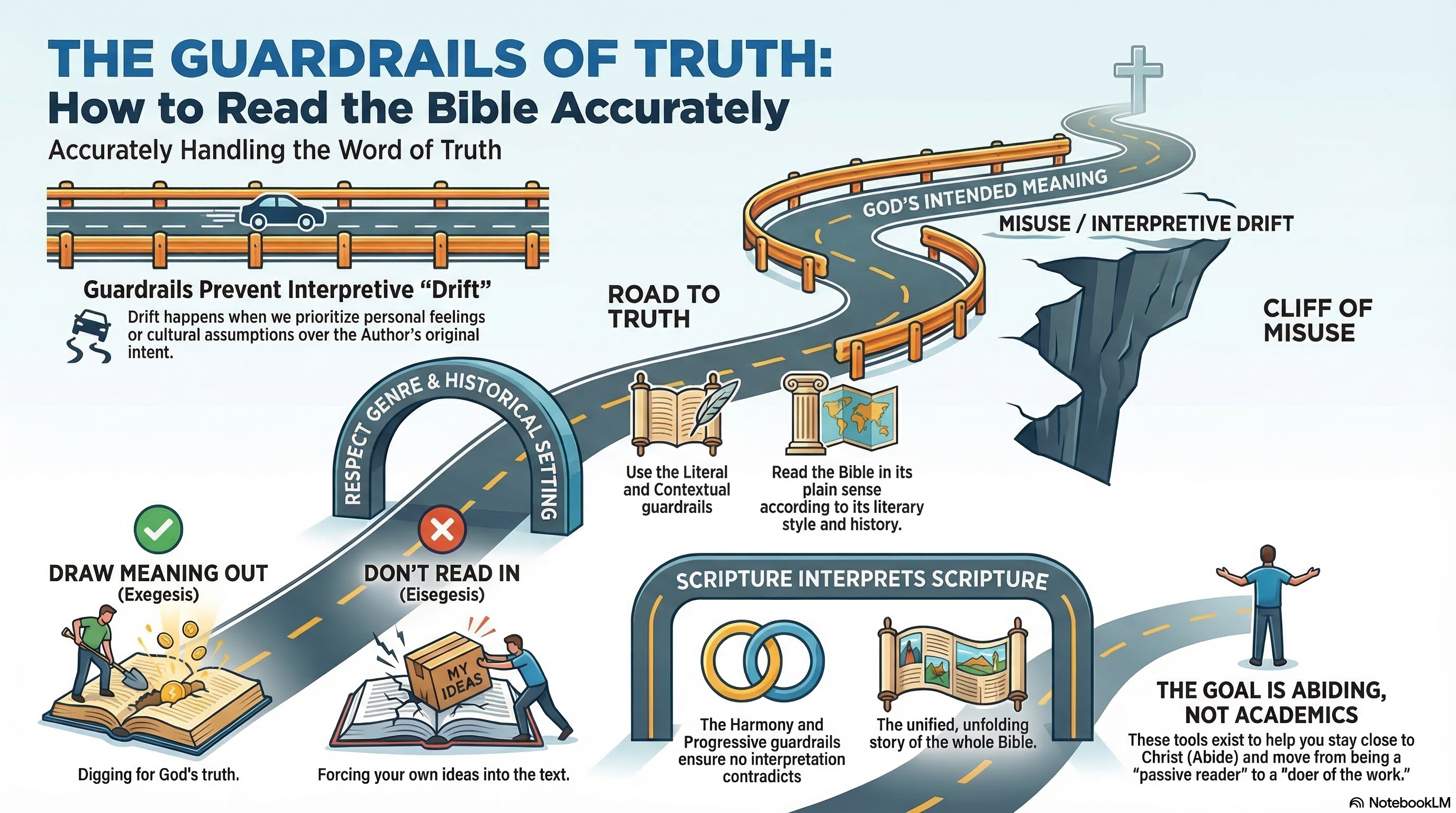
The guardrails are not an end in themselves. They are the road that leads to the Vine. Every principle in this lesson exists to help you stay closer to Jesus — to Meditate and Obey, Study and Apply, Hear and Do. And you are not learning them alone. The Advocate is with you.
Final Invitation: The Blessing of the Doer
God deeply desires to be known by you. He wants to reveal Himself to you more than you want to know Him. That is not a platitude. It is grounded in the very nature of the Word itself:
10 "For as the rain and the snow come down from heaven, And do not return there without watering the earth And making it bear and sprout, And giving seed to the sower and bread to the eater, 11 So will My word be which goes forth from My mouth; It will not return to Me empty, Without accomplishing what pleases Me, And without succeeding in the matter for which I sent it.
He sent His Word to accomplish something in you. He is committed to it.
There is a Hebrew word for the person who lives this way: Ashrei. Often translated as "blessed," it carries an intensity that a single English word cannot hold, "Oh, the blessednesses." It describes the joy, contentment, and flourishing of the person who has built their life on God and His Word.
1 How blessed is the man who does not walk in the counsel of the wicked, Nor stand in the way of sinners, Nor sit in the seat of scoffers!
25 But one who looks intently at the perfect law, the law of freedom, and abides by it, not having become a forgetful hearer but a doer of the work, this man will be blessed in what he does.
As you Study & Apply the Word, remember: the Holy Spirit is your Advocate and Teacher. He will guide you into all truth and empower you to walk in these guardrails. You are not on this road alone.
Engage the Text: Isaiah 55:10–11, Psalm 1:1, and James 1:25
- In Isaiah 55:10–11, what analogy does God use for His Word? What two things does He say His Word will not do?
- In Psalm 1:1, what three places does the blessed man not walk, stand, or sit?
- In James 1:25, what does the "doer of the work" do with "the perfect law, the law of freedom"? What three things does he not become?
- These three passages span centuries and three different genres — prophecy, poetry, and letter. Yet they agree: God's Word accomplishes its purpose, the one who receives it is blessed, and that blessing is tied to obedience. How does the Harmony Guardrail help us recognize this as a unified biblical theme rather than three unrelated passages saying similar things by coincidence?
- Isaiah 55 uses natural imagery (rain, snow, seed). Psalm 1 uses natural imagery (a tree, water). James uses a legal metaphor (the law of freedom). Using the Literal Guardrail, how does identifying each passage's genre shape how you read it — and yet how do they converge on the same truth?
- Using the Progressive Guardrail: Isaiah wrote before the full revelation of Christ, Psalm 1 is ancient Hebrew wisdom, and James writes to the early church after the resurrection. How does reading all three together reveal God's consistent character across time — and show that the promise of blessing for the "doer of the Word" was never a new idea?
- God says His Word "will not return to Me empty." Is there a passage He has sent into your life recently that you have been sitting with but not yet obeying? What would it look like to let it accomplish what He intended?
- The blessed person in Psalm 1 deliberately avoids certain counsel. Whose counsel is most shaping your thinking right now? How does it measure up against God's Word?
- James 1:25 describes looking intently — not glancing, not browsing. What would it mean for you to look intently at one passage of Scripture this week, applying at least one of the guardrails you learned today?
May you find the deep satisfaction and redemptive favor of God, the true Ashrei, as you delight in His Word and walk in His ways. Meditate and Obey. Study and Apply. Hear and Do. This is how we abide in Christ. This is how we demonstrate our love for God.