The Literal Guardrail
How reading the Bible according to its own language — genre, authorial intent, and plain meaning — keeps us close to what God actually said.
The Heart of Abiding: An Invitation to the Word
Our calling as disciples is formed around three essential action pairs: Meditate & Obey, Study & Apply, and Hear & Do. These are not tasks on a checklist. They are the rhythm of a heart that loves God. And just as a young vine will struggle without a structure to cling to, our reading of the Word needs a trellis. In the Abide program, we call these interpretive guardrails. They are not meant to hem us in; they are designed to lift us toward the light so we can bear fruit that lasts.
Before we can read God's Word well, we must understand what it is. Jesus declared it in a single, clear sentence:
17 Sanctify them by the truth; Your word is truth.
This is not a poetic claim. It is the reason every guardrail exists. The Word is not one voice among many competing for our attention, it is truth. And truth, precisely because it is truth, deserves to be received faithfully, on its own terms, in the way its Author intended. That is what the Literal Guardrail protects.
The foundation of all our study — the Word itself, and what it promises to the one who remains in it:
4 Abide in Me, and I in you. As the branch cannot bear fruit from itself unless it abides in the vine, so neither can you unless you abide in Me. 5 I am the vine, you are the branches; he who abides in Me and I in him, he bears much fruit, for apart from Me you can do nothing.
1 How blessed is the man who does not walk in the counsel of the wicked, Nor stand in the way of sinners, Nor sit in the seat of scoffers! 2 But his delight is in the law of Yahweh, And in His law he meditates day and night. 3 And he will be like a tree firmly planted by streams of water, Which yields its fruit in its season And its leaf does not wither; And in whatever he does, he prospers.
Engage the Text: John 15:4–5 and Psalm 1:1–3
- In John 15:4–5, what is the stated condition for bearing "much fruit"? What absolute statement does Jesus add at the end of verse 5?
- In Psalm 1:2, what two things does the blessed man do with the law of Yahweh?
- What image does Psalm 1:3 use to describe the man who meditates on the Word? What specific features of the image does the psalmist highlight?
- Jesus says "apart from Me you can do nothing." Reading this literally and in its genre — a metaphor used during a parable in the Gospel of John — what is the plain force of "nothing"? What happens to the disciple who softens this statement?
- Psalm 1 is poetry. The "tree planted by streams of water" is not a literal tree. What is the literal truth the image is conveying? How does identifying the genre protect you from misreading either the promise or the warning?
- Compare how Jesus describes abiding in John 15 with how the psalmist describes it in Psalm 1. What unified truth emerges when you hold both passages together?
- Where in your life right now do you feel most like a branch that is trying to bear fruit on its own? What would it look like to simply remain?
- The Psalmist's blessed man is described by what he does not do as well as what he does. What counsel or voice are you currently weighing against the Word?
- What is one practice this week that would help you "meditate day and night" on even a single verse?
The guardrails are not a substitute for the Vine, they are the trellis that helps us stay connected to it. Every tool we learn in this series exists for one purpose: to help us hear God's voice more clearly so we can abide in His love more deeply.
The Literal Guardrail: Taking God at His Word
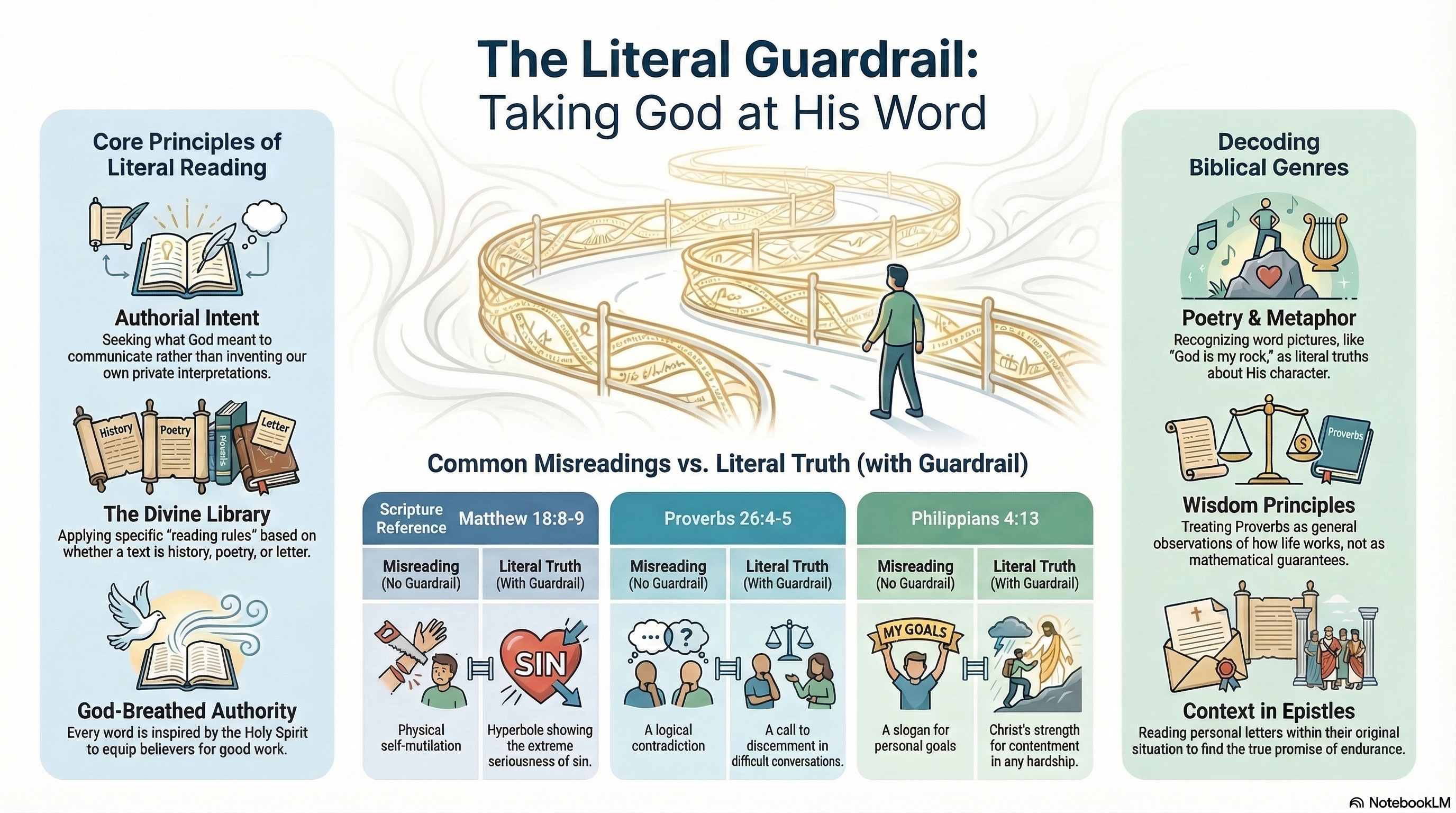
The Literal Guardrail means we take the Bible's words at face value to find the author's intended meaning, even when figurative language is used. Taking God at His Word is an act of trust and honesty. It means we stop trying to make the Bible say what we want it to say and instead humbly ask what He meant to communicate.
Reading the Bible "literally" does not mean reading every passage as if it were a newspaper article. It means reading each passage according to its literary genre. A story is read as a story. A poem is read as a poem. A letter is read as a letter. We seek the author's intended meaning, which requires us to understand the type of literature we are engaging with.
Why does this matter so much? Because of what this Word is:
16 All Scripture is God-breathed and profitable for teaching, for reproof, for correction, for training in righteousness, 17 so that the man of God may be equipped, having been thoroughly equipped for every good work.
20 Know this first of all, that no prophecy of Scripture comes by one's own interpretation.
Because every word of Scripture is God-breathed, it carries the authority and precision of its Author. Because no passage comes by private interpretation, the meaning does not belong to us to invent. The Author placed it there. Our calling is to find it. The Literal Guardrail is how we do that faithfully.
Consider Psalm 19:14, where God is called "my rock and my Redeemer":
14 Let the words of my mouth and the meditation of my heart Be acceptable in Your sight, O Yahweh, my rock and my Redeemer.
We know intuitively that God is not a literal stone. The genre signals that this is poetry, reaching for a metaphor that conveys something the psalmist cannot express any other way: God is the unmoving, unbreakable source of strength and salvation. The literal truth — that He is solid, utterly dependable — is found precisely through the figurative language of rock.
The Literal Guardrail also protects us from the opposite error: over-spiritualizing texts that were meant to be concrete. Consider Proverbs 22:6, the familiar verse about training children:
6 Train up a child according to his way, Even when he is old he will not depart from it.
Applying the Literal Guardrail, and an awareness of genre, helps us read this as a wisdom principle about the formative power of early instruction, not as a mathematical guarantee of a specific outcome in every case. We read a proverb as a proverb.
Engage the Text: Psalm 19:14 and Proverbs 22:6
- In Psalm 19:14, what two words does the psalmist use to describe God in the closing line?
- What is the psalmist asking God to evaluate, and what standard is he asking God to apply?
- In Proverbs 22:6, what action is commanded, and what long-term outcome is described?
- What genre is Psalm 19? What clues in the text signal that "rock" is a metaphor rather than a geological statement? What does the metaphor actually communicate about God's character that a hyper-literal reading would miss entirely?
- Proverbs is wisdom literature. How is a proverb different from a legal statute or a direct promise? How does understanding the genre protect you from applying Proverbs 22:6 as a guarantee, and then losing your faith when a grown child walks away?
- If you stripped the Literal Guardrail away and read both passages without regard for genre, what false conclusions might you reach? Now apply it correctly — what does each passage actually say?
- Is there a passage you have treated as a promise when it may have been wisdom literature, poetry, or prophecy? How would the Literal Guardrail change your reading?
- The psalmist calls God "my rock." Where in your life right now do you need God to be that unmoving source of strength?
- What is one area of your life where you need a wise principle to navigate by rather than a guaranteed outcome?
The Literal Guardrail honors the creativity and intentionality of its Author. God chose to speak through poetry, wisdom, history, letter, and prophecy — and reading each well, in its own voice, is the doorway to hearing Him accurately.
The Divine Library: Understanding Genre
To read the Bible well, we must remember that it is a divine library. If you walked into a library and picked up a volume of poetry, you would not read it with the same expectations you bring to a history textbook or a personal letter. Each section of Scripture carries its own "reading rules," and honoring those rules is how we honor the Holy Spirit who inspired them.
Here is how the Literal Guardrail applies across the different rooms of God's Word:
- History: Ask "What actually happened?" and trust the account as a literal foundation for your faith. Historical narrative is meant to be received as fact, not allegory.
- Poetry: Look through the vivid word pictures to find the literal emotional or spiritual truth the author is conveying. The image is the vehicle; the truth it carries is the destination.
- Wisdom / Law: Approach these as divine instruction: designed by God to set His people apart and to show how life works when lived His way. Read proverbs as principles, not promises.
- Parable: Seek the central point of the lesson Jesus is teaching. Parables are stories meant to illustrate a deeper spiritual reality. Press for the main truth rather than allegorizing every detail.
- Epistle (Letter): Treat as personal, situational correspondence. Ask "Who was this written to, and why?" The answers unlock the intended instruction.
By reading "a story as a story" or "a letter as a letter," we honor the Author and protect ourselves from turning a general wisdom principle into an unbreakable promise, or a poetic expression into a scientific formula. This kind of reading is not casual. It is the posture of someone who actively seeks:
1 My son, if you will receive my words And treasure my commandments within you, 2 To make your ear pay attention to wisdom, Incline your heart to discernment; 3 For if you call out for understanding, Give your voice for discernment; 4 If you seek her as silver And search for her as for hidden treasures; 5 Then you will understand the fear of Yahweh And find the knowledge of God.
The hidden treasures are there — buried in the right reading of the right genre. They require silver-seeker effort, not tourist browsing. Understanding the divine library is the beginning of that search.
Genre is not a technicality. It is the Author's chosen form of communication. When we respect it, we are not applying a rule of scholarship — we are showing respect for the way God decided to speak.
Practice Case 1: The Parable
Our Lord Jesus often used word pictures to break through our passivity. He used shocking, even alarming language to help us see the weight of our choices and the beauty of the Kingdom.
8 "And if your hand or your foot causes you to stumble, cut it off and throw it from you; it is better for you to enter life crippled or lame, than, having two hands or two feet, to be cast into the eternal fire. 9 "And if your eye causes you to stumble, tear it out and throw it from you. It is better for you to enter life with one eye, than, having two eyes, to be cast into the fiery hell."
If we ignore the Literal Guardrail and read these words without regard for genre, we might conclude that Jesus is commanding physical self-mutilation. But the Literal Guardrail tells us Jesus is using hyperbole — vivid exaggeration — to reveal a literal, urgent truth. Jesus is not asking for your hand or your eye. He is asking for your radical, unsentimental obedience. He is saying that sin is so destructive, so costly to your relationship with God, that no sacrifice required to deal with it is disproportionate.
Engage the Text: Matthew 18:8–9
- What two body parts does Jesus single out in these verses? What does He say about each one?
- What two eternal destinations does Jesus contrast across both verses?
- What phrase does Jesus repeat across both verses to state His core point?
- What genre is this passage? What clues in the text and surrounding chapters signal the genre? How does identifying the genre determine whether Jesus is speaking literally or hyperbolically?
- What would happen if you removed the Literal Guardrail and read this passage without genre awareness? What false conclusion would you reach? What true conclusion would you miss?
- The literal truth Jesus is communicating is about the seriousness of sin. How does this meaning, arrived at through the guardrail, produce a more urgent and accurate application than a hyper-literal or dismissive reading would?
- Is there a sin in your life that you have been treating as a minor inconvenience rather than the grave threat Jesus describes here? What would "radical steps to remove it" actually look like for you?
- Jesus pairs the warning with a promise: entering life is the goal. How does keeping both the warning and the promise in view shape your motivation for obedience?
- What area of your spiritual life has grown numb to the urgency Jesus is communicating here? What would it look like to take it seriously this week?
Hyperbole is not exaggeration for its own sake. It is a tool of love — a way of saying: this matters more than you may realize. The Literal Guardrail helps us hear the urgency Jesus intended without retreating into either self-harm or indifference.
Practice Case 2: The Proverb
Wisdom literature offers "sketches" of how life usually works — general principles for navigating well, rather than binding promises that hold in every case. One of the most striking examples is a pair of proverbs that appear to directly contradict each other:
4 Do not answer a fool according to his folly, Lest you yourself also be like him. 5 Answer a fool according to his folly, Lest he be wise in his own eyes.
At first glance, these verses seem to cancel each other out. But wisdom literature does not work like legal statutes. A proverb is a principle forged from observation of how life works, not a rule that applies identically to every situation. The Literal Guardrail helps us see that these are not competing commands but two sides of the same coin of discernment.
The two proverbs give us both sides of a real tension:
- If answering a fool in kind will only pull you down to their level, stay silent.
- If silence will only inflate their arrogance and confirm their folly, speak up.
The key is that the decision must be made for the benefit of the other person, not to satisfy your own need to be right.
Engage the Text: Proverbs 26:4–5
- What negative outcome does verse 4 warn about if you do answer a fool?
- What negative outcome does verse 5 warn about if you do not answer a fool?
- What single word links both proverbs in their framing of "the fool"?
- How is wisdom literature different from law or prophecy? Why does identifying this genre change how you read an apparent contradiction between two adjacent verses?
- If you read both verses as binding, universal rules without the guardrail, you face an impossible contradiction. How does the Literal Guardrail resolve the tension without canceling either verse?
- The literal message of both verses together is a call to discernment. What is the guardrail protecting you from at both ends — from reckless confrontation on one side and cowardly silence on the other?
- Is there a relationship in your life where you are facing a "fool" in the biblical sense — someone who dismisses wisdom? Which proverb applies more directly to your situation right now?
- The deciding factor is what will benefit the other person. How does that standard change your instinctive approach?
- What would it look like to bring this passage into your prayer life before a difficult conversation, asking God which side of the coin applies?
The Literal Guardrail does not produce confusion when two proverbs appear to disagree. It produces clarity — by revealing that the genre calls for wisdom, not a simple either/or. God did not give us a rulebook. He gave us a Word that forms us into the kind of people who can discern.
Practice Case 3: The Epistle
When we read the epistles, we are reading personal letters written to real people in real situations. To find the literal meaning, we must understand the who, when, and why of the letter. Context is the key that unlocks the heart of the message, and nowhere is this more important than one of the most beloved and most misapplied verses in Scripture:
11 Not that I speak from want, for I learned to be content in whatever circumstances I am. 12 I know how to get along with humble means, and I also know how to live in abundance; in any and all things I have learned the secret of being filled and going hungry, both of having abundance and suffering need. 13 I can do all things through Him who strengthens me.
We often encounter Philippians 4:13 on motivational banners and sports jerseys, used as a "superhero" slogan. But the Literal Guardrail demands that we read this as a letter, understand Paul's actual situation, and let the context do its work. Paul was writing from a prison cell, discussing his hard-won ability to be content regardless of whether he was "well-fed or hungry," in "abundance or in need." The phrase "I can do all things" is not a declaration of unlimited human capacity. It is a declaration of contentment under any circumstance — endurance through the strength Christ provides.
When we receive the verse in its literal, contextual meaning, it is transformed from a shallow slogan into a profound promise: the Father's power is sufficient to sustain you not when everything goes your way, but in the valley.
Engage the Text: Philippians 4:11–13
- What word does Paul use in verse 11 to describe what he has learned? What does that word imply about how this quality was acquired?
- What four contrasting circumstances does Paul list in verse 12?
- What does "all things" refer to in the immediate context of verse 13? What things specifically is Paul claiming he can do?
- What genre is Philippians? What does that genre tell you about how to read verse 13? How does treating it as personal, situational correspondence change its plain meaning compared to treating it as a universal promise with no context?
- What does Paul mean by "I can do all things" when you read it in the context of verses 11–12? How does the immediate literary context limit and clarify the scope of "all things"?
- What happens to the promise of verse 13 when it is stripped from its context and turned into a general power claim? What is lost, and what is the person who uses it that way actually missing?
- Is there a circumstance in your life — not a competition to win or a goal to achieve — where you need the endurance Paul is describing? How does the literal meaning of this verse speak to that need more directly than the misapplied version?
- Paul says he "learned" contentment — it was not natural, it was formed through hardship. What difficult circumstance in your life is God using to teach you the same lesson?
- What would it look like to replace a "superhero" reading of this verse with a "valley" reading, and to let that version become your actual comfort?
The Literal Guardrail does not diminish Philippians 4:13. It rescues it. A promise of endurance in any circumstance through Christ's strength is far more powerful for most of our lives than a promise of unlimited capability. When we let the verse say what Paul actually said, we find a truth we can live in.
Walking with the Teacher
The guardrails are tools, and tools require a skilled hand. As you learn to apply the Literal Guardrail, remember that you were never meant to navigate this alone. You have not been handed a set of rules and left to figure them out by yourself. You have been given a Teacher.
25 "These things I have spoken to you while abiding with you. 26 "But the Advocate, the Holy Spirit, whom the Father will send in My name, He will teach you all things, and bring to your remembrance all that I said to you."
Menō — this word for abiding — is not passive. It is an active, intentional remaining close. The Holy Spirit is your Advocate and Teacher, and He delights in guiding you into the truth the Father placed inside His Word. He will open the right genre to your understanding, surface the right context at the right moment, and bring to your memory what you have studied and stored. The guardrails are the structure. The Spirit is the life that flows through them.
And this was always God's design. In the New Covenant, He did not merely leave us a set of rules to apply by effort alone — He promised to write His Word on our hearts and move within us to walk in it:
26 "Moreover, I will give you a new heart and put a new spirit within you; and I will remove the heart of stone from your flesh and give you a heart of flesh. 27 "I will put My Spirit within you and cause you to walk in My statutes, and you will be careful to do My judgments."
13 "But when He, the Spirit of truth, comes, He will guide you into all the truth; for He will not speak from Himself, but whatever He hears, He will speak; and He will disclose to you what is to come."
The Spirit of truth is your guide into all the truth, including the truths hidden inside the right reading of genre, context, and authorial intent. Every time you sit down with a passage and apply the Literal Guardrail, you are partnering with the very One who inspired those words in the first place.
11 Teach me Your way, O Yahweh; I will walk in Your truth; Unite my heart to fear Your name.
The psalmist's prayer is the right posture for every Bible student: Teach me. I will walk. Unite my heart. That three-part rhythm — receiving instruction, committing to obedience, asking for an undivided heart — is Abide in miniature.
Engage the Text: John 14:25–26 and Psalm 86:11
- In John 14:26, what two specific things does Jesus say the Holy Spirit will do?
- What title does Jesus use for the Holy Spirit in verse 26?
- In Psalm 86:11, what three things does the psalmist ask God to do — and what commitment does he place between each request?
- Jesus says the Spirit "will teach you all things." Applying the Literal Guardrail: what does "all things" refer to in this context? How does the phrase "all that I said to you" help you interpret the scope accurately, and protect you from over-expanding the promise?
- Psalm 86:11 uses the phrase "your truth." Applying genre awareness — this is a personal prayer of David, not a doctrinal treatise — what is the literal force of asking to "walk in your truth"? Is this a passive state or an active commitment?
- How do John 14:26 and Psalm 86:11 together describe the relationship between the Spirit's work and the disciple's response? Who does what?
- The guardrails are tools for staying connected to the Teacher. Which area of your study life — observation, genre, context — do you most need the Spirit's help with right now?
- The psalmist asks God to "unite my heart." Is your heart divided in your approach to God's Word — wanting His truth but also holding on to a reading you prefer? What would a "united heart" look like in that area?
- Jesus promises the Spirit will "bring to your remembrance all that I said to you." Is there a command or promise of Jesus that has been surfacing in your life recently? What is it, and what might God be asking you to do with it?
You are not learning the guardrails by intellectual effort alone. The Advocate is with you, ready to make the ancient text alive, the difficult passage clear, and the convicting Word effective. Bring the tools. He will bring the light.
Final Invitation: The Joy of Hearing Him Clearly
The purpose of the Literal Guardrail is not precision for its own sake. It is intimacy. The more faithfully we hear what God actually said, the more closely we can walk with the God who said it.
There is a Hebrew word that describes the life this produces: Ashrei — often translated "blessed," but carrying an intensity a single English word cannot hold: "Oh, the blessednesses." It describes the deep joy, contentment, and flourishing of the person who has built their life on what God actually said, and who walks in it.
The Word we are learning to read carefully is not a burden to carry. It is a gift more valuable than we fully realize:
7 The law of Yahweh is perfect, restoring the soul; The testimony of Yahweh is sure, making wise the simple. 8 The precepts of Yahweh are right, rejoicing the heart; The commandment of Yahweh is pure, enlightening the eyes. 9 The fear of Yahweh is clean, enduring forever; The judgments of Yahweh are true; they are righteous altogether. 10 They are more desirable than gold, even more than much fine gold; Sweeter also than honey and the drippings of the honeycomb.
1 How blessed is the man who does not walk in the counsel of the wicked, Nor stand in the way of sinners, Nor sit in the seat of scoffers! 2 But his delight is in the law of Yahweh, And in His law he meditates day and night.
25 But one who looks intently at the perfect law, the law of freedom, and abides by it, not having become a forgetful hearer but a doer of the work, this man will be blessed in what he does.
28 But He said, "On the contrary, blessed are those who hear the word of God and keep it."
The man who looks intently — not glancing, not browsing — and who takes what he finds there seriously enough to obey it: this man will be blessed. The Literal Guardrail is one of the key tools that makes that kind of intent gaze possible. It trains us to see what is actually there rather than what we wish were there. And it is what is actually there that transforms us.
Engage the Text: Psalm 1:1–2 and James 1:25
- In Psalm 1:1, what three things does the blessed man not do? What do the three verbs — walk, stand, sit — suggest about a progression?
- In Psalm 1:2, what does the blessed man's heart do with the law of Yahweh?
- In James 1:25, what three things does the man not become, and what is the contrasting description of the same man?
- Psalm 1 is poetry; James 1 is an epistle. Yet they arrive at the same truth: the doer of the Word is blessed. Apply the Literal Guardrail to each passage separately — what does each one specifically say, in its own genre? Now consider: what unified biblical principle emerges when you hold them together?
- James 1:25 describes looking intently at "the perfect law, the law of freedom." Apply the Literal Guardrail: in the context of James's letter, who is the audience and what is "the law of freedom" referring to? How does the genre and context protect you from reading this verse as merely referring to Old Testament law?
- Psalm 1 describes a man defined by what he avoids as well as what he practices. How does the Literal Guardrail — reading the poem as a portrait rather than a set of rules — help you receive its wisdom as an invitation rather than a checklist?
- James describes a "forgetful hearer" — someone who encounters the Word but does not let it change them. Is there a truth from this lesson that God has already put in front of you more than once? What would it mean to move from hearing to doing this week?
- The Literal Guardrail helps you look intently rather than glancing. What is one passage you have been glancing at that deserves a longer, more careful gaze?
- The ultimate goal is Ashrei — the deep blessedness of the person who walks in what God actually said. What is one step you could take today toward that kind of life?
The Literal Guardrail is not the destination. It is the road. Every principle in this lesson exists to bring you closer to Jesus — to Meditate and Obey, Study and Apply, Hear and Do. And the Teacher walks with you every step of the way.