The Contextual Guardrail
How reading every passage within its surrounding text, its historical world, and God's larger story keeps us close to what God actually meant.
The Heart of Abiding: An Invitation to the Word
Have you ever clipped a verse out of your Bible, built a whole expectation on it, and then felt confused or quietly let down when life did not unfold the way you expected? Perhaps it was a promise about receiving the desires of your heart. Perhaps it was a command that seemed to speak directly to your situation, until someone gently pointed out that the verses around it were telling a different story. Most of us have been there, not out of carelessness, but out of eagerness. We love God's Word. We want to live in it. But wanting to live in it is not the same as knowing how to read it well.
The Word we are called to abide in is not a collection of fortune-cookie insights designed to be sampled one by one. It is a living document with real authors, real audiences, real history, and one great unified story with Jesus at its center. To hear what God actually said, we must learn to read His Word on its own terms.
Paul reminds us of this with a promise that changes how we approach every page of Scripture:
4 For whatever was written in earlier times was written for our instruction, so that through the perseverance and the encouragement of the Scriptures we might have hope.
Notice what Paul is saying: writings composed for people in very different times and circumstances were written for our instruction. Not merely for theirs. For ours. But to receive that instruction faithfully, we must understand the world in which those words were first spoken, the literary form in which they were delivered, and the great story they were serving. That is precisely what the Contextual Guardrail teaches us to do.
This Abide Discovery Session will give you tools for that work. Our path is shaped by three essential action pairs: Meditate & Obey, Study & Apply, and Hear & Do. The Contextual Guardrail is one of the most powerful resources we have for moving from casual reading to the kind of careful engagement that leads to genuine obedience.
Engage the Text: Romans 15:4
- What specific purpose does Paul assign to the ancient writings in this verse? What two qualities does he say they produce in the reader?
- What is the ultimate outcome Paul points to at the end of the verse? What is the stated pathway for reaching it?
- Whose benefit does Paul say these ancient writings serve? How does that claim land when you consider how different the original audience's world was from yours?
- Paul says the ancient writings were composed "for our instruction." But they were also written for specific audiences in specific times and places. How does the Contextual Guardrail help you receive the instruction that is meant for you without ignoring the original audience?
- Paul connects perseverance and encouragement to the Scriptures. Does a verse read out of context carry the same power to sustain? What is lost when the surrounding text is removed?
- How does knowing that ancient texts were deliberately preserved for your instruction change the posture you bring to a passage that seems unfamiliar or difficult?
- Is there a portion of the Old Testament you have largely set aside as "not for me"? How does Romans 15:4 challenge that assumption?
- Where in your life right now do you most need the encouragement of Scripture? What kind of careful, contextual reading might unlock it?
- What is one step you could take this week to move from reading isolated verses to reading them within their surrounding chapter or book?
The Scriptures were not written to us, but they were written for us. Every page, every covenant, every command belongs to one story that God has been telling since the beginning. The Contextual Guardrail is the tool that helps us hear our place in it.
The Contextual Guardrail: Reading the Bible in Its Home
The Contextual Guardrail is our commitment to read every passage within its proper setting. This guardrail holds that a word, a verse, or a passage cannot be understood correctly when it has been removed from its home. And that home has three distinct rooms, three layers that together form the full context of any biblical text.
Before we explore each layer, it is worth understanding why this guardrail belongs alongside the Literal Guardrail we studied in the previous session. The Literal Guardrail teaches us to read the Bible according to its literary genre, taking God at His word without either flattening figurative language into a wooden literalism or dissolving concrete commands into vague spiritual impressions. The Contextual Guardrail takes the next step: it asks us to read each passage within the world it was written in, the text that surrounds it, and the larger story it belongs to.
These two guardrails are partners. Neither is sufficient alone. The Literal Guardrail without the Contextual Guardrail can leave us applying an ancient law designed for rooftop living spaces to a modern suburban home. The Contextual Guardrail without the Literal Guardrail can cause us to dissolve every concrete command into a principle, losing the sharp edge of what God actually said. Together, they keep us both faithful and wise.
The authority behind this careful approach rests on the nature of the Word itself. Peter makes this plain:
20 Know this first of all, that no prophecy of Scripture comes by one's own interpretation.
The meaning of Scripture belongs to its Author. Our task is not to create it but to receive it faithfully. The Contextual Guardrail is one of our primary tools for doing exactly that. It does not make Bible study more complicated. It makes it more alive.
Engage the Text: 2 Peter 1:20
- What does Peter identify as the source that Scripture does NOT come from? What is the force of the phrase "first of all" at the opening of the verse?
- What type of writing does Peter use as his example? What does that suggest about the scope of his principle?
- What does Peter's warning imply we should do instead of reading by private interpretation? What posture does the verse assume?
- If no prophecy comes by private interpretation, what does that reveal about the relationship between the reader and the Author? How does the Contextual Guardrail protect that relationship?
- "Private interpretation" often happens when a verse is read in isolation, cut off from the context that gives it meaning. How is reading a verse out of context a form of private interpretation, even when we do it unintentionally?
- How does understanding the original audience and historical setting of a passage protect you from the kind of private reading Peter warns against?
- Is there a verse you have been reading in a way shaped more by your current circumstances than by its original context? What would it look like to step back and read it contextually?
- Knowing that the meaning belongs to the Author, what posture do you bring to a passage when it says something you did not expect, or did not want to hear?
- What is one question about the context of a passage you have wanted to explore but never have? What resource could help you find that answer?
The guardrail is not a barrier between you and the Bible. It is the path into the Bible's actual meaning. And the meaning that is actually there is always richer, more hopeful, and more transforming than any meaning we could read into the page from the outside.
Three Rooms in the House of Context
Every passage in Scripture has a home with three rooms. We cannot say we have fully understood a passage until we have walked through all three.
Room One: The Literary Layer (Surrounding Text and Genre)
A word's meaning is determined not by a dictionary but by the company it keeps. The paragraphs and chapters surrounding a verse are its closest family. A verse read in isolation has been separated from the people who know it best. Beyond the surrounding text, the literary layer also requires us to identify the genre of the passage, whether it is poetry, law, narrative, parable, or letter, because each genre carries its own reading rules. The Literal Guardrail, which we explored in the previous session, is the primary tool for the Literary Layer. Contextual reading builds directly on that foundation.
Room Two: The Historical-Cultural Layer (The Ancient World)
The Bible was written in times, places, and cultures that are very different from our own. The people who first received these words lived in a world with different economies, different social structures, different legal traditions, and different understandings of commitment and covenant. To read a passage without stepping into that world, even briefly, is to risk misapplying a command or missing a promise entirely. Context does not diminish the Word. It reveals how much more is actually there. The Linguistic Guardrail, which we will cover more deeply in a future lesson, is specifically designed to work within this Historical-Cultural Layer by helping us recover the precise meaning of the ancient words that shaped the original audience's world.
Room Three: The Theological-Canonical Layer (The Big Story)
Every passage in Scripture is one scene in a larger drama, the story of God's redemptive relationship with humanity, moving toward Christ. The theological-canonical layer asks: where does this passage fit in that unfolding story? Is it establishing a covenant, anticipating a fulfillment, or celebrating one already arrived? Without this layer, we can apply a promise designed for a specific phase of God's story as though it belongs identically to every phase. With it, we see how each passage connects to the whole, and how the whole illuminates each passage. The Progressive Guardrail, which we will dig into more deeply in a future lesson, relates to this Theological-Canonical Layer by teaching us to look for the progressive revelation of God's unfolding story.
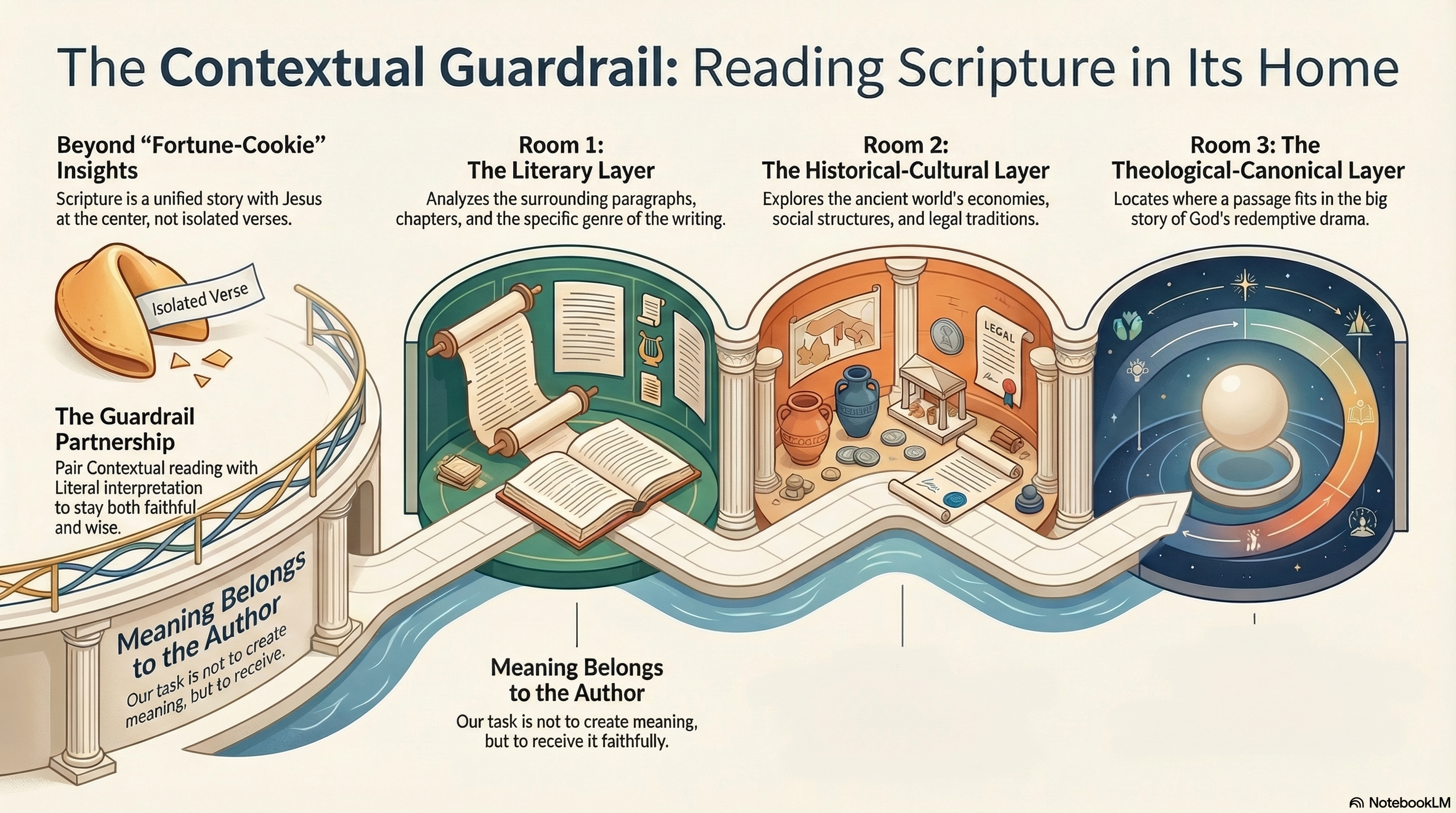
These three layers are not obstacles between you and the Bible. They are the dimensions of its meaning. A verse read in only one layer is like a photograph when the scene is actually a motion picture. Context is how we experience the motion.
Practice Case 1: The Literary Layer
The literary layer asks us to read every verse within its surrounding text and with an awareness of its genre. When we do, verses that seemed thin, or even troubling, often open into something far richer than we first imagined.
Psalm 37:4: Not a Blank Check
Few verses in Scripture are quoted more often out of context than this one:
4 Delight yourself in Yahweh; And He will give you the desires of your heart.
This verse is sometimes treated as a blank check. The formula seems simple: love God, and He will give you what you want, a new job, a better relationship, the specific outcome you have been praying for. The desire becomes the goal, and God becomes the means of reaching it.
But the literary layer changes everything. To read this verse faithfully, we must first ask what kind of writing this is. Psalm 37 is Hebrew poetry, and within Hebrew poetry, parallel structures carry enormous interpretive weight. In this verse, "delight" and "desire" are not two separate transactions, a condition on one side and a reward on the other. They are one movement of the heart.
Consider how this works in ordinary experience. Think of someone you love deeply, a spouse, a close friend, a child. When you truly delight in that person, what does your heart naturally desire? You desire more of them. Their presence, their company, their voice. The object of your delight becomes the object of your desire. The two cannot be separated.
Now apply that observation to the verse. If your deepest delight is in Yahweh, your deepest desire becomes Yahweh Himself. The promise is not that God will grant everything on your wish list. It is a far more astonishing guarantee: when you seek more of God, He will give you exactly what you are seeking. He will give you Himself, more of His presence, more of His wisdom, more of His likeness. That is the desire of a heart that has been transformed by genuine delight in Him.
The literary layer, simply by asking us to hold both halves of the verse together and to understand how Hebrew poetry works, unlocks a promise that is infinitely larger than the blank-check version.
Engage the Text: Psalm 37:4
- What are the two main clauses in Psalm 37:4? What is the grammatical relationship between the first and the second?
- What genre is Psalm 37? What does that genre tell you about how to read the structure of its verses?
- What does it mean to "delight" in something or someone? What naturally follows from genuine delight?
- Literary Layer: The two halves of this verse are directly linked. How does reading them together, rather than treating the second half as a standalone promise, change what the verse is actually offering?
- Literary Layer (Genre): Hebrew poetry often links parallel concepts. If "delight" and "desire" are mirroring each other, what does that tell you about what the "desires of the heart" will actually look like in a person who genuinely delights in God?
- A common misreading treats this verse as a formula for receiving material blessings. What is lost when the verse is detached from its literary structure? What is gained when it is read correctly?
- Has your understanding of this verse been the blank-check version? How does the contextual reading change what you are actually asking God for?
- What do you genuinely delight in right now? Is God among the things that bring you the deepest joy? What would it look like to practice delighting in Him more intentionally this week?
- The deeper promise of this verse is God Himself. How does that understanding change the way you pray?
The blank-check reading shrinks the promise. The contextual reading reveals that God is offering something far greater than any item on a wish list. He is offering Himself. And that is the only desire that, when fulfilled, leaves the heart truly satisfied.
James 1:18–25: The Literary Sandwich
Our second example of the literary layer comes from a passage that is often applied as general social advice, a tip for better conversations or a more peaceful marriage. The context reveals something far more specific.
18 In the exercise of His will He brought us forth by the word of truth, so that we would be a kind of first fruits among His creatures. 19 Know this, my beloved brothers. But everyone must be quick to hear, slow to speak and slow to anger; 20 for the anger of man does not achieve the righteousness of God. 21 Therefore, laying aside all filthiness and all that remains of wickedness, in gentleness receive the implanted word, which is able to save your souls. 22 But become doers of the word, and not merely hearers who delude themselves. 23 For if anyone is a hearer of the word and not a doer, he is like a man who looks at his natural face in a mirror; 24 for once he looked at himself and has gone away, he immediately forgot what kind of person he was. 25 But one who looks intently at the perfect law, the law of freedom, and abides by it, not having become a forgetful hearer but a doer of the work, this man will be blessed in what he does.
Many of us know verses 22 through 25, the mirror illustration and the call to be doers rather than hearers only. And most of us know verse 19, the instruction to be "quick to hear, slow to speak, and slow to anger." We apply it when tensions rise in a difficult conversation.
But the literary layer asks a different question: what is the surrounding context of this passage? What comes before verse 19, and what comes after it?
Before verse 19: James says we were brought forth by the "word of truth" (v. 18). After verse 19: James tells us to receive the "implanted word" (v. 21), to become doers of the word (v. 22), and to look intently at "the perfect law, the law of freedom" and abide by it (v. 25). The entire section, from verse 18 to verse 25, is about one thing: Scripture. God's Word. The "word of truth" that gave us new life.
This is what scholars call a literary inclusio, a sandwich structure where the author frames a central teaching with the same theme on both sides. James frames verses 19 and 20 between "word of truth" (v. 18) and "implanted word" (v. 21). He is not giving general relationship advice. He is telling us how to respond to Scripture when it confronts and corrects us.
Read in that light, the three instructions in verse 19 take on a more specific and urgent meaning:
- "Quick to hear" means being eager and receptive to what God's Word is showing us. It is a call to a humble, teachable spirit that welcomes correction from Scripture rather than deflecting it.
- "Slow to speak" means being slow to argue with or push back against what God is revealing. It is the posture of one who does not object to the Word but receives it.
- "Slow to anger" refers to the specific resistance that flares up when Scripture confronts a sin we prefer to keep. The "anger of man" in verse 20 is not general irritability. It is the proud refusal that rises in us when God's Word demands a change we do not want to make.
The literary layer transforms verse 19 from a social tip into a description of the soul posture required to receive the Word of God with genuine openness.
Engage the Text: James 1:18–25
- What does James identify as the source of new spiritual life in verse 18? What does he call that same Word in verse 21?
- What three instructions appear in verse 19? What does verse 20 add immediately after the third one?
- What does the man in the mirror do after looking at himself? What does the man who "looks intently" do differently?
- Literary Layer (Surrounding Text): James uses "word of truth" (v. 18) and "perfect law, the law of freedom" (v. 25) as the frame for the entire passage. How does identifying this literary boundary change what verse 19 is actually instructing?
- Literary Layer (Inclusio): If "quick to hear, slow to speak, slow to anger" is specifically about receiving Scripture rather than managing conversations, how does that change what each phrase means? What does "slow to anger" look like when the passage confronting you is one that calls out a sin you are holding onto?
- The man in the mirror looks and walks away unchanged. What literal truth is James conveying through this illustration? How does this image show what passive hearing without doing actually produces?
- When God's Word has confronted something in your life, have you been "quick to hear," or have you been quick to argue? What did that look like?
- Is there a command or correction in Scripture you have been slow to receive lately? What would it look like to welcome it with the gentleness James describes in verse 21?
- The promise at the end of verse 25 is that the doer of the work will be blessed. What is one area of your life where you need to move from looking in the mirror to doing what it shows?
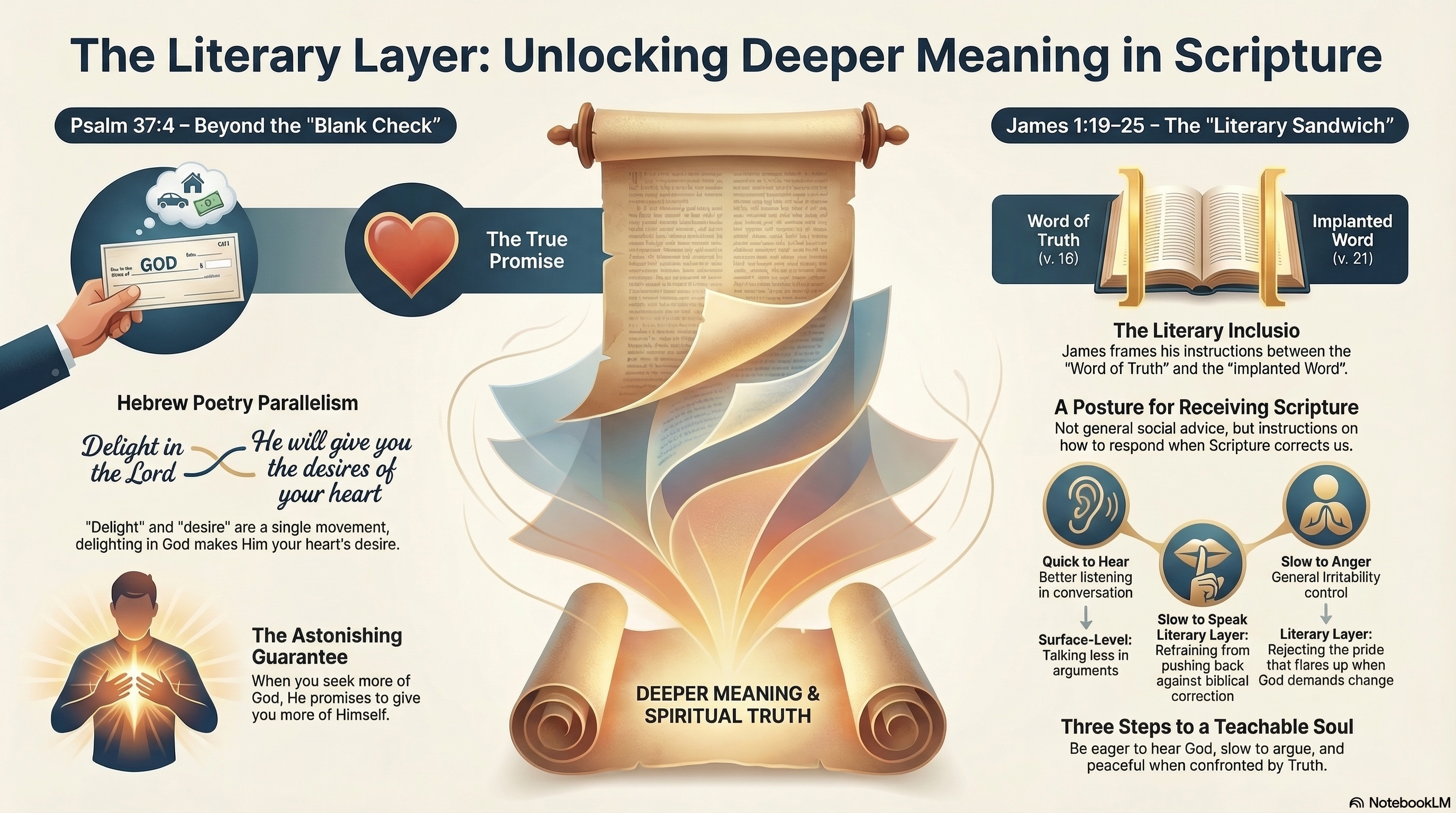
The literary layer rescues verse 19 from becoming a personality tip and reveals it as a call to a specific posture of the soul. God wants us to approach His Word the way a student approaches a great teacher: hungry to receive, unhurried to respond, and at peace with being changed.
Practice Case 2: The Historical-Cultural Layer
The historical-cultural layer asks us to step into the world of the original audience before we step back into our own. Some of the most powerful passages in Scripture only reveal their full meaning when we understand the cultural setting in which they were first enacted.
To see how this layer works, we begin with a contrast between two very different ways of making a serious commitment.
Contracts and Covenants: Two Different Worlds
Our modern world is built on the concept of a contract. A contract is a legal agreement rooted in suspicion. We sign it to protect ourselves from the other party. Contracts are limited in time, focused on the exchange of goods and services, and governed by a single principle: "I will do my part, if and when you do yours." Contracts are transactional. They exist because we do not fully trust each other.
The world of the Bible operated on a fundamentally different idea: the covenant. A covenant is a sacred agreement built on trust. It is not designed for the protection of individuals but for their union and blessing. Covenants are unlimited in time and governed by a relational principle: "I will be this to you, and you will be this to me." Two parties enter the covenant as separate individuals and emerge bound together by shared identity and shared responsibility. Covenants are not transactional. They are transformational.
| Modern Contract | Biblical Covenant | |
|---|---|---|
| Foundation | Suspicion (self-protection) | Trust (union and blessing) |
| Duration | Limited time | Unlimited time |
| Nature | Exchange of goods and services | Exchange of life and identity |
| Core Principle | "I'll do my part if you do yours." | "I will be this to you, and you to me." |
Without understanding this difference, a pivotal scene in Genesis 15 remains confusing, even unsettling. With it, that scene becomes one of the most breathtaking moments in all of Scripture.
Genesis 15: The Covenant in the Dark
9 So He said to him, "Bring Me a three year old heifer, and a three year old female goat, and a three year old ram, and a turtledove, and a young pigeon." 10 Then he brought all these to Him and split them into parts down the middle and laid each part opposite the other; but he did not split apart the birds. ... 12 Now it happened that when the sun was going down, a deep sleep fell upon Abram; and behold, terror and great darkness fell upon him. ... 17 Now it happened that the sun had set, and it was very dark, and behold, there appeared a smoking oven and a flaming torch which passed between these pieces. 18 On that day Yahweh cut a covenant with Abram, saying, "To your seed I have given this land..."
To a modern reader, this scene is simply strange. Animals slaughtered and split in two. A deep sleep falling on Abram. Fire passing through the pieces in the dark. Without the historical-cultural layer, we might read this as an ancient curiosity and move on.
The historical-cultural layer opens everything. In the ancient Near East, when two parties entered a covenant, they performed a ceremony called "cutting a covenant," and the Hebrew words behind "cut a covenant" in verse 18 reflect this practice exactly: to make a covenant was literally to cut one. Both parties would bring animals, slaughter them, and split the bodies down the middle, forming a blood-stained aisle between the pieces. Then both parties would walk through that aisle together.
By walking through the pieces, each party was speaking a visual oath: "May what happened to these animals happen to me if I break this covenant. If I fail to keep my word, may I be cut off as these animals were cut." It was the most solemn form of commitment the ancient world knew.
Now read the passage again with that context in full view.
Abram has prepared the animals. The sun has set. It is very dark. And then, while Abram is in a deep sleep, unable to participate, a smoking oven and a flaming torch, the symbols of God's presence, pass through the pieces. Alone.
God alone walks the aisle.
In a culture where both parties were expected to take on the covenant curse together, God is making a unilateral declaration: "If either of us fails to keep this covenant, the curse falls on Me."
This is the most breathtaking dimension of the scene: God binds Himself to His promise even for Abram's failures. He is essentially saying, "May I be cut off if this covenant is broken." This is not the logic of a contract. It is the logic of a love that refuses to let go.
The Gospel Connection
And throughout history, God's people repeatedly broke that covenant. The curse was ours to bear. But centuries after that dark night in Genesis 15, in Philippians 2, Paul shows us exactly how God kept the oath He made in the darkness:
5 Have this way of thinking in yourselves which was also in Christ Jesus, 6 who, although existing in the form of God, did not regard equality with God a thing to be grasped, 7 but emptied Himself, by taking the form of a slave, by being made in the likeness of men. 8 Being found in appearance as a man, He humbled Himself by becoming obedient to the point of death, even death on a cross.
Jesus was "cut off" for our transgressions. He bore the full weight of the covenant curse that God had placed upon Himself in the darkness of Genesis 15. The cross was not a surprise. It was the fulfillment of a promise made to a sleeping man in the ancient night, a promise that the God who walked alone through those pieces was committed to keeping, at any cost.
Without the historical-cultural context of covenant-cutting, Genesis 15 is a puzzle. With it, the cross of Christ becomes the fulfillment of a promise made before Abraham even had a son.
Engage the Text: Genesis 15 and Philippians 2:5–8
- In Genesis 15:10, what does Abram do with the animals? Where does he place the pieces? What happens to him in verse 12?
- In Genesis 15:17, what passes through the pieces? What does verse 18 say God did on that day?
- In Philippians 2:7–8, what two acts of humility does Paul describe? What is the end point of Christ's obedience?
- Historical-Cultural Layer: Without knowing the "cutting a covenant" ceremony, what might a modern reader conclude about Genesis 15:17–18? What critical truth is invisible without the cultural context?
- Historical-Cultural Layer: The significance of God alone passing through the pieces is that He alone takes on the covenant curse. How does understanding this ancient ceremony change the emotional and theological weight of the passage?
- Theological-Canonical Layer: How does Philippians 2:5–8 illuminate what Genesis 15:17–18 was foreshadowing? What unified truth emerges when you read both passages together across the full arc of Scripture?
- Has your sense of God's faithfulness ever felt transactional, as though you must hold up your end before He holds up His? How does the unilateral covenant in Genesis 15 reframe the relationship?
- God made a promise He was willing to die to keep. How does that reality sustain you in a season where God's promises feel distant or unfulfilled?
- What does it mean for your faith that the God who kept His word in Christ is the same God who is keeping it for you today?
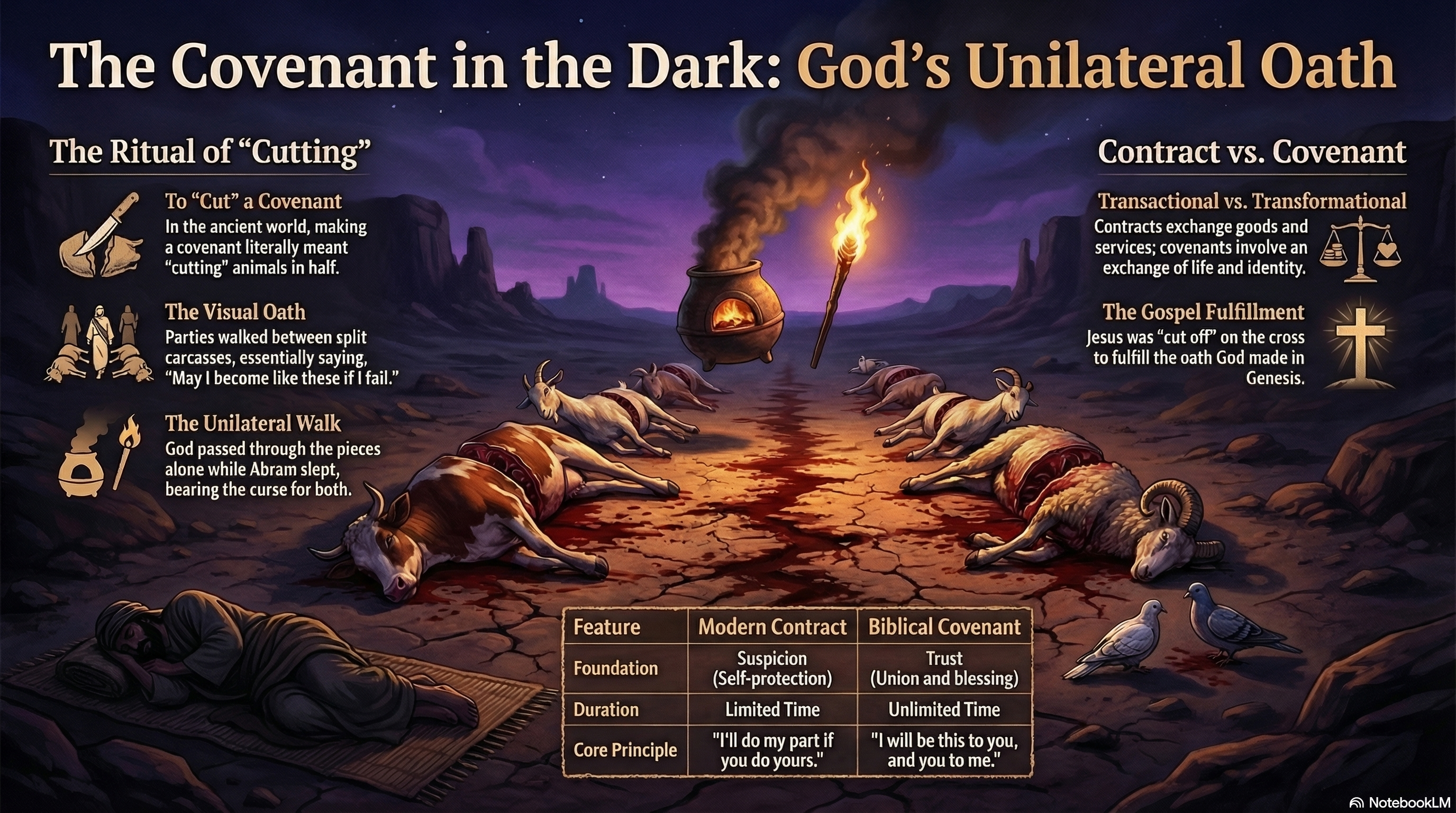
The historical-cultural layer does not complicate Genesis 15. It transforms it from an ancient curiosity into one of the most powerful demonstrations of grace in all of Scripture. God alone walked the aisle. God alone bore the curse. That is the covenant we have been brought into. Context helps us see how deeply we are loved.
Practice Case 3: The Theological-Canonical Layer
The theological-canonical layer asks us to place each passage within the larger story of God's redemptive plan, with Christ at the center. This layer is especially important when we encounter Old Testament laws that seem culturally specific. Without it, we face two equally unhelpful options: apply the command literally in a cultural context it was not designed for, or dismiss it entirely as having nothing to offer. The theological-canonical layer opens a third way.
Deuteronomy 22:8: The Parapet Law
8 "When you build a new house, you shall make a parapet for your roof, so that you will not bring bloodguilt on your house if anyone falls from it."
At first reading, this looks like a building code for ancient Israel. And in one sense, it was. Flat roofs were common in that culture, used as living and working spaces. A low wall around the edge was a practical safety measure.
If we apply the Literal Guardrail without the Contextual Guardrail, we might conclude that every homeowner today is obligated to build a wall around their roof. But most of us have pitched roofs and do not use them as gathering spaces. A strictly literal reading, culturally unaware, produces an obligation that simply does not fit.
The theological-canonical layer asks a different question: what is the eternal principle this culturally specific law was encoding? What was God teaching about His own character and His expectations for His people, in language suited to their world?
The key is the word bloodguilt. In the ancient Near Eastern world, bloodguilt was a concept with both legal and spiritual dimensions. If someone died on your property because of your negligence, you bore moral and spiritual responsibility for that death. The law was not primarily about walls. It was about the ethical weight of our responsibility for the safety of others.
The eternal principle embedded in the parapet law is this: we are responsible for the foreseeable safety of those in our care, and neglect of that responsibility carries real moral weight before God.
That principle does not belong to one culture. It belongs to every era and every household. A pool without a fence, a car seat installed incorrectly, an icy walkway left untreated, a hazard in a home where children play: these are the modern parapets. The specific application has changed. The eternal commitment to the safety of our neighbor has not.
Where the Story Is Heading
The theological-canonical layer also shows us where this principle is going. The laws of the Mosaic covenant, given to Israel for a specific time and culture, were always pointing toward a new arrangement. The prophet Jeremiah announced it centuries later:
31 "Behold, days are coming," declares Yahweh, "when I will cut a new covenant with the house of Israel and with the house of Judah, 32 not like the covenant which I cut with their fathers in the day I took them by the hand to bring them out of the land of Egypt, My covenant which they broke, but I was a husband to them," declares Yahweh. 33 "But this is the covenant which I will cut with the house of Israel after those days," declares Yahweh: "I will put My law within them, and on their heart I will write it; and I will be their God, and they shall be My people."
God was never merely interested in walls on rooftops. He was always forming a people whose hearts would be so shaped by His law that protecting others would be an instinct, not a regulation. The parapet law and the New Covenant promise are not distant strangers. They are chapters in the same story. The theological-canonical layer shows us how to read the early chapters in light of where the story is heading, and how to read the later chapters in light of where they began.
Engage the Text: Deuteronomy 22:8 and Jeremiah 31:31–33
- In Deuteronomy 22:8, what specific consequence does the law attach to the absence of a parapet? What is the nature of that consequence, legal, spiritual, or both?
- In Jeremiah 31:31, what does God say the new covenant will NOT be like? What happened to the previous covenant?
- In Jeremiah 31:33, where does God say He will put His law in the new covenant? How is this different from the way the old covenant law was delivered?
- Historical-Cultural Layer: Flat roofs were living spaces in ancient Israel. How does understanding this cultural reality explain why the parapet command existed, and how does that understanding help you move from the specific ancient application to the eternal principle?
- Theological-Canonical Layer: Deuteronomy 22:8 belongs to the Mosaic covenant given to Israel for a specific covenantal moment. Jeremiah 31 announces a new covenant where the law moves from stone to hearts. How do these two passages together show the progression of how God has always intended to protect His people and how He desires us to protect one another?
- The word "bloodguilt" is the ethical heart of Deuteronomy 22:8. How does identifying that key concept help you recognize the eternal principle that carries forward even when the specific cultural law does not?
- What are the modern parapets in your life, the practical responsibilities you carry for the safety and well-being of those in your care? What does faithful stewardship of that responsibility look like?
- God's intent has always been to write His care for others on our hearts. Is His law currently more of an external rule you follow or an internal instinct you live from? What would it look like to invite Him to move it deeper?
- The Contextual Guardrail prevents you from either rigidly applying an ancient law or dismissing it entirely. How does finding the eternal principle help you engage the Old Testament with both faithfulness and wisdom?
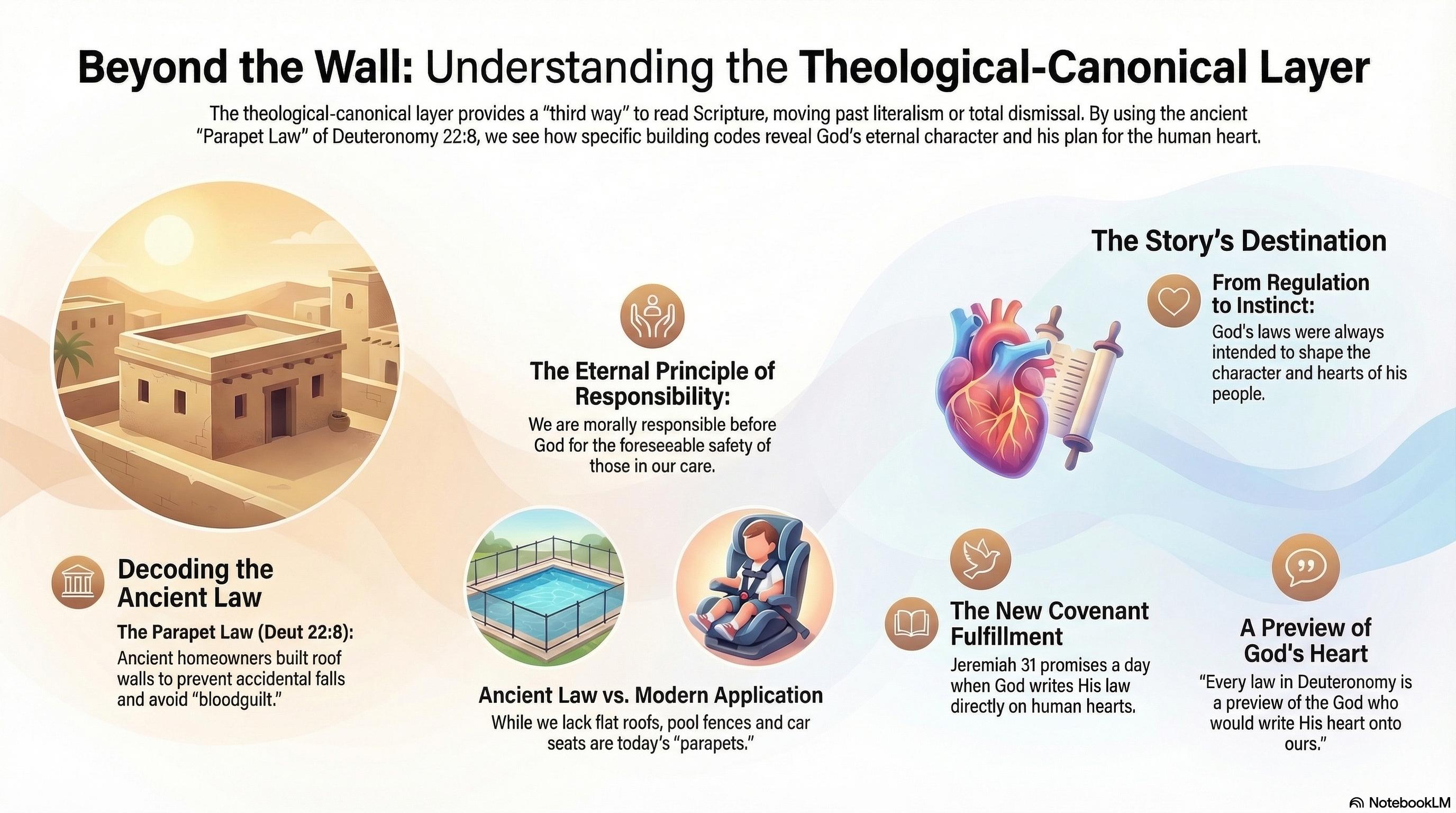
The theological-canonical layer does not dismiss Old Testament law. It honors it by asking what God was teaching about His own character through it, and then shows us where that teaching is heading. Every law in Deuteronomy is a preview of the God who would one day write His heart directly onto ours.
How the Guardrails Work Together
The Contextual Guardrail and the Literal Guardrail are not competing tools. They are partners, and there are passages in Scripture that require both, applied together, to arrive at the correct interpretation.
Consider how they work in tandem with the Deuteronomy 22:8 passage we just studied. The Literal Guardrail identified the genre: Old Testament Law. That identification immediately signals that a culturally situated command may carry a timeless principle without being a universal statute for every era. The Contextual Guardrail then does its work: the historical-cultural layer reveals why the parapet existed (roofs as living spaces), the key ethical concept is identified (bloodguilt), and the theological-canonical layer places the law within the larger story (pointing toward the New Covenant in Jeremiah 31).
Without the Literal Guardrail's genre identification, we might not know we were reading a culturally situated law rather than an eternal command. Without the Contextual Guardrail's three-layer analysis, we would not know what eternal truth the law was encoding or where it was heading in God's story.
When you sit down with a passage, the first question belongs to the Literal Guardrail: What kind of writing is this? The second question belongs to the Contextual Guardrail: What is the world around this text, and what larger story is it serving?
And you are not meant to do this work alone. Jesus made a promise to His disciples that is also a promise to every disciple who comes after:
25 "These things I have spoken to you while abiding with you. 26 "But the Advocate, the Holy Spirit, whom the Father will send in My name, He will teach you all things, and bring to your remembrance all that I said to you."
The guardrails are the structure. The Spirit is the life that flows through them. Every time you open a passage and ask, "What kind of writing is this?" and "What world did this come from?" and "Where does this fit in God's great story?", you are not performing an academic exercise. You are practicing the posture of a disciple who is listening for the Teacher's voice inside the text.
The psalmist modeled this posture in a single prayer that is worth making your own before every study session:
11 Teach me Your way, O Yahweh; I will walk in Your truth; Unite my heart to fear Your name.
Teach me. I will walk. Unite my heart. That three-part rhythm, receiving instruction, committing to obedience, asking for an undivided heart, is the spirit of every guardrail we are learning to use.
Engage the Text: John 14:25–26 and Psalm 86:11
- In John 14:26, what two specific things does Jesus say the Holy Spirit will do?
- What title does Jesus give the Holy Spirit in verse 26? What does that title suggest about the Spirit's role in our study?
- In Psalm 86:11, what three things does the psalmist ask God to do? What commitment does he state between each request?
- The Holy Spirit is described as a Teacher who "teaches all things." How does this promise shape the way you bring the Literal and Contextual Guardrails to a passage, as tools used in partnership with the Spirit rather than as a substitute for the Spirit?
- The Spirit brings "to your remembrance all that I said to you." How does careful study, including the patient work of both guardrails, create the conditions in which the Spirit's teaching can take root?
- Applying the Contextual Guardrail to John 14:26 itself: Jesus made this promise to His disciples in a specific historical-literary context, the upper room, the night before His crucifixion. Does this promise extend to every disciple who follows Jesus? What other passages help you answer that question?
- Before your next study session, what would it look like to deliberately invite the Holy Spirit's partnership with a specific prayer, rather than simply opening the text?
- Is there a passage where you have been relying on your own interpretive instincts without pausing to listen? What would it look like to bring both the guardrail tools and a posture of openness to that passage?
- The Spirit "brings to remembrance." What truth from Scripture has been returning to your attention recently? What might the Spirit be inviting you to do with it?
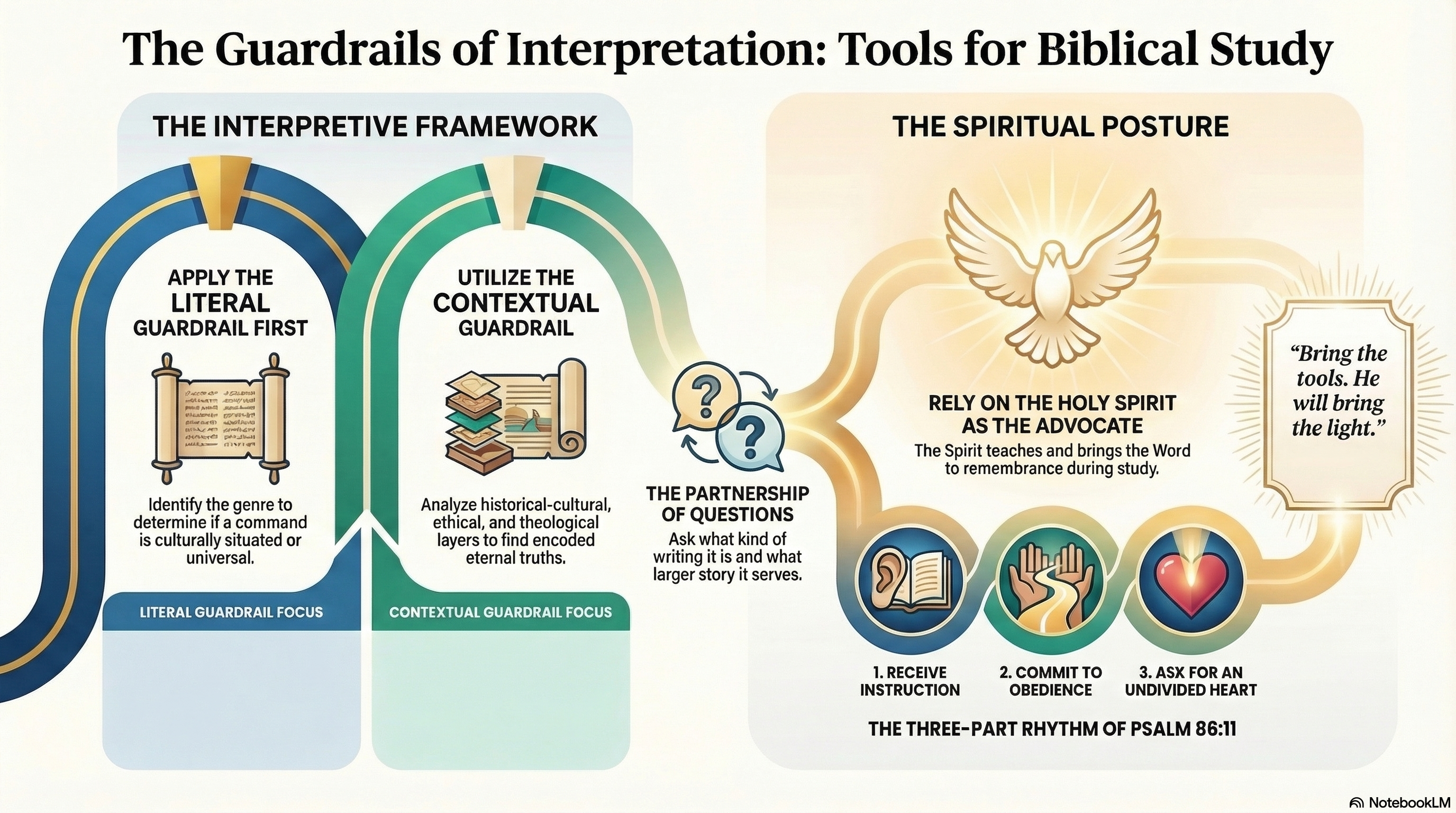
You are not learning the guardrails by intellectual effort alone. The Advocate is with you, ready to make the ancient text alive, the difficult passage clear, and the convicting Word effective. Bring the tools. He will bring the light.
Final Invitation: The Joy of Hearing Him Clearly
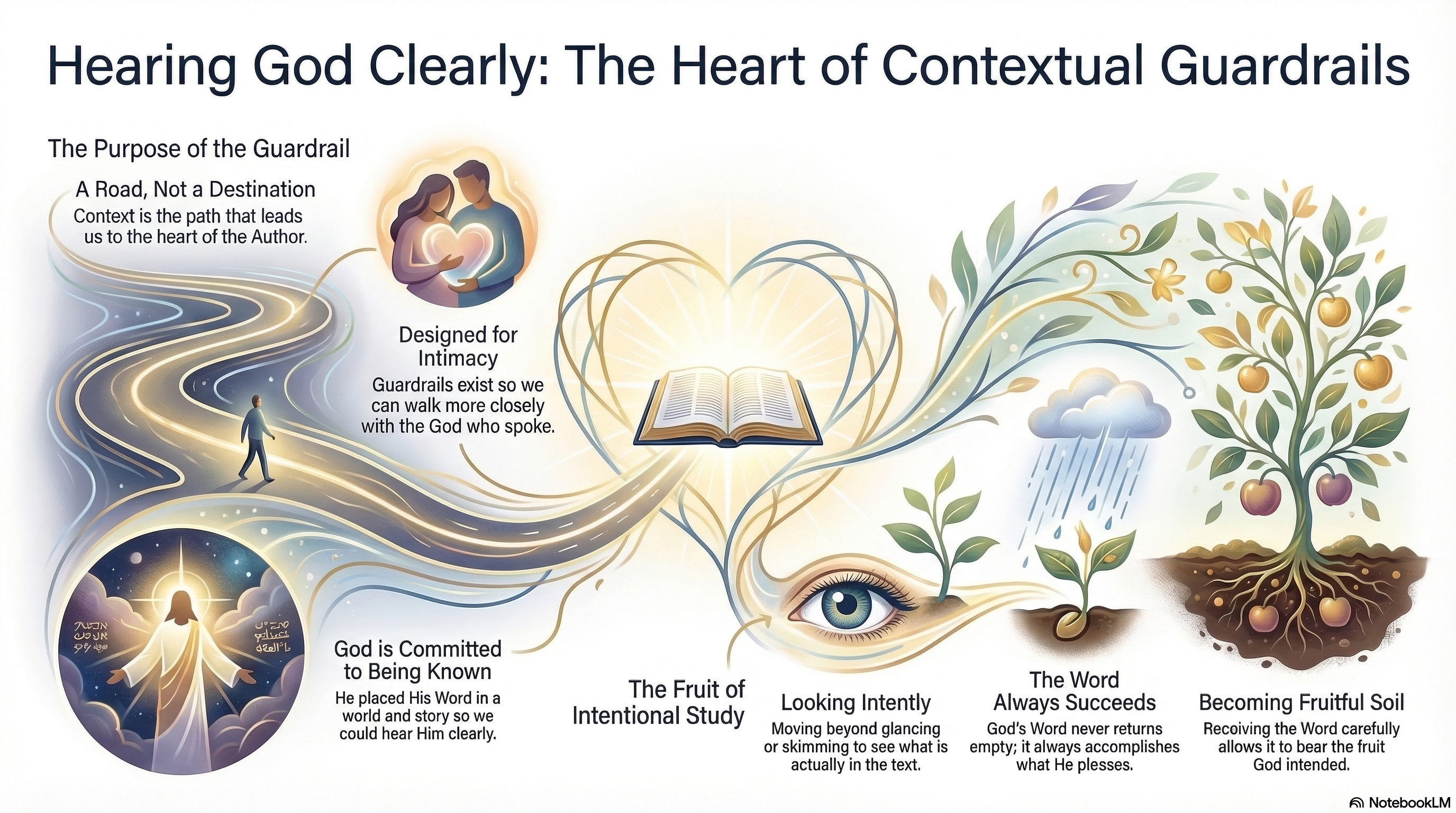
The Contextual Guardrail exists for one reason: intimacy. The more clearly we hear what God actually said, the more closely we can walk with the God who said it. Context is not the destination. It is the road that leads us to the heart of the Author.
God has never been in the business of making His Word inaccessible. He is committed to being known. The prophet Isaiah captured this with an image that has never grown old:
10 "For as the rain and the snow come down from heaven, And do not return there without watering the earth And making it bear and sprout, And giving seed to the sower and bread to the eater, 11 So will My word be which goes forth from My mouth; It will not return to Me empty, Without accomplishing what pleases Me, And without succeeding in the matter for which I sent it.
His Word will not return empty. It will accomplish what He pleases. It will succeed in what it was sent to do. And when we receive it carefully, within its context, with open and teachable hearts, we become the soil in which that Word bears exactly the fruit He intended.
25 But one who looks intently at the perfect law, the law of freedom, and abides by it, not having become a forgetful hearer but a doer of the work, this man will be blessed in what he does.
28 But He said, "On the contrary, blessed are those who hear the word of God and keep it."
The person who looks intently, not glancing, not skimming, not pulling verses from their home, but looking with the full attention of a disciple who expects God to speak, this is the person who will be blessed. The Contextual Guardrail is one of the key tools that makes that kind of intent gaze possible. It trains us to see what is actually in the text rather than what we hoped might be there. And what is actually there is always better.
God wants to reveal Himself to you more than you want to know Him. That is not a platitude. It is the only reason these guardrails exist. He placed His Word inside a world, inside a literary form, inside a grand story that moves toward His Son, so that we would have every possible resource to hear Him clearly. He is committed to being known. These guardrails are His gift to help you know Him.
Engage the Text: Isaiah 55:10–11, James 1:25, and Luke 11:28
- In Isaiah 55:10–11, what analogy does God use for His Word? What two things does He say His Word will not do?
- In James 1:25, what three things does the person who is blessed do with "the perfect law, the law of freedom"? What does he not become?
- In Luke 11:28, what two actions does Jesus describe as the condition of blessing?
- Theological-Canonical Layer: Isaiah writes centuries before Christ, James writes to the early church after the resurrection, and Jesus speaks the words of Luke 11:28 during His ministry. Yet all three arrive at the same truth: the Word accomplishes its purpose, and those who receive it and walk in it are blessed. How does seeing this convergence across time and genre demonstrate that the "one meaning" behind these passages is a consistent thread in God's character, not a coincidence?
- Literary Layer: Isaiah 55 uses natural imagery (rain, snow, seed). James uses a legal metaphor (the law of freedom). Luke records direct speech from Jesus. Using the Literal Guardrail, how does identifying each passage's genre shape how you read it? How do they all converge on the same truth despite using different literary forms?
- James 1:25 describes looking "intently" at the Word. How do the Literal and Contextual Guardrails together describe what "looking intently" actually requires? What does a person who uses both guardrails do that a casual reader does not?
- God says His Word "will not return to Me empty." Is there a passage He has been sending into your life repeatedly that you have not yet obeyed? What would it look like to receive it as the Word that has been sent specifically to accomplish something in you?
- The blessed person in James 1:25 is a "doer of the work," not a "forgetful hearer." Is there a truth from this session that you are being invited to act on this week? What is the first step?
- What is one practice, however small, that would help you begin reading passages in context rather than in isolation? Name it specifically, and commit to it this week.
May you find the deep joy and redemptive favor of God, the true Ashrei, as you delight in His Word, handle it carefully, and walk in His ways. Meditate and Obey. Study and Apply. Hear and Do. This is how we abide in Christ. This is how we demonstrate our love for God.