The Progressive Guardrail
How reading every passage in light of its place in God's unfolding plan across covenants protects us from applying the wrong truth to the wrong era.
Published April 5, 2026 · Updated October 3, 2026
In this lesson · 8 sections
- Section 1The Heart of Abiding: An Invitation to the Word
- Section 2The Progressive Guardrail: Later Revelation Builds on Earlier Revelation
- Section 3Three Questions Every Reader Should Ask
- Section 4The First Two Stages: Creation and the World After the Flood
- Section 5Stage Three: The Holy Distinction
- Section 6Stage Four: The Ultimate Fulfillment
- Section 7Walking with the Teacher: How the Guardrails Work Together
- Section 8Final Invitation: The Joy of Hearing Him Clearly
The Heart of Abiding: An Invitation to the Word
Someone, at some point, has probably asked you this. Or maybe you have asked yourself: does God change His mind? He told Adam and Eve to eat only plants. Then He told Noah that all meat was acceptable. Then He gave Moses detailed rules about which animals were clean and which were defiled. Then Jesus declared all foods clean. Which one are we supposed to follow? How can all of them be true at the same time?
If you have sat with that question and not known what to say, you are not alone. It feels like a discrepancy. And if you are honest, it has probably made you wonder, at least briefly, whether the Bible is as coherent as you believe it to be. That moment of honest uncertainty is not weakness. It is the doorway into one of the most clarifying guardrails in all of Abide 101: the Progressive Guardrail.
This Abide Discovery Session introduces a truth that changes how you read the entire Bible: God did not deliver His full plan all at once. He unfolded His revelation gradually, across centuries, across different peoples, and across distinct covenantal relationships, always moving toward the same destination. When you understand this, the apparent contradictions dissolve. What looked like inconsistency turns out to be the most coherent story ever told.
Our path through this course is shaped by three action pairs: Meditate & Obey, Study & Apply, and Hear & Do. Every one of them assumes that what we are hearing and meditating on is the right truth for the right era. The Progressive Guardrail ensures we know which era we are in. And beneath every era, one thing never changed: God's covenant faithfulness to speak clearly to His people across all of time:
21 "As for Me, this is My covenant with them," says Yahweh: "My Spirit which is upon you, and My words which I have put in your mouth, shall not depart from your mouth, nor from the mouth of your seed, nor from the mouth of your seed's seed," says Yahweh, "from now and forever."
God's covenant is not one announcement made in a single moment. It is a living commitment, passed from generation to generation, persisting through every stage of His unfolding plan. The words He placed in the mouths of His people in one era did not become irrelevant in the next: they became the foundation on which the next revelation was built.
And that progressive plan arrived at a destination: a High Priest who fulfilled every stage that came before Him:
14 Therefore, since we have a great high priest who has passed through the heavens, Jesus the Son of God, let us take hold of our confession. 15 For we do not have a high priest who cannot sympathize with our weaknesses, but One who has been tempted in all things like we are, yet without sin. 16 Therefore let us draw near with confidence to the throne of grace, so that we may receive mercy and find grace to help in time of need.
Everything the Old Covenant priesthood anticipated, everything the Levitical system was designed to point toward, arrived in the person of Jesus. He passed through the heavens as the One the entire progression was building toward. The Progressive Guardrail is what allows us to see that the journey was not confusion. It was preparation.
Engage the Text: Isaiah 59:21 and Hebrews 4:14–16
- In Isaiah 59:21, what does God say will "not depart"? To how many generations does He extend this promise, and what word does He use for its duration?
- In Hebrews 4:14, what two things does the author say we have, and what does he say we should do in response to having them?
- In Hebrews 4:15–16, what two qualities of Jesus does the author emphasize? What does the combination of those qualities make possible for us?
- Isaiah 59:21 describes God's words persisting from generation to generation. What does it mean for Bible study that the words God spoke in one era were building toward something rather than being replaced by something? How does that reframe the experience of reading a book like Leviticus?
- Hebrews 4:14 says Jesus "passed through the heavens" as our great High Priest. The entire Levitical priestly system was designed to give Israel access to God. How does knowing that Jesus is the fulfillment of that system change how you read passages about the priesthood, sacrifice, and cleanliness in the Old Testament?
- The Progressive Guardrail asks: what stage of God's plan is this passage written in? How does applying that question to Hebrews 4 help you locate yourself in the story: not under the Mosaic system, but on the other side of the fulfillment, approaching the throne of grace with confidence?
- Have you ever felt confused or even defensive when someone pointed out apparent contradictions between the Old Testament and the New? How does the idea of progressive revelation, God unfolding a plan across time, change how you would respond to that challenge?
- Hebrews 4:16 says we can "draw near with confidence" to the throne of grace. That confidence is the fruit of the entire progressive plan. Is that how you currently approach God in prayer and study? If not, what gets in the way?
- This week, choose one Old Testament passage that has confused or troubled you. Read it asking: what stage of God's plan was this written in, and what was it pointing toward? Write down what you discover.
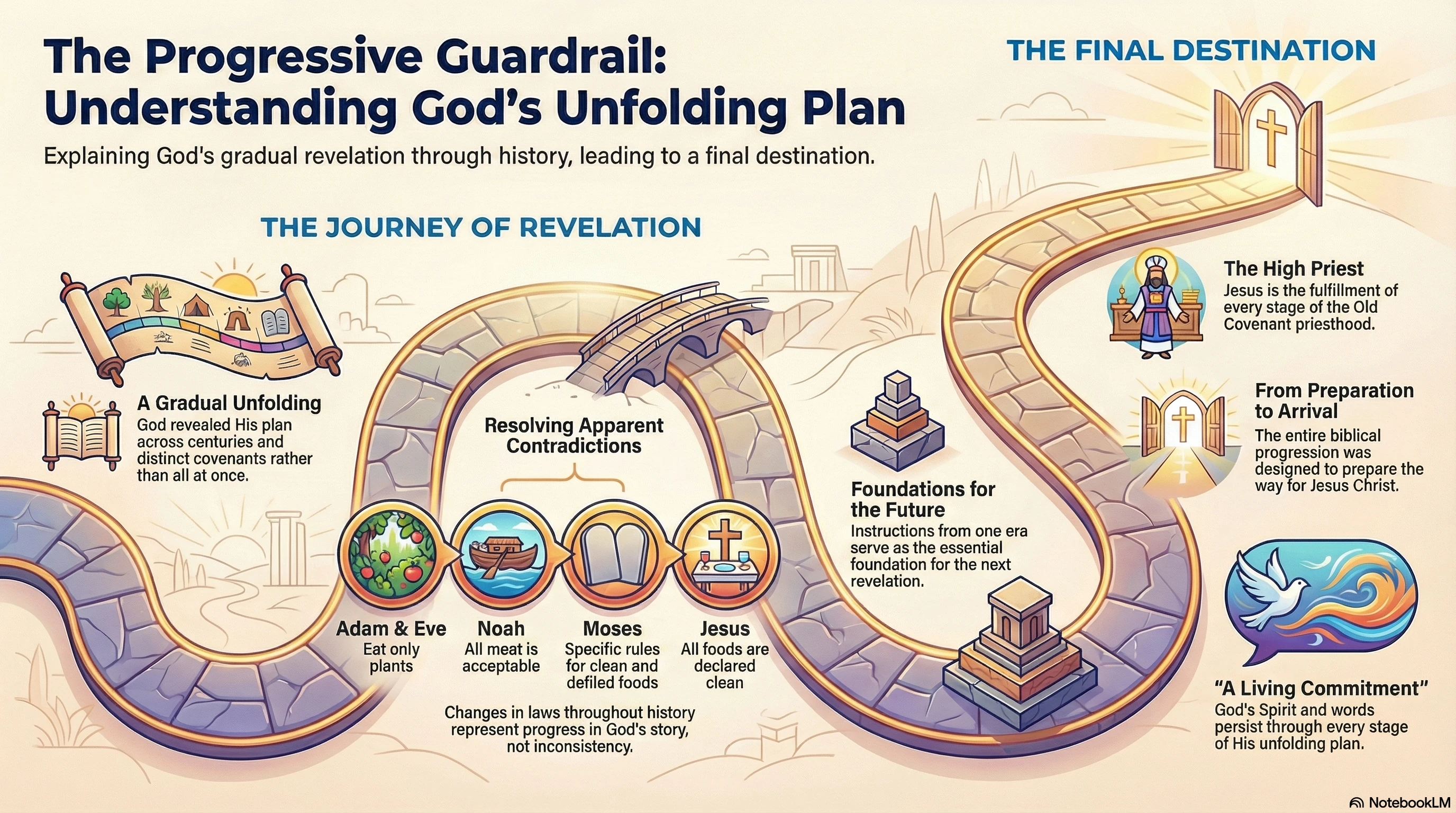
God's plan did not arrive all at once, but His faithfulness did. The words He placed in the mouths of His people across every era were never random; they were one continuous covenant, building toward the great High Priest who fulfilled them all. The Progressive Guardrail is what lets us see the whole story instead of just isolated chapters.
The Progressive Guardrail: Later Revelation Builds on Earlier Revelation
Where does this sit in the unfolding story? What had God revealed by then, and what did He reveal later?
The Progressive Guardrail holds that God's revelation unfolds gradually across time, and that later parts of the Bible can clarify, expand, or supersede what came earlier, without contradicting it. The unfolding of Scripture is not a series of corrections. It is the natural progression of a plan that was coherent from the beginning.
This guardrail guards against two opposite errors that undermine faithful interpretation.
The first is the error of flattening: treating the entire Bible as if it were written to one audience, in one era, under one set of instructions. This is what produces the question "Can I eat bacon or not?" without any sense that the answer depends on which covenant you are reading in and which one you now live under.
The second is the error of severing: treating the Old Testament as irrelevant or contradicted by the New, as if the God who gave the Mosaic law was a different God than the One who sent Jesus. Both errors miss the coherence of a single Author working a single plan across a vast and deliberate timeline.
Paul captures the purpose of the earlier revelation precisely:
4 For whatever was written in earlier times was written for our instruction, so that through the perseverance and the encouragement of the Scriptures we might have hope.
Notice what Paul says: "whatever was written in earlier times." He is not limiting this to some of the Old Testament. He means all of it. Every dietary law, every sacrifice, every priestly regulation was written for our instruction. Not as a direct set of rules to follow today, but as a revelation of the God who was working His plan across time. We read those earlier texts and find hope, because they show us a God who is faithful to what He promises, who does not abandon His plans midstream, and who kept every word He spoke across centuries of human history.
The Progressive Guardrail gives us the interpretive posture we need to read those earlier texts honestly: not mining them for rules to apply directly, but learning from them who God is and where His plan was going.
Engage the Text: Romans 15:4
- Paul says the earlier Scriptures were written for what primary purpose? What two gifts does he say they provide?
- Notice Paul says "whatever was written." What is the scope of his claim? Does he leave any portion of the Old Testament outside this purpose?
- The word "hope" is the goal Paul names. What kind of hope does he have in mind: optimism about the future, or something grounded in demonstrated faithfulness?
- Paul says the earlier Scriptures produce hope "through perseverance and encouragement." If the Old Testament's value for us today is instruction, perseverance, and hope rather than direct rule application, how does that reframe the purpose of reading a book like Leviticus? What are we looking for when we read it?
- The Progressive Guardrail says later revelation builds on earlier revelation without contradiction. Romans 15:4 suggests the earlier texts still have a role to play even after the New Covenant arrives. How does this prevent us from dismissing the Old Testament as "outdated" while also protecting us from trying to live under its specific covenant terms?
- Some readers struggle with the Old Testament because they do not know how to read it: is it instruction to obey, history to learn from, or prophecy to trace? How does Romans 15:4 help answer that question for someone who has been confused about what the Old Testament is for?
- How often do you read the Old Testament in your personal study? Is it a regular part of your Bible engagement, or does it feel hard to know what to do with it? How does the purpose Paul describes in Romans 15:4 make the Old Testament more approachable?
- Think of a passage in the Old Testament that has encouraged you or given you a clearer picture of God's character. How does knowing that passage was "written for your instruction" change how you hold it?
- This week, read one chapter of an Old Testament book you rarely visit. As you read, ask: what does this passage reveal about God's character and the direction of His plan? Write down one thing that gives you hope.
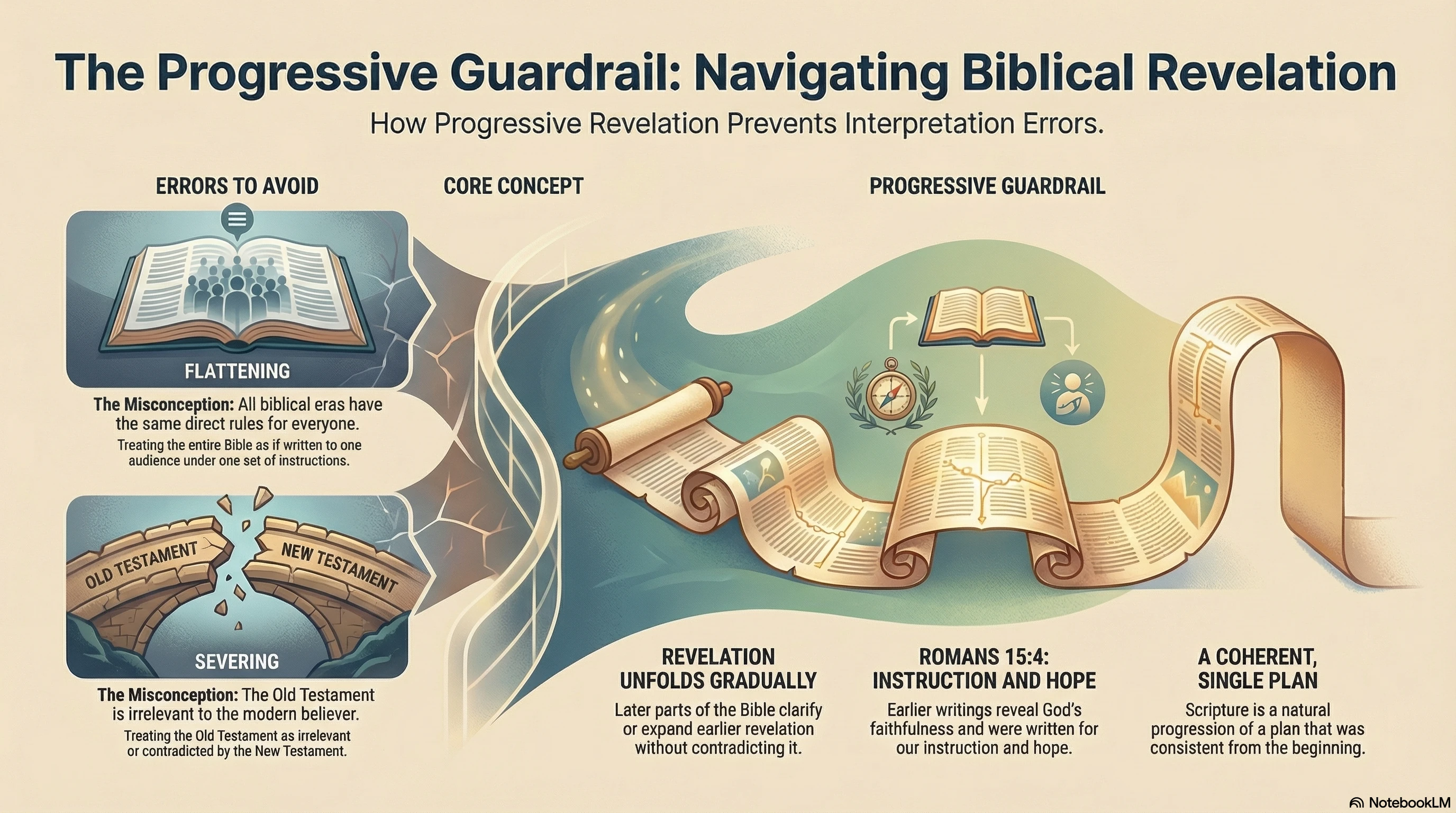
The Old Testament was not a rough draft. It was the earlier chapters of the same story, written for your instruction and your hope. The Progressive Guardrail protects us from flattening the Bible into a single era and from severing the Old from the New. God was building something across every page.
Three Questions Every Reader Should Ask
The Progressive Guardrail becomes a practical tool the moment we turn it into a set of diagnostic questions. Before interpreting any passage and before deciding what to do with it, the faithful reader pauses to ask three things:
Question 1: When was this written? Every text was produced at a specific moment in redemptive history. A command given to Adam in a sinless garden carries different weight than a command given to Moses in the wilderness, and both carry different weight than a command given to the church after the resurrection. Locating the passage on the timeline is the first act of faithful interpretation.
Question 2: To whom was this written? Was this addressed to all of humanity? To the nation of Israel under the Mosaic Covenant? To a specific New Testament church? To the twelve disciples in a unique moment of Jesus' earthly ministry? The original audience shapes the original meaning, and the original meaning shapes how we receive it.
Question 3: What part of God's unfolding story is this? Is this passage in the era of creation, the era of the patriarchs, the era of the Mosaic law, the era of the prophets, the era of the Gospels, the era of the early church? Each era carries its own covenantal context. The same God is at work in every one of them, but He is working differently in each.
These three questions do not make the Bible less authoritative. They make it more intelligible. They are the lens through which the text comes into focus, so that what seemed like contradiction resolves into the coherent story of a God who keeps His promises.
The food example we are about to study is one of the clearest illustrations in all of Scripture of these three questions at work. We will look at four passages written in four eras, and yet see how they are part of one story.
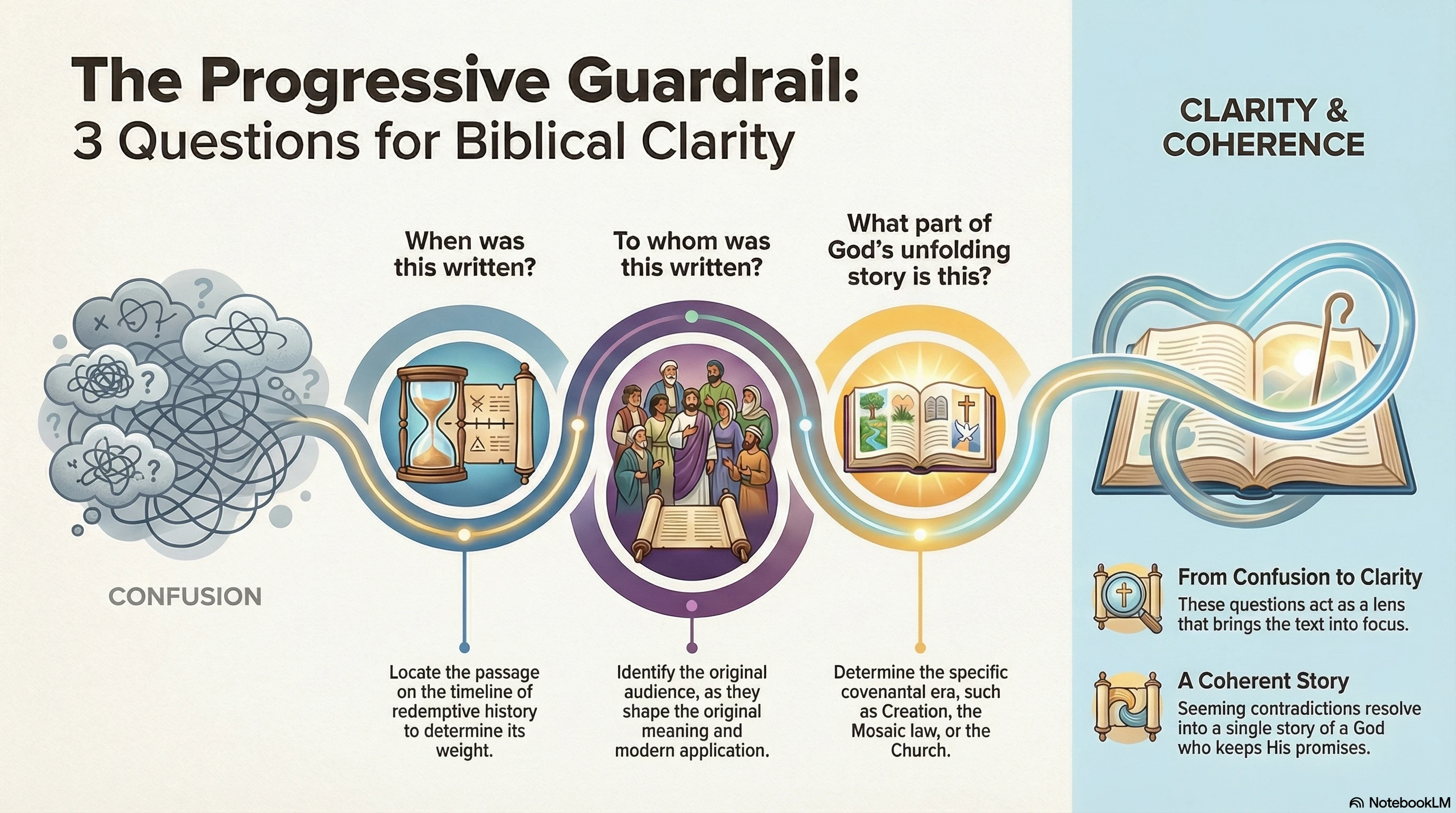
The Progressive Guardrail is not abstract theology. It is three practical questions asked before every interpretation: When was this written? To whom? What part of the story is this? These questions are the difference between confusion and clarity when reading across the whole Bible.
The First Two Stages: Creation and the World After the Flood
The Progressive Guardrail becomes visible the moment we trace a single subject across the biblical timeline. Food is the perfect object lesson, and it begins at the very beginning.
Stage 1: The Original Design
In the opening chapter of Genesis, before the fall and before the fracture of the world God made, we see the first provision:
29 Then God said, "Behold, I have given to you every plant yielding seed that is on the surface of all the earth, and every tree which has the fruit of the tree yielding seed; it shall be food for you;
This is the diet God established in a perfect world, in the era of original creation, for the first human beings. It is not yet complicated by the fall, by death, or by the changed conditions of the world. Before sin entered, this is what provision looked like.
Stage 2: The New Provision After the Flood
Fast forward through the fall, the expulsion from the garden, the spread of sin across the earth, and the catastrophic judgment of the flood. Noah and his family step off the ark into a different world. The era has changed, and with it, God's provision expands:
3 "Every moving thing that is alive shall be food for you; as with the green plant, I give all to you.
Notice the language: "as with the green plant." God is not contradicting Genesis 1:29. He is expanding upon it for a new reality. The world after the flood is not the world before the fall. God adapts His provision to the era His people are actually living in, not the era they left behind.
This is the Progressive Guardrail in its simplest form: the same Provider, the same generosity, but the specific expression of that provision has advanced. The reader who applies the three diagnostic questions here has no confusion: different era, different human situation, different specific provision. One consistent God.
Engage the Text: Genesis 1:29 and Genesis 9:3
- In Genesis 1:29, what does God say He has "given" to humanity? What two categories does He identify?
- In Genesis 9:3, what single phrase captures the scope of the new provision? What comparison does God use to connect this new provision to the earlier one?
- What is the significant moment in redemptive history that occurs between Genesis 1:29 and Genesis 9:3? How does that moment explain why the provision might change?
- The first diagnostic question is: "When was this written?" Genesis 1:29 is written in the era of original, pre-fall creation. Genesis 9:3 is written in the era after the fall and after the flood. How does locating each passage on the timeline immediately remove the apparent contradiction between them?
- The second diagnostic question is: "To whom was this written?" Genesis 1:29 is addressed to Adam and Eve before any covenant is established. Genesis 9:3 is addressed to Noah in a specific moment of renewed provision. Why does knowing the original audience matter for how we receive each passage?
- God says in Genesis 9:3, "as with the green plant, I give all to you." He draws an explicit connection to the earlier provision rather than ignoring it. What does this tell us about how progressive revelation works: not by erasing what came before, but by what?
- Have you ever read two passages of Scripture that seemed to say opposite things and concluded that the Bible was contradicting itself? How does the example of Genesis 1:29 and 9:3 give you a new framework for approaching those moments?
- The world Noah stepped into after the flood was harder, more dangerous, and less ordered than the garden. God's provision expanded to meet that reality. How does the pattern of God adapting His provision to the era without abandoning His generosity speak to your own changing circumstances?
- God's faithfulness across Genesis 1 and Genesis 9 is the same faithfulness Paul describes in Romans 15:4: "written for our instruction, that we might have hope." What does the provision in these two passages teach you about the character of the God you are abiding in?
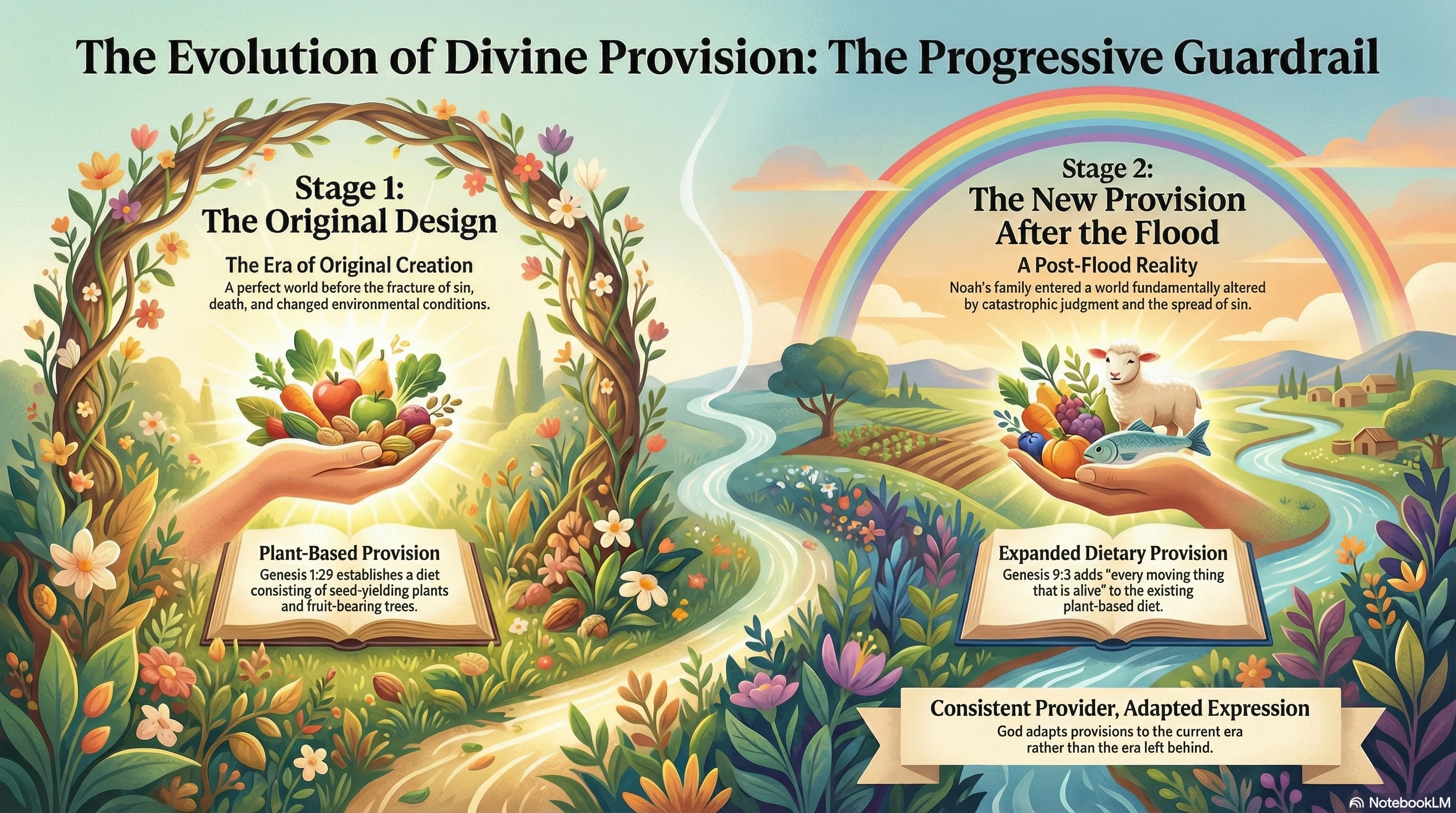
Genesis 9:3 is not a contradiction of Genesis 1:29. It is an expansion: the same generous God, adapting His provision to a world that has changed. The Progressive Guardrail protects us from treating this as inconsistency and helps us see it as exactly what it is: faithful provision for the actual era God's people are living in.
Stage Three: The Holy Distinction
Centuries after Noah, God brought His people out of Egypt and into the wilderness. He established a covenant with the nation of Israel at Sinai, a covenant unlike any that had come before it. Israel was called to something specific and visible: to be a holy nation, distinct from every people around them, a kingdom of priests set apart for Yahweh in the middle of a pagan world (Exodus 19:5–6).
5 'So now then, if you will indeed listen to My voice and keep My covenant, then you shall be My treasured possession among all the peoples, for all the earth is Mine; 6 and you shall be to Me a kingdom of priests and a holy nation.' These are the words that you shall speak to the sons of Israel."
That calling required visible markers. Israel's worship, their calendar, their social laws, and yes, their diet were all shaped to say to the surrounding nations: we are not like you. This was not meant to be permanent in its specific form. It was meant to be faithful for this era of God's plan, until the One who would bless all nations arrived.
4 'Nevertheless, you shall not eat of these, among those which chew the cud or among those which divide the hoof: the camel, for though it chews cud, it does not divide the hoof; it is unclean to you. 5 'Likewise, the shaphan, for though it chews cud, it does not divide the hoof; it is unclean to you; 6 the rabbit also, for though it chews cud, it does not divide the hoof; it is unclean to you; 7 and the pig, for though it divides the hoof, thus making a split hoof, it does not chew cud; it is unclean to you. 8 'You shall not eat of their flesh, and you shall not touch their carcasses; they are unclean to you.
This is a law for a specific people, in a specific era, under a specific covenant. The three diagnostic questions answer the confusion immediately:
- When was this written? In the era of the Mosaic Covenant, given to Israel in the wilderness.
- To whom was this written? To the nation of Israel, the people called to be visibly separate from the nations.
- What part of God's story is this? The stage in which God was setting apart one people to be the container of His presence and the vehicle of His blessing, awaiting the arrival of the Messiah.
The dietary restrictions were not arbitrary. They were part of a larger architecture of holiness: external markers of an internal calling. An Israelite who ate pork was not merely breaking a health rule; they were blurring the line between the holy and the common at a moment when that line was critical to God's purposes.
This does not make Leviticus 11 irrelevant for us. It makes it instructive. When we ask "what does this reveal about God's character?" we find a God who takes holiness seriously, who orders the lives of His people with precision, and who designed every detail of the Mosaic system with purpose. That character has not changed. But the specific expression of holiness has advanced, as Stage Four will show.
There is an abiding principle revealed in these passages: God expects His people to be holy and set apart, living differently and distinctly from the peoples who do not belong to Him. That timeless abiding principle does not fade as the story of Scripture unfolds; it is progressively reinforced and brought to its fullness in Christ.
Engage the Text: Leviticus 11:4–8
- The text lists specific animals that are declared "unclean to you." What is the repeated phrase that ends the description of each animal? Who is the original audience for this declaration?
- What two physical characteristics does Leviticus 11 use to determine clean versus unclean animals? What does it tell us about the kind of legal system this is: simple and accessible, or complex and nuanced?
- The restrictions on flesh are accompanied by a restriction on touching carcasses. What does the extension of the law beyond eating to touching suggest about the purpose of these laws: were they about nutrition, or about something else?
- The three diagnostic questions clarify that these laws were given to Israel, in the Mosaic era, as part of a covenantal calling to be visibly distinct from the nations. How does applying those three questions to Leviticus 11 change the way you read these restrictions? Does the Progressive Guardrail make this passage more meaningful, or less?
- The dietary laws were "boundary markers": visible signs of a covenant people's identity in the middle of a pagan world. What does this purpose tell us about why the laws were given, and what does that "why" suggest about when and how their purpose might be completed?
- The Progressive Guardrail says later revelation can clarify or supersede earlier stipulations without contradiction. Leviticus 11 was not a mistake to be corrected; it was a faithful instruction for a specific era. How does framing it that way honor both the authority of the Mosaic law AND the authority of the New Covenant that fulfilled it?
- Have you ever read a passage like Leviticus and felt that it was irrelevant or confusing? How does asking "what does this reveal about God's character and His purposes in this era?" change your engagement with passages like this one?
- The calling of Israel to be a holy, distinct people was not just about dietary rules; it was about imaging God in the middle of the nations. In the New Covenant, that calling extends to the church. How does understanding the purpose behind the Mosaic laws help you think about what it means to be a holy, distinct person in your own cultural context?
- Romans 15:4 says all of this was "written for our instruction, that we might have hope." What instruction do you take from Leviticus 11, and what hope does it give you about the God who designed this stage of His plan?
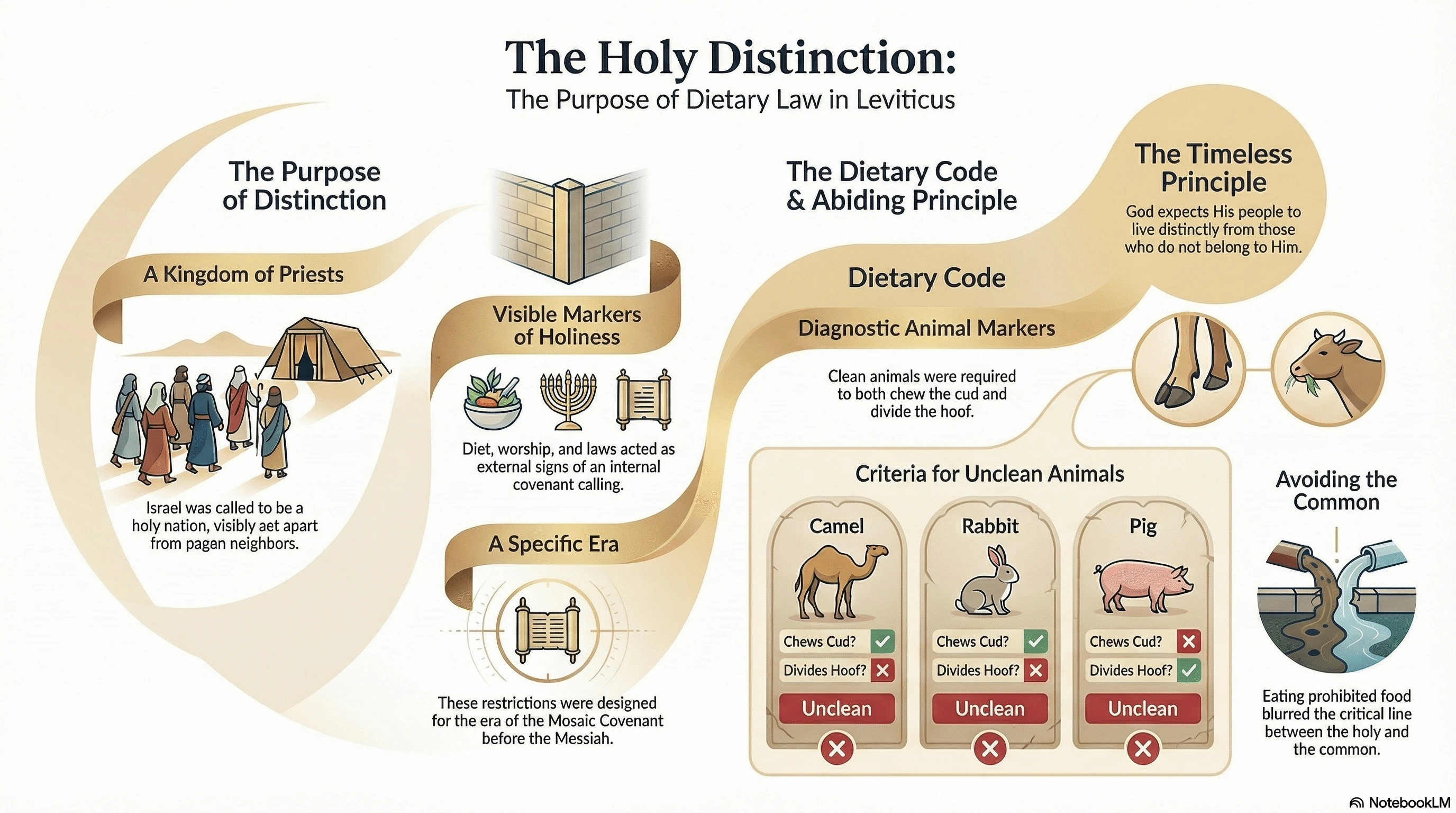
Leviticus 11 is not an outdated rulebook. It is the faithful instruction of a God who was setting apart one nation as the visible bearer of His presence in a pagan world, until the One who would bless all nations arrived. The Progressive Guardrail shows us the purpose behind the restriction, and then invites us to watch that purpose reach its fulfillment.
Stage Four: The Ultimate Fulfillment
When Jesus arrived, He did not break the Mosaic law. He fulfilled it. He was the Messiah the entire Mosaic system was designed to produce and point toward: the final sacrifice, the great High Priest, the One in whom all the nations of the earth would be blessed. And when He declared the era of that fulfillment, even the dietary laws that served the purpose of separation were released.
The moment came in an exchange with the Pharisees about ritual washing:
14 And after He called the crowd to Him again, He began saying to them, "Listen to Me, all of you, and understand: 15 there is nothing outside the man which can defile him if it goes into him; but the things which proceed out of the man are what defile the man. 16 {"And if anyone has ears to hear, let him hear."} 17 And when He had left the crowd and entered the house, His disciples were asking Him about the parable. 18 And He said to them, "Are you lacking understanding in this way as well? Do you not perceive that whatever goes into the man from outside cannot defile him, 19 because it does not go into his heart, but into his stomach, and goes to the sewer?" (Thus He declared all foods clean.) 20 And He was saying, "That which proceeds out of the man, that is what defiles the man. 21 "For from within, out of the heart of men, proceed the evil thoughts, sexual immoralities, thefts, murders, adulteries, 22 coveting, wickedness, deceit, sensuality, envy, slander, pride, and foolishness. 23 "All these evil things proceed from within and defile the man."
The parenthetical note in verse 19 is one of the most significant interpretive statements in the Gospels: "(Thus He declared all foods clean.)" This is not Jesus being casual about the Mosaic law. This is Jesus announcing that the purpose that law was serving, the visible separation of a holy people from the nations, has now arrived at its fulfillment. The barrier between Jew and Gentile is being dismantled, because the Gospel He is inaugurating is for every nation on earth.
But notice carefully what Jesus does in the same breath. He does not lower the bar of holiness. He raises it. By moving the locus of defilement from the external to the internal, Jesus is not releasing His people from the call to be distinct; He is intensifying it. The food on your plate never made you unholy before God. What makes you unholy is what lives in your heart: evil thoughts, sexual immorality, deceit, pride, sensuality, envy, slander. These emerge from within, and these are what defile the man. The timeless abiding principle remains exactly what it was in Leviticus: God's people are called to holiness, to live differently and distinctly from the world around them. But in the New Covenant, that call reaches past your plate and past your external religious observance, all the way into your motives, your thought life, and the hidden interior of your soul. The old boundary markers of the Mosaic era have served their purpose. The new boundary marker is the transformed heart.
Yet even this profound declaration was not immediately grasped, even by the apostles closest to Jesus. The old covenant rhythms ran deep. It took a direct vision from God for the Apostle Peter to fully receive what Jesus had already announced:
9 And on the next day, as they were on their way and approaching the city, Peter went up on the housetop about the sixth hour to pray. 10 But he became hungry and was desiring to eat. And while they were making preparations, he fell into a trance 11 and saw heaven opened up, and an object like a great sheet coming down, lowered by four corners to the ground, 12 and there were in it all kinds of four-footed animals and crawling creatures of the earth and birds of the sky. 13 And a voice came to him, "Rise up, Peter, slaughter and eat!" 14 But Peter said, "By no means, Lord, for I have never eaten anything defiled and unclean." 15 Again a voice came to him a second time, "What God has cleansed, no longer consider defiled." 16 And this happened three times and immediately the object was taken up into heaven.
Peter's response in verse 14 is exactly what we should expect: he had lived his whole life under the Mosaic dietary laws. He was not disobeying; he was being faithful to the era he had always known. The vision did not correct his prior faithfulness. It announced that a new era had arrived.
"What God has cleansed, no longer consider defiled." This is the Progressive Guardrail at its most explicit. The Mosaic dietary restrictions were not a mistake. They were not a lesser revelation. They were faithful instruction for their era. And now, in the era of the New Covenant, with the Gospel going to every people and nation, the specific covenantal boundary markers that separated Israel from the nations have served their purpose. A Christian can eat a meal with anyone from any culture. The wall of separation has come down, because the fulfillment that wall was protecting has arrived.
Engage the Text: Mark 7:14–23 and Acts 10:9–16
- In Mark 7:15, what contrast does Jesus draw between what goes INTO a person and what comes OUT? What does He say is the actual source of defilement?
- In Mark 7:19, the text includes the parenthetical note "(Thus He declared all foods clean.)" Who inserted this note, and what does its placement in the narrative suggest about its intended scope?
- In Acts 10:14, Peter's response to the vision reveals his prior convictions. What does his response tell us about how faithfully he had been living under the Mosaic dietary laws? And what does the voice's response in verse 15 announce?
- The three diagnostic questions applied to Mark 7: Jesus is speaking in the era of the New Covenant's inauguration, to crowds in Israel, at the moment when the purpose of the Mosaic boundary markers is being fulfilled. How does applying those questions to Jesus' declaration in verse 19 help you see it not as breaking the Mosaic law but as announcing its fulfillment?
- Peter's vision in Acts 10 repeated three times, the same number as his denial of Jesus and his restoration in John 21. What does the repetition suggest about the depth of the re-orientation God was calling Peter to? And how does the Progressive Guardrail explain why Peter needed that re-orientation?
- The voice says "What God has cleansed, no longer consider defiled." This statement only makes sense if the Mosaic restrictions were legitimate and binding in their own era. How does this verse confirm rather than undermine the authority of Leviticus 11? And how does it illustrate what the Progressive Guardrail means by "later revelation can clarify or supersede earlier stipulations without contradiction"?
- The story of the dietary laws is ultimately a story about the Gospel expanding to all peoples. Peter's vision in Acts 10 immediately preceded his visit to Cornelius, a Gentile, the first non-Jewish person to receive the Gospel in Acts. How does understanding the Progressive Guardrail help you see the connection between food laws, Jewish-Gentile barriers, and the global scope of the Gospel?
- Peter had been faithful under the old instructions. The vision did not condemn his prior faithfulness; it called him into a new era. Is there an area of your own spiritual life where you have been faithful under a pattern or understanding that God is now inviting you to expand or release? How does Peter's story encourage you in that transition?
- The four stages of the food example, from Genesis 1 to Acts 10, show a God who was always moving His plan forward. What does that trajectory tell you about where you are now in the story? And what does it stir in you about where the story is still going?
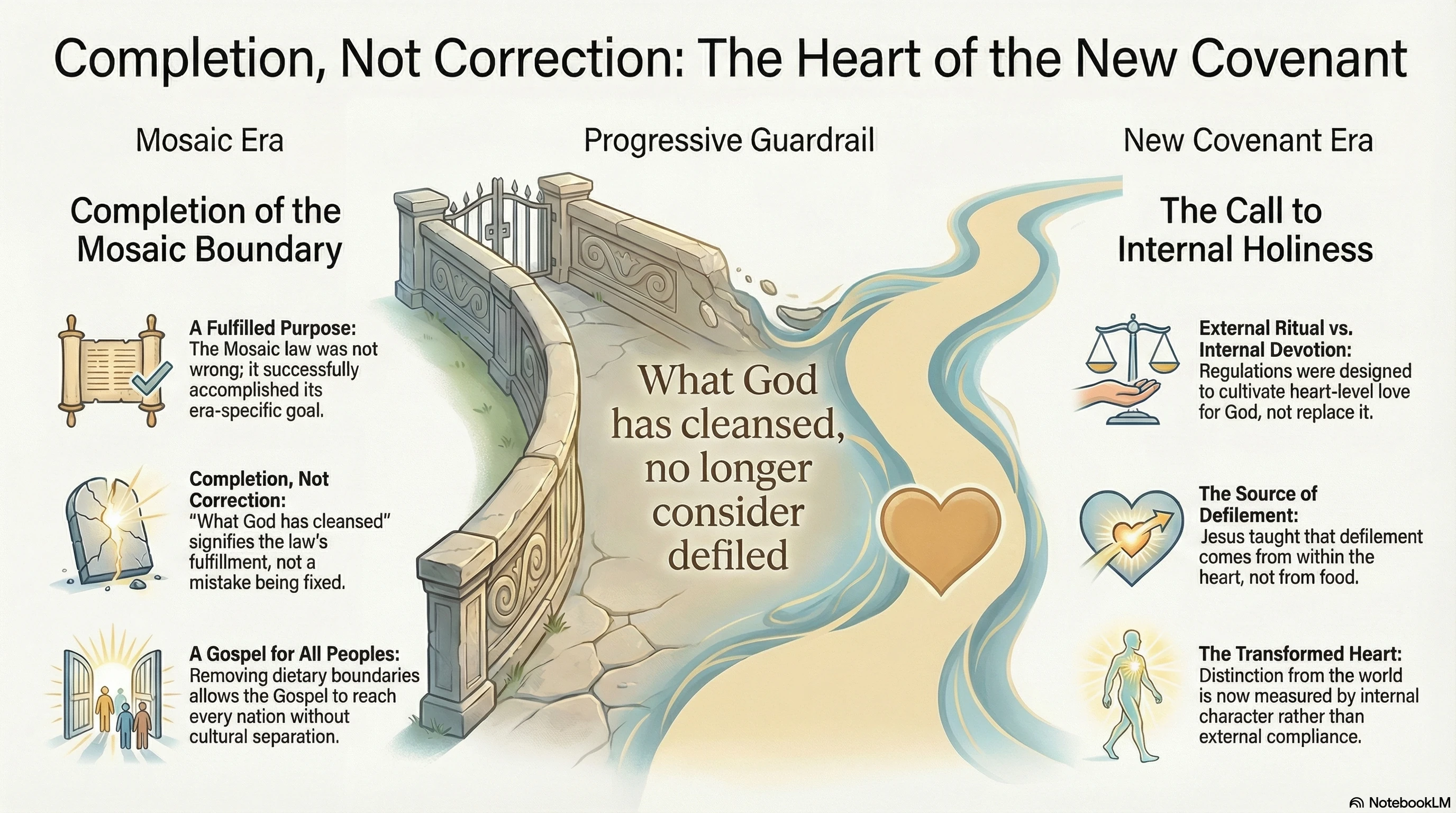
Jesus declared all foods clean not because the Mosaic law was wrong, but because it had accomplished its purpose. The Progressive Guardrail shows us that "What God has cleansed, no longer consider defiled" is not a correction: it is a completion. The Gospel is now for all peoples, and the dietary boundaries that once marked the separation between Israel and the nations have fulfilled their role.
But do not mistake the removal of the external boundary for the removal of the call. The heart was always the point. Even in the Mosaic covenant, God commanded Israel to love Him with all their heart, soul, and might (Deuteronomy 6:5). The external regulations were never meant to replace that interior devotion; they were designed to express and cultivate it.
Israel drifted toward external compliance and missed the heart beneath the law. Jesus did not introduce a new standard in Mark 7. He called His people back to the one that was always there, and made it unmistakably clear: God's people are to be holy and distinct, living differently from the world around them. That distinction has always been measured in the heart. It still is. And if we are honest, the temptation to settle for external compliance rather than internal transformation is not an ancient Israelite problem. It is ours too.
Walking with the Teacher: How the Guardrails Work Together
The Progressive Guardrail does not stand alone. In every stage of the food example we have just traced, at least one other guardrail was essential.
The Contextual Guardrail was at work in every stage: we had to read each passage in its surrounding narrative to understand what God was doing in that specific moment, not just what the verse said in isolation. The Literal Guardrail reminded us that Genesis is narrative, Leviticus is law, Mark is Gospel, and Acts is narrative, and that reading each in light of its genre kept us from misapplying the content. The Exegetical Guardrail pressed us to draw out what each Author placed in each text rather than projecting our modern assumptions onto ancient commands. And the One-Meaning Guardrail kept us from deciding that the Levitical dietary laws "mean something different" to us today when what they actually mean is what they always meant: specific instructions for a specific covenant people in a specific era.
Every guardrail depends on the others. Remove the Progressive Guardrail, and the system produces confusion or legalism. Remove the Contextual Guardrail, and even the progressive reading becomes disconnected from the situations it was meant to address.
This is the architecture of faithful reading: not a single tool applied in isolation, but a community of guardrails working together, each protecting the reader from a different angle of error, and all of them confirming the same unified story.
And beneath the whole system is the same conviction: the Word is one story, told by one Author, speaking with one voice, who was always moving toward one destination. That Author stands ready to help every faithful reader receive what He placed in every stage:
8 For by grace you have been saved through faith, and this not of yourselves, it is the gift of God; 9 not of works, so that no one may boast. 10 For we are His workmanship, created in Christ Jesus for good works, which God prepared beforehand so that we would walk in them.
We now live in the era of fulfillment. By grace, through faith, in the One who completed every stage of the progressive plan. And within that era, we are called to walk in the good works God prepared beforehand.
But what does that walking look like? The timeless abiding principle has not changed. God's people are to be holy and distinct, living differently from the world around them, not through dietary restrictions and covenant boundary markers, but through transformed hearts, renewed minds, and lives that visibly reflect the image of God to a dying world. The specific expressions change as the story advances. The call beneath them never does.
The Progressive Guardrail is not just an interpretive tool. It is a reminder of where we stand in the story: on the other side of the fulfillment, called to walk in everything the entire progression was building toward. And when every stage of that progression is held together, from Genesis to Revelation, what emerges is not contradiction but harmony. That is where we are headed in the next lesson.
Engage the Text: Ephesians 2:8–10
- In verses 8–9, Paul names three things that salvation is NOT of: ourselves, our works, and our boasting. What is it of? And what does he call it in verse 8?
- In verse 10, Paul uses the word "workmanship" to describe who we are. What does that word suggest about the relationship between the Creator and the created?
- Paul says the good works we are to walk in were "prepared beforehand." How far back does "beforehand" reach? How does this connect to the progressive nature of God's plan?
- The Progressive Guardrail has shown us that we now live in the era of New Covenant fulfillment, the era Ephesians 2:8–10 describes. How does knowing WHERE you are in the story change how you understand the "good works" you are called to walk in? Are they the Mosaic law's specific instructions, or something else?
- The Contextual Guardrail, the Literal Guardrail, the One-Meaning Guardrail, and the Progressive Guardrail all worked together in the food example. Which one do you find yourself most naturally applying already? Which one do you most need to strengthen?
- Paul says God "prepared beforehand" the good works we are to walk in. This is the language of a progressive plan: God was preparing, stage by stage, the life we are now called to live. How does viewing your obedience as walking in what God already prepared change the way you approach your daily decisions?
- Look back at the four stages of the food example. Which stage surprised you most, and why? What does your surprise reveal about a prior assumption you were carrying?
- Paul says we are God's "workmanship, created in Christ Jesus." We are not our own authors. How does the humility of that description connect to the humility required to read the whole Bible on the Author's terms, using guardrails rather than our own instincts?
- We are now living in the era the entire progressive plan was building toward. What is one thing about your current life in Christ, one freedom, one invitation, one calling, that you can now receive more fully because you understand the story behind it?
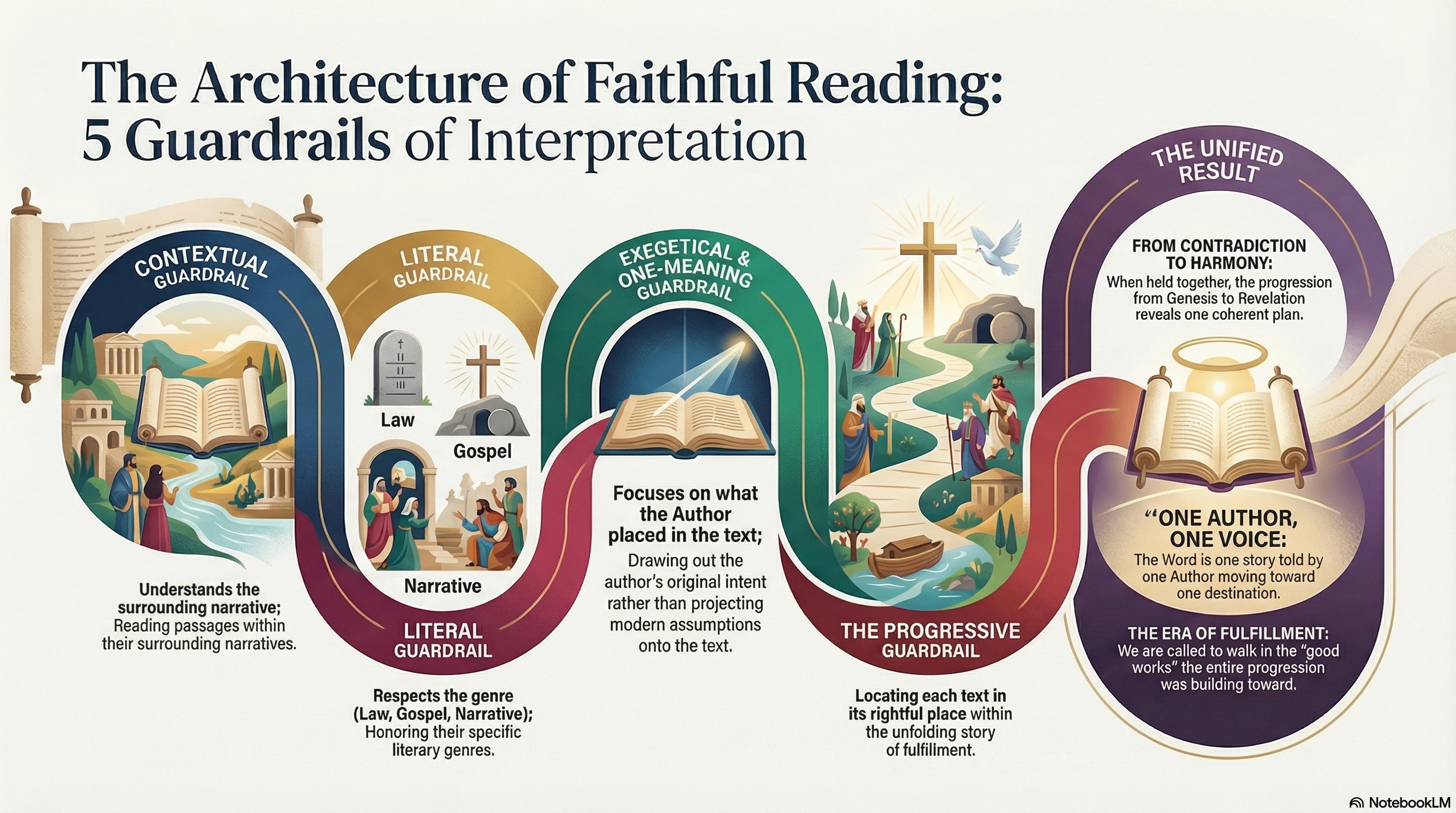
The guardrails were never meant to be used one at a time. They are a system, and the food example has shown exactly how they work together: the Contextual Guardrail kept each passage in its narrative world, the Literal Guardrail honored its genre, the Exegetical Guardrail drew out what the Author placed there, the One-Meaning Guardrail held the original intent in place, and the Progressive Guardrail located each text in its rightful place in the story. Remove any one of them and the reading drifts. Hold them together and the story comes into focus: one Author, one voice, one coherent plan moving toward fulfillment. We now live on the other side of that fulfillment, called to walk in what every stage was building toward. That is not a burden. That is an inheritance.
Final Invitation: The Joy of Hearing Him Clearly
The Progressive Guardrail resolves confusion. But its deeper gift is confidence: the quiet assurance that the God you are abiding in has been faithful across every era of human history, and that He has never once been surprised by how His plan unfolded.
When you read Genesis and find provision, Leviticus and find holiness, Mark and find fulfillment, and Acts and find the Gospel breaking past every boundary, you are not reading a book full of competing instructions. You are reading the testimony of a God who kept every word He ever spoke, across centuries, through nations, in every covenant He made:
9 "You shall know therefore that Yahweh your God, He is God, the faithful God, who keeps His covenant and His lovingkindness to a thousand generations with those who love Him and keep His commandments;
A thousand generations. Not one era. Not one covenant. A thousand generations of faithfulness, moving always toward the same destination. The Progressive Guardrail is what lets you stand in that long line of people whom God has been keeping His covenant with, and say: He was faithful then. He is faithful now. He will be faithful in every stage to come.
And the invitation we have received in this era, the era of fulfillment and New Covenant, is not a burden. It is the lightest and most liberating calling the progressive plan has ever produced:
1 Everyone who believes that Jesus is the Christ has been born of God, and everyone who loves the One who gives new birth loves also the one who has been born of Him. 2 By this we know that we love the children of God, when we love God and do His commandments. 3 For this is the love of God, that we keep His commandments; and His commandments are not burdensome. 4 For everything that has been born of God overcomes the world; and this is the overcoming that has overcome the world — our faith. 5 Who is the one who overcomes the world, but he who believes that Jesus is the Son of God?
"His commandments are not burdensome." This is the voice of the New Covenant era, spoken from the other side of the fulfillment. The entire weight of Mosaic ceremony, sacrifice, and separation has been absorbed by the One who fulfilled it. What remains is the love of God expressed in a life of faithful discipleship: believing in Jesus, loving God, caring for His people, and walking in the good works He prepared beforehand.
This is the room the entire progressive plan was building toward. The Progressive Guardrail gives you the eyes to see that you are already in it. God wants to reveal Himself to you more than you want to know Him, and He has been preparing this revelation since long before you arrived. Walk in it.
Engage the Text: Deuteronomy 7:9 and 1 John 5:1–5
- In Deuteronomy 7:9, what three descriptions does Moses give to Yahweh? What time span does he use to express the faithfulness of God's covenant? And what conditions does he describe on the human side?
- In 1 John 5:2–3, what does John say is the evidence that we love the children of God? What does he immediately clarify about the nature of those commandments?
- In 1 John 5:4–5, what is "the overcoming that has overcome the world"? And what is the specific content of that faith?
- Deuteronomy 7:9 was spoken to Israel at a specific moment in the progressive plan. 1 John 5:1–5 was written to believers in the era of New Covenant fulfillment. Both passages speak about a people who love God and keep His commandments. How does the Progressive Guardrail help you hold these two passages together: the same calling, expressed in two different eras, showing the coherence of the whole story?
- 1 John 5:3 says His commandments are "not burdensome." The Mosaic law carried enormous ceremonial, civil, and sacrificial weight. The New Covenant has not added to that weight: it has absorbed it in Christ. How does understanding the progressive plan make 1 John 5:3 ring more true rather than feeling like an exaggeration?
- Both passages connect faithfulness to God with love, both for God and for His people. How does the Progressive Guardrail, which shows us that God has been faithfully keeping His commitments across every era, shape the way we return that faithfulness? What does "keeping His commandments" look like for someone who knows they are living in the era of fulfillment?
- Deuteronomy 7:9 says God keeps His covenant to "a thousand generations." You are one of those generations. How does standing in that long line of faithfulness, and knowing that God has never abandoned a single generation He committed to, strengthen your own confidence in abiding with Him?
- 1 John 5:4 says "everything that has been born of God overcomes the world." The four stages of the food example showed us a God who kept moving His plan forward through the flood, through Egypt, through the cross, and through an upper room in Joppa. What "world" are you facing right now, and how does the God who has been faithful through all of those stages speak into it?
- The entire progressive plan, from creation to covenant to fulfillment, was building toward the invitation John describes: believing in Jesus, loving God, overcoming the world by faith. You have received the invitation. What does it look like today, in your specific life, to walk in the era the whole story was building toward?
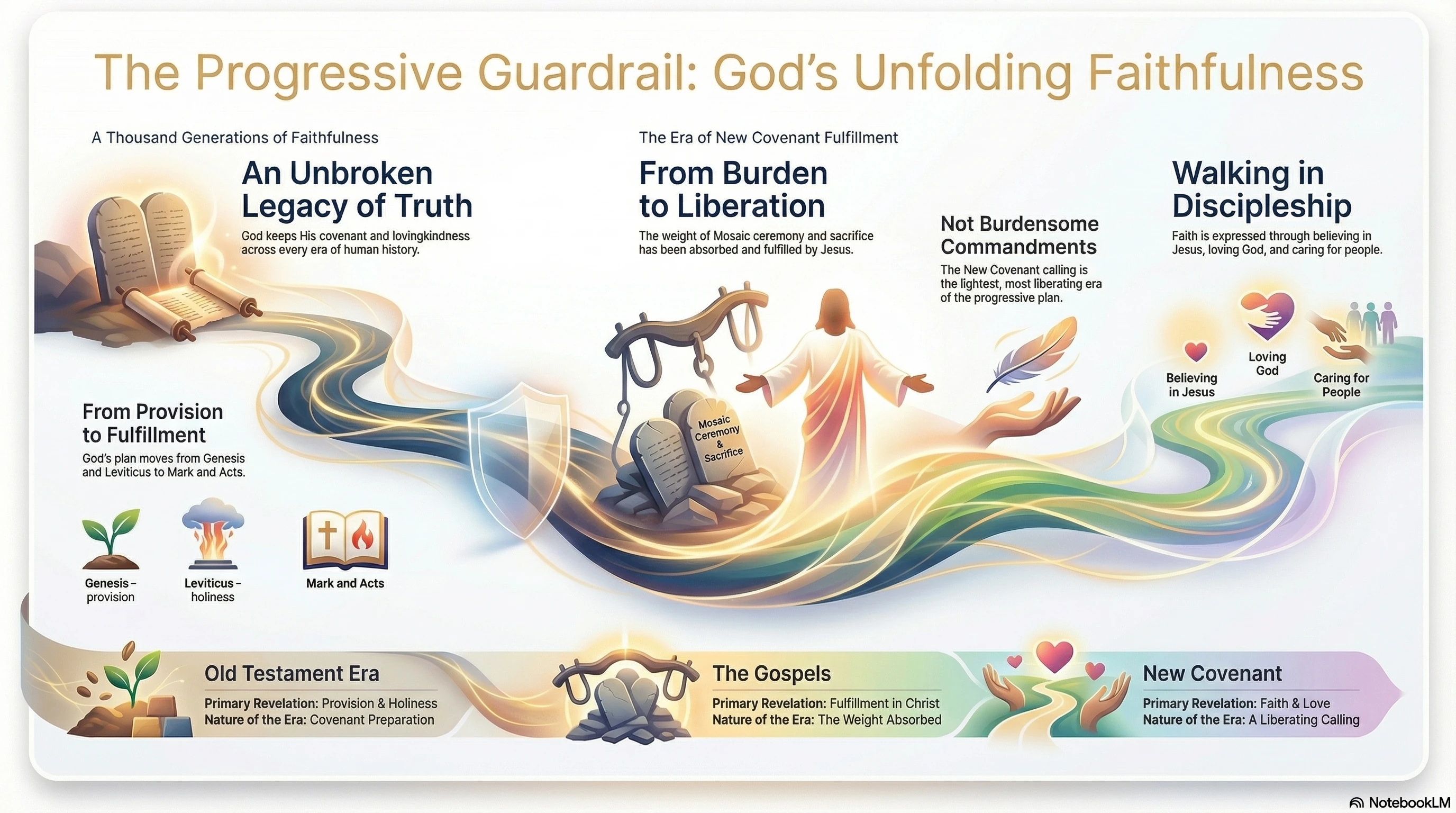
May you find clarity where there was confusion. May every passage you read come into focus as a chapter in a story that has been moving toward you since the beginning. May the God who kept His covenant through every era keep you confident that you are standing in the room He always intended to build.
Meditate and Obey. Study and Apply. Hear and Do.
This is how we abide in Christ. This is how we demonstrate our love for God.
Scripture quotations marked Berean Standard Bible (BSB) or Majority Standard Bible (MSB) are taken from texts that have been dedicated to the public domain. Free resources are available at BereanBible.com and MajorityBible.com.
Scripture quotations taken from the (LSB®) Legacy Standard Bible®, Copyright © 2021 by The Lockman Foundation. Used by permission. All rights reserved. Managed in partnership with Three Sixteen Publishing Inc. LSBible.org and 316publishing.com.