The Harmony Guardrail
How reading every passage in light of what the whole of Scripture says protects us from false contradictions and opens the single, unified truth of God's Word.
Published April 5, 2026 · Updated October 3, 2026
In this lesson · 7 sections
- Section 1The Heart of Abiding: An Invitation to the Word
- Section 2The Harmony Guardrail: One Author, One Story
- Section 3Two Questions That Dissolve the Contradiction
- Section 4Practice Case 1: Faith and Works
- Section 5Practice Case 2: The Sign That Waited
- Section 6Walking with the Teacher: How the Guardrails Work Together
- Section 7Final Invitation: The Joy of Hearing Him Clearly
The Heart of Abiding: An Invitation to the Word
You are reading your Bible one morning, feeling settled in your study. Then you move from one epistle to another and land on two passages that seem to pull in opposite directions. One tells you that salvation is entirely by grace, with nothing from your own effort. The other tells you that a person is justified by works and not by faith alone. You read them again. They still seem to contradict each other.
If that moment has ever made you close the book, or set it down and wonder what you are missing, you are in good company. This is one of the most common places where sincere, faithful readers feel the ground shift. That experience is not a sign that something is wrong with your faith. It is an invitation to pick up a guardrail that has been waiting for you.
This Abide Discovery Session introduces the Harmony Guardrail: the conviction that any interpretation of a Bible passage must agree with the rest of the Bible, because the entire Scripture is a unified message from one divine Author. Before we examine the apparent tension in any passage, the question worth asking first is not "which verse wins?" It is: what kind of God wrote this? The Apostle John gives us the foundation:
5 And this is the message we have heard from Him and declare to you, that God is Light, and in Him there is no darkness at all. 6 If we say that we have fellowship with Him and yet walk in the darkness, we lie and do not do the truth; 7 but if we walk in the Light as He Himself is in the Light, we have fellowship with one another, and the blood of Jesus His Son cleanses us from all sin.
John is not speaking poetically in a loose sense. He is making a claim about God's nature that has enormous implications for how we read His Word. God is Light. There is no darkness in Him. No inconsistency. No self-contradiction. No revision of the record. His character is perfectly unified, and because the Bible is the product of His breath, the book that comes from Him shares that unity. When we find what looks like a contradiction in Scripture, the problem is not in the Bible. It is in our interpretation. The Harmony Guardrail is the tool that helps us find where we went off course.
Engage the Text: 1 John 1:5–7
- John opens by saying "this is the message we have heard from Him and declare to you." What does his introduction tell you about the source and certainty of the claim he is about to make?
- What does the phrase "no darkness at all" communicate about the completeness of God's light? Does John leave any partial exception in God's character?
- In verses 6 and 7, John sets up two contrasting ways of living. What is the outcome for the person walking in darkness, and what is the outcome for the person walking in the light?
- What does John say fellowship with God requires? How does the blood of Jesus factor into that condition in verse 7?
- If God is Light with no darkness in Him, what does that tell us about the possibility of genuine contradiction within His Word? How does this truth function as the theological foundation for the Harmony Guardrail?
- When a reader encounters two passages that seem to contradict each other, the Harmony Guardrail says the problem lies in interpretation, not in the text. How does John's description of God's nature support that claim?
- Verse 7 says that walking in the light leads to fellowship and cleansing. Working carefully through an apparent contradiction, rather than dismissing it, is one form of walking in the light. How does that discipline reflect the posture John is describing?
- The Harmony Guardrail asks us to trust that Scripture is coherent even before we have fully resolved a difficulty. How does faith in the God described in verse 5 make that kind of patient trust possible?
- Think of a passage or biblical topic that has seemed contradictory or confusing to you. How does the truth of 1 John 1:5 change how you approach that difficulty? Does knowing God has no darkness in Him shift your posture toward the text?
- Have you ever abandoned a question in your Bible study rather than working through it? What would it look like this week to return to that question with the Harmony Guardrail as your tool?
- John connects walking in the light to honest community: "we have fellowship with one another." Is there someone in your life with whom you could study a difficult passage together? How might shared study help you find the harmony you have been missing?
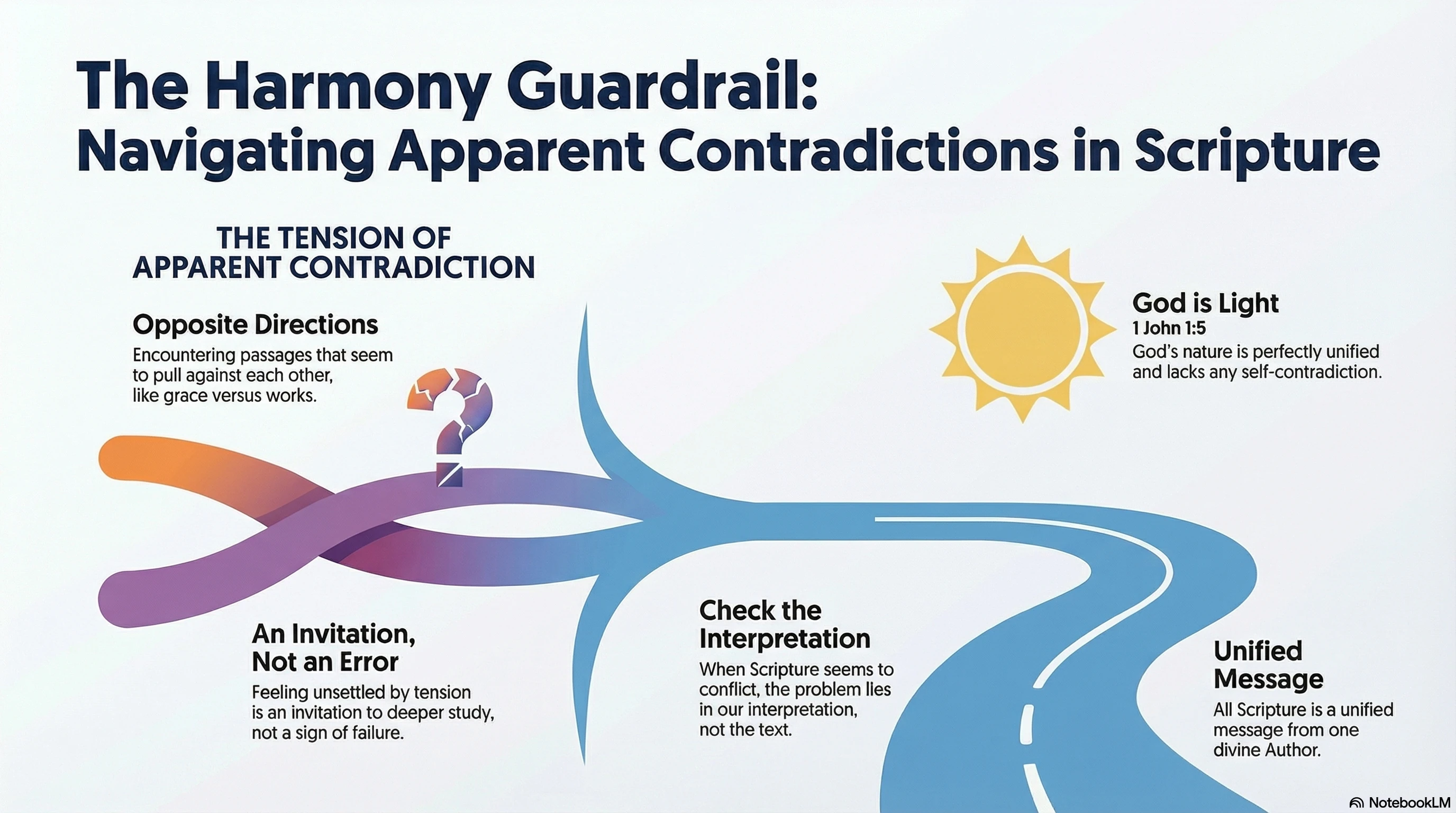
The Harmony Guardrail is not wishful thinking. It is grounded in the character of God Himself. Because God is Light with no darkness at all, His Word cannot ultimately contradict itself. When we find an apparent contradiction, the invitation is not to doubt the Bible. It is to dig deeper until the harmony reveals itself.
The Harmony Guardrail: One Author, One Story
Do clear passages elsewhere agree with my reading?
The Harmony Guardrail holds that any interpretation of a Bible passage must agree with the rest of the Bible, because the entire Scripture is a unified message from one divine Author.
This guardrail is built on a truth so simple it is easy to miss: the Bible was not written by committee. Many human authors, yes, across many centuries and cultures. But behind every human pen was one Author whose plan never changed, whose character never shifted, and whose story was moving toward one destination. When we say that God is the Author of all Scripture, we are saying that every verse in every book belongs to one story. One story, told by one Author, does not ultimately contradict itself.
This is what we mean when we say "Scripture interprets Scripture." If a verse is unclear, the best commentary on it is the rest of the Bible. If a passage seems to say something startling, we look to the whole of God's Word to understand what it actually means. We do not pull a single thread out of the tapestry and call it the whole picture.
Jesus Himself affirmed this conviction in the Sermon on the Mount. He did not come to discard what had been written but to fulfill it, and He called every word of Scripture authoritative:
19 "Whoever then annuls one of the least of these commandments, and teaches others to do the same, shall be called least in the kingdom of heaven; but whoever does and teaches them, he shall be called great in the kingdom of heaven.
Notice what Jesus is doing here. He is not saying that every Old Testament command applies in exactly the same way in the New Covenant era. He is saying that every word God spoke carries weight, that nothing in the canon is throwaway, and that the person who takes all of Scripture seriously is the one who walks with integrity in the kingdom. He sees the whole Bible as a unified, authoritative body of revelation. The Harmony Guardrail follows directly from that conviction.
Engage the Text: Matthew 5:19
- Jesus describes two kinds of people in this verse. What is the difference between what each person does, and what are their respective outcomes in the kingdom of heaven?
- What does the phrase "even the least of these commandments" tell us about how Jesus views the scope of Scripture? Does He assign different levels of authority to different portions of God's Word?
- Jesus pairs doing and teaching together. What does this pairing tell us about the relationship between personally obeying the Word and helping others understand it?
- The Harmony Guardrail depends on the conviction that the whole Bible is authoritative and unified. How does Jesus' statement in Matthew 5:19 provide the doctrinal foundation for treating every part of Scripture as part of one coherent story?
- If someone dismissed portions of the Old Testament as no longer relevant, how would Matthew 5:19 challenge that approach? What would the Harmony Guardrail add to the discussion?
- Jesus' statement assumes that the commandments He references all belong to the same body of authoritative teaching. How does this help us understand why Scripture can interpret Scripture, rather than requiring us to go outside the Bible to resolve apparent contradictions?
- Are there portions of the Bible you tend to skip over because they feel disconnected from your life or faith? How does Jesus' affirmation of "the least of these commandments" change how you view those passages?
- Jesus calls someone great in the kingdom who both does and teaches the commandments. In your current Bible engagement, are you working toward both: obeying what you read and being prepared to explain it to others? Which side needs more attention right now?
- This week, make it your practice to read one passage and ask: how does this fit into the larger story of Scripture? Write down one connection you discover between the passage and another part of the Bible.
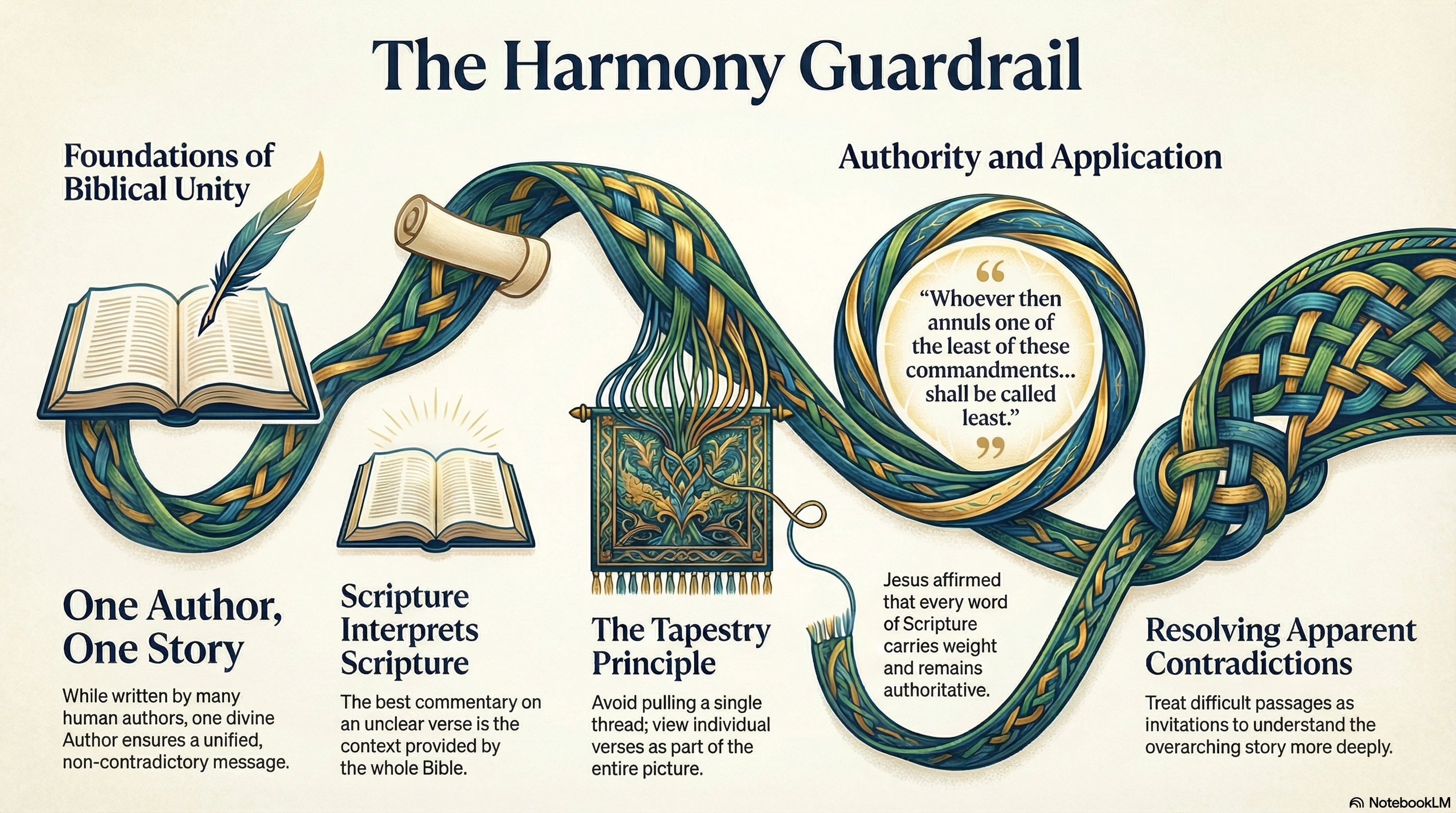
The Harmony Guardrail is simply taking seriously what Jesus already believed: that every word God spoke belongs to one story, told by one Author, moving toward one destination. When we bring that conviction to Bible study, apparent contradictions become invitations to understand the whole story more deeply.
Two Questions That Dissolve the Contradiction
The Harmony Guardrail becomes a practical tool the moment we learn to apply it. When two passages seem to clash, the faithful reader does not choose one over the other. Instead, two diagnostic questions go to work.
Question 1: Who is writing, and to whom?
Every Bible passage was written by a specific human author, addressing a specific audience with a specific need. Paul was not James, and James was not writing to the same people Paul was addressing. When we understand the author's situation and his readers' circumstances, passages that seemed to fight each other often turn out to be answering different questions. They are not contradicting each other. They are completing each other.
Question 2: What genre am I reading?
The Bible contains many types of writing: historical narrative, poetry, prophecy, wisdom literature, epistle, and apocalyptic. Genre shapes how a passage communicates. A prophecy communicates differently than a letter. A psalm expresses differently than a law code. When we confuse genres, we create contradictions that were never there. When we honor genre, we allow each passage to do the work it was designed to do.
These two questions are already built into the Literal Guardrail and the Contextual Guardrail. The Harmony Guardrail builds on both of them. All seven guardrails work together. None of them works well alone. As we practice bringing each one to bear, the harmony of God's Word becomes more visible, not less.
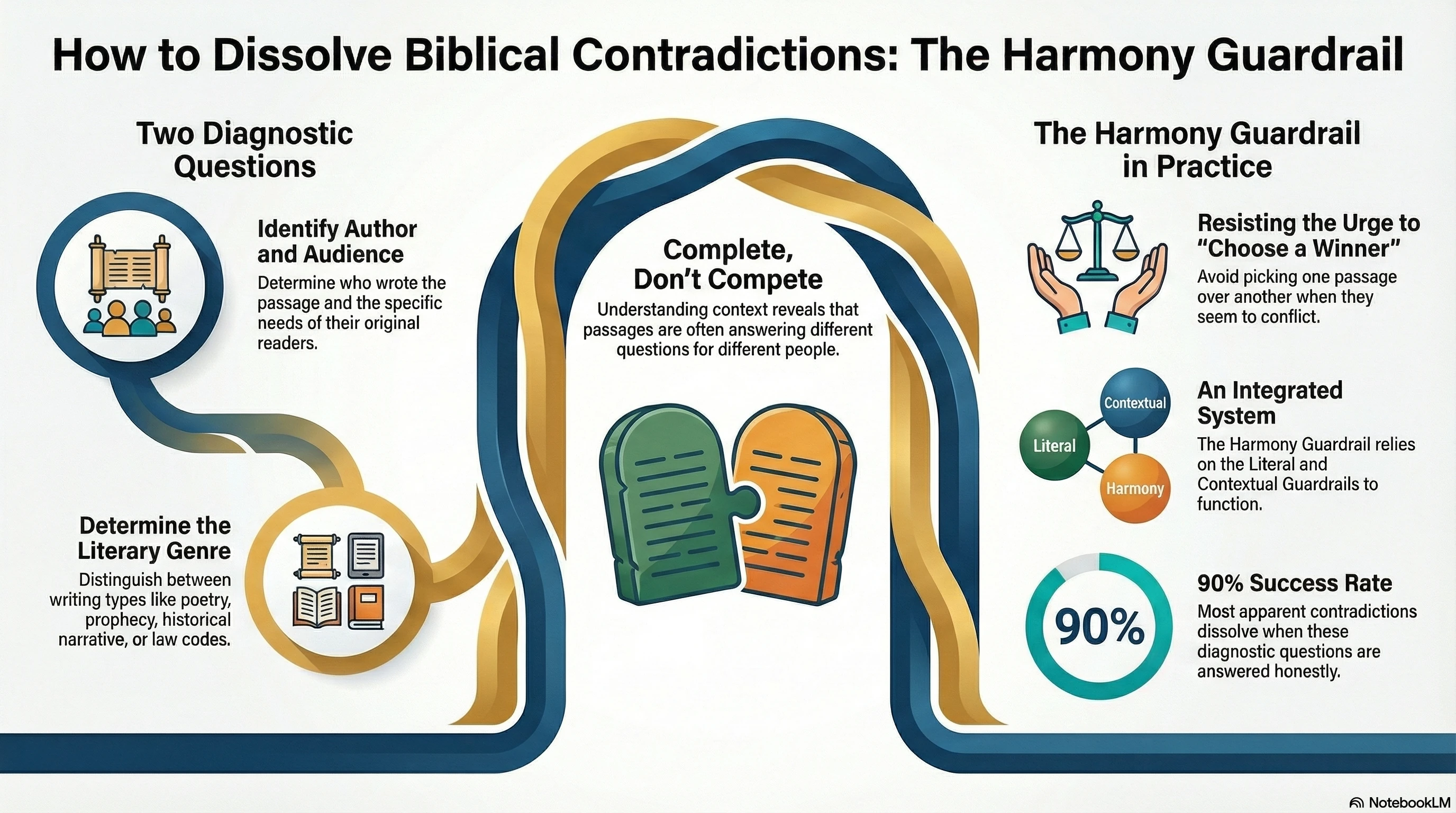
When two passages seem to contradict each other, resist the urge to choose a winner. Ask instead: who was writing, to whom, and in what genre? Nine times out of ten, the apparent contradiction dissolves when those questions are answered honestly. This is the Harmony Guardrail doing its work.
Practice Case 1: Faith and Works
This is the most well-known apparent contradiction in the New Testament, and it has caused real confusion for many faithful readers. Let us work through it together, using the two diagnostic questions.
Paul writes to the church in Ephesus:
8 For by grace you have been saved through faith, and this not of yourselves, it is the gift of God; 9 not of works, so that no one may boast.
Then James writes this in his epistle:
24 You see that a man is justified by works and not by faith alone.
At first glance, this looks like a head-on collision. Paul says not by works. James says by works and not by faith alone. Which one is correct?
Both of them are. Here is why.
Question 1: Who is writing, and to whom?
Paul's audience was likely people who believed they could earn God's acceptance through their own moral effort or religious law-keeping. His task was to correct that error at the root: salvation is entirely God's gift, received through faith alone. Works play no role in purchasing it.
James's audience was in a completely different situation. His readers claimed to have faith but showed no evidence of it in the way they lived. James was not addressing how a person gets saved. He was addressing how a person proves, to themselves and to others, that their faith is genuine. A faith that produces no change, no action, no love, is not the saving faith Paul described. It is a dead imitation.
Question 2: What kind of justification is each author describing?
Paul is describing justification before God: the legal declaration that a sinner is righteous in God's sight, which comes entirely through faith in Christ. James is describing justification before others: the visible evidence, the lived-out demonstration, that a person's faith is real. Abraham was declared righteous by God in Genesis 15 through faith. He demonstrated that righteousness to others by offering Isaac on the altar in Genesis 22. The two moments are decades apart. The two kinds of justification are not in competition. They are describing different facets of the same truth.
The Harmony Guardrail resolves the tension: Paul describes how we are saved. James describes what saving faith looks like in action. Works do not earn salvation. But genuine saving faith will inevitably produce works as its fruit. The two authors are not fighting. They are building one complete picture together.
Engage the Text: Ephesians 2:8–9 and James 2:24
- In Ephesians 2:8–9, Paul uses the phrase "not of yourselves." What is he ruling out, and what is he protecting?
- Paul says no one may "boast." What kind of attitude toward salvation would boasting represent? Why does grace eliminate it entirely?
- James says a man is justified "by works and not by faith alone." Read James 2:14–17 in your Bible for broader context. What kind of faith is James critiquing, and what is wrong with it?
- Paul is answering the question "how does a person come to be right with God?" James is answering the question "how do we recognize whether faith is genuine?" These are different questions. How does identifying the different questions these authors are answering dissolve the apparent contradiction between them?
- The Harmony Guardrail says that when two passages seem to clash, we look for the single truth that both are pointing toward. What is the unified truth that Paul and James together reveal about the relationship between faith and works?
- How does applying the Contextual Guardrail, knowing the audience each author was addressing, serve the Harmony Guardrail in this example? What would happen to our interpretation if we ignored the different contexts?
- Have you tended to lean on Paul's side or James's side of this discussion? What has that imbalance cost you in your understanding of the Christian life?
- The unified truth is this: we are saved by grace through faith alone, but the faith that saves us is never alone. It always produces fruit. Which side of this truth needs more attention in your life right now: trusting God's free gift, or living out its evidence?
- This week, identify one "work" that your faith is calling you toward but that you have been postponing. What would it look like to take one step toward it?
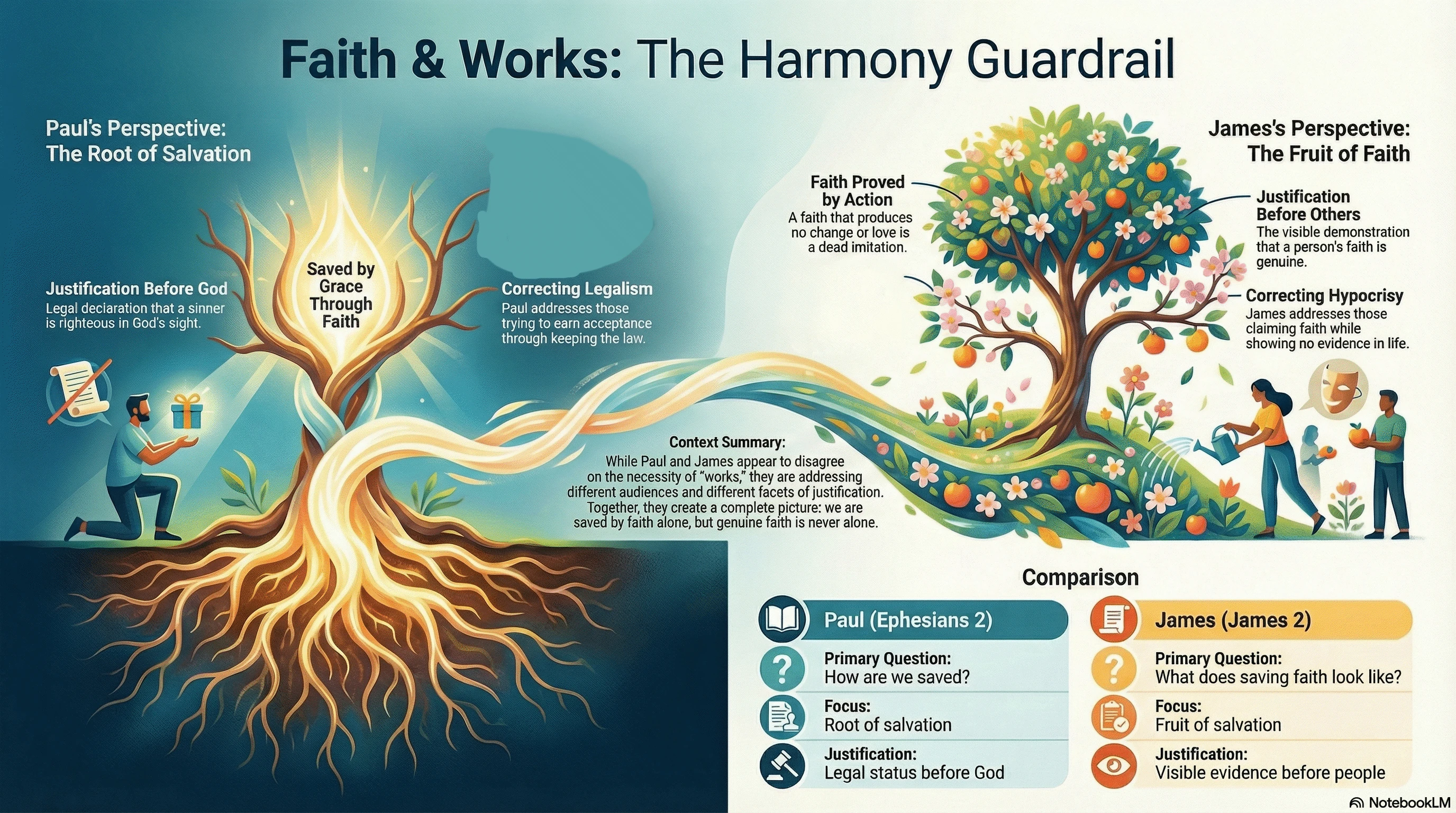
Paul and James are not contradicting each other. They are completing each other. Paul tells us how we are saved: by grace through faith alone. James tells us what that saving faith looks like when it is real: it works. The Harmony Guardrail keeps us from choosing one at the expense of the other and losing half the picture.
Practice Case 2: The Sign That Waited
The second way the Harmony Guardrail protects us is by showing how later parts of the Bible shed light on earlier parts. This is the principle we sometimes call the Bible being its own best commentary, and the clearest example in this session is one of the most beloved prophecies in all of Scripture.
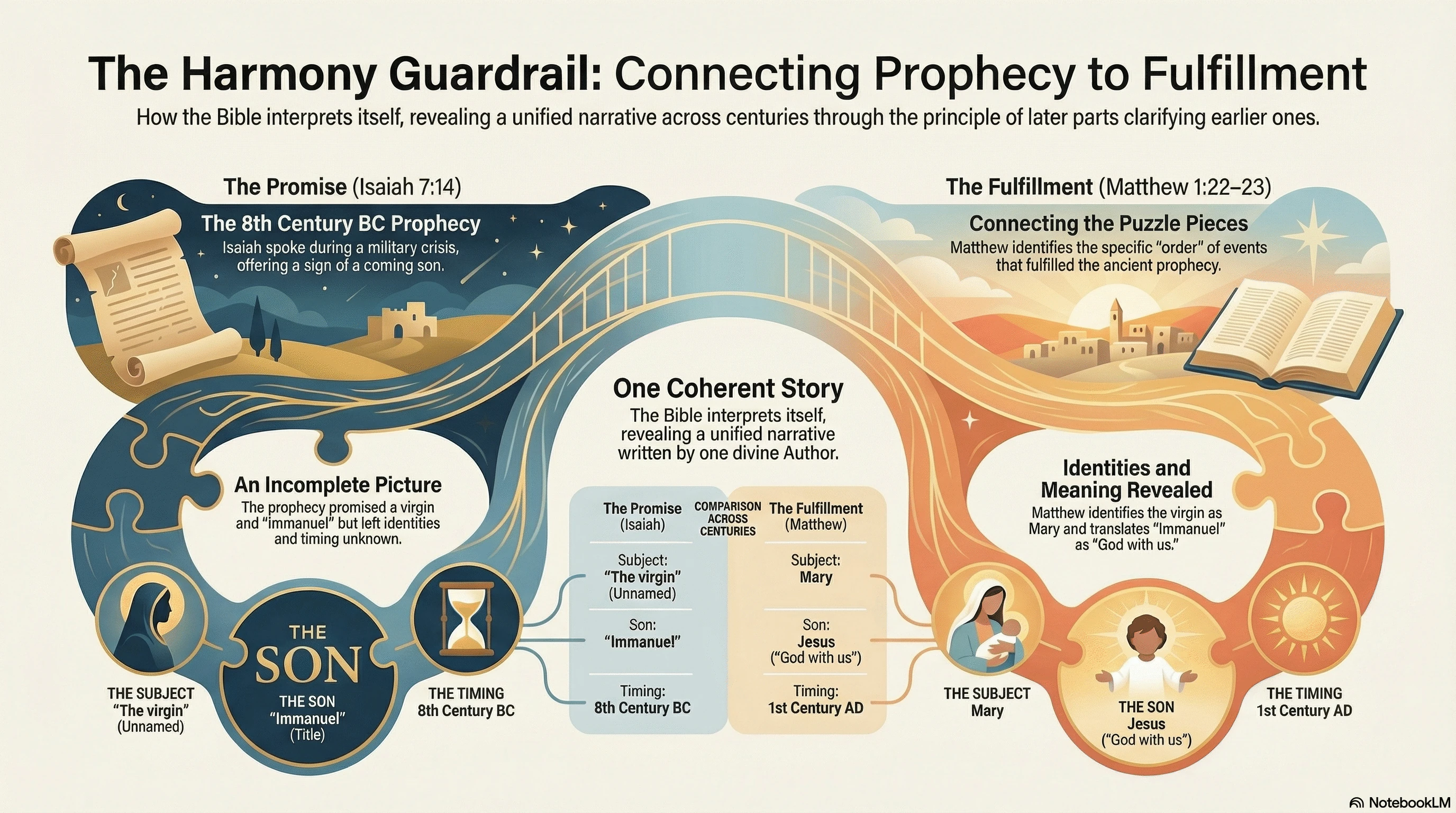
Isaiah was a prophet in the eighth century before Christ. He wrote to the southern kingdom of Judah during a time of military threat and political anxiety. In the middle of that moment, he spoke a word that was clearly pointing beyond his own generation:
14 "Therefore the Lord Himself will give you a sign: Behold, the virgin will be with child and bear a son, and she will call His name Immanuel."
If you read this verse in isolation from the rest of Scripture, you have a piece of a picture. A sign is coming. A virgin. A son. A name that means "God with us." But you cannot yet tell who the virgin is, when this will happen, or how it will be fulfilled. The prophecy is waiting. The puzzle piece is real and beautiful, but the completed picture is not yet visible.
Now the Harmony Guardrail does something remarkable. It invites us to let the rest of Scripture speak. Roughly seven hundred years later, Matthew writes the account of Jesus' birth. And he pauses specifically to connect Isaiah's prophecy to what he is witnessing:
22 Now all this took place in order that what was spoken by the Lord through the prophet would be fulfilled, saying, 23 "Behold, the virgin shall be with child and shall bear a Son, and they shall call His name Immanuel," which translated means, "God with us."
Three things happen in these two verses that the Harmony Guardrail makes possible.
First, Matthew identifies the prophecy. He does not claim this is a loose echo of Isaiah's words. He says the events of Jesus' birth happened "in order that" the prophecy "would be fulfilled." This is direct, unambiguous fulfillment language.
Second, Matthew identifies the people. The virgin in Isaiah's prophecy is Mary. The son is Jesus. What was unnamed in the eighth century BC now has a face and a name.
Third, Matthew translates the promise. He does not assume his readers know what Immanuel means. He tells them: "God with us." The promise that hung in the air for centuries, waiting for its meaning to become clear, is now fully explained by the text itself. The Bible interpreted itself.
This is the Harmony Guardrail working precisely. We do not need an outside source to explain Isaiah 7:14. We need the rest of the Bible. The Old Testament gives us the promise. The New Testament shows us its fulfillment. Together they reveal a picture so precise, so unified, that the only adequate explanation is one divine Author who knew how the story would end from the moment He gave the first clue.
Engage the Text: Isaiah 7:14 and Matthew 1:22–23
- In Isaiah 7:14, what specific elements of the sign does God provide: the person involved, the event, and the name? What is not yet explained in the verse itself?
- In Matthew 1:22–23, what does Matthew explicitly say the purpose of the events surrounding Jesus' birth was? What word does he use to link the prophecy to the fulfillment?
- Matthew translates the name Immanuel for his readers. What does this tell you about how Matthew understands the relationship between the Old and New Testaments? Is he treating them as separate books or as one continuous story?
- Isaiah 7:14 was a genuine prophecy that awaited fulfillment for roughly seven hundred years. How does the Harmony Guardrail train us to hold an Old Testament promise with confidence, even when it is not yet fully explained within its own context?
- Matthew says the events of Jesus' birth happened "in order that" the prophecy would be fulfilled. The fulfillment was not accidental or loosely parallel; it was intentional. What does this level of precision say about the nature of the Author who was working across both books?
- The Harmony Guardrail says that the Bible is its own best commentary. Matthew's interpretation of Isaiah is the Bible interpreting itself. How does this give you a model for your own Bible study? When you do not understand a verse, where should you look first?
- Isaiah wrote in the genre of prophecy and poetry; Matthew wrote in the genre of historical Gospel narrative. How did honoring the distinct genre of each passage allow the Harmony Guardrail to do its work?
- Is there a promise in the Old Testament that you have read but never found its New Testament fulfillment? This week, choose one Old Testament prophecy and trace it forward into the New Testament. Write down what you discover.
- Matthew took the time to translate Immanuel for his readers: "God with us." What does it mean to you personally that God has not merely observed you from a distance, but has come to dwell with you? Let that truth settle before you move on.
- The Harmony Guardrail builds confidence: the same God who kept His word from Isaiah to Matthew will keep His word to you. Is there a promise from Scripture that you have been struggling to trust? How does the precision of this fulfilled prophecy speak to your doubt?
The Old Testament is not a mystery to be set aside once the New Testament arrives. It is the promise that the New Testament fulfills. When we let Scripture interpret Scripture, what emerges is not a collection of loosely related writings. It is one perfectly coherent story, told by one Author who always knew where it was going.
Walking with the Teacher: How the Guardrails Work Together
The Harmony Guardrail is the seventh guardrail in Abide 101, and there is a reason it comes last. It is not a tool that can stand alone. It is the place where all the other guardrails converge.
Think about what made the two practice cases in this session work.
In Practice Case 1, resolving the faith-and-works tension required the Literal Guardrail: recognizing that both Paul and James were writing in the Epistle genre, each shaped by a different occasion. It required the Contextual Guardrail: understanding the different audiences each author was addressing and the specific error each was correcting. And it required the One-Meaning Guardrail: holding each author to his single intended meaning rather than blending their messages into confusion.
In Practice Case 2, reading Isaiah 7:14 in light of Matthew 1:22–23 required the Progressive Guardrail: understanding that God reveals His truth across time, and that later Scripture builds on and clarifies earlier Scripture. It required the Literal Guardrail again: honoring the distinct genres of prophecy and Gospel narrative. And it required the Exegetical Guardrail: drawing meaning out of Matthew's text rather than reading assumptions back into Isaiah.
None of those guardrails worked in isolation. Every one of them served the Harmony Guardrail, and the Harmony Guardrail brought all of them to their proper conclusion.
This is why the Abide program describes Bible engagement as practice, not performance. Practice is exactly the right word. The Apostle Paul captures it this way:
9 The things you have learned and received and heard and seen in me, practice these things, and the God of peace will be with you.
The call is not to have mastered a set of tools. It is to practice them. And practice, by definition, means using the tools repeatedly, bringing them to bear on passage after passage, season after season, until they become second nature. You do not need to be a scholar to apply the Harmony Guardrail. You need to be someone who shows up and practices. The promise attached to that practice is remarkable: "the God of peace will be with you."
Peace is exactly what the Harmony Guardrail produces in your study of Scripture. Not the peace of having every question resolved at once, but the peace of knowing that the God who wrote this book has no darkness in Him, that His story does not contradict itself, and that every question you bring to the text in faith can be answered by the text, given time, practice, and the leading of the Holy Spirit.
Engage the Text: Philippians 4:9
- Paul tells the Philippians to practice "the things you have learned and received and heard and seen." Notice that his list involves multiple channels: learning, receiving, hearing, and seeing. What does this variety of channels suggest about how truth is acquired and internalized?
- The word "practice" implies repetition over time, not a one-time event. What does that tell us about the kind of Bible engagement Paul envisions? Is it an achievement to be reached or a rhythm to be maintained?
- Paul names God "the God of peace" in this verse. Why is that particular name fitting for someone who is working through difficult or apparently contradictory passages?
- Paul's call to practice "the things you have learned" connects to all seven guardrails. Go through the list: Literal, Contextual, One-Meaning, Exegetical, Linguistic, Progressive, and Harmony. For each one, identify one way it directly serves the Harmony Guardrail's work. What would be lost if any one of them were missing?
- The Harmony Guardrail brings the other six guardrails to their conclusion. How does this explain why the Harmony Guardrail appears last in Abide 101, rather than first? What has to be in place before harmony can be recognized?
- Paul says the God of peace "will be with" those who practice these things. The practice of faithful interpretation is not a solo exercise; it is done in the presence of the Author. How does that change the posture you bring to a difficult passage?
- When you sit down to study the Bible, do you reach for multiple guardrails intentionally? Or do you tend to use one approach and miss the others? Which guardrail is most underused in your current practice?
- The promise in Philippians 4:9 is not reserved for experts. It belongs to those who practice. What specific habit could you build into your weekly Bible study that would help you apply all seven guardrails more consistently?
- Is there someone in your life who is a model of faithful, well-rounded Bible study? What is one thing you have observed in them that you want to imitate? Consider telling them this week.
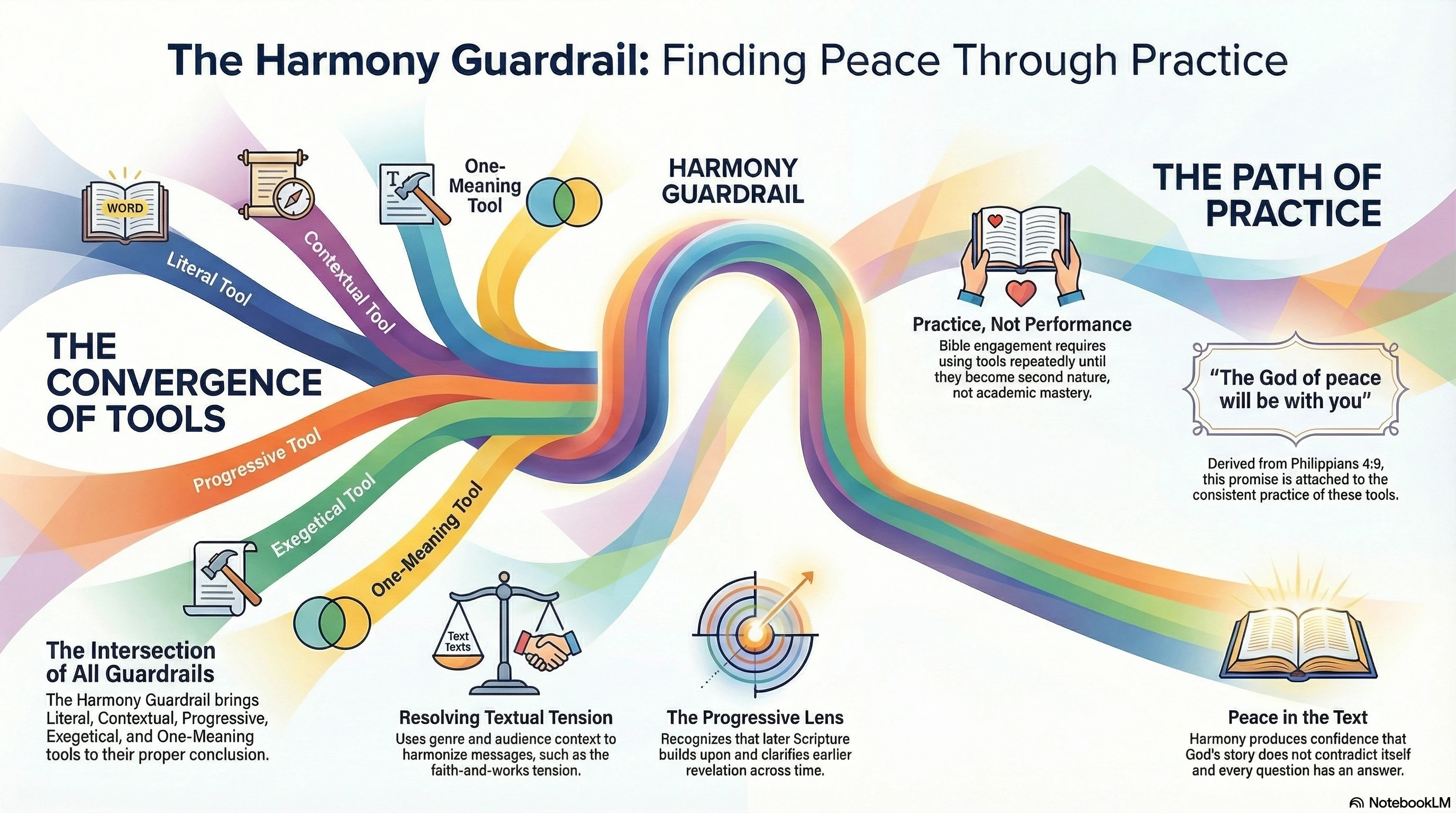
None of the guardrails works alone. The Harmony Guardrail is where all seven converge. And the path to using them well is not genius; it is practice. Show up. Bring the tools. And trust the promise: "the God of peace will be with you."
Final Invitation: The Joy of Hearing Him Clearly
You have reached the end of the guardrails section of Abide 101. Seven guardrails. Seven sessions of learning to protect your interpretation, to honor the text, to hear God's actual voice rather than a projection of your own assumptions.
And what does it all produce? Not a complicated method to manage. Not a checklist to perform before every study. It produces the capacity to hear Him more clearly. And hearing Him clearly is what makes Meditate & Obey, Study & Apply, and Hear & Do something more than a slogan. It is the fruit of a life rooted in the whole Word of God.
The psalmist understood this long before the guardrails had a name. He looked at a God whose works were unlike anything else in all of creation, and he could not be quiet about it. And then, at the center of his praise, he made a prayer that is exactly what every guardrail in this program has been asking you to make:
8 There is no one like You among the gods, O Lord, Nor are there any works like Yours. 9 All nations whom You have made shall come and worship before You, O Lord, And they shall glorify Your name. 10 For You are great and do wondrous deeds; You alone are God. 11 Teach me Your way, O Yahweh; I will walk in Your truth; Unite my heart to fear Your name. 12 I will give thanks to You, O Lord my God, with all my heart, And will glorify Your name forever. 13 For Your lovingkindness toward me is great, And You have delivered my soul from Sheol below.
Read verse 11 slowly. "Teach me Your way, O Yahweh; I will walk in Your truth; Unite my heart to fear Your name."
That phrase, "unite my heart," is the goal of every guardrail you have studied. A divided heart reads the Bible the way it reads everything else: looking for confirmation of what it already believes, picking what it likes and setting aside what costs it something. A united heart comes to the Word with full attention, ready to hear what God actually said, ready to let the whole of Scripture speak, ready to discover the harmony that is always there when every verse is allowed to belong to the one story God has been telling since the beginning.
God wants to reveal Himself to you far more than you want to know Him. That may be hard to believe on the days when the Bible feels confusing or distant or demanding. But it is true. The Harmony Guardrail is one of the most powerful proofs that it is true, because it shows you that God took the trouble to write His whole story with such precision that fifteen centuries of human authors, writing in three languages on three continents, produced a book that sings one song. He went to extraordinary lengths to make Himself known to you.
Bring your questions to this Word. Bring your confusion. Bring your doubts and your half-finished thoughts. The God of Light, with no darkness in Him at all, will guide you into the truth. He always has. He always will.
Engage the Text: Psalm 86:8–13
- The psalmist opens with a comparative claim: "There is no one like You." What two things does he point to as the evidence for God's incomparable nature in verses 8 and 10?
- In verse 11, the psalmist makes three requests of God. What are they, and what do they tell us about the kind of relationship with God he is seeking?
- In verse 13, the psalmist grounds his praise in a specific, personal experience of God's action. What is it? Notice that his thanksgiving flows from what God has actually done, not from abstract theological ideas.
- The psalmist declares that God's works are unlike anything else. The entire canon of Scripture, unified under one divine Author, is one of those works. How does studying the harmony of Scripture deepen your sense of wonder at the God who wrote it?
- Verse 9 says "all nations" will come to worship God. This is a promise of universal reach. How does the Harmony Guardrail, which shows us God's single plan running through the whole Bible, connect to this vision of all peoples glorifying His name?
- The guardrails are tools, but they always serve a person, not a method. The psalmist is not praising God's interpretive system. He is praising God Himself. How do the guardrails you have learned in Abide 101 serve the end goal: deeper, more accurate, more joyful worship?
- Verse 11 asks God to "unite my heart." Is your heart united in your approach to Scripture right now? Are there parts of the Bible you are avoiding, arguments you are winning instead of listening to, or conclusions you are protecting before you have read carefully? Bring those honestly to God in prayer.
- The psalmist closes by praising God's lovingkindness and his own deliverance. As you complete the guardrails section of Abide 101, what is one specific way God has clarified something, drawn you closer to Himself, or surprised you through this study? Take a moment to give Him thanks for it.
- You have now been given seven guardrails. They are not meant to sit on a shelf. How will you carry them into your Bible reading this week? Choose one guardrail, name a specific passage you will read, and decide in advance how you will apply that tool to what you find.
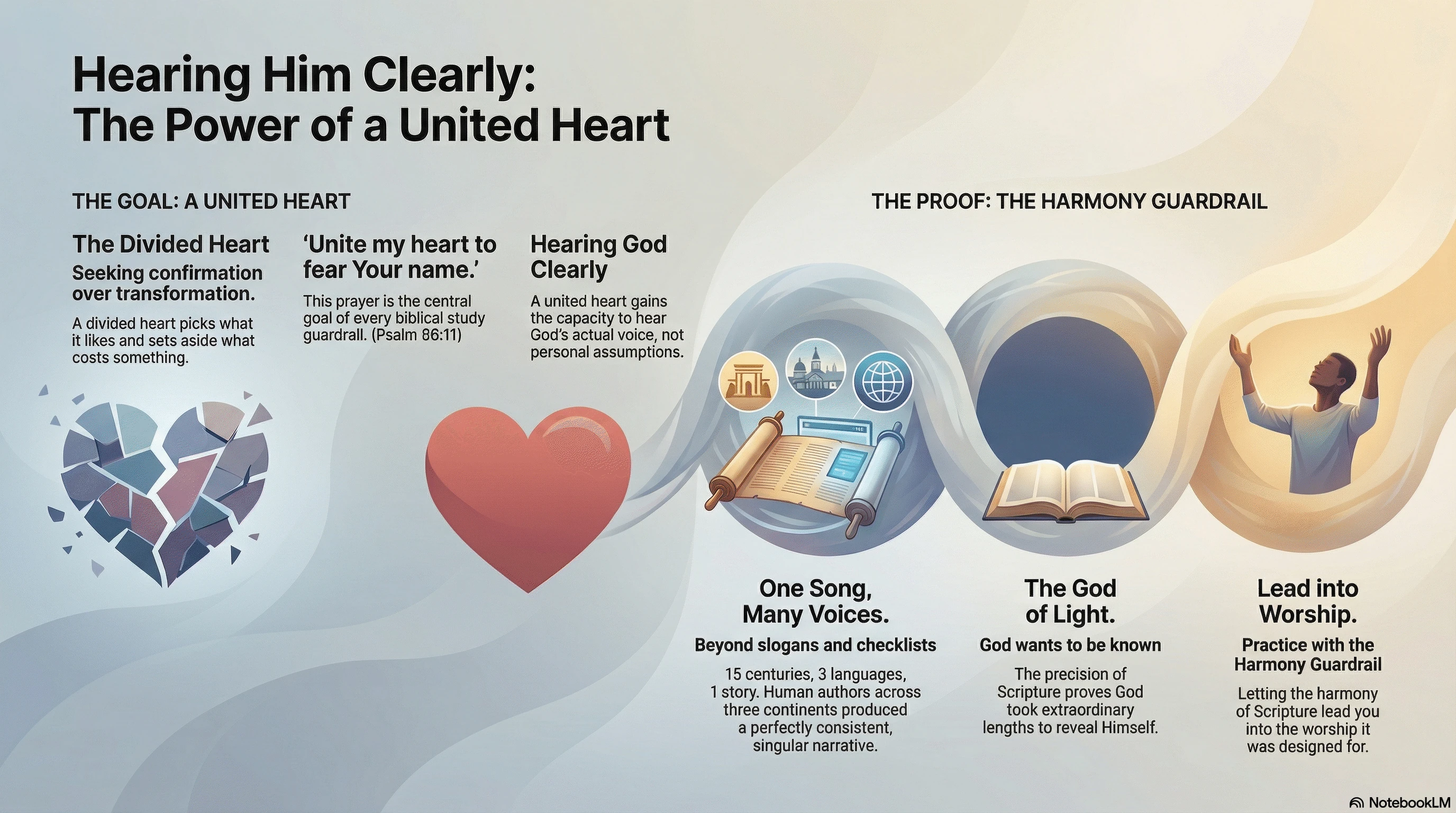
God has no darkness in Him. His Word, written by many authors across fifteen centuries, tells one story without contradiction. The Harmony Guardrail does not just protect your interpretation. It gives you access to the full picture of who He is. Study with it. Practice with it. And let the harmony of Scripture lead you into the worship it was always designed to produce.
Meditate and Obey. Study and Apply. Hear and Do.
This is how we abide in Christ. This is how we demonstrate our love for God.
Scripture quotations marked Berean Standard Bible (BSB) or Majority Standard Bible (MSB) are taken from texts that have been dedicated to the public domain. Free resources are available at BereanBible.com and MajorityBible.com.
Scripture quotations taken from the (LSB®) Legacy Standard Bible®, Copyright © 2021 by The Lockman Foundation. Used by permission. All rights reserved. Managed in partnership with Three Sixteen Publishing Inc. LSBible.org and 316publishing.com.