The Biblical Mandate to Meditate and Obey · Lesson Plan
Discipleship is teaching disciples to prayerfully read, study, and meditate on God's Word, and to interpret, apply, and obey it, empowered by the Holy Spirit.
Published March 27, 2026 · Updated October 5, 2026
Leader Prep Sheet
Lesson Goal: Help your class see that the Abide program is not built on a ministry preference but on what Scripture itself asks of every disciple: to hear God in His Word and to do what He says, with the Holy Spirit's help.
Big Idea: Discipleship is teaching disciples to prayerfully read, study, and meditate on God's Word, and to interpret, apply, and obey it, empowered by the Holy Spirit. In short: Meditate and Obey. Study and Apply. Hear and Do.
Main Outcomes:
- Students can say why the Abide program exists, from Scripture.
- Students see that remaining in Christ and letting His words remain in them belong together (John 15:7–10).
- Students leave with one concrete step of obedience for this week.
How this packet works:
- Twelve slides. Use the teaching deck (the Slides link on this page): the cover, the conviction, one illustrated slide for each of the nine sections, and the close. Each illustrated slide stays on the screen while you teach that section.
- The handout carries the detail. The tables and lists from the lesson (the John 15 table, the two builders, the meditation bridge, the four kinds of work in 2 Timothy 3, the three practices) are on the student handout. The script tells you when to point to it.
- You will not cover the whole article, and that is fine. The lesson page is long on purpose. Students who attend the class can read it on their own; tell them where to find it.
- Two lengths. The script is written for 45 minutes. For 30 minutes, skip the paragraphs marked (45-minute only) and follow the 30-minute flow.
- Read Scripture from the Bible. When the script says to have someone read a passage aloud, ask a volunteer ahead of time. All quotations in this packet are from the Berean Standard Bible (BSB).
Materials Needed:
- Bibles (any translation; the slides quote the BSB)
- The teaching slides and a screen
- One student handout per person
- This packet, printed
Teacher Emphasis:
- Keep the tone pastoral, warm, and invitational. This is good news: God speaks, and He helps us listen.
- Keep returning to the conviction and the three pairs. Repetition is how the class will remember them.
- Each passage was spoken first to someone else: Israel, Joshua, Jesus' disciples, Timothy, the apostles. Say who first, then what carries over to us. The lesson models this on purpose.
- Aim for clarity and a response, not information. One thing obeyed beats ten things learned.
Scripture List
- Psalm 119:1–8: Blessed are those who walk in God's Word and seek Him with all their heart.
- John 1:1–18: Jesus is the Word who became flesh and has made the Father known.
- John 15:1–11: Remain in Christ; His words remain in us, and obedience keeps us in His love.
- James 1:22–25: Hearing without doing is self-deception.
- Matthew 7:21–27: Both builders hear; the one who acts on Jesus' words stands.
- Deuteronomy 6:4–9: God's words belong in every part of the day.
- Joshua 1:8–9: Meditate day and night so that you may be careful to do it.
- Psalm 1: The one who delights and meditates is like a tree planted by streams of water.
- 2 Timothy 3:14–17: All Scripture is God-breathed and equips us for every good work.
- 1 Corinthians 2:10–14: The Spirit gives understanding of what God has freely given.
- John 14:15–31: Love for Jesus keeps His word; the Spirit teaches and reminds.
- Matthew 28:18–20: Make disciples, teaching them to obey all that Jesus commanded.
- Isaiah 55:6–11: God's word does not return to Him empty.
Timed Teaching Flow · 30 Minutes
| Time | Slide | Section | Script Cue | Notes |
|---|---|---|---|---|
| 0:00–1:00 | 1 | Welcome | "Today we ask why the Abide program exists." | Brief welcome; open in prayer |
| 1:00–3:00 | 2 | The Abide Conviction | "Discipleship is teaching disciples to prayerfully read, study, and meditate on God's Word..." | Read the conviction together; name the three pairs |
| 3:00–6:00 | 3 | 1 · Psalm 119:1–8 | "Many voices are faithful. But every teacher should be weighed against the Word." | Bereans (Acts 17:11); Ashrei |
| 6:00–9:00 | 4 | 2 · John 1:1–18 | "The goal is not knowing the text. It is knowing Him." | The Word made flesh; verse 18 |
| 9:00–13:00 | 5 | 3 · John 15:1–11 | "Stay with Me. Do not leave." | menō; handout: the John 15 table |
| 13:00–16:00 | 6 | 4 · James 1 · Matthew 7 | "Hearing without doing leaves a house that falls." | The mirror; handout: the two builders |
| 16:00–20:00 | 7 | 5 · Deuteronomy 6 · Joshua 1 · Psalm 1 | "God's words belong in the spaces between." | hāgâ; handout: the meditation bridge |
| 20:00–22:30 | 8 | 6 · 2 Timothy 3:14–17 | "Scripture does not stop at the diagnosis." | Handout: the four kinds of work |
| 22:30–25:00 | 9 | 7 · 1 Corinthians 2 · John 14 | "We are not alone in our effort to obey." | First the apostles, then every believer |
| 25:00–27:00 | 10 | 8 · Matthew 28:18–20 | "Not only knowing all that Jesus commanded, but obeying it." | Handout: the three practices |
| 27:00–28:30 | 11 | 9 · Isaiah 55:6–11 | "God's word is like the rain." | First to Israel |
| 28:30–30:00 | 12 | The Response | "Where in your life have you kept His Word out?" | Quiet; this week's step; close in prayer |
Timed Teaching Flow · 45 Minutes
| Time | Slide | Section | Script Cue | Notes |
|---|---|---|---|---|
| 0:00–2:00 | 1 | Welcome | "Today we ask why the Abide program exists." | Welcome; open in prayer |
| 2:00–5:00 | 2 | The Abide Conviction | "Discipleship is teaching disciples to prayerfully read, study, and meditate on God's Word..." | Read it together; "It is not the Abide program's idea. It is God's." |
| 5:00–9:00 | 3 | 1 · Psalm 119:1–8 | "They listened eagerly, and then they checked." | Bereans; Ashrei; read Psalm 119:1–2 aloud |
| 9:00–13:00 | 4 | 2 · John 1:1–18 | "Jesus is the Word, and He has made the Father known." | Read John 1:14 and 1:18; exēgeomai; John 5:39–40 |
| 13:00–19:00 | 5 | 3 · John 15:1–11 | "This is where the Abide program gets its name." | Read 15:4–5 and 15:9–10; menō; handout table |
| 19:00–24:00 | 6 | 4 · James 1 · Matthew 7 | "No one would do that. Yet that is exactly what we do." | The mirror story; the two builders on the handout |
| 24:00–30:00 | 7 | 5 · Deuteronomy 6 · Joshua 1 · Psalm 1 | "Reading lets the Word pass through the mind. Meditating makes it stay." | Point to the four moments in the picture; hāgâ; the bridge |
| 30:00–34:00 | 8 | 6 · 2 Timothy 3:14–17 | "All Scripture is God-breathed" (2 Timothy 3:16, BSB) | theopneustos; walk the four kinds of work on the handout |
| 34:00–38:00 | 9 | 7 · 1 Corinthians 2 · John 14 | "The difference is not intelligence. It is the Spirit." | John 14:26 to the apostles first; 1 John 2:27 |
| 38:00–41:00 | 10 | 8 · Matthew 28:18–20 | "One command: make disciples." | Obey = keep (John 15:10); the three practices |
| 41:00–43:00 | 11 | 9 · Isaiah 55:6–11 | "…will not return to Me empty" (Isaiah 55:11, BSB) | Read 55:10–11 aloud slowly |
| 43:00–45:00 | 12 | The Response | "Open that ground to the rain." | Silence; one step this week; say the three pairs together; pray |
Full Lecture Script
Welcome
Say this verbatim:
"Welcome. Today we begin with a simple question: why does the Abide program exist? Why build a whole discipleship program around reading, studying, and meditating on God's Word, and then interpreting, applying, and obeying it? Here is the short answer, and we will spend the rest of our time showing it from Scripture: this is not our idea. It is God's."
"Let's pray. Father, You have spoken. Open our ears to hear You in Your Word today, and give us hearts that want to do what You say. In Jesus' name, amen."
The Abide Conviction
Say this verbatim:
"Here is the conviction the whole program rests on. Let's read it together: 'Discipleship is teaching disciples to prayerfully read, study, and meditate on God's Word, and to interpret, apply, and obey it, empowered by the Holy Spirit.'"
"That is a mouthful, so here it is in six words, three pairs: Meditate and Obey. Study and Apply. Hear and Do. Say them with me. Meditate and Obey. Study and Apply. Hear and Do. Notice that every pair ends in doing. Hearing God is never the finish line. This is what it means to abide in Christ."
Section 1 · Psalm 119:1–8 · From Passive Reader to Active Disciple
Say this verbatim:
"Where do you turn when you have a question about God, the Bible, or how to live? Most of us reach for a sermon clip, a podcast, a post, or a book. Many of those voices are faithful, and God gives His church pastors and teachers to build us up. We need them. But every teacher, including this one, should be weighed against the Word itself."
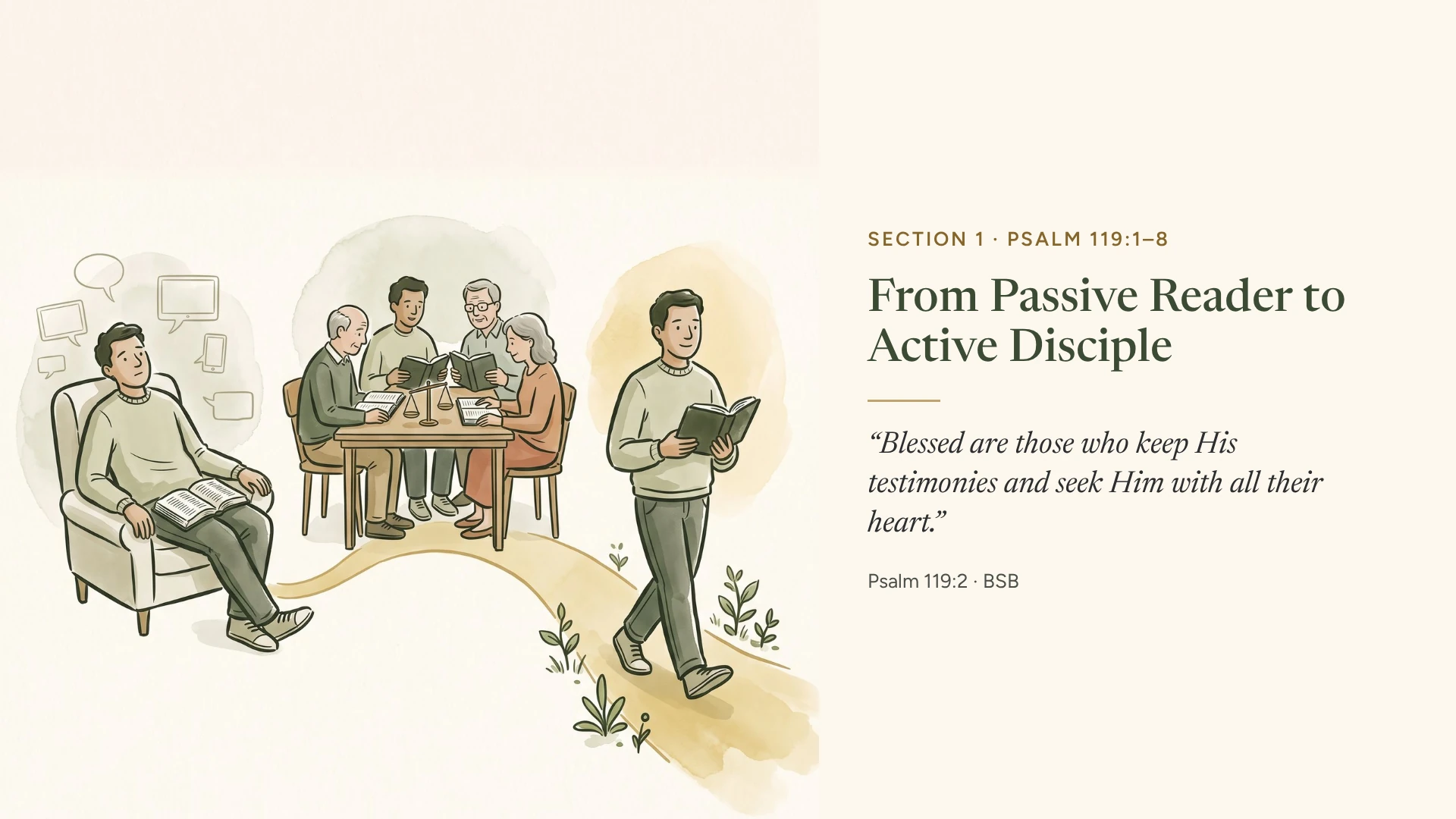
"When Paul and Silas taught in the synagogue at Berea, Luke tells us the Jewish listeners there 'received the message with great eagerness and examined the Scriptures every day to see if these teachings were true' (Acts 17:11, BSB). They listened eagerly, and then they checked. That is the picture on the slide: from sitting among many voices, to weighing what we hear, to walking with God's Word open in our own hands."
(45-minute only) Ask a volunteer to read Psalm 119:1–2 aloud:
Blessed are those whose way is blameless, who walk in the Law of the LORD. Blessed are those who keep His testimonies and seek Him with all their heart. (Psalm 119:1–2, BSB)
Then say:
"Psalm 119 is the longest psalm in the Bible, 176 verses of Israel's love for the Law the LORD gave His people. It opens with the Hebrew word Ashrei: blessed. It is less a blessing spoken over someone than a word of congratulation: how favored is the one who lives under the authority of what God has said! And notice who receives it. Not a casual reader, but those who 'seek Him with all their heart' (v. 2, BSB)."
"So the first move in this lesson is from passive reader to active disciple: from glancing at the text to walking in it."
Section 2 · John 1:1–18 · The Living Word
Say this verbatim:
"John opens his Gospel with a word his first readers already knew: 'In the beginning was the Word, and the Word was with God, and the Word was God' (John 1:1, BSB). To Israel, the word of God meant God in action: creating, revealing, delivering. To Greek readers, the word logos meant reason, the order behind the world. John filled that familiar word with new meaning. The Word is not a principle. He is a Person. 'The Word became flesh and made His dwelling among us' (v. 14, BSB)."
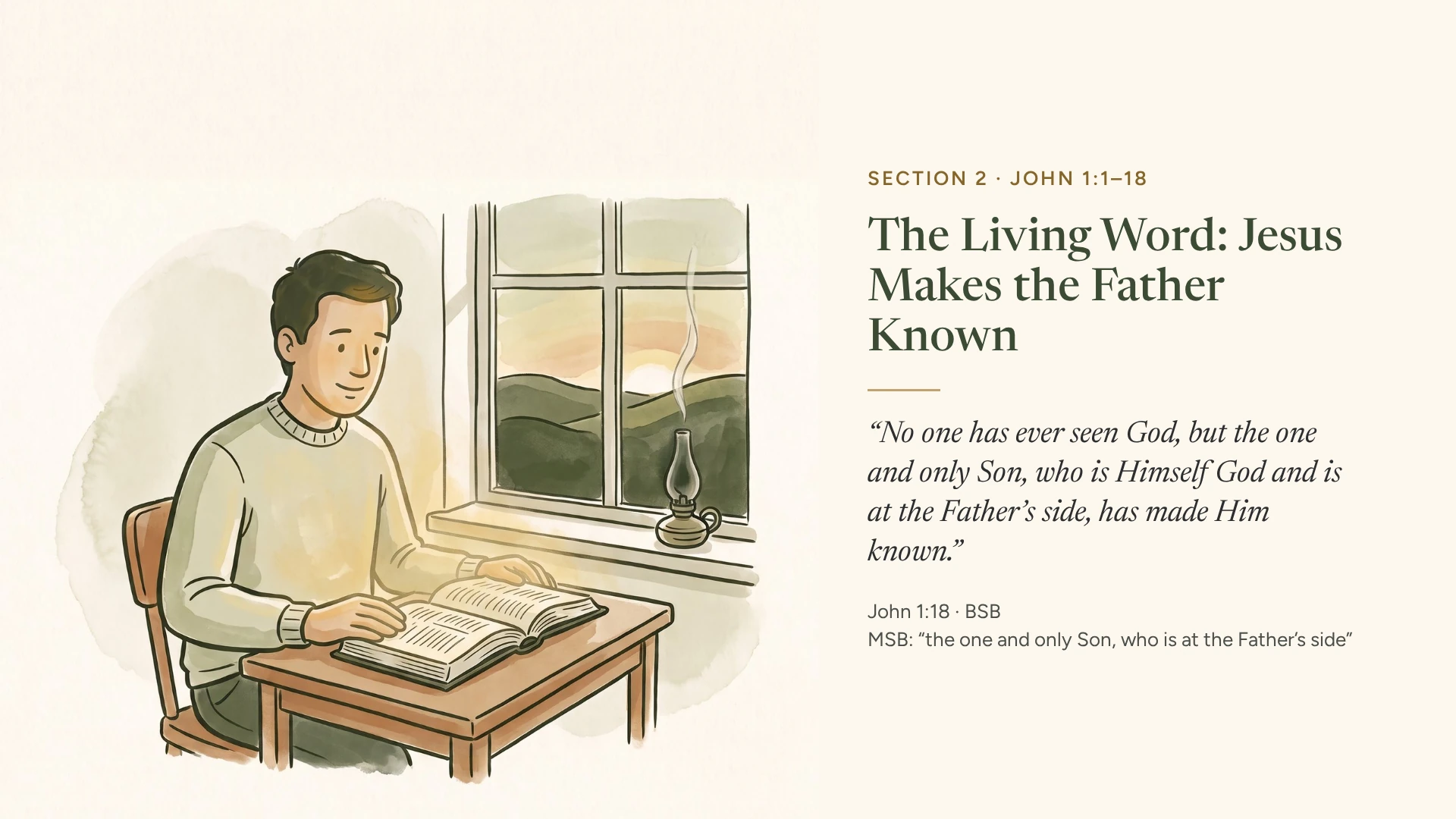
"Then John closes the passage where he began. Verse 18: 'No one has ever seen God, but the one and only Son, who is Himself God and is at the Father's side, has made Him known' (John 1:18, BSB). The verb for 'made Him known' (v. 18, BSB) is exēgeomai, to tell fully. It is where English gets the word exegesis. The Son has made the Father known, fully. He told us about the Father, and He showed us the Father. As Jesus told Philip, 'Anyone who has seen Me has seen the Father' (John 14:9, BSB)."
(45-minute only)
"One small note you will see on the slide: the Majority Standard Bible, which follows most surviving Greek manuscripts, reads 'the one and only Son, who is at the Father's side' (John 1:18, MSB). Either way, the point stands: the Son has made the Father known."
"Where do we see the Son today? In the Scriptures that testify about Him. Jesus told those who opposed Him in Jerusalem, 'These are the very words that testify about Me, yet you refuse to come to Me to have life' (John 5:39–40, BSB). Knowing the text is not the goal. Knowing Him is. We read the written Word to know the living Word."
Section 3 · John 15:1–11 · Abiding in the Vine
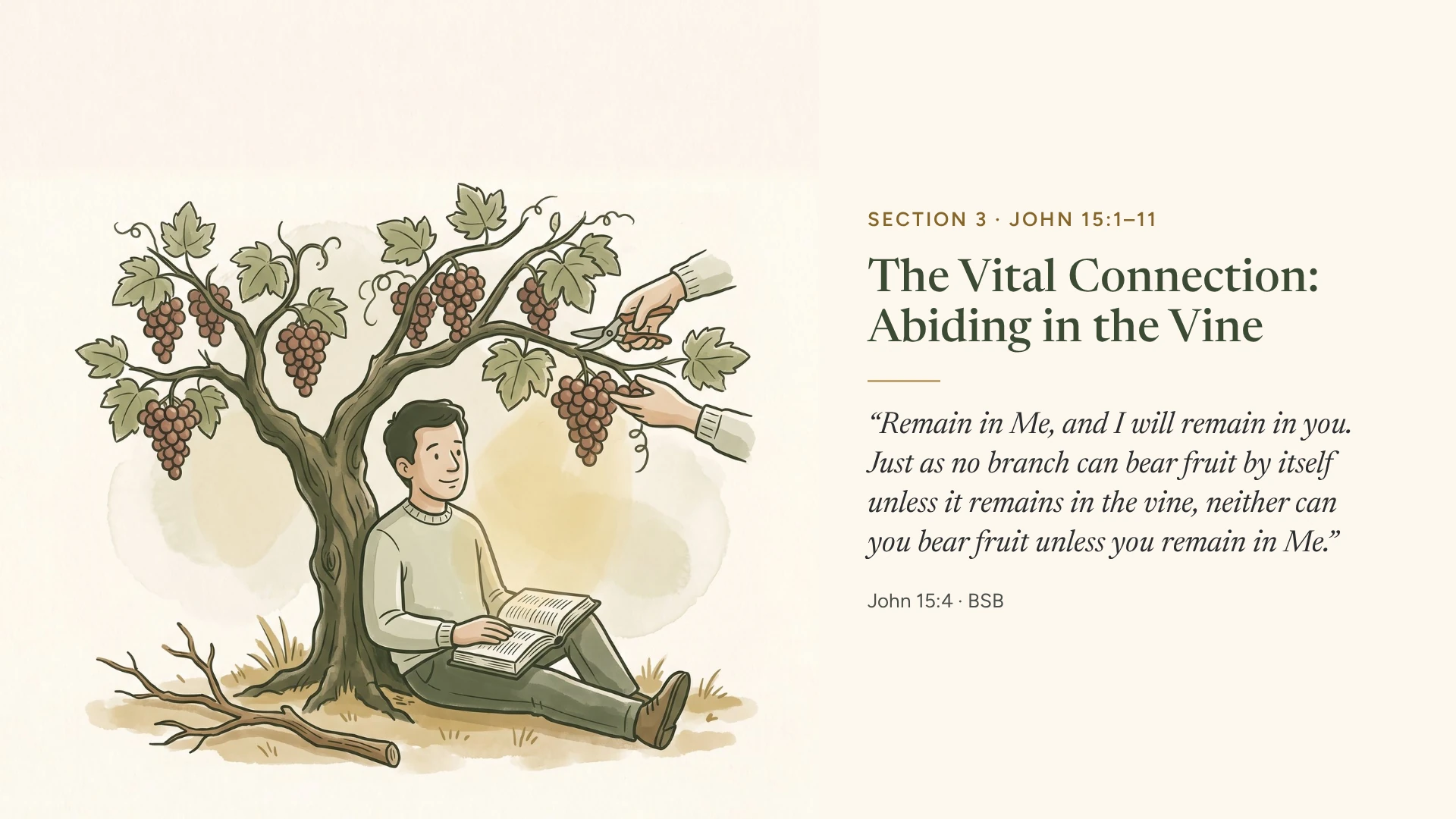
Say this verbatim:
"Jesus spoke these words to His disciples on His last night with them before the cross. John 1 told us who the Word is. John 15 tells us how we live with Him. And this passage is where the Abide program gets its name."
Ask a volunteer to read John 15:4–5 aloud:
Remain in Me, and I will remain in you. Just as no branch can bear fruit by itself unless it remains in the vine, neither can you bear fruit unless you remain in Me. I am the vine and you are the branches. The one who remains in Me, and I in him, will bear much fruit. For apart from Me you can do nothing. (John 15:4–5, BSB)
Then say:
"The word the BSB translates 'remain' is the Greek verb menō. Its basic meaning is simple: to stay in the same place. Jesus used it when He told the Twelve to stay in one house until they left a town. In John 15 the place is a Person. So when Jesus says 'Remain in Me' (v. 4, BSB), He is saying: stay with Me. Do not leave. He uses that one verb ten times in verses 4 through 10. When Jesus repeats something ten times, He is telling us: this is the thing."
"And the stakes are clear: 'apart from Me you can do nothing' (v. 5, BSB). A branch cut off from the vine does not produce less fruit. It produces none."
(45-minute only)
"But there is grace here too. The Father prunes every branch that does bear fruit 'to make it even more fruitful' (v. 2, BSB). If you feel God cutting something away in your life right now, the pruning has a purpose: more fruit."
"Now look at the table on your handout. Verse 7: 'If you remain in Me and My words remain in you, ask whatever you wish, and it will be done for you' (John 15:7, BSB). Remaining goes both ways. We stay in Him, and His words stay in us. Verse 9: 'As the Father has loved Me, so have I loved you. Remain in My love' (v. 9, BSB). His love comes first. We are not told to remain in order to be loved. We are told to remain in a love already given. And verse 10: 'If you keep My commandments, you will remain in My love, just as I have kept My Father's commandments and remain in His love' (v. 10, BSB)."
"Put those together. His words remaining in us and our keeping His commandments are two sides of one life. Reading, studying, and meditating on Scripture is not an academic hobby next to our relationship with Jesus. It is part of that relationship. And Jesus tells us why He said all this: 'so that My joy may be in you and your joy may be complete' (v. 11, BSB)."
Section 4 · James 1:22–25 and Matthew 7:21–27 · The Mirror and the Foundation
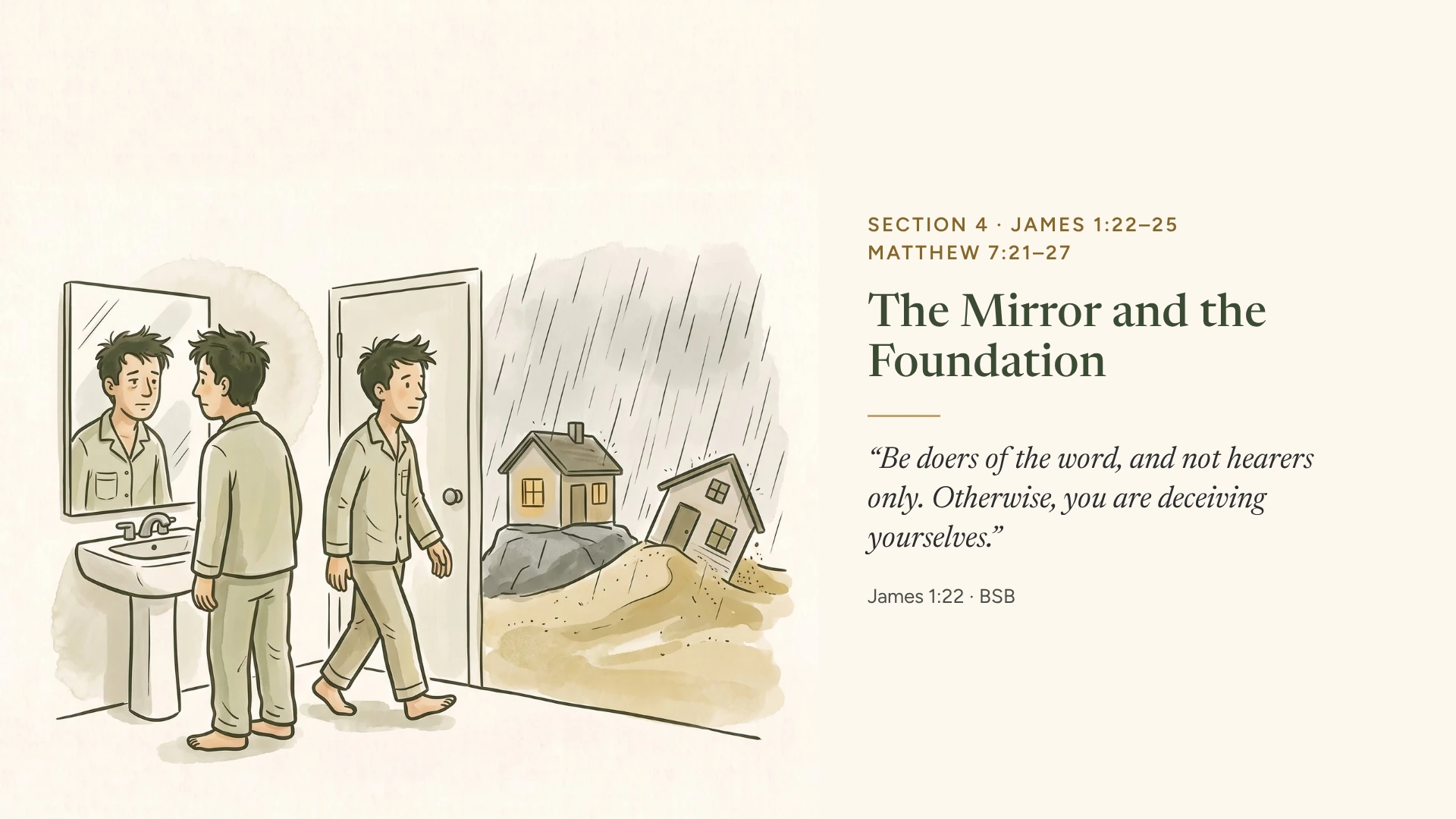
Say this verbatim:
"James puts it bluntly: 'Be doers of the word, and not hearers only. Otherwise, you are deceiving yourselves' (James 1:22, BSB). Then he gives a picture everyone recognizes: a man looks at his face in a mirror and walks away, and immediately forgets what he looks like."
"Picture it. You roll out of bed with messy hair, bad breath, and oily skin, still in your pajamas. You look in the mirror and see all of it. Then you leave. You don't brush your hair. You don't brush your teeth. You don't wash your face. You don't change your clothes. You just look, and walk out the door to work or school. No one would do that. Yet that is exactly what we do when we see ourselves in God's Word and walk away unchanged."
"But James does not leave us there. The one who 'looks intently into the perfect law of freedom, and continues to do so,' James says, 'will be blessed in what he does' (v. 25, BSB). Keep looking, and act on what you see."
(45-minute only)
"Jesus makes the same point at the end of the Sermon on the Mount, spoken to His disciples with the crowds listening. Calling Him 'Lord, Lord' is not enough; what counts is doing 'the will of My Father in heaven' (Matthew 7:21, BSB)."
"Then come the two builders on your handout. Both hear the same words. Both face the same storm. The wise builder is 'everyone who hears these words of Mine and acts on them' (Matthew 7:24, BSB), and his house 'did not fall, because its foundation was on the rock' (v. 25, BSB). The foolish builder hears and does not act, and his house fell, 'and great was its collapse!' (v. 27, BSB). The difference is not what they heard but what they did. Hearing more does not change the forecast. Doing what Jesus says is the foundation."
Section 5 · Deuteronomy 6:4–9, Joshua 1:8–9, and Psalm 1 · The Ancient Mandate
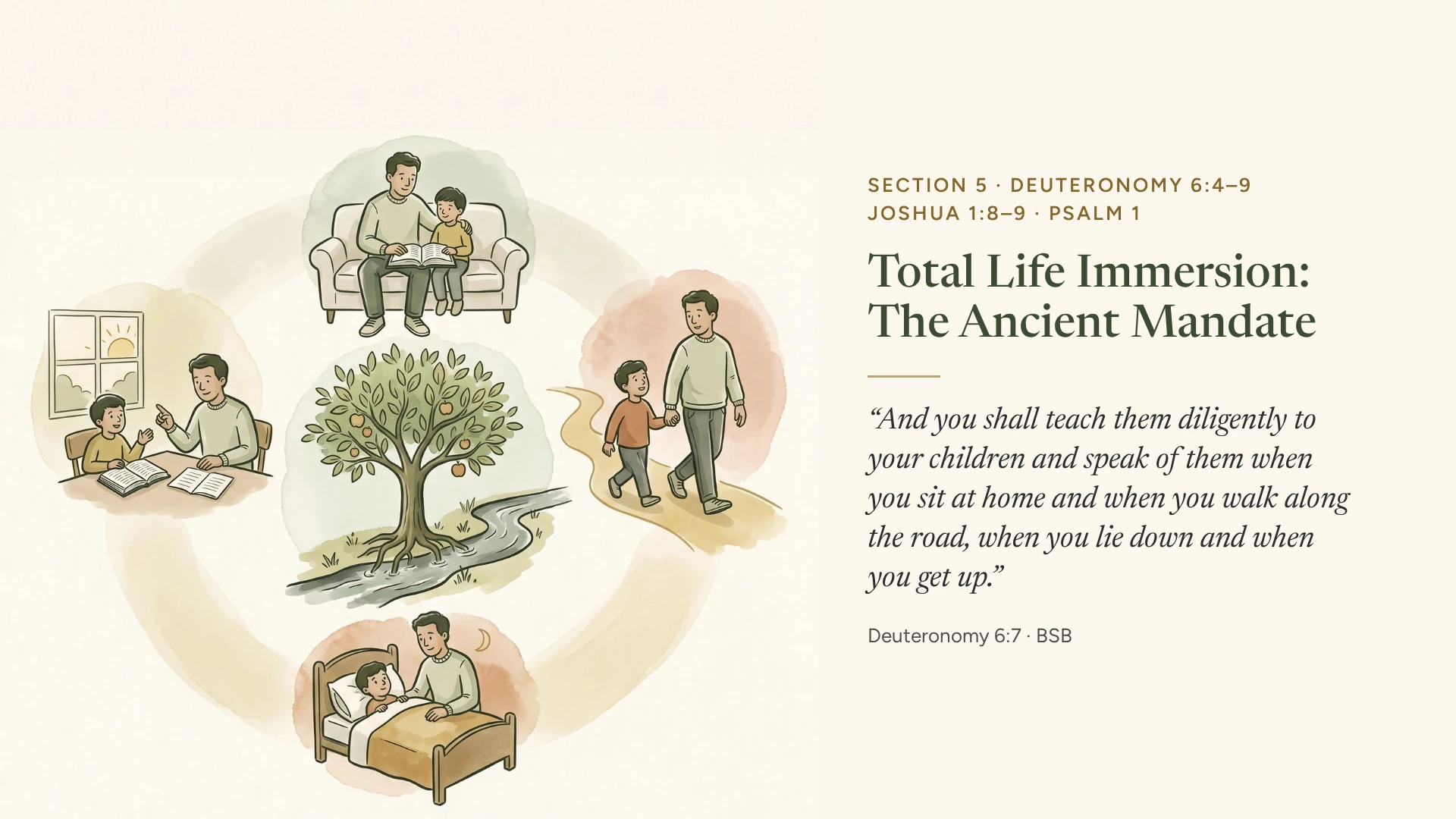
Say this verbatim:
"Long before Jesus said 'Remain in Me' (John 15:4, BSB), God called His people Israel to keep His words at the center of everyday life. Moses spoke the Shema to Israel as they prepared to enter the land: 'These words I am commanding you today are to be upon your hearts' (Deuteronomy 6:6, BSB). Then he named where those words belong: 'when you sit at home and when you walk along the road, when you lie down and when you get up' (v. 7, BSB). Look at the four moments on the slide. God's words were not saved for special occasions. They belonged in the spaces between. Centuries later Jesus called verses 4 and 5 the most important commandment, and He calls us to love God that same way, with everything we are."
"How do God's words get from the page into the heart? Joshua 1:8 and Psalm 1:2 answer with one Hebrew word, hāgâ: meditate. In these verses it means to think intently and at length, for spiritual purposes. The LORD spoke Joshua 1:8 to Joshua as he took up Moses' work: 'This Book of the Law must not depart from your mouth; meditate on it day and night, so that you may be careful to do everything written in it' (Joshua 1:8, BSB). Notice the order: the Word in his mouth, the Word on his mind day and night, and then the Word in his life."
(45-minute only)
"This is not the meditation many people picture. Richard Foster put it in one line: 'Eastern meditation is an attempt to empty the mind; Christian meditation is an attempt to fill the mind.' And Brian Hedges draws the line between reading and meditating: 'When you read you allow the Word to pass through the mind, but when you meditate you cause the Word to stay on the mind.' That is how His words remain in us. Think of a cow chewing the cud, or a dog with a bone: coming back to the same truth again and again."
"On your handout, meditation is a bridge: from reading to praying, from the mind to the heart, and from hearing to doing. And Psalm 1 shows where it leads. The one whose 'delight is in the Law of the LORD,' who 'meditates day and night,' is 'like a tree planted by streams of water, yielding its fruit in season, whose leaf does not wither' (Psalm 1:2–3, BSB). That is the tree in the middle of the slide."
Section 6 · 2 Timothy 3:14–17 · The God-Breathed Manual
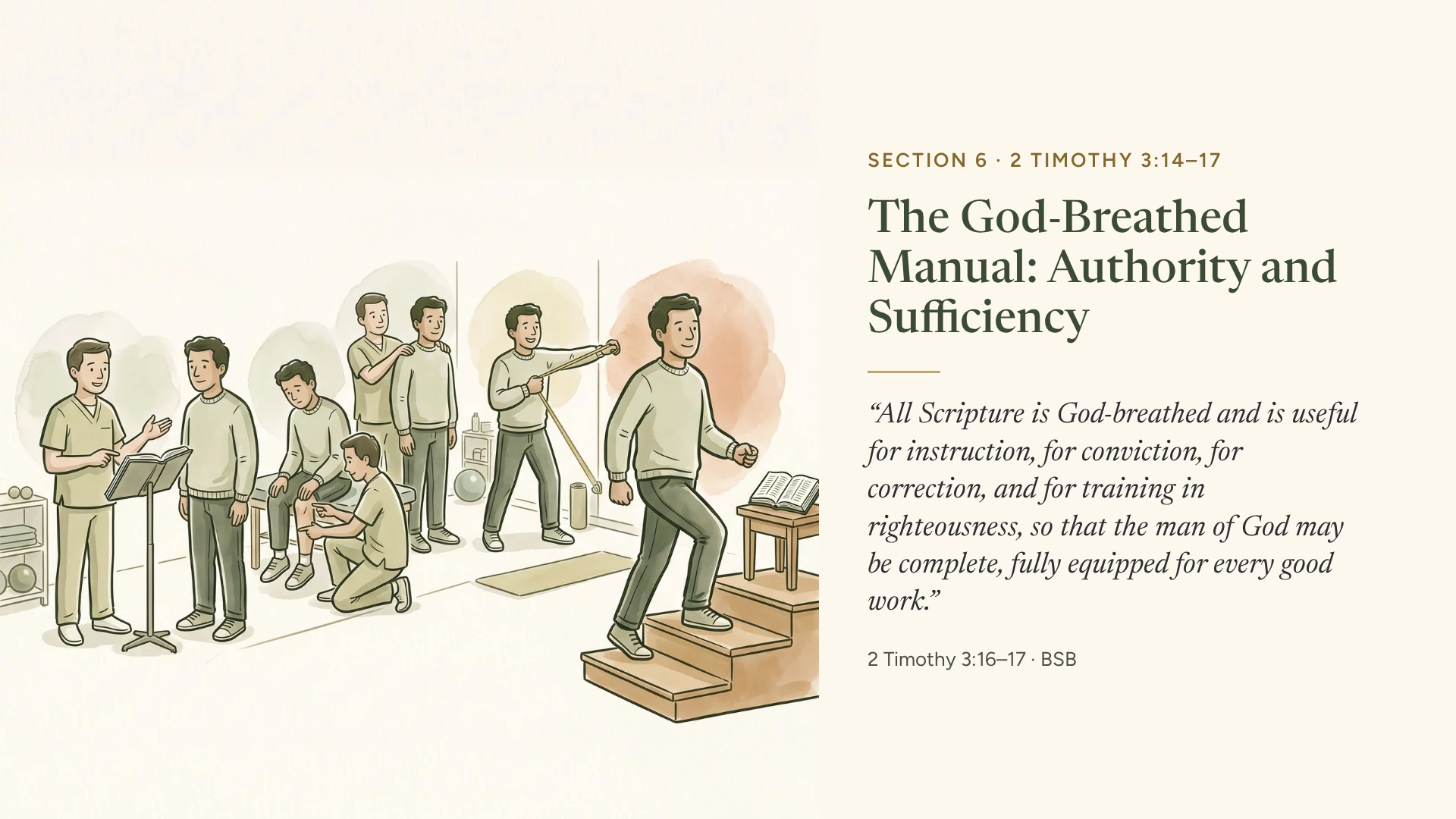
Say this verbatim:
"We cannot build a life on human opinion. Paul reminded Timothy that from infancy he had known 'the Holy Scriptures, which are able to make you wise for salvation through faith in Christ Jesus' (2 Timothy 3:15, BSB). Then he wrote: 'All Scripture is God-breathed' (v. 16, BSB). The Greek word appears nowhere else in the New Testament. It means inspired by God, breathed out by Him. God did not use the human writers as typewriters. He breathed out His Word through them."
"Because Scripture comes from God, it is 'useful for instruction, for conviction, for correction, and for training in righteousness' (v. 16, BSB). Picture a physical therapist, as in the slide, and follow along on your handout. Instruction: the therapist explains how the body is meant to move; Scripture shows us what is true. Conviction: the assessment shows exactly where something is wrong; Scripture shows us where we have strayed. Correction: the adjustment sets it right; Scripture does not stop at the diagnosis. Training: the daily exercises build new strength; Scripture forms new habits of right living."
"And the goal is verse 17: 'so that the man of God may be complete, fully equipped for every good work' (2 Timothy 3:17, BSB). That is the man climbing the steps."
Section 7 · 1 Corinthians 2:10–14 and John 14:15–31 · The Divine Partner
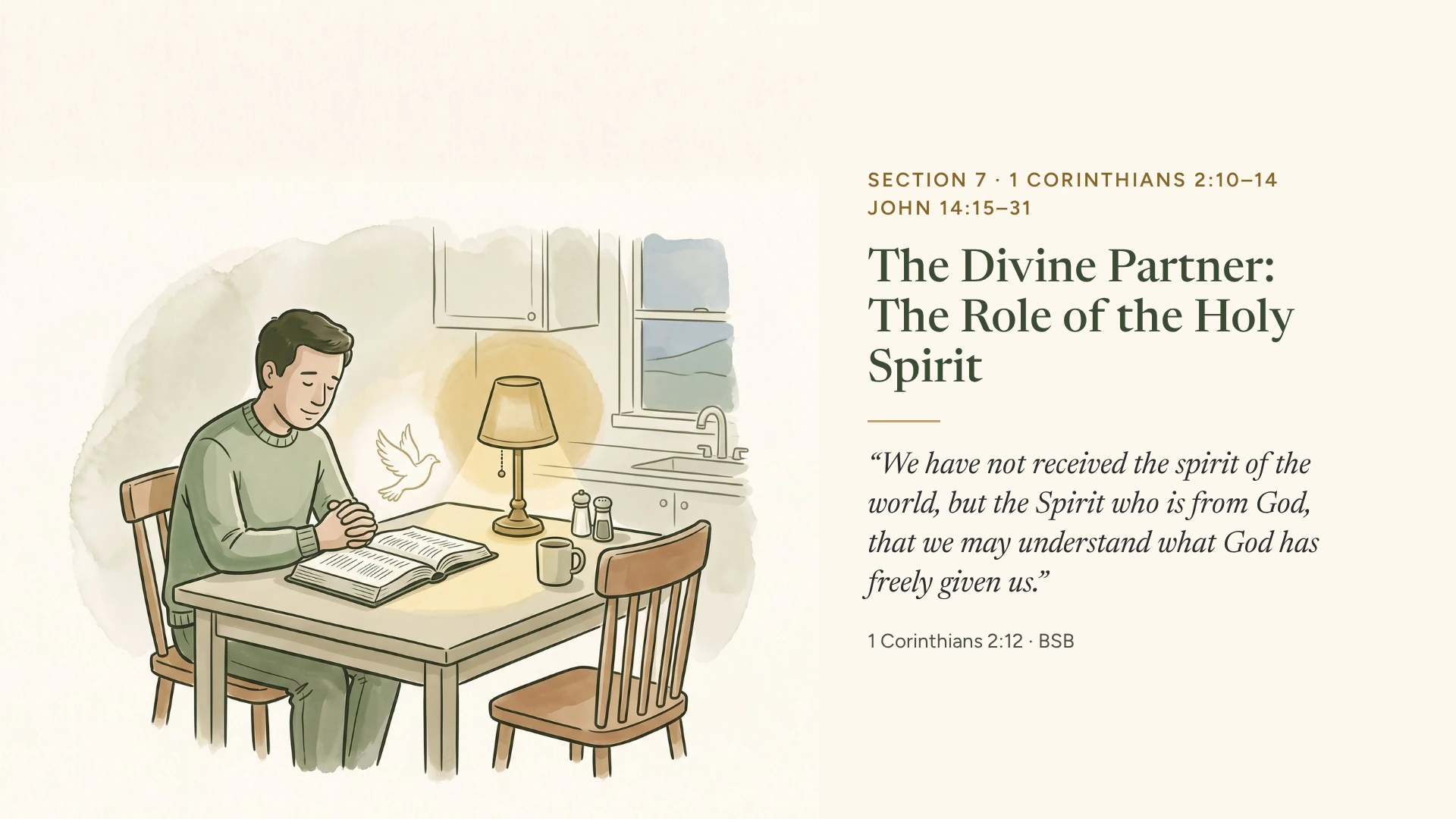
Say this verbatim:
"Careful study matters, but study alone is not enough. Paul writes, 'The natural man does not accept the things that come from the Spirit of God. For they are foolishness to him, and he cannot understand them, because they are spiritually discerned' (1 Corinthians 2:14, BSB). The difference is not intelligence. It is the Spirit: 'We have not received the spirit of the world, but the Spirit who is from God, that we may understand what God has freely given us' (v. 12, BSB). That is why the man on the slide prays before he reads."
"On the night before the cross, Jesus promised His disciples: 'the Advocate, the Holy Spirit, whom the Father will send in My name, will teach you all things and will remind you of everything I have told you' (John 14:26, BSB). That promise was given first to the apostles, the men who had heard Jesus speak and would bear witness to His words. The same Spirit now teaches every believer."
(45-minute only)
"John later wrote to believers that 'the anointing you received from Him remains in you,' and then he added, 'so remain in Him' (1 John 2:27, BSB), the same word Jesus used in John 15. And Jesus tied the Spirit's presence to love and obedience: 'If anyone loves Me, he will keep My word. My Father will love him, and We will come to him and make Our home with him' (John 14:23, BSB)."
"Discipline without the Spirit wears us out. When the Spirit opens the text, study becomes fellowship. We are not alone in our effort to obey."
Section 8 · Matthew 28:18–20 · The Great Commission
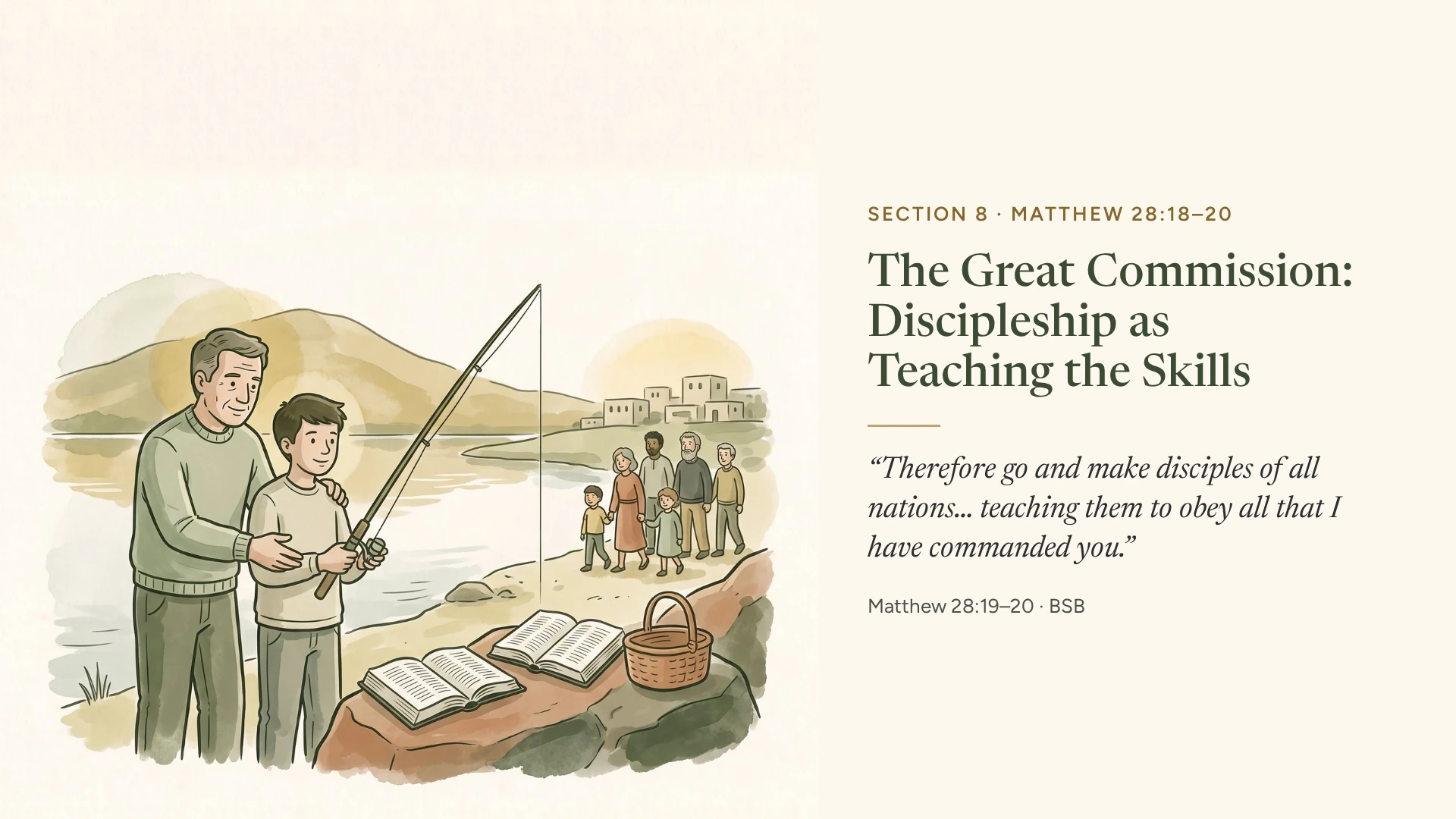
Say this verbatim:
"Matthew's Gospel closes on a mountain in Galilee, where Jesus met the eleven disciples. Matthew writes: 'Then Jesus came to them and said, “All authority in heaven and on earth has been given to Me. Therefore go and make disciples of all nations, baptizing them in the name of the Father and of the Son and of the Holy Spirit, and teaching them to obey all that I have commanded you. And surely I am with you always, even to the end of the age.”' (Matthew 28:18–20, BSB). Notice the order: first His authority, then the task. In the Greek there is one command, make disciples. Going, baptizing, and teaching describe how it is done."
"And notice what the teaching aims at: not only knowing all that Jesus commanded, but obeying it. The word the BSB translates 'obey' is the same verb Jesus used when He said, 'If you keep My commandments' (John 15:10, BSB). It is the difference between handing someone a fish and teaching them to fish for themselves. That is what the picture shows."
"On your handout are the three pairs of practices we learn and then pass on. Meditate and Obey. Study and Apply. Hear and Do. This whole program exists so you can feed on God's Word yourself, and help someone else do the same."
Section 9 · Isaiah 55:6–11 · The Proven Mandate
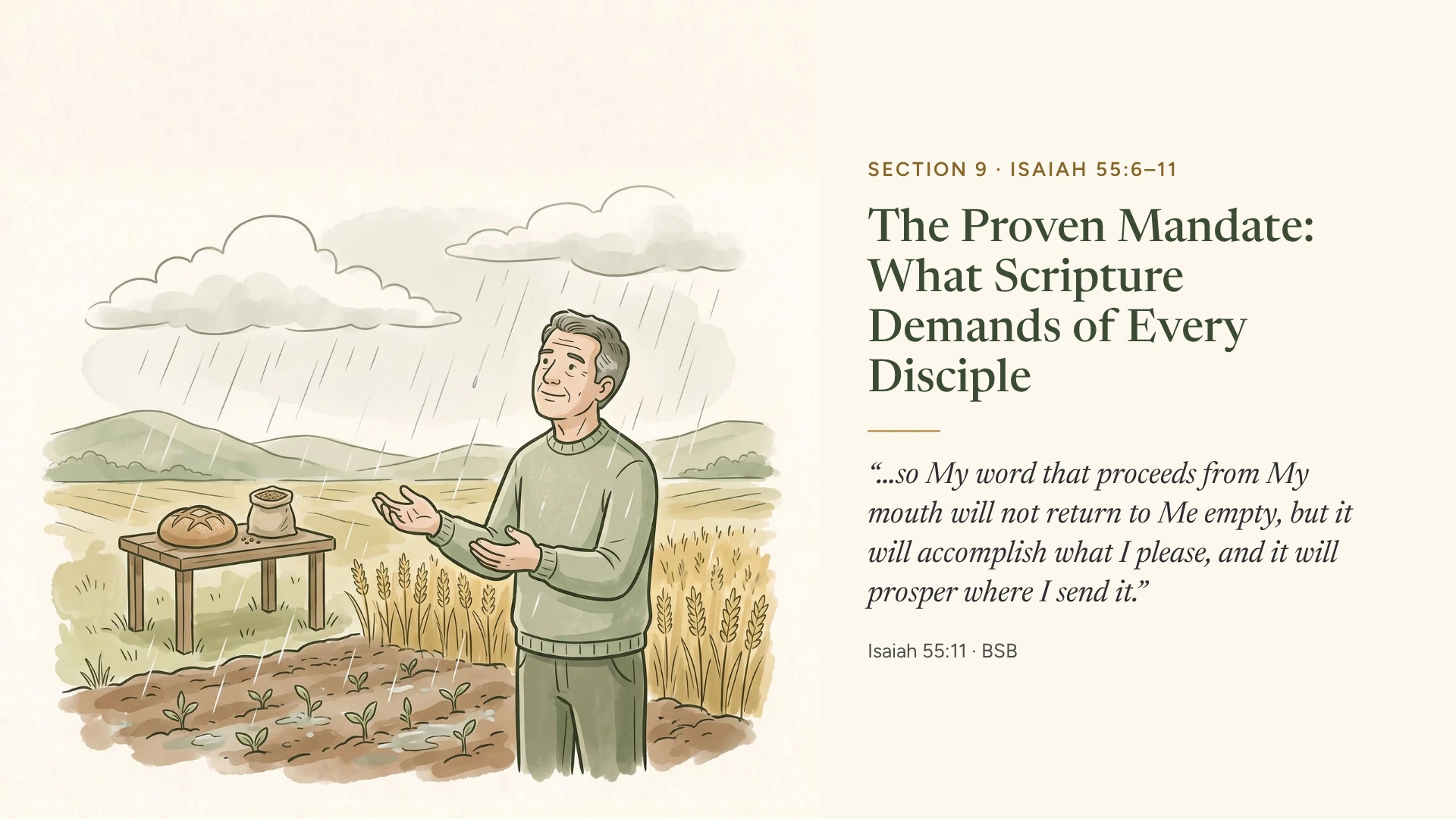
Ask a volunteer to read Isaiah 55:10–11 aloud slowly:
For just as rain and snow fall from heaven and do not return without watering the earth, making it bud and sprout, and providing seed to sow and food to eat, so My word that proceeds from My mouth will not return to Me empty, but it will accomplish what I please, and it will prosper where I send it. (Isaiah 55:10–11, BSB)
Then say:
"Isaiah spoke these words first to Israel, calling them to 'return to the LORD' and promising that 'He will freely pardon' (v. 7, BSB). Then the LORD said His word is like the rain. Rain and snow do not go back to heaven without watering the earth, making it bud and sprout. And 'so My word that proceeds from My mouth will not return to Me empty' (v. 11, BSB). God's word always does what He sends it to do. That is the man in the field with his hands open to the rain."
The Response
Say this verbatim:
"So here is the question for every one of us: Where in your life have you kept His Word out? Take a minute with that. Don't answer out loud."
(Pause for a full minute.)
"Open that ground to the rain. Step out in grace, lean into the joy of obedience, and let His Word do what He sends it to do. On your handout, write one step you will take this week. Just one."
"Let's say them together one more time: Meditate and Obey. Study and Apply. Hear and Do. This is how we abide in Christ. This is how we demonstrate our love for God."
"Let's pray. Lord, thank You that Your word never returns to You empty. Show each of us where we have kept it out, and give us grace to open that ground this week. Make us doers of Your word, not hearers only. In Jesus' name, amen."
Discussion Prompts
Use these after the teaching or in small groups. Choose two or three based on the time you have.
- Where do you usually turn first when you have a question about God or how to live? What would it look like this month to check what you hear against Scripture, the way the Bereans did?
- Jesus begins with "Remain in Me" (John 15:4, BSB) and uses that verb ten times in verses 4–10. What helps you stay with Him day to day? What pulls you away?
- Remember the mirror. Where are you most likely to look into God's Word and walk away unchanged?
- Deuteronomy 6:7 names home, the road, bedtime, and morning. Which of those "spaces between" could hold God's Word for you this week?
- Which of the three pairs (Meditate and Obey, Study and Apply, Hear and Do) comes most naturally to you, and which is hardest?
Optional Homework
Assign one or both before the next session:
Reading Assignment: Read the lesson page on your own; it covers more than we had time for today. Then read John 15:1–11 slowly, twice. Write down three things you notice about what the text actually says, and one question it raises.
Application Assignment: Write down one thing God showed you today that you have been hearing but not yet doing. Write one concrete step you will take before next week, and tell one trusted person.
Scripture quotations marked Berean Standard Bible (BSB) or Majority Standard Bible (MSB) are taken from texts that have been dedicated to the public domain. Free resources are available at BereanBible.com and MajorityBible.com.