Study to be Approved to God as a Workman · Lesson Plan
Why we need to be taught how to accurately handle the word of truth, and the tools every disciple needs to bridge the ancient world to the here and now.
Published March 27, 2026 · Updated October 5, 2026
Leader Prep Sheet
Lesson Goal: Help your class see why reading the Bible well takes some work, and why that is good news: every gap between the Bible's world and ours has a bridge, and God Himself helps us cross.
Big Idea: Paul charged Timothy to be a workman who accurately handles the word of truth. The Bible was meant to be understood, but it was written in a world very different from ours. Gaps of history, literature, theology and application stand between its first readers and us, and each one has a bridge. The last bridge is the Holy Spirit's work in us.
Main Outcomes:
- Students can name the four gaps (historical, literary, theological, appropriation) and one bridge for each.
- Students see, through the Good Samaritan, how crossing the gaps makes a passage hit harder, not smaller.
- Students leave with the book background guide and one step of obedience for this week.
How this packet works:
- Eleven slides. Use the teaching deck (the Slides link on this page): the cover, one illustrated slide for each of the seven sections, the map of the four gaps, the book background guide, and the close. Each illustrated slide stays on the screen while you teach that section.
- The handout carries the detail. The two words in 2 Timothy 2:15, the table of the two worlds, the Good Samaritan's three gaps, the four literary and theological bridges, the three ways a passage crosses to today, and a Book Background Guide worksheet are on the student handout. The script tells you when to point to it.
- You will not cover the whole article, and that is fine. The lesson page is long on purpose. Students can read it on their own; tell them where to find it.
- Two lengths. The script is written for 45 minutes. For 30 minutes, skip the paragraphs marked (45-minute only) and follow the 30-minute flow.
- Read Scripture from the Bible. When the script says to have someone read a passage aloud, ask a volunteer ahead of time. All quotations in this packet are from the Berean Standard Bible (BSB).
Materials Needed:
- Bibles (any translation; the slides quote the BSB)
- The teaching slides and a screen
- One student handout per person
- This packet, printed
Teacher Emphasis:
- Keep the tone hopeful. Every gap in this lesson is paired with its bridge. If someone in your class has felt like a stranger in a foreign land when reading the Bible, they are not doing it wrong, and this lesson is for them.
- Each passage was spoken first to someone else: Timothy in Ephesus, an expert in the law, Israel's exiles in Babylon, the believers at Philippi. Say who first, then what carries over to us. The lesson models this on purpose.
- Describe the Bible's world and ours side by side without ranking them. Some in your class may live closer to the Bible's world than you do.
- Aim for a response, not information. One step obeyed beats ten facts learned.
Scripture List
- 2 Timothy 2:14–18: Make every effort to be an unashamed workman who accurately handles the word of truth.
- Psalm 119:129–130: The unfolding of God's words gives light, even to the simple.
- Luke 10:30–37: The Good Samaritan: who was a neighbor? Go and do likewise.
- Hebrews 1:1–2: God spoke in many ways through the prophets, and in these last days by His Son.
- Ezekiel 33:30–32: The exiles heard Ezekiel's words but did not put them into practice.
- 2 Timothy 4:9–13: Paul's closing requests: come quickly, bring Mark, the cloak and the scrolls.
- Philippians 2:12–13: Work out your salvation, for it is God who works in you.
- Psalm 119:18: Open my eyes that I may see wondrous things from Your law.
Timed Teaching Flow · 30 Minutes
| Time | Slide | Section | Script Cue | Notes |
|---|---|---|---|---|
| 0:00–1:00 | 1 | Welcome | "Have you ever felt like a stranger in a foreign land while reading the Bible?" | Brief welcome; open in prayer |
| 1:00–5:00 | 2 | 1 · 2 Timothy 2:14–18 | "Make every effort to present yourself approved to God" (2 Timothy 2:15, BSB) | Paul in prison, Timothy in Ephesus; handout: the two words |
| 5:00–7:30 | 3 | 2 · Psalm 119:129–130 | "A deep well whose waters lie close to the surface." | The simple = beginners |
| 7:30–9:00 | 4 | The Four Gaps | "Every gap has a bridge." | Name the four; the shed |
| 9:00–14:00 | 5 | 3 · Luke 10:30–37 | "Watch the story sharpen as each gap closes." | Time, place, culture; handout: the two worlds and the three gaps |
| 14:00–17:00 | 6 | 4 · Hebrews 1:1–2 | "In many different ways" (Hebrews 1:1, BSB) | Language, genre, supernatural, theological; handout |
| 17:00–21:30 | 7 | 5 · Ezekiel 33:30–32 | "They hear your words but do not put them into practice" (Ezekiel 33:32, BSB) | Exiles in Babylon; handout: three ways across |
| 21:30–24:00 | 8 | 6 · 2 Timothy 4:9–13 | "Know the book before you read it." | Scripture first, then consult wisely |
| 24:00–26:00 | 9 | Book Background Guide | "Six questions, six gaps." | Handout worksheet |
| 26:00–28:00 | 10 | 7 · Philippians 2:12–13 | "it is God who works in you" (Philippians 2:13, BSB) | The Spirit bridges the last gap |
| 28:00–30:00 | 11 | The Invitation | "God is more intent on revealing himself to you..." | Pray Psalm 119:18; this week's step |
Timed Teaching Flow · 45 Minutes
| Time | Slide | Section | Script Cue | Notes |
|---|---|---|---|---|
| 0:00–2:00 | 1 | Welcome | "Have you ever felt like a stranger in a foreign land while reading the Bible?" | Welcome; the Tuesday kitchen; open in prayer |
| 2:00–8:00 | 2 | 1 · 2 Timothy 2:14–18 | "Into that setting, Paul wrote the verse at the center of this lesson." | Read 2:14–18 aloud; the two words; whose approval |
| 8:00–12:00 | 3 | 2 · Psalm 119:129–130 | "God's words give light to beginners." | Read 119:129–130 aloud; the deep well |
| 12:00–14:00 | 4 | The Four Gaps | "Every gap has a bridge." | Walk the four; the shed and the Spirit |
| 14:00–21:00 | 5 | 3 · Luke 10:30–37 | "Crossing the gaps did not make the story smaller." | The 1940 newspaper; the two worlds table; read 10:30–37 aloud |
| 21:00–26:00 | 6 | 4 · Hebrews 1:1–2 | "The variety is a gift." | Read 1:1–2 aloud; four bridges on the handout |
| 26:00–32:00 | 7 | 5 · Ezekiel 33:30–32 | "Hearing is not the finish line." | Read 33:30–32 aloud; the pop star; three ways across |
| 32:00–36:00 | 8 | 6 · 2 Timothy 4:9–13 | "Let Scripture answer first." | Read 4:9–13 aloud; three to five sources; Proverbs 18:17 |
| 36:00–39:00 | 9 | Book Background Guide | "Six questions, six gaps." | Walk the worksheet; lesson 6 pointer |
| 39:00–42:00 | 10 | 7 · Philippians 2:12–13 | "We make every effort, and God works in us." | Read 2:12–13 aloud |
| 42:00–45:00 | 11 | The Invitation | "Open my eyes that I may see wondrous things from Your law" (Psalm 119:18, BSB) | Pray it together; this week's step; the three pairs; pray |
Full Lecture Script
Welcome
Say this verbatim:
"Picture a Tuesday afternoon. The refrigerator is humming. You open your Bible, hungry for a word from God, and you land on bronze altars, a long genealogy, or a law about boundary markers. You know these words are holy, but you cannot see how they connect to your two o'clock meeting or the bills on the counter."
"If you have ever felt like a stranger in a foreign land while reading the Bible, you are not alone, and you are not doing it wrong. The Bible was written in a world very different from ours, so reading it well takes some work. That is good news. It means there is far more waiting for you in God's Word than a quick glance can find. Today we pick up the tools to find it."
"Let's pray. Father, You have spoken, and You want to be known. Open our eyes today to see You in Your Word, and give us willing hearts. In Jesus' name, amen."
Section 1 · 2 Timothy 2:14–18 · The Workman
Say this verbatim:
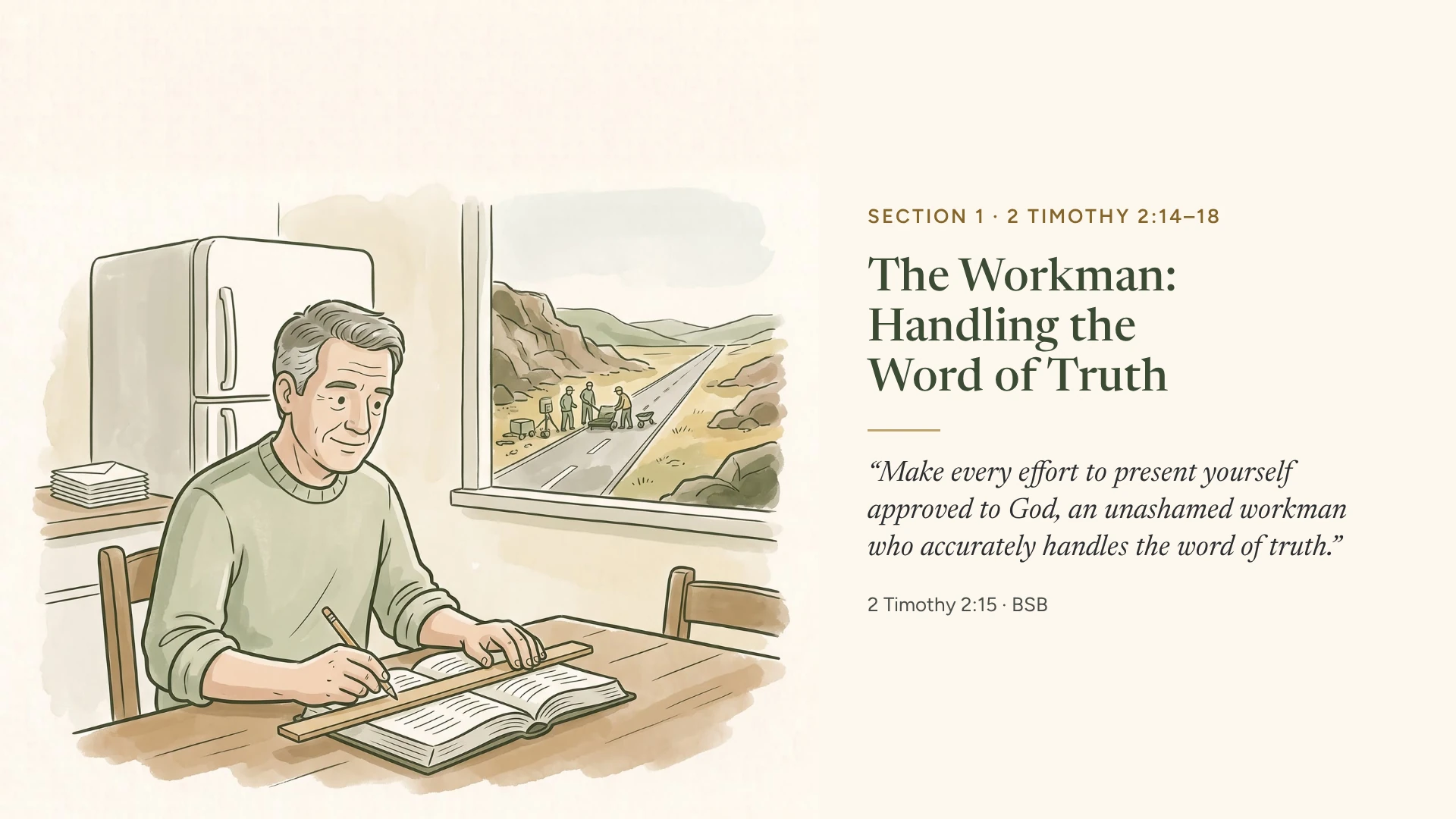
"Scripture itself expects that work. Near the end of his life, Paul wrote from prison in Rome to Timothy, the younger coworker he called his son in the faith. Paul knew his time was short: 'I am already being poured out like a drink offering, and the time of my departure is at hand' (2 Timothy 4:6, BSB). Timothy was most likely still in Ephesus, where some were quarreling over words, and two teachers, Hymenaeus and Philetus, were saying 'that the resurrection has already occurred' (2 Timothy 2:18, BSB). Into that setting, Paul wrote the verse at the center of this lesson."
(45-minute only) Ask a volunteer to read 2 Timothy 2:14–18 aloud:
Remind the believers of these things, charging them before God to avoid quarreling over words, which succeeds only in leading the listeners to ruin. Make every effort to present yourself approved to God, an unashamed workman who accurately handles the word of truth. But avoid irreverent, empty chatter, which will only lead to more ungodliness, and the talk of such men will spread like gangrene. Among them are Hymenaeus and Philetus, who have deviated from the truth. They say that the resurrection has already occurred, and they undermine the faith of some. (2 Timothy 2:14–18, BSB)
Then say:
"Verse 15 is on the slide: 'Make every effort to present yourself approved to God, an unashamed workman who accurately handles the word of truth' (2 Timothy 2:15, BSB). Look at the two words on your handout. 'Make every effort' (v. 15, BSB) means to do something with intense effort and motivation. This is not a casual glance at a verse of the day. Paul uses the same verb later when he begs Timothy, 'Make every effort to come to me quickly' (2 Timothy 4:9, BSB). He cared about both."
"'Accurately handles' (v. 15, BSB) means to teach correctly, to expound rightly. The word was built from 'straight' and 'cut,' and you may have heard it pictured as a road crew cutting a straight road, like the one through the window on the slide. That picture is an illustration, not the point Paul is making. The contrast in this passage is with the false teachers, who 'deviated from the truth' (v. 18, BSB). Timothy is to handle the word of truth without bending it, and to back up what he teaches with how he lives."
(45-minute only)
"Notice whose approval matters. Timothy is to present himself 'approved to God' (v. 15, BSB), not to the loudest voices in Ephesus. The workman who needs no shame is the one whose work holds up when God inspects it."
"This charge was first given to a church leader facing false teaching. It does not stop with him. Paul told Timothy to pass what he had heard on 'to faithful men who will be qualified to teach others as well' (2 Timothy 2:2, BSB), and that chain of faithful teaching reaches us. The goal is not to be clever with the Bible but faithful to it."
Section 2 · Psalm 119:129–130 · Meant to Be Understood
Say this verbatim:
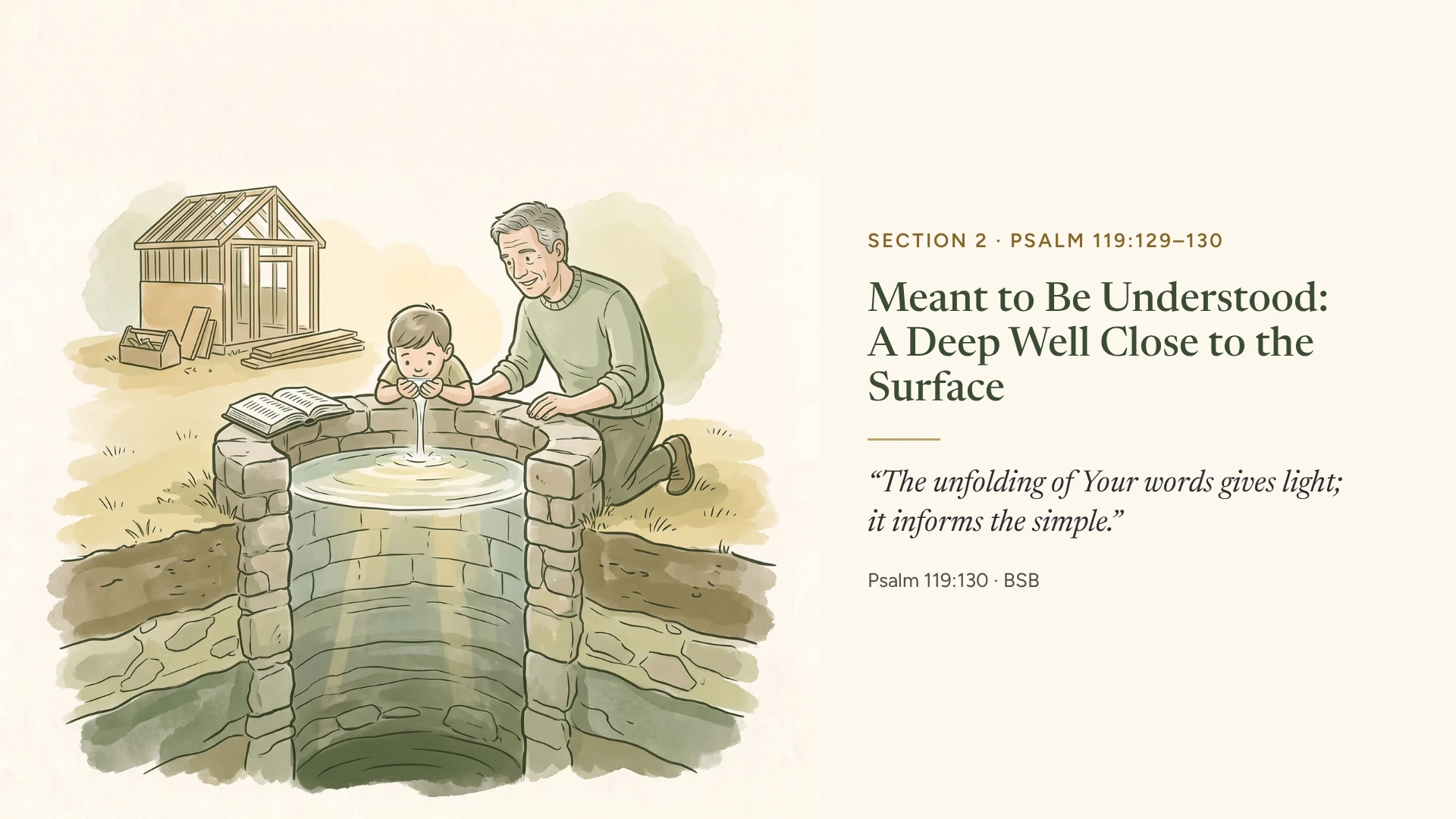
"Here is the good news before we name a single challenge. The textbook behind the Abide program, Fuhr and Köstenberger's Inductive Bible Study, describes the Bible as 'a deep well whose waters lie close to the surface.' Scholars spend whole careers on narrow corners of it, 'while a five-year-old can understand the basic message of the gospel and be saved.' You do not have to reach the bottom of the well to drink from it. That is the child on the slide."
(45-minute only) Ask a volunteer to read Psalm 119:129–130 aloud:
Wonderful are Your testimonies; therefore I obey them. The unfolding of Your words gives light; it informs the simple. (Psalm 119:129–130, BSB)
Then say:
"Israel's psalmist knew this joy. Notice who receives the light: 'The unfolding of Your words gives light; it informs the simple' (Psalm 119:130, BSB). Not the experts, but the simple. In Proverbs that word is often a warning about being easily misled, but here it is good news. God's words give light to beginners. They were given to be understood."
The Four Gaps
Say this verbatim:
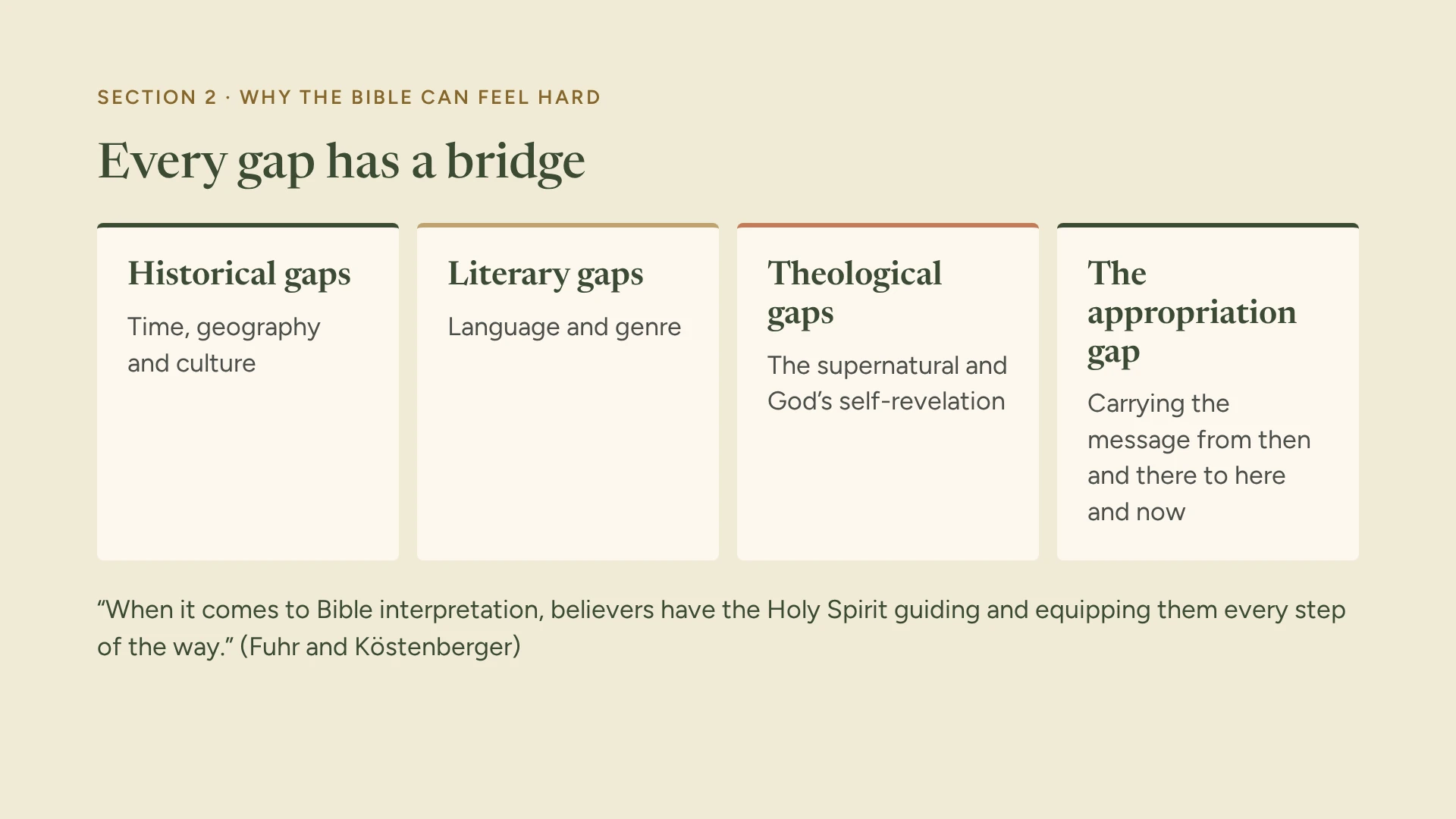
"So why does the Bible sometimes feel hard? Because of how God chose to speak. Rather than dictating a list of rules, as the textbook puts it, 'God chose to reveal his Word in and through human affairs': real authors, in real times and places, writing in their own languages. That distance creates gaps, and this lesson walks across each one. Historical gaps: time, geography and culture. Literary gaps: language and genre. Theological gaps: the supernatural and God's self-revelation. And the appropriation gap: carrying the message from then and there to here and now."
"If that feels like a lot, take heart. The authors compare it to building a shed in your backyard: count the cost, get the right tools, and follow someone who has done it before. Then they add what no shed project has: 'When it comes to Bible interpretation, believers have the Holy Spirit guiding and equipping them every step of the way.' Every gap has a bridge."
Section 3 · Luke 10:30–37 · Historical Gaps
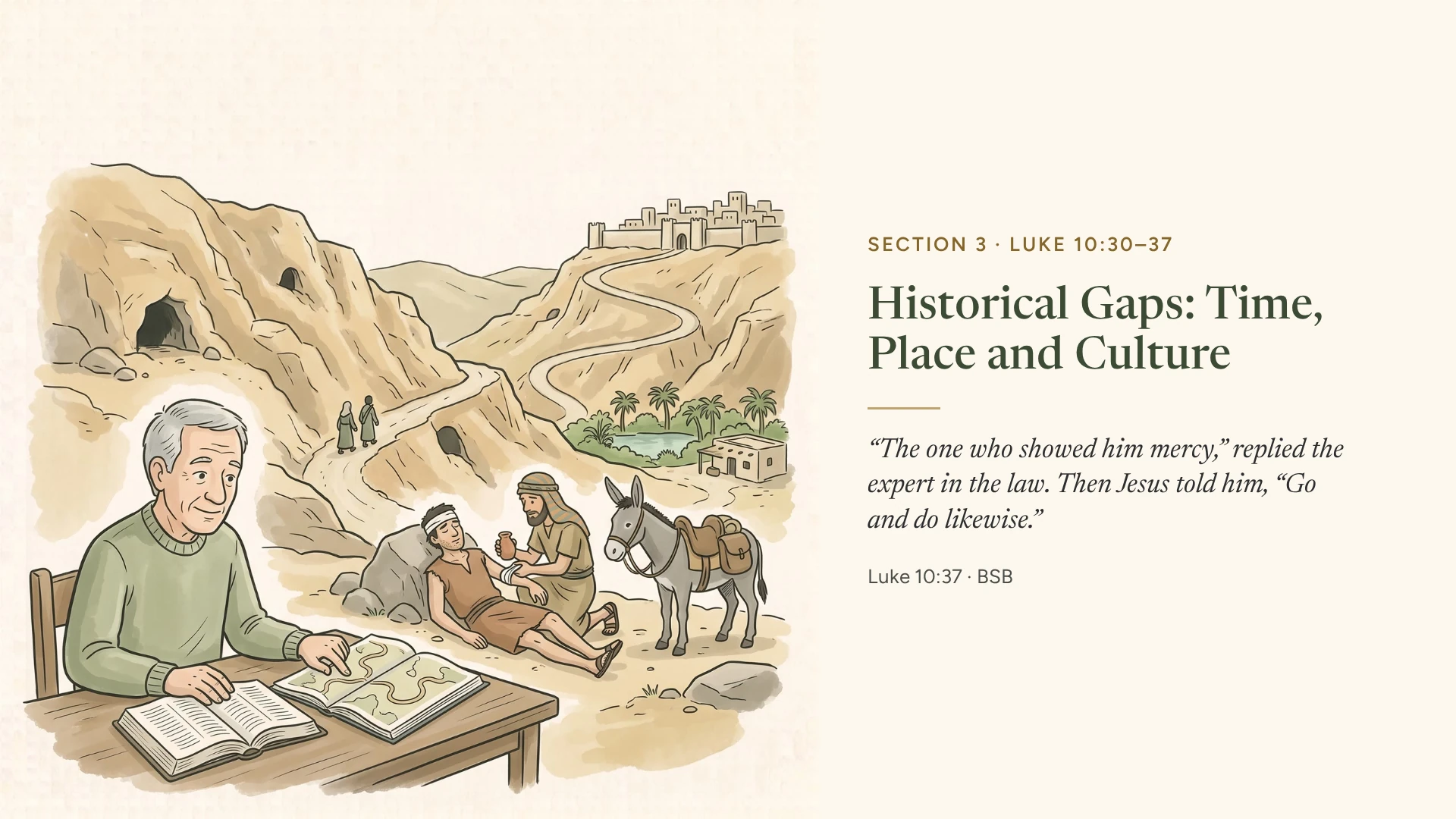
Say this verbatim:
"Three gaps of history stand between us and the people in the Bible, and each one has a bridge. The time gap: imagine a London newspaper from the fall of 1940. A Londoner then would know every name on the front page: Churchill, the Luftwaffe, the Battle of Britain. Many readers today would miss the details. The Bible's first readers knew names like Nebuchadnezzar, Cyrus and Herod the same way. The bridge: learn a little of the history behind the book. The introduction in a good study Bible is a great place to start."
"The place gap: the drop from Jerusalem down to the Dead Sea is steeper than the drive from Denver up to the Colorado ski resorts. The bridge: keep a Bible atlas, or the maps in the back of your Bible, open as you read. That is what the man on the slide is doing."
"The culture gap: Paul closes Romans with 'Greet one another with a holy kiss' (Romans 16:16, BSB). Try that at work today and, as the authors say, it may land you in trouble! We cannot become first-century people, but with humility we can understand the Bible's cultures far better than we do now."
(45-minute only)
"Look at the table on your handout: the world of the Bible beside much of today's world. Belonging, commitments, making a living, communication, time, age, worship, the unseen world. These rows describe; they do not rank. If you grew up in a culture that still farms the land, honors its elders, or passes its stories down by word of mouth, parts of the left-hand column may feel familiar. That is a gift: you already stand closer to the Bible's world than many readers do."
"Now watch all three gaps at once. An expert in the law, wanting to justify himself, asked Jesus, 'And who is my neighbor?' (Luke 10:29, BSB). Jesus answered with a story."
Ask a volunteer to read Luke 10:30–37 aloud:
Jesus took up this question and said, “A man was going down from Jerusalem to Jericho when he fell into the hands of robbers. They stripped him, beat him, and went away, leaving him half dead. Now by chance a priest was going down the same road, but when he saw him, he passed by on the other side. So too, when a Levite came to that spot and saw him, he passed by on the other side. But a Samaritan on a journey came upon him, and when he saw him, he had compassion. He went to him and bandaged his wounds, pouring on oil and wine. Then he put him on his own animal, brought him to an inn, and took care of him. The next day he took out two denarii and gave them to the innkeeper. ‘Take care of him,’ he said, ‘and on my return I will repay you for any additional expense.’ Which of these three do you think was a neighbor to the man who fell into the hands of robbers?” “The one who showed him mercy,” replied the expert in the law. Then Jesus told him, “Go and do likewise.” (Luke 10:30–37, BSB)
Then say:
"Look at the three gaps on your handout. Place: 'going down from Jerusalem to Jericho' (v. 30, BSB) is real geography. The road, New Testament scholar James Edwards writes, 'descended 3,400 feet (1,040 m) through steep and rugged hill country pockmarked with caves,' hiding places for robbers. Jesus' first listeners could picture that road."
"Time: priests and Levites served at the temple in Jerusalem, and many priests lived in Jericho. A wounded man would hope that men who served God in the temple would serve him on the roadside. Both pass by, Edwards notes, 'for reasons we are not told.' Let's not add reasons the text does not give."
"Culture: 'Jews do not associate with Samaritans' (John 4:9, BSB). To most Jews of Jesus' day, a good Samaritan 'would have been a contradiction in terms.' And when Jesus asks who was a neighbor, the expert answers, 'The one who showed him mercy' (v. 37, BSB). As Edwards observes, he cannot bring himself to name the Samaritan."
"Crossing the gaps did not make the story smaller. It made it hit harder, just as it did for the first listeners. And Jesus' last words cut deeper: 'Go and do likewise' (v. 37, BSB)."
Section 4 · Hebrews 1:1–2 · Literary and Theological Gaps
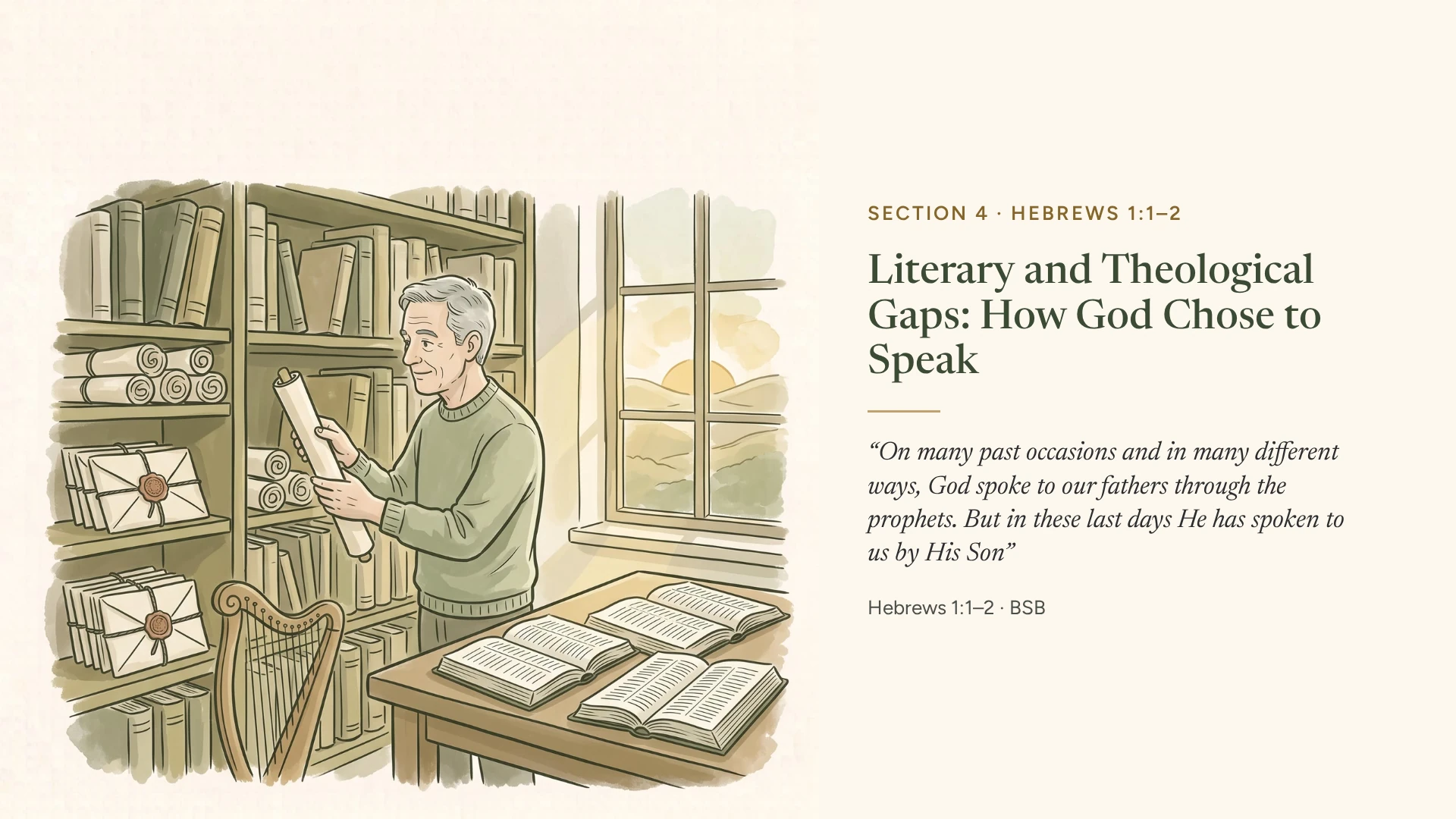
Say this verbatim:
"The Bible is more than history. It is also literature, and above all it is God's own message to us. The opening lines of Hebrews, written to believers who knew Israel's prophets well, name both: 'On many past occasions and in many different ways, God spoke to our fathers through the prophets. But in these last days He has spoken to us by His Son' (Hebrews 1:1–2, BSB). 'In many different ways' (v. 1, BSB): that is the literary side. 'He has spoken to us by His Son' (v. 2, BSB): that is the theological side, God making Himself known."
"Follow the four bridges on your handout. Language: the Bible was written in Hebrew, some Aramaic, and Greek. Translations bridge that gap imperfectly, but, as the authors say, 'quality Bible study can be performed through modern translations.' The bridge: compare a few good translations, like the Bibles open on the slide. Lesson 7 will show you simple word-study tools. Genre: the Bible is a library of law, history, poetry, wisdom, prophecy, gospel and letters. The bridge: before you read, ask what kind of writing it is. Lesson 5 walks you through the main kinds."
(45-minute only)
"The authors add a word of joy: 'God could have chosen to reveal a less complex Word, but he didn't.' The variety is a gift. The supernatural: 'The Bible nowhere defends the existence of God; it assumes it.' Many readers today look first for a natural explanation; the bridge is faith, reading the Bible as a book in which God is really present and really at work. And the theological gap: across sixty-six books, one story grows clearer from Genesis to Revelation and finds its high point in the Son. We 'bridge this theological gap increasingly, but never completely.' That is not discouraging. It means there is always more of God to know."
Section 5 · Ezekiel 33:30–32 · The Appropriation Gap
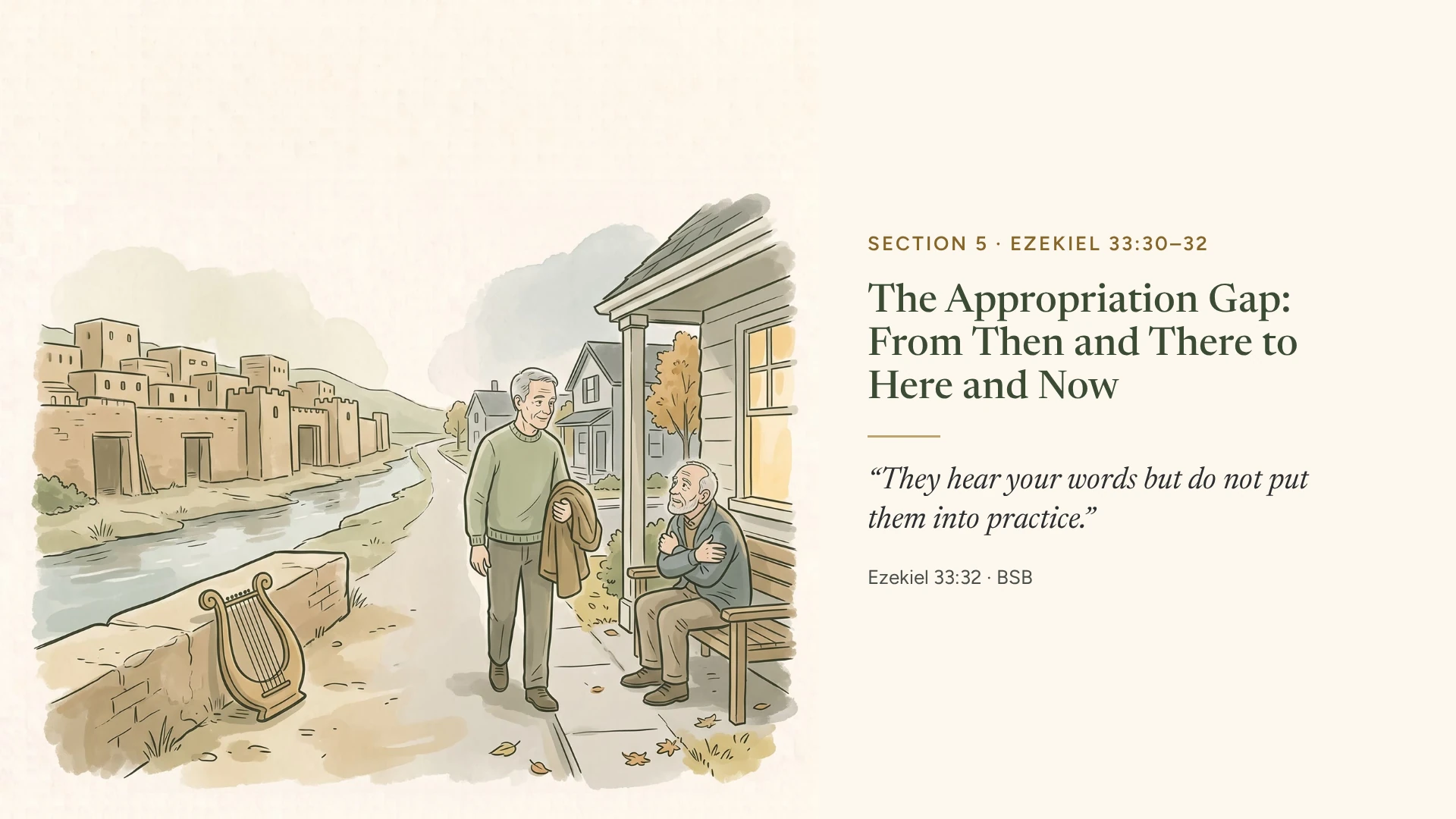
Say this verbatim:
"Now we come to the gap that matters most, and the most exciting one, because this is where the Bible starts changing your life. The textbook puts it plainly: 'one of the primary challenges facing us today is not correct interpretation but appropriate application.'"
"The prophet Ezekiel saw what happens when that gap goes uncrossed. He lived among Israel's exiles in Babylon. When news came that Jerusalem had fallen, 'The city has been taken!' (Ezekiel 33:21, BSB), the people finally wanted to hear the prophet God had sent them."
(45-minute only) Ask a volunteer to read Ezekiel 33:30–32 aloud:
As for you, son of man, your people are talking about you near the city walls and in the doorways of their houses. One speaks to another, each saying to his brother, ‘Come and hear the message that has come from the LORD!’ So My people come to you as usual, sit before you, and hear your words; but they do not put them into practice. Although they express love with their mouths, their hearts pursue dishonest gain. Indeed, you are to them like a singer of love songs with a beautiful voice, who skillfully plays an instrument. They hear your words but do not put them into practice. (Ezekiel 33:30–32, BSB)
Then say:
"Ezekiel had become popular. One commentary compares him to a pop star: 'People may have been humming along to his tune, but they are paying no attention to the true meaning of his lyrics.' These listeners understood Ezekiel perfectly. Their gap was obedience: twice God says, 'They hear your words but do not put them into practice' (Ezekiel 33:32, BSB). That is the lyre on the slide: lovely, and left lying on the wall."
"So how do we carry a passage across? Look at the three ways on your handout. Some words cross directly: 'Go and do likewise' (Luke 10:37, BSB) applies to every believer, just as it stands. Some cross by a cultural equivalent: 'Greet one another with a holy kiss' (Romans 16:16, BSB) is about warm, family affection among believers, and today that might be a handshake, a hug or a warm word. And some are tied to their first setting but still carry a principle: 'bring the cloak that I left with Carpus at Troas' (2 Timothy 4:13, BSB). No one today needs to travel to Troas! But Paul was asking Timothy to go out of his way, by way of Troas, to bring a cold prisoner his coat. That is the man on the slide carrying a coat to his neighbor. When a brother or sister is in need, we can go out of our way to serve them too."
Section 6 · 2 Timothy 4:9–13 · Know the Book Before You Read It
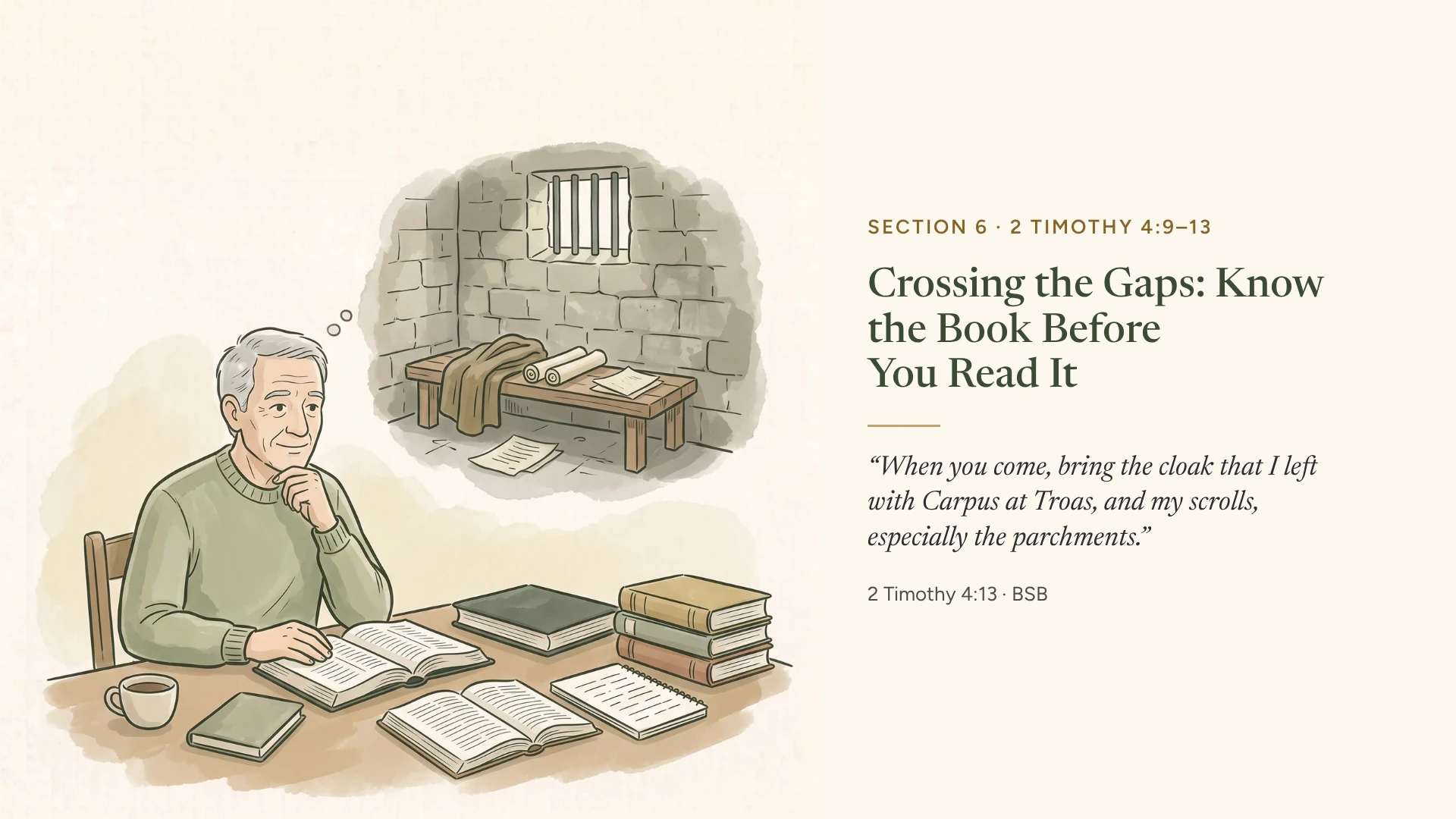
Say this verbatim:
"You now know the gaps. Here is more good news: you do not have to cross them one verse at a time. Before you begin a book of the Bible, take a little time to learn its background: who wrote it, to whom, when, where, and why."
"Start with Scripture itself. 2 Timothy answers many of its own questions. Who wrote it, and to whom? Paul, to 'Timothy, my beloved child' (2 Timothy 1:2, BSB). Where is Paul? In prison in Rome; his friend Onesiphorus 'was unashamed of my chains' (2 Timothy 1:16, BSB). What is happening? False teachers are spreading error, and Paul knows his life is nearly over."
(45-minute only) Ask a volunteer to read 2 Timothy 4:9–13 aloud:
Make every effort to come to me quickly, because Demas, in his love of this world, has deserted me and gone to Thessalonica. Crescens has gone to Galatia, and Titus to Dalmatia. Only Luke is with me. Get Mark and bring him with you, because he is useful to me in the ministry. Tychicus, however, I have sent to Ephesus. When you come, bring the cloak that I left with Carpus at Troas, and my scrolls, especially the parchments. (2 Timothy 4:9–13, BSB)
Then say:
"Read with that background in mind, these requests come alive: a man nearly alone, 'Only Luke is with me' (2 Timothy 4:11, BSB), asking for his friends, his coat and his scrolls. That is the cell on the slide."
"Then consult wisely. Scripture does not answer every question. For the rest, the authors recommend study Bibles, Bible dictionaries, atlases and good commentaries, used not as a crutch but as a complement to your own study. Because 'commentators are not inspired,' they suggest at least three to five sources, remembering Proverbs: 'The first to state his case seems right until another comes and cross-examines him' (Proverbs 18:17, BSB)."
(45-minute only)
"You can see why with 2 Timothy. One handbook dates the letter around AD 66, another AD 67. One says the letter gives no definite indication of where Timothy was; another says he was evidently in Ephesus. Neither is careless. Weigh their reasons, and hold your conclusion with humility. In the authors' words, 'consultation is conversation.' Listen to your sources, but do not simply give in to them."
Book Background Guide
Say this verbatim:
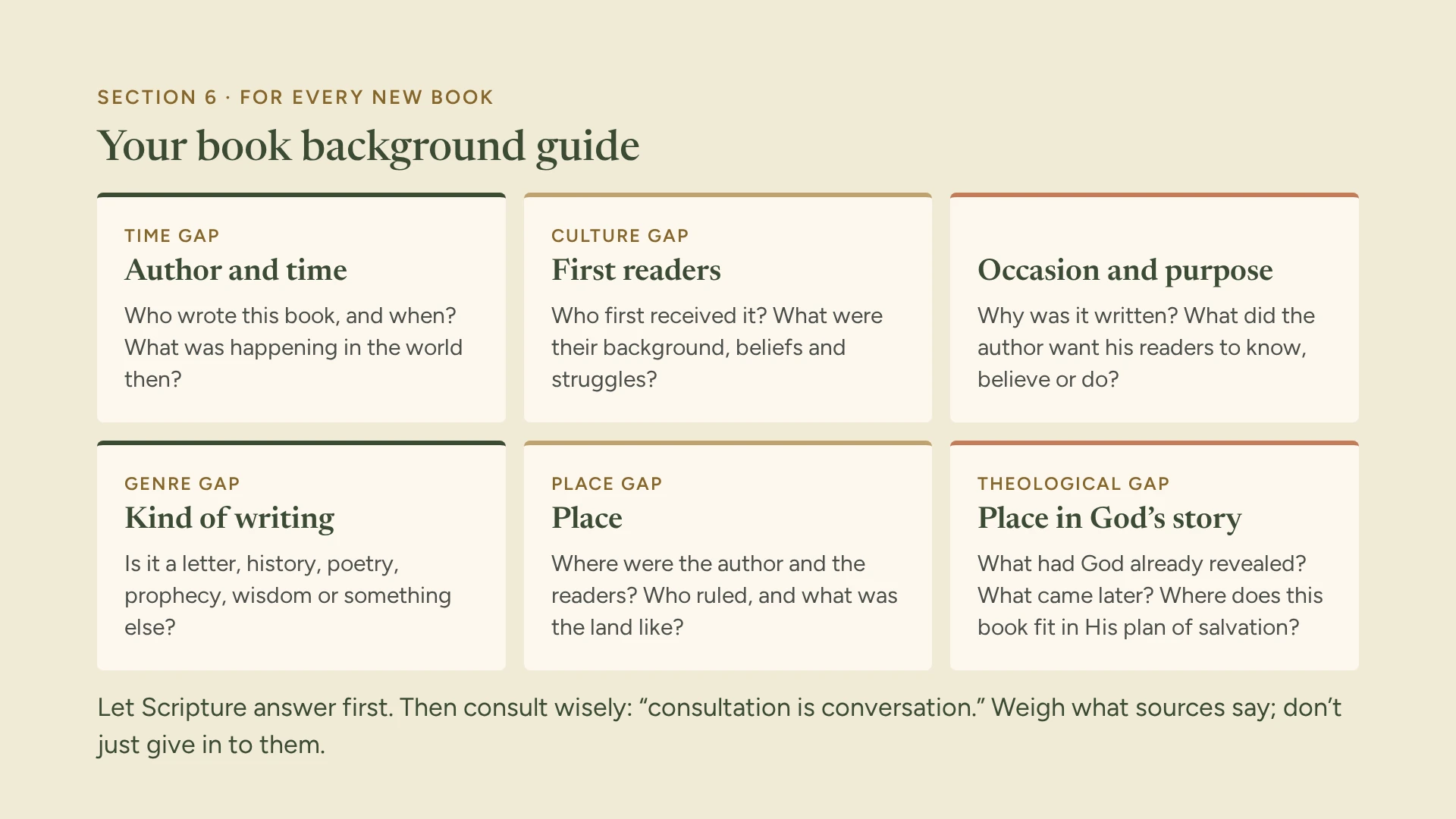
"Here are six questions to ask each time you begin a new book. Each one helps you cross one of the gaps. Author and time: who wrote this book, and when? First readers: who first received it, and what were they facing? Occasion and purpose: why was it written? Kind of writing: is it a letter, history, poetry, prophecy or wisdom? Place: where were the author and the readers? And place in God's story: what had God already revealed, and where does this book fit in His plan of salvation?"
"Your handout has this guide as a worksheet, with room to write. Let Scripture answer first, then talk with trusted guides. In lesson 6 you will learn to look at the context of each passage, too. For now, start with the book."
Section 7 · Philippians 2:12–13 and Psalm 119:18 · The Spirit Bridges the Last Gap
Say this verbatim:
"Here is the best news of all. You do not cross the last gap by yourself. The authors write, 'Hard work and study alone will never bridge the appropriation gap. Only the Spirit of God working effectively in the life of the believer will transfer the message of the text from the mind to the heart.'"
(45-minute only) Ask a volunteer to read Philippians 2:12–13 aloud:
Therefore, my beloved, just as you have always obeyed, not only in my presence, but now even more in my absence, continue to work out your salvation with fear and trembling. For it is God who works in you to will and to act on behalf of His good purpose. (Philippians 2:12–13, BSB)
Then say:
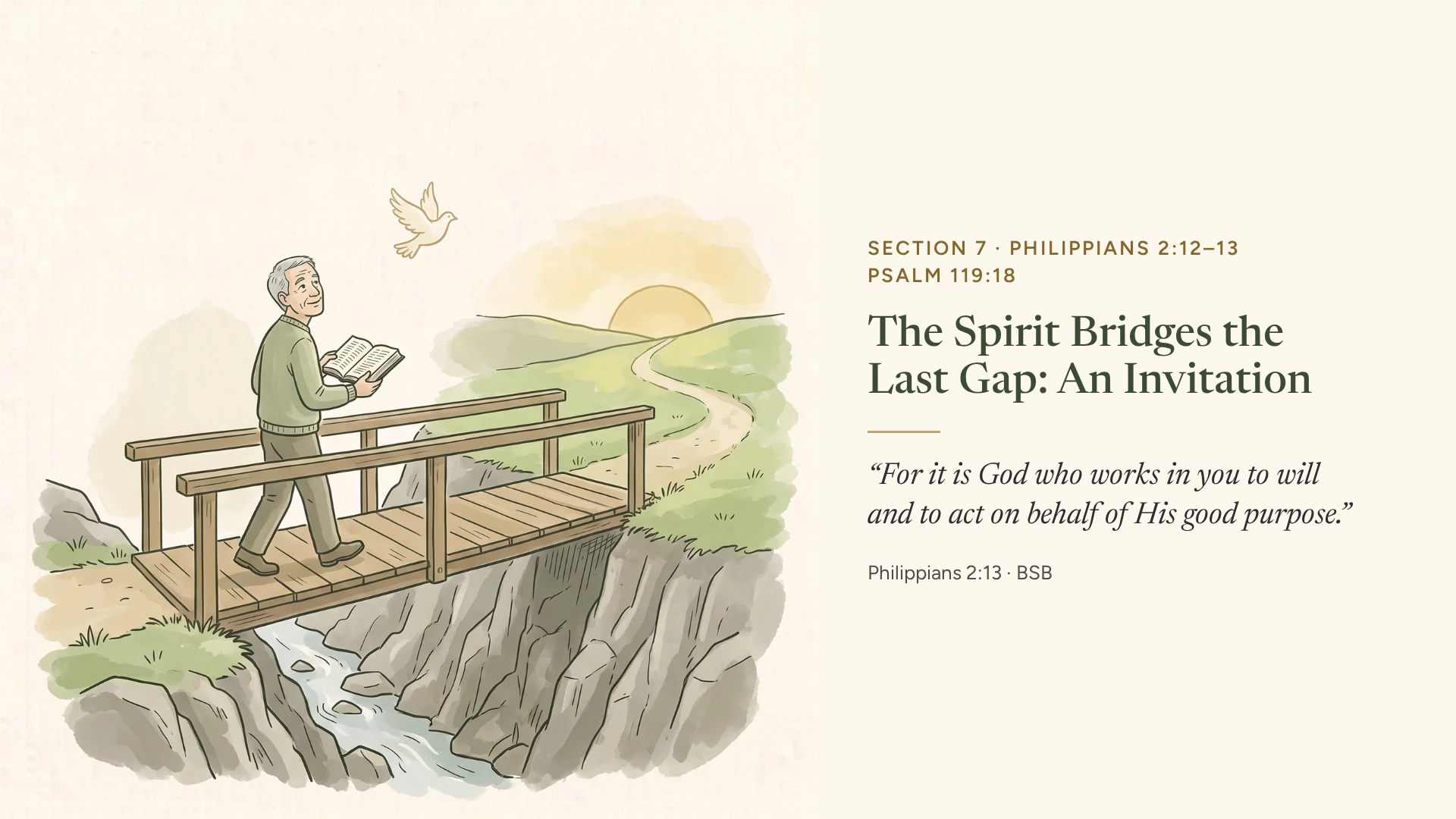
"Paul wrote this to the believers at Philippi, whom he could not visit in person. They keep working, and God is at work in them, 'to will and to act' (Philippians 2:13, BSB): both the wanting and the doing. That is the workman of Section 1. We make every effort, and God does in us what our effort alone never could. That is the man on the bridge, with the dove going ahead of him."
(45-minute only)
"And here is a word of grace for every beginner. The authors write that 'the Holy Spirit will use God's Word in the life of the Spirit-filled believer in spite of his or her misunderstanding and even misinterpretation.' So we come with reverence and humility, and with hope."
The Invitation
Say this verbatim:
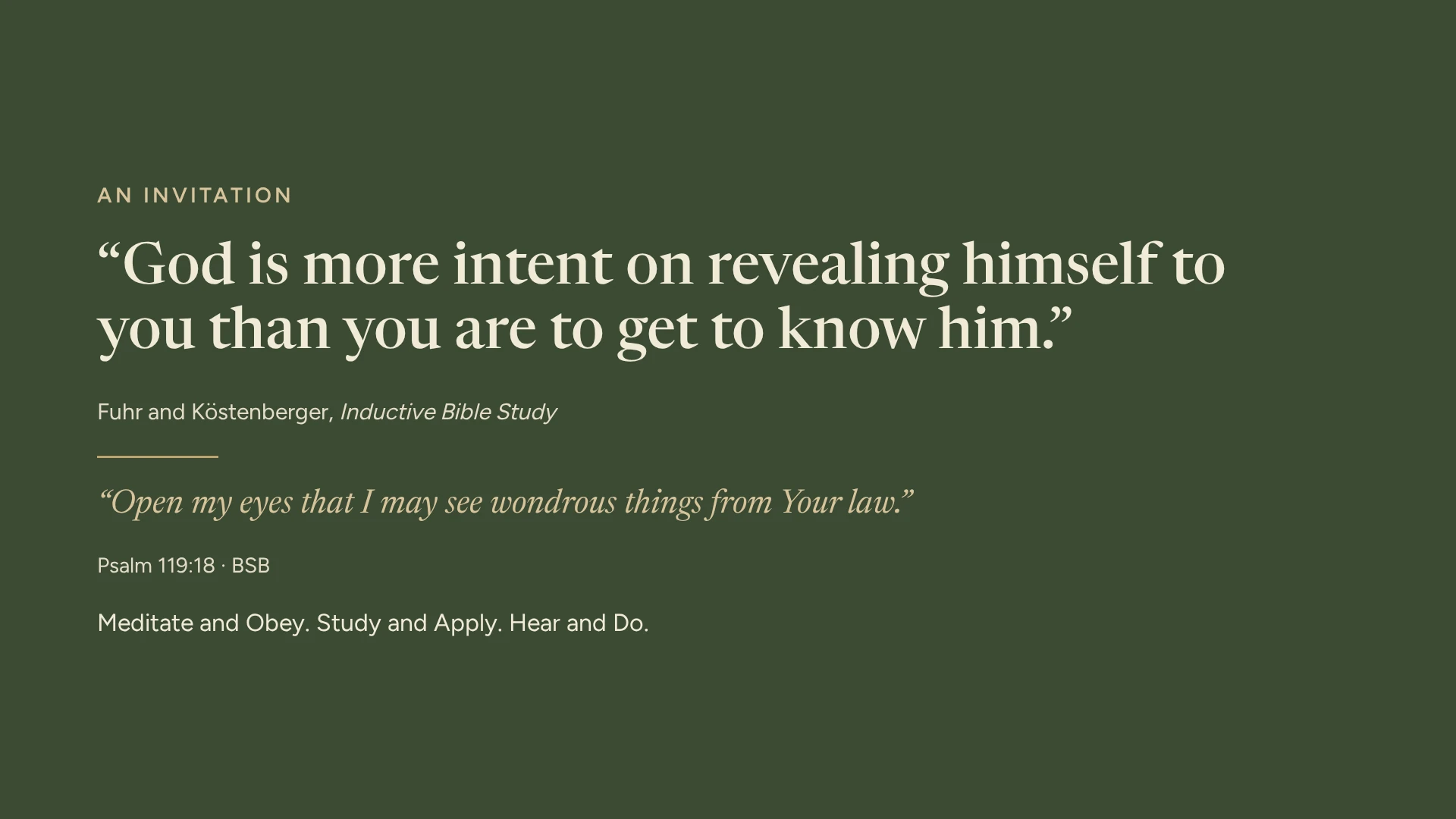
"So here is our invitation, in the words that close the textbook's first chapter: 'God is more intent on revealing himself to you than you are to get to know him.' Come to His Word with humble confidence: humble, because the gaps are real; confident, because God wants to meet you there."
"Let's make the psalmist's prayer our own. Pray it with me: 'Open my eyes that I may see wondrous things from Your law' (Psalm 119:18, BSB)."
(Pause.)
"On your handout, write one step you will take this week. Maybe it is the book background guide for the next book you read. Maybe it is going out of your way for someone who is cold. Just one."
"Let's say them together: Meditate and Obey. Study and Apply. Hear and Do. This is how we abide in Christ. This is how we demonstrate our love for God."
"Let's pray. Father, thank You that You want to be known, and that Your Word was meant to be understood. Make us faithful workmen, eager to learn and quick to obey. By Your Spirit, carry Your Word from our minds to our hearts this week. In Jesus' name, amen."
Discussion Prompts
Use these after the teaching or in small groups. Choose two or three based on the time you have.
- When have you felt like a stranger in a foreign land while reading the Bible? Which of the four gaps was in the way?
- In the Good Samaritan, which gap (time, place or culture) changed the story most for you, and why?
- Look at the table of the two worlds. Which rows feel closest to your own life? Which feel farthest away?
- Ezekiel's listeners enjoyed his words but did not do them. Where are you most likely to enjoy God's Word without obeying it?
- Paul told Timothy to "make every effort" (2 Timothy 2:15, BSB), and he told the Philippians that "it is God who works in you" (Philippians 2:13, BSB). How do those two truths fit together in your own life?
Optional Homework
Assign one or both before the next session:
Reading Assignment: Read the lesson page on your own; it covers more than we had time for today. Then choose a short book of the Bible (Philippians, Titus, James or Ruth) and fill in the Book Background Guide on your handout, letting Scripture answer first.
Application Assignment: Paul asked Timothy to go out of his way to bring a cold prisoner his coat. This week, go out of your way to meet one practical need for someone. Write down what you did and what you learned.
Scripture quotations marked Berean Standard Bible (BSB) or Majority Standard Bible (MSB) are taken from texts that have been dedicated to the public domain. Free resources are available at BereanBible.com and MajorityBible.com.